She is as in a field a silken tent
At midday when the sunny summer breeze
Has dried the dew and all its ropes relent,
So that in guys it gently sways at ease,
And its supporting central cedar pole,
That is its pinnacle to heavenward
And signifies the sureness of the soul,
Seems to owe naught to any single cord,
But strictly held by none, is loosely bound
By countless silken ties of love and thought
To everything on earth the compass round,
And only by one's going slightly taut
In the capriciousness of summer air
Is of the slightest bondage made aware.
✦
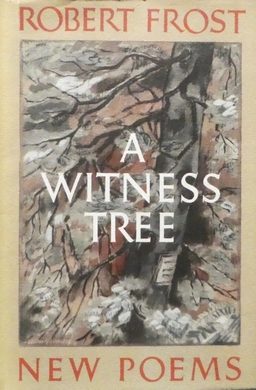
From the bookA Witness TreeFirst-edition dust jacket, Henry Holt, 1942
Analysis
The Silken Tent: analysis
Introduction
A woman is compared to a silken tent standing in a summer field. The tent appears relaxed and free, yet its upright shape depends on a central pole and many cords. The comparison develops through the entire poem before ending with a slight awareness of restraint.
The poem asks how freedom can coexist with attachment. Its answer is expressed through physical balance rather than through an abstract argument. Support, connection, and tension all contribute to the tent's ease. The unnamed woman remains distinct from any identified person in the poet's life.
Summary
The opening compares an unnamed woman to a silken tent in a field at midday. A sunny summer breeze has dried the dew. The tent's ropes have relaxed, allowing it to sway gently at ease in its guy ropes.
The description moves to the central cedar pole. It supports the tent and points toward heaven. The speaker explicitly says that it signifies the soul's sureness. Although the tent has this supporting center, it seems to owe nothing to any individual cord.
The speaker then describes the tent as neither strictly held by a single tie nor entirely without connections. It is loosely bound through countless ties of love and thought. These ties connect it in every direction to the things of the earth.
At the end, the summer air changes unpredictably. One of the cords becomes slightly taut. Only then does the tent, or the woman represented by it, become aware of the slightest bondage. The poem concludes with this small sensation rather than a collapse, escape, or removal of the ties.
Themes and meaning
The central comparison joins independence to support. The tent does not stand through isolation. Its pole and ropes hold a shape in which it can move easily. The woman can therefore be read as someone whose confidence includes both inner steadiness and relationships. The text explicitly connects the cedar pole with the soul, but does not identify that support as a particular religion.
The distinction between one cord and many ties matters. No single attachment appears to control the whole structure. Instead, many connections distribute their influence around it. The poem names these connections as love and thought. That language makes the tent's practical anchoring a model for emotional and intellectual involvement.
The apparent contradiction in being loosely bound gives the poem its main tension. Bondage usually suggests the opposite of freedom, yet these ties permit the tent's ease. The comparison allows a reading in which commitments sustain a person rather than simply restrict one. It does not establish that every possible commitment is benign.
The ending tests this balance without destroying it. A changing breeze makes one tie perceptible. The repeated smallness of the tension limits the disturbance: the cord goes only slightly taut, and the bondage is the slightest. Freedom is presented as an experience maintained among attachments, with occasional reminders of their presence.
Tone
The tone is admiring, composed, and attentive to balance. The summer setting and the dried dew create a moment of ease. The speaker follows the tent's small movements rather than presenting a dramatic struggle. The comparison lets admiration for the woman emerge through the details of her apparent steadiness.
The language grows more abstract as the pole signifies the soul and the ropes become ties of love and thought. Even then, physical tension keeps the description concrete. The final reference to bondage adds a slight reservation. It complicates the praise without changing the voice into complaint or announcing a failure of freedom.
Form and structure
The poem is a fourteen-line sonnet written as a single sentence. Its rhyme pattern follows the English sonnet arrangement: three alternating-rhyme quatrains followed by a closing couplet. The verse is predominantly iambic pentameter, though its clauses move freely across line endings and some longer words need careful attention in reading.
The unbroken sentence makes the comparison unfold gradually. Qualifying clauses keep adjusting the relation between support and freedom before the main conclusion arrives. The closing rhyme of air and aware joins the external movement of the breeze to the internal awareness it produces. Formal constraint accompanies a description of apparently effortless movement.
Poetic devices
Extended simile line 1
She is as in a field a silken tent The opening comparison supplies the framework for the entire poem. Later details explain a human condition through the tent’s physical arrangement.
Alliteration line 2
At midday when the sunny summer breeze The repeated s sounds link the mild season and moving air. Their softness contributes to the unhurried description of the tent.
Personification line 3
Has dried the dew and all its ropes relent, The ropes seem to relax a demand. This human verb prepares for the later connection between physical cords and emotional ties.
Symbol line 5
And its supporting central cedar pole, The pole supplies an inner support distinct from the surrounding cords. The following lines explicitly associate that upright center with the soul’s steadiness.
Metaphor line 10
By countless silken ties of love and thought Attachments become cords that connect the woman to the world. Their silk suggests delicacy without making them altogether without strength.
Paradox line 9
But strictly held by none, is loosely bound The line joins connection with a lack of strict control. Its apparent contradiction expresses the poem’s central account of supported freedom.
Enjambment line 12
And only by one's going slightly taut The line postpones the completed account of awareness. The sentence remains suspended while one small change in tension begins to register.
Understatement line 14
Is of the slightest bondage made aware. The modest degree of restraint qualifies the poem’s admiration. It acknowledges dependence without turning the image into a scene of captivity.
Words worth knowing
guys
Guy ropes: cords that anchor and steady a tent.
pinnacle
The highest point or peak.
naught
Nothing.
taut
Stretched tight rather than slack.
capriciousness
Unpredictable changes of direction or inclination.
What readers have said
Rachel L. recalls an English teacher using the poem to explain how commitments can contribute to a free person’s identity. Rachel L., 2005
Ruairi J. Topping reads the cedar pole as the woman’s backbone and confidence, while noting another reader’s religious interpretation. Ruairi J. Topping, 2005
Kim S sees a strong independent person whose connections to friends and family occasionally reveal an earthly, dependent side. Kim S, 2004
The imagery is so descriptive. You can picture the whole scene; the day, the whether, the tent, the field. Yet while it is so clear what Frost is talking about, it is only there to tell of another event. This independent individual. A person so strong that nothing has control over them. This is an admirable person that others are in awe of. They almost seem divine, but then every now and again you get a slight glimpse into their earthly side. This part that has friends and family and is in some way tied to the earth- this part that shows when the wind blows.
Dean J. ParkerUnited States
This the Pinnical of Robert Frost Romantic Poems. It ties two people together in Love that surpasses all but the Saviors love for sinfull man. All other is of the flesh, this exceeds them all. This is one of the Poems that made love Poetry.
Candace W.United States
I think Frost is explaining the supression of women in society. The silken tent being the woman, and her ties of love and thought being responsibilties that overwhelm her. She is rigid and " taugt" because she has no room to grow.
a friend of mine, an english teacher, quoted from this poem to help her explain to me how one's commitments and the things that "tie us down" are an integral part of our identity as a free person. Without any attachments whatsoever, one is just a pile of cloth, however beautiful. With only 'earthly' ties,(ropes that have their stake in the ground and spread the cloth out) a person can be 'opened up, and noticed by…
Read the whole comment
a friend of mine, an english teacher, quoted from this poem to help her explain to me how one's commitments and the things that "tie us down" are an integral part of our identity as a free person. Without any attachments whatsoever, one is just a pile of cloth, however beautiful. With only 'earthly' ties,(ropes that have their stake in the ground and spread the cloth out) a person can be 'opened up, and noticed by the world." They will even look full and complete if the ropes' pulls are carefully balanced. But, having no 'higer' dimension, the cloth can offer little shelter to others, and is at the mercy of the other commitments; she may be 'streatched too thin', 'flattened' into shallowness by the nagging tensions of daily life. Only when the supporting pole, God, is in it's proper, central position, can the tent truely be a tent. then, the wider and more diverse the other stakes are, more they serve to open the cloth and better display the qualities of her weave. With a deeply anchored ceter pole, no other event or person can pull the tent down and destroy her usefullness and beauty.
Ruairi J. ToppingBelgium
Im at this presnt time, writing a coparison between the silken tent and shakespeare's sonnet 71. I was interested to find what others thought the ropes and the cedar pole signified in this poem. One of the comments mentioned that they thought the pole signified god holding up the tent. I see the pole as the backbone of the woaman, confident to stand without aid or being pulled back by anyone. She has come through a…
Read the whole comment
Im at this presnt time, writing a coparison between the silken tent and shakespeare's sonnet 71. I was interested to find what others thought the ropes and the cedar pole signified in this poem. One of the comments mentioned that they thought the pole signified god holding up the tent. I see the pole as the backbone of the woaman, confident to stand without aid or being pulled back by anyone. She has come through a storm "dried the dew" signifiying in my oppinion an argument with her partner. Even though the ropes were tought and pulling on the cedar pole sh stayed strong. I'm not sure what exactly the ropes are and if anyone has any suggestions i would be very interested to know what they think.
I believe the tent to be all of us. The pole is our dreams and ambition. The ties are the Earthly ties that keep us well rounded and in touch with reality. Without these ties that seem to restrict us, we would fall and our achievements would not be so high.
LorianneUnited States
I think the Center post is the woman's dedication toward God. I think the ties are the many men who seek her favor. She does not seem too interested in any particular one of them.
TjBUnited States
I think it's wonderful how so many different interpretations can be made from this poem. The doesn't seem to be all that straightforward with a single conceited (dominating) idea. From what I gather from reading this poem and what I've read from these comments, Frost may have been trying to incorporate several meanings into this poem. I think everyone is correct on this one. I believe that poetry is how you, the reader, interpret it and how you connect it to your own personal life or beliefs.
andrewUnited Kingdom
This is one of the great love poems of the C20 century. Frost speaks of an ideal relationship between man and woman, seeing her as both committed and free - there is a link here to the loving observation of the woman in Simon and Garfunkle´s Bride over Troubled Water. Incidentally, the supporting central cedar pole is surely intended as a sexual reference. A great poem by an evergreen poet. Andrew
The tent in my opinion is a women's soul (perhaps his wife or a daughter who he was close to) and the cedar pole is trying to uplift her to heaven. The silken ties are perhaps the love and memories that are keeping her spirit close to earth. Now, I feel that Frost's other poems such as God's Garden and The Path Not Taken set up a spirtual background for his later poetry, creating this understanding of God and Nature. I feel that in this poem Frost expresses an rare understanding of the hardships of letting loved ones go, even when our thoughts are keeping that person from fully moveing on.
Chris OUnited States
The poem is actually written about a flirt. He starts by calling her beuatiful and then precedes to speak about guys, which in this case means I think guy wires. Wires used to hold a pole up. She has many "guys." He then talks about her "sureness" and then goes on to say that when one rope becomes taut she feels confined and moves on.
Bhavana BandekarIndia
a beautiful poem with a typical indian concept of how the woman is fragile and also bound by traditional ties of responsibilities and duties , and yet strong morally and emotionally . Her life is guided by her conscience and her love encompasses all around her. Storms may bombard all around her but like the 'central pole' her soul looks heavenward and she remains steadfast.
Rachel V.Canada
I think this poem is beautiful, it's about a women, and how there are many strings or ropes holding her up, but without them she would be nothing. Without a rope to hold up the tent, the tent would just be a pile on the ground...
lejlaAzerbaijan
cuz guys are just ropes. but it's an interesting idea and maybe you can come up with something that would be backed up by the poem but still way out there...like, bondage doesn't really sound so great - what's up with that?
ShaneequaCuba
Negro, this poem aint about no white itch in a tent its about jesus and the reencarnation into a BLACK JESUS! AMEN! and for the dude from belgium you should read this poem again cuasue you got this shizncik all WRONG! IT be looking like a HOT MESS! so once you get your shiz together you come back on here and give another comment untill then go suck on someting... EVIL LAUGH AS I LEAVE!
thanUnited Kingdom
In my opinion the poem talks about a woman's faith (silken tent-feels very soft but very hard to tear) in God (cedar pole) , which is being put into test.That even in the thick of temptation (sunny summer breeze) she holds on to be chaste.... Bless her..
After his wife died he fell in love with a gal by the name of Kay Morrison. This poem is actually about her. There is no deep meaning about women rights or anything like that. Sorry. Doing research about the poet will tell you alot about the poem. Just a tip.
windowUnited States
Poor baby wants to be shakespear, but he's to weak. Anyone who shares such weakness, whether by loneliess or hurt, and tries to draw from this poem will remain so - is that, in its nature turned out, not beatiful?
BalaramNepal
This poem is intends to show the relationship in modern sense that women are seeking.
Erdim KOCTurkey
Frost has not only set himself the difficult task of writing in the intricate form of a sonnet; he has increased the difficulty by writing it in a single sentence.
Ce Marsh HallUnited States
The Silken Tent
The metaphor here is a comparison of a woman to a spider web -- many shared characteristics, some shared communication skills, some shared results.
Doc AmesUnited States
Frost: silken tent
Good Grief! Leave it alone. The poem speaks for itself. Most of these comments are absurd!
The imagery is so descriptive. You can picture the whole scene; the day, the whether, the tent, the field. Yet while it is so clear what Frost is talking about, it is only there to tell of another event. This independent individual. A person so strong that nothing has control over them. This is an admirable person that others are in awe of. They almost seem divine, but then every now and again you get a slight glimpse into their earthly side. This part that has friends and family and is in some way tied to the earth- this part that shows when the wind blows.
This the Pinnical of Robert Frost Romantic Poems.
It ties two people together in Love that surpasses
all but the Saviors love for sinfull man. All other
is of the flesh, this exceeds them all. This is one of the Poems that made love Poetry.
I think Frost is explaining the supression of women in society. The silken tent being the woman, and her ties of love and thought being responsibilties that overwhelm her. She is rigid and " taugt" because she has no room to grow.
a friend of mine, an english teacher, quoted from this poem to help her explain to me how one's commitments and the things that "tie us down" are an integral part of our identity as a free person. Without any attachments whatsoever, one is just a pile of cloth, however beautiful. With only 'earthly' ties,(ropes that have their stake in the ground and spread the cloth out) a person can be 'opened up, and noticed by…
Read the whole commenta friend of mine, an english teacher, quoted from this poem to help her explain to me how one's commitments and the things that "tie us down" are an integral part of our identity as a free person. Without any attachments whatsoever, one is just a pile of cloth, however beautiful.
With only 'earthly' ties,(ropes that have their stake in the ground and spread the cloth out) a person can be 'opened up, and noticed by the world." They will even look full and complete if the ropes' pulls are carefully balanced. But, having no 'higer' dimension, the cloth can offer little shelter to others, and is at the mercy of the other commitments; she may be 'streatched too thin', 'flattened' into shallowness by the nagging tensions of daily life.
Only when the supporting pole, God, is in it's proper, central position, can the tent truely be a tent. then, the wider and more diverse the other stakes are, more they serve to open the cloth and better display the qualities of her weave. With a deeply anchored ceter pole, no other event or person can pull the tent down and destroy her usefullness and beauty.
Im at this presnt time, writing a coparison between the silken tent and shakespeare's sonnet 71. I was interested to find what others thought the ropes and the cedar pole signified in this poem. One of the comments mentioned that they thought the pole signified god holding up the tent. I see the pole as the backbone of the woaman, confident to stand without aid or being pulled back by anyone. She has come through a…
Read the whole commentIm at this presnt time, writing a coparison between the silken tent and shakespeare's sonnet 71. I was interested to find what others thought the ropes and the cedar pole signified in this poem. One of the comments mentioned that they thought the pole signified god holding up the tent. I see the pole as the backbone of the woaman, confident to stand without aid or being pulled back by anyone. She has come through a storm "dried the dew" signifiying in my oppinion an argument with her partner. Even though the ropes were tought and pulling on the cedar pole sh stayed strong. I'm not sure what exactly the ropes are and if anyone has any suggestions i would be very interested to know what they think.
I believe the tent to be all of us. The pole is our dreams and ambition. The ties are the Earthly ties that keep us well rounded and in touch with reality. Without these ties that seem to restrict us, we would fall and our achievements would not be so high.
I think the Center post is the woman's dedication toward God. I think the ties are the many men who seek her favor. She does not seem too interested in any particular one of them.
I think it's wonderful how so many different interpretations can be made from this poem. The doesn't seem to be all that straightforward with a single conceited (dominating) idea. From what I gather from reading this poem and what I've read from these comments, Frost may have been trying to incorporate several meanings into this poem. I think everyone is correct on this one. I believe that poetry is how you, the reader, interpret it and how you connect it to your own personal life or beliefs.
This is one of the great love poems of the C20 century. Frost speaks of an ideal relationship between man and woman, seeing her as both committed and free - there is a link here to the loving observation of the woman in Simon and Garfunkle´s Bride over Troubled Water. Incidentally, the supporting central cedar pole is surely intended as a sexual reference. A great poem by an evergreen poet.
Andrew
The tent in my opinion is a women's soul (perhaps his wife or a daughter who he was close to) and the cedar pole is trying to uplift her to heaven. The silken ties are perhaps the love and memories that are keeping her spirit close to earth. Now, I feel that Frost's other poems such as God's Garden and The Path Not Taken set up a spirtual background for his later poetry, creating this understanding of God and Nature. I feel that in this poem Frost expresses an rare understanding of the hardships of letting loved ones go, even when our thoughts are keeping that person from fully moveing on.
The poem is actually written about a flirt. He starts by calling her beuatiful and then precedes to speak about guys, which in this case means I think guy wires. Wires used to hold a pole up. She has many "guys." He then talks about her "sureness" and then goes on to say that when one rope becomes taut she feels confined and moves on.
a beautiful poem with a typical indian concept of how the woman is fragile and also bound by traditional ties of responsibilities and duties , and yet strong morally and emotionally . Her life is guided by her conscience and her love encompasses all around her. Storms may bombard all around her but like the 'central pole' her soul looks heavenward and she remains steadfast.
I think this poem is beautiful, it's about a women, and how there are many strings or ropes holding her up, but without them she would be nothing. Without a rope to hold up the tent, the tent would just be a pile on the ground...
cuz guys are just ropes. but it's an interesting idea and maybe you can come up with something that would be backed up by the poem but still way out there...like, bondage doesn't really sound so great - what's up with that?
Negro, this poem aint about no white itch in a tent its about jesus and the reencarnation into a BLACK JESUS! AMEN! and for the dude from belgium you should read this poem again cuasue you got this shizncik all WRONG! IT be looking like a HOT MESS! so once you get your shiz together you come back on here and give another comment untill then go suck on someting... EVIL LAUGH AS I LEAVE!
In my opinion the poem talks about a woman's faith (silken tent-feels very soft but very hard to tear) in God (cedar pole) , which is being put into test.That even in the thick of temptation (sunny summer breeze) she holds on to be chaste.... Bless her..
After his wife died he fell in love with a gal by the name of Kay Morrison. This poem is actually about her. There is no deep meaning about women rights or anything like that. Sorry. Doing research about the poet will tell you alot about the poem. Just a tip.
Poor baby wants to be shakespear, but he's to weak. Anyone who shares such weakness, whether by loneliess or hurt, and tries to draw from this poem will remain so - is that, in its nature turned out, not beatiful?
This poem is intends to show the relationship in modern sense that women are seeking.
Frost has not only set himself the difficult task of writing in the
intricate form of a sonnet; he has increased the difficulty by writing
it in a single sentence.
The Silken Tent
The metaphor here is a comparison of a woman to a spider web -- many shared characteristics, some shared communication skills, some shared results.
Frost: silken tent
Good Grief! Leave it alone.
The poem speaks for itself.
Most of these comments are absurd!
LOL