Something inspires the only cow of late
To make no more of a wall than an open gate,
And think no more of wall-builders than fools.
Her face is flecked with pomace and she drools
A cider syrup. Having tasted fruit,
She scorns a pasture withering to the root.
She runs from tree to tree where lie and sweeten
The windfalls spiked with stubble and worm-eaten.
She leaves them bitten when she has to fly.
She bellows on a knoll against the sky.
Her udder shrivels and the milk goes dry.
✦
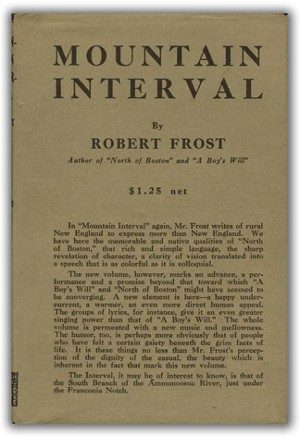
From the bookMountain IntervalFirst-edition dust jacket, Henry Holt, 1916
Analysis
The Cow In Apple-Time: analysis
Introduction
A cow abandons the ordinary pasture for fallen apples. Walls cease to restrain her, and the taste of fruit displaces her usual food. The account follows her appetite through a series of physical details, ending with her milk going dry.
The narrator treats the animal as both a real cow and an almost human rebel. She appears to judge walls, builders, and grazing land. That language invites comparison with human indulgence, but the poem does not supply an explicit moral. Its comedy depends on the tension between the cow's apparent triumph and the bodily cost recorded at the end.
Summary
The speaker notices a recent change in the behavior of the only cow. Something inspires her to treat a wall as though it were an open gate. She also behaves as if the people who build walls are fools. The first lines describe her disregard for the boundary rather than explaining exactly how she crosses it.
Bits of crushed apple cover her face, and she dribbles a liquid compared to cider syrup. Having tasted fruit, she rejects a pasture that is drying out. She runs between trees where fallen apples lie and sweeten. The fruit is caught among stubble and damaged by worms.
The cow bites the apples but leaves them behind when she must move quickly. She bellows from a small hill against the sky. The final line turns from this conspicuous activity to the state of her udder. It shrivels, and her milk dries up. The poem ends with that change, without describing a farmer's response, a cure, or the cow's death.
Themes and meaning
Appetite changes the cow's relation to her surroundings. The wall initially belongs to a human system of enclosure, but she treats it as an opening. The comparison makes her look resourceful and dismissive. What constrains a well-managed animal no longer appears meaningful to one intent on fruit.
The poem also complicates a simple contrast between wholesome duty and dangerous pleasure. The rejected pasture is withering, while the apples offer sweetness. Her choice has an understandable sensory appeal. At the same time, the fallen fruit is worm-eaten and caught in stubble. Its attraction does not make it perfect or harmless.
Human attitudes enter through verbs of judgment. The cow seems to scorn the pasture and dismiss the builders. Such language makes her conduct available as a comparison with rebellion, self-indulgence, or freedom from unnecessary rules. Those remain readings of the account. The poem neither names a human counterpart nor tells readers which allegory to adopt.
The final line shifts the standard by which her activity is measured. Running, eating, and bellowing suggest abundant energy, while the drying milk records a loss of bodily function. That loss matters particularly from the perspective of a milk-producing farm. The poem places apparent independence beside an ending that can seem cautionary, wasteful, or simply consequential.
Tone
The tone is amused and observant. The opening word "Something" makes the narrator sound curious about a familiar animal's change of habits. The grand dismissal of wall-builders gives the cow a comic importance greater than her practical escape requires.
The middle lines become tactile and untidy, with crushed fruit, dribbling liquid, stubble, and bitten apples. The cow is active rather than dignified. Her bellowing briefly creates a large silhouette against the sky. The ending then contracts attention to the udder and the absence of milk. The voice remains restrained, allowing the physical consequence to interrupt the comedy.
Form and structure
The poem consists of eleven lines in one stanza. Its movement is broadly iambic and often close to pentameter, though some lines expand beyond a regular ten-syllable pattern. Rhyming pairs organize the opening and middle: late and gate, fools and drools, fruit and root, sweeten and eaten.
The closing three lines rhyme on fly, sky, and dry. That triplet draws the final actions and consequence together. Sentences frequently cross line boundaries, notably the description of syrup and the apples beneath the trees. The sentence about the fallen fruit runs across the line ending after sweeten, leaving the next line to name the apples.
Poetic devices
Comic comparison line 2
To make no more of a wall than an open gate, The wall becomes functionally identical to an entrance in the cow’s behavior. The comparison makes her escape appear casual rather than heroic.
Personification line 3
And think no more of wall-builders than fools. The narrator gives the cow an opinion of the people enforcing boundaries. This mock judgment invites comparison with human defiance.
Imagery line 4
Her face is flecked with pomace and she drools The untidy face makes the indulgence visible. It prevents the cow’s apparent independence from becoming an entirely elevated or abstract idea.
Metaphor line 5
A cider syrup. Having tasted fruit, The thick drool is described through an apple drink. The comparison keeps the fruit’s taste and the animal’s bodily response closely connected.
Personification line 6
She scorns a pasture withering to the root. The verb scorns turns a change of diet into an act of disdain. The drying grass also explains why the rejected option seems unattractive.
Enjambment line 7
She runs from tree to tree where lie and sweeten The sentence requires the next line to name what lies beneath the trees. The running syntax accompanies the cow’s movement between them.
Visual framing line 10
She bellows on a knoll against the sky. The raised ground makes the cow conspicuous. Her noise and silhouette briefly suggest expansive confidence before the final bodily detail.
Closing rhyme line 11
Her udder shrivels and the milk goes dry. The rhyme with fly and sky binds the apparent freedom to its consequence. The poem ends on depletion rather than on the energetic bellow.
Words worth knowing
pomace
The crushed pulp or residue of fruit.
windfalls
Fruit that has fallen from the trees.
stubble
Short stalks remaining after vegetation has been cut.
knoll
A small rounded hill.
udder
The milk-producing organ of a cow.
What readers have said
Larry reads the cow’s pursuit of sweetness as an image of indulgence or addiction that carries its own cost. Larry, 2009
Scott King sees an allegory of someone whose rebellion and pleasure-seeking displace a productive role. Scott King, 2010
siobhan emphasizes the cow’s uncomplicated treatment of barriers and considers whether the poem contains envy of that simplicity. siobhan, 2007
I did more research about this poem and here is what it is about. This cow is looking for something to eat so there is 2 things dry grass which it always eats or a juicy red apple. The cow chooses the apple and it becomes sick and its utters shrivle up and it becomes sick. The figurative meaning of this poem would be: Think befor you do things and befor you take ricks make sure that they are for the best.
FredChina
Cows are like totally cool I like apples
BobUnited States
i was told by my teacher that the cow is drunk
Luis Ricardo MedeirosVenezuela
I like this poem a lot, l have to memorize it for my school
Michael ValeraPhilippines
I like the poem because it is funny but has good meaning...think twice or more before you do something/decide
StefvenUnited States
I don't gather a warning in this at all, but more an incentive to reap the benefits of exploration. Granted, the cow does seem to experience a reason to bellow, but she has also gained an exposure many will continually lack: The knowledge of "What If..."
codyUnited States
this poem is all about a cow that wonders off past the fence to an apple tree. if cows eat to many apples their milk goes sour and they become sick. this has to do with the sugar of the apple. the poem is based on a true life experience Frost had with one of his cows that wondered away and got sick from eating apples from an apple tree... no the cow does not die and no it is not drunk
Taisha Turner
It is best to stay with the tried and true. The cow learns the hard way.
ryanUnited States
i see the poem as having almost an adam and eve type theme... I also dont see it as a warning but an analysis on the human trait of always wanting more than what you have
siobhanCanada
the poem begins with the theme of simplicity: "to make no more of a wall than an open gate". The cow (obviously) lacks an analytical point of view that we, as humans, have developed the need to pursue the 'why' in virtually situation that rpesents itself.there is almost an expression of envy from frost, a jealousy that the cow is able to view things in such a simple manner. The poem then moves into how lush the cow…
Read the whole comment
the poem begins with the theme of simplicity: "to make no more of a wall than an open gate". The cow (obviously) lacks an analytical point of view that we, as humans, have developed the need to pursue the 'why' in virtually situation that rpesents itself.there is almost an expression of envy from frost, a jealousy that the cow is able to view things in such a simple manner. The poem then moves into how lush the cow is. the cow eats the windfallen apples as if there will be no tomorrow. As many things in life, too much of a good thing can be bad for you. The withering of the fall season mimics the (now) withering udders of the cow. frost uses the cow/farm situation as a metaphor for a deeper meaning.
II think this poem goes way beyond the obvious and is just not all about a cow wondering off for some sweet apples! It’ s about the her falling to sweet temptation, over indulgences, A feeling of importance, a high that makes her forget about her mundane existence, No matter what the consequences, she will always go back to them during apple to time, and she pays the price, like that of a drug addict or alcoholic ,
Any thoughts ??
RebeccaUnited States
lesson
The cow should have stayed in the field. It can't survive on apples.
charlUnited Kingdom
The Cow in Apple Time
i belive this is a persona of a person who is going through the ageing process and is in a protest against death 'She bellows on a knoll against they sky' and also implying with 'her udder shrivels and the milk goes dry' that as we become old we cannot nourish ourselves or another human life.
I think the cow is a metaphor for a person who does not ant to seclude themselves which is the complete opposite to the farmer in his poem 'Mending Wall'. I get this idea because of the quote 'to make no more of a wall than an open gate' and 'think no more of wall builders than fools'.
What appeases us isnt always good for us, as is the case with alcahol and smoking
Scott KingUnited States
The Cow at Apple Time
While it may describe a real cow and real apples, I think Mr. Frost phrased it in a way that it serves as an allegory of that wayward person who, in his rebellion and pursuit of pleasure, has ceased to fulfill his purpose and productivity in life (as the cow ceased to give milk). The words "shrivels" and "dry" in the last line describe the pathetic state of that person who has gone "out of bounds" to serve Self.
chayisUnited States
determining meter
does anyone know what the meter of the is poem is?
It's said that Frost was referring to his children by using the cow. How they could go wayward sometimes and instead of reprimanding them, he'd let them learn from their mistakes. Face the consequences
andrew
does anyone have an analysis on the enjambment that frost uses on lines 1, 4-5?
this poem rocks
I did more research about this poem and here is what it is about. This cow is looking for something to eat so there is 2 things dry grass which it always eats or a juicy red apple. The cow chooses the apple and it becomes sick and its utters shrivle up and it becomes sick. The figurative meaning of this poem would be: Think befor you do things and befor you take ricks make sure that they are for the best.
Cows are like totally cool
I like apples
i was told by my teacher that the cow is drunk
I like this poem a lot, l have to memorize it for my school
I like the poem because it is funny but has good meaning...think twice or more before you do something/decide
I don't gather a warning in this at all, but more an incentive to reap the benefits of exploration. Granted, the cow does seem to experience a reason to bellow, but she has also gained an exposure many will continually lack: The knowledge of "What If..."
this poem is all about a cow that wonders off past the fence to an apple tree. if cows eat to many apples their milk goes sour and they become sick. this has to do with the sugar of the apple. the poem is based on a true life experience Frost had with one of his cows that wondered away and got sick from eating apples from an apple tree... no the cow does not die and no it is not drunk
It is best to stay with the tried and true. The cow learns the hard way.
i see the poem as having almost an adam and eve type theme... I also dont see it as a warning but an analysis on the human trait of always wanting more than what you have
the poem begins with the theme of simplicity: "to make no more of a wall than an open gate". The cow (obviously) lacks an analytical point of view that we, as humans, have developed the need to pursue the 'why' in virtually situation that rpesents itself.there is almost an expression of envy from frost, a jealousy that the cow is able to view things in such a simple manner. The poem then moves into how lush the cow…
Read the whole commentthe poem begins with the theme of simplicity: "to make no more of a wall than an open gate". The cow (obviously) lacks an analytical point of view that we, as humans, have developed the need to pursue the 'why' in virtually situation that rpesents itself.there is almost an expression of envy from frost, a jealousy that the cow is able to view things in such a simple manner. The poem then moves into how lush the cow is. the cow eats the windfallen apples as if there will be no tomorrow. As many things in life, too much of a good thing can be bad for you. The withering of the fall season mimics the (now) withering udders of the cow. frost uses the cow/farm situation as a metaphor for a deeper meaning.
the cow at apple time
II think this poem goes way beyond the obvious and is just not all about a cow wondering off for some sweet apples! It’ s about the her falling to sweet temptation, over indulgences, A feeling of importance, a high that makes her forget about her mundane existence, No matter what the consequences, she will always go back to them during apple to time, and she pays the price, like that of a drug addict or alcoholic ,
Any thoughts ??
lesson
The cow should have stayed in the field. It can't survive on apples.
The Cow in Apple Time
i belive this is a persona of a person who is going through the ageing process and is in a protest against death 'She bellows on a knoll against they sky' and also implying with 'her udder shrivels and the milk goes dry' that as we become old we cannot nourish ourselves or another human life.
I think the cow is a metaphor for a person who does not ant to seclude themselves which is the complete opposite to the farmer in his poem 'Mending Wall'. I get this idea because of the quote 'to make no more of a wall than an open gate' and 'think no more of wall builders than fools'.
The Cow in the apple Tree-Moral
What appeases us isnt always good for us, as is the case with alcahol and smoking
The Cow at Apple Time
While it may describe a real cow and real apples, I think Mr. Frost phrased it in a way that it serves as an allegory of that wayward person who, in his rebellion and pursuit of pleasure, has ceased to fulfill his purpose and productivity in life (as the cow ceased to give milk). The words "shrivels" and "dry" in the last line describe the pathetic state of that person who has gone "out of bounds" to serve Self.
determining meter
does anyone know what the meter of the is poem is?
I loved your analysis agree with you. Do you read Frost? If so I have some very interesting things to share.
genius
The last cow on the farm wanted freedom from imprisonment and the taste of sweet apples instead of withering grass before her death.
I love this
It's said that Frost was referring to his children by using the cow. How they could go wayward sometimes and instead of reprimanding them, he'd let them learn from their mistakes. Face the consequences
does anyone have an analysis on the enjambment that frost uses on lines 1, 4-5?