You come to fetch me from my work to-night
When supper's on the table, and we'll see
If I can leave off burying the white
Soft petals fallen from the apple tree
(Soft petals, yes, but not so barren quite,
Mingled with these, smooth bean and wrinkled pea);
And go along with you ere you lose sight
Of what you came for and become like me,
Slave to a Springtime passion for the earth.
How Love burns through the Putting in the Seed
On through the watching for that early birth
When, just as the soil tarnishes with weed,
The sturdy seedling with arched body comes
Shouldering its way and shedding the earth crumbs.
✦
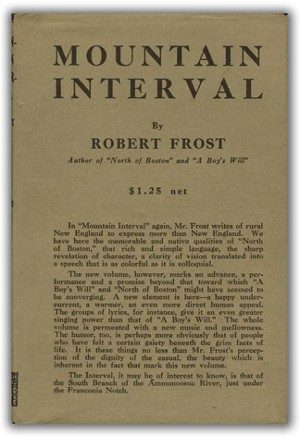
From the bookMountain IntervalFirst-edition dust jacket, Henry Holt, 1916
Analysis
Putting in the Seed: analysis
Introduction
"Putting in the Seed" is a fourteen-line poem spoken by someone planting a garden in spring. It is evening, and another person has come out to call the speaker in to supper. The speaker is busy covering seeds with soil among fallen apple blossom.
Half teasing, the speaker warns the visitor not to catch the same passion for the earth. The poem then turns to the love that drives planting and to the moment a seedling breaks the surface. Its words for plant growth also belong to human love and birth. That double sense is why readers have long argued over what the poem is really about.
Summary
The speaker addresses someone who has come to fetch them from work in the evening. Supper is already on the table. The speaker says they will see whether the work can be left. That work is burying the white, soft petals that have fallen from the apple tree.
In a parenthesis, the speaker corrects this description. The petals are not so barren after all, because smooth beans and wrinkled peas are mixed in with them. The speaker then wonders whether they can go along with the visitor in time. The risk is that the visitor will forget the errand. The visitor might then become like the speaker, a "Slave to a Springtime passion for the earth."
The second sentence is an exclamation. It describes how Love burns through the work of putting in the seed. The feeling carries on through the time spent watching for the first shoots. Those shoots appear just as weeds begin to spoil the soil. Then the sturdy seedling comes up, arched, pushing its way through and shedding crumbs of earth.
Themes and meaning
Passion for the earth is the poem's starting point. The speaker treats gardening as a passion, not a chore. The speaker is a "Slave to a Springtime passion for the earth" (line 9). "Slave" admits that the passion is not wholly chosen. It keeps the speaker at work while supper waits.
The poem sets love of the earth beside the bond with the person who comes to fetch the speaker. The call to supper is an ordinary household claim. The speaker warns that the visitor could "lose sight / Of what you came for" and be drawn in too. The "Love" of line 10 is not attached to anyone. It can be read as love of the earth, as love between the two people, or as both at once.
Fertility and birth run through the vocabulary, which belongs to plants and human bodies at once. The word "barren" (line 5) is said of people as well as ground. The phrases "early birth" (line 11) and "arched body" (line 13) describe a seedling in terms of a newborn. Many readers take the poem as a sustained comparison between planting and human conception. The text supports this double sense without ever stating it.
Death and renewal are joined in a single act. The first labour named is burial. The speaker is "burying" fallen petals, the spent remains of the apple blossom. Hidden among them are beans and peas, which will grow. The same handfuls of soil cover what is finished and what is to come.
The close is about watching and patience. Line 11 speaks of "the watching for that early birth". The planter cannot make the seed rise, only wait for it. The seedling does the last work itself, "Shouldering its way" up. The final image gives the plant a strength and will of its own.
Tone
The poem opens in a warm, easy, conversational voice. The phrase "we'll see" sounds amused and a little reluctant. The speaker is in no hurry to come in to supper.
The parenthesis in lines 5–6 is playful. The speaker corrects the word "barren" in mid-sentence, like someone thinking aloud. Calling oneself a "Slave" (line 9) is self-mocking rather than bitter. The warning to the visitor is a tease, not a threat.
The second sentence shifts register. "How Love burns" is an exclamation, rapt and close to reverent. The capitals on "Love" and "Seed" lift the tone. A brief note of trouble enters with the weeds in line 12. The poem ends in admiration of the "sturdy seedling", physical and exact.
Form and structure
The poem is a single stanza of 14 lines. Its length and rhyme make it a sonnet of an unusual kind. The rhyme scheme is ABABABABCDCDEE. The first eight lines use only two rhyme sounds, alternating night, white, quite and sight with see, tree, pea and me. A new quatrain and a closing couplet follow, as in an English sonnet.
The metre is iambic pentameter. Most lines have ten syllables, and the range runs from 8 to 11. Line 9 opens on the stressed "Slave", and line 14 opens on "Shouldering". The seedling's push lands at the start of the last line.
The grammar does not match the rhyme. The first sentence runs through line 9, although line 9 already carries the new rhyme. The turn from invitation to exclamation comes at line 10. The final pair, "comes" and "crumbs", is a near rhyme.
Poetic devices
Direct address line 1
You come to fetch me from my work to-night The poem opens as speech to a listener who is present. It sets a domestic scene at evening and a call away from work.
Enjambment line 3
burying the white The line breaks after the adjective, so "white" hangs before its noun. The pause lets whiteness itself seem to be buried before the petals arrive in line 4.
Repetition line 5
Soft petals, yes The speaker repeats the phrase from line 4 inside a parenthesis. It works as a correction in mid-speech that reveals the hidden seeds.
Imagery line 6
smooth bean and wrinkled pea Two textures set side by side make the seeds tangible. The contrast shows close, hands-on attention to the work.
Metaphor line 9
Slave to a Springtime passion for the earth Gardening becomes an enslaving passion. The alliteration of "Slave" and "Springtime" stresses how complete the hold is.
Personification line 10
How Love burns through the Putting in the Seed Capitalised Love acts like a fire moving through the work. It raises planting to something close to ritual.
Metaphor line 12
the soil tarnishes with weed Soil is treated like metal losing its shine. Weeds dull the clean surface just as the seedling appears.
Personification line 13
The sturdy seedling with arched body comes The seedling is given a body and a posture. The image invites the reading of the seedling as a newborn.
Alliteration line 14
Shouldering its way and shedding the earth crumbs The repeated sh sound mimics effort and friction. The heavy line ends the poem on the plant's own push upward.
Words worth knowing
to-night
An older hyphenated spelling of tonight. Here it means this evening.
leave off
Stop or break off doing something.
ere
An old word for before.
barren
Unable to produce growth. The word is used of land and also of people who cannot have children, a sense readers often notice here.
tarnishes
Usually said of metal losing its shine. Here the weeds spoil and darken the clean surface of the soil.
Context
"Putting in the Seed" appeared in Robert Frost's collection Mountain Interval, published in 1916. It is the fourteenth poem in that book.
What readers have said
American Lady expecting her first child, whose husband showed her the poem, first read it as about pregnancy, then decided on rereading that it is about the act of sex itself. American Lady, 2006
SmartDancer accepts that the poem links sex with the fertilising of the earth, but finds a deeper layer in which the speaker feels for nature the love usually tied to love-making. SmartDancer, 2006
ea sees a practical side: a person absorbed in work, whether writing or gardening, needs someone down to earth to call them back to the household's routine. ea, 2007
uncarvedblock123 suggests "burying the white" can also mean filling a blank page, while "barren", "smooth bean" and "wrinkled pea" carry sexual suggestion. uncarvedblock123, 2007
Shirley Eliakis reads the speaker as past a personal season of fertility, knowing the planted seed will grow without control, so the task is to watch and let life be. Shirley Eliakis, 2007
Tina, a student, facing an exam objects that readers over-analyse the poem, since every reading seems to reduce to life, death, sex or love. Tina, 2006
I think that this poem is about the beginning and end of life. The title refers to the beginning of life, like planting a seed and line 12 refers to the end of life.
leighUnited Kingdom
i have to study this poem for my a levels and i feel that this poem is very metaphorical and that the seed represents a new life (a baby). i interpret this poem as having sexual qualitys to it
RosyUnited Kingdom
I have read an analysis of this which says the poem is purely about his love of nature, but my English teacher insists that he has ulterior motives in all of his poems. In this case I would definitely suggest that there are sexual connotations throughout, and also ideas of reproduction, procreation. For example 'barren' can not only mean empty, but can also mean that a person is unable to have children. I think that the poem may be about Frost realising that the only love he has is for nature, and he no longer craves sex (he was writing this poem when he was slightly older, and had conceived all the children he would ever have).
kayleighUnited Kingdom
i am also studying him for my a-levels and personally i hink he is a rubbish poet. I think that its nice to have a hidden meaning in a poem and have to think about it. But when everyone has to try just tothink of anything ithink its pointless. it doesnt convey a message at all. thanks exam board for giving us this.
David HurnUnited Kingdom
I am also studying this for my A Levels I think this particular poem is ambiguous with many different meanings the main the growth of a plant or a baby!! "Seedling" confirms it has something to do with plants and "arched body" suggests the figure is of a baby lying in a womans stomach
MattUnited Kingdom
I really feel that this poem is an extended metaphor for a block of wood. The poem and the block of wood are very similar. Both could be made into something rather beautiful and nice, but just like a drunk carpenter, Frost just couldn't be bothered to add something special to this poem. Just a bunch of lines that happen to rhyme - like a wood block just happens to be an effective doorstop. Oh and you could also say that it's a continuation of 'After Apple Picking', which is a rather more special work from Frost's collections.
KatieUnited Kingdom
I am studying this poem for my A-Levels, and I believe that the poem consists of ideas of the growth of a baby. Planting the seed being conception, and the growth of the baby to that of 'early birth' and 'arched body', showing the extent of the meaning throughout the poem, leading to the belief of the seedling being that of a baby. I find this poem very interesting, evaluating the concepts of Frost's poems, into…
Read the whole comment
I am studying this poem for my A-Levels, and I believe that the poem consists of ideas of the growth of a baby. Planting the seed being conception, and the growth of the baby to that of 'early birth' and 'arched body', showing the extent of the meaning throughout the poem, leading to the belief of the seedling being that of a baby. I find this poem very interesting, evaluating the concepts of Frost's poems, into that of reality can be some what of challenge, but the ways he uses metaphors to construct ideas such as birth, and relating his views and concepts into other poems. In relation of ' the Apple Tree', to that of 'After Apple-Picking'. Also unlike 'The Oven Bird', 'Putting in the Seed' is a happy, contented sonnet, and relate to the joy of birth and creation which is a common nature in Frost's poetry.
I am ALSO studying robert frost poems for A level. But how many hidden meanings are there in these poems because our teacher mike says there all about sex :(
StevieUnited Kingdom
Just wanna say thanks for all the help, I really cant get the "hidden meanings" on my own and you guys have shown me a completely different side to this poem (I thought Oven Bird was all about de-forestation!)...
VikramUnited Kingdom
Im also studying Robert Rrost poems for my A-levels and all your comments have really helped me understand what they mean...Thanx :)
kyleUnited Kingdom
i think this poem has so many meaning there is no point tryin to analyse it true hidden message
TrudiUnited Kingdom
Definately sexual undertones here... Interesting that your teacher says all Frosts poems are about sex, ours says they are all about DEATH..... Stopping by woods...not merely a cheery little poem about snow, but apparently Frost contemplating suicide. Cheery, wasn't he?
Ess GeeUnited Kingdom
Frost is a deep poet. "Putting in the seed" has definatley got a sexual agenda, the title alone conveys this. "if i leave off burrying the white soft petals" seems to be Frost describing love making outside and the sheer weight burries the soft white petals. This may be related to Frost's mistress. Definatley a light hearted poem which uses love making as a metaphor to conve his love for nature. Good luck in you exams everyoneXXX
emiUnited Kingdom
hey, im also doing robert frost for my a-levels,which at first i thought it was a bummer, but by reading ur comments i can get ur ideas about this poem,which for me is,better,cos i did think o no... poems..analysing, arrrrrr!so thanx for your comments uve helped me out! gud luk eveyone!
Fairy princes T*n*aUnited Kingdom
hey, reading your comments have given me some great ideas! but just starting the course id like some help from you guys, if you guys have any important info or facts that are useful about the poem, please could you write back!just to help me out! thanx! love me x
trishaUnited Kingdom
personally i think Robert Frost is not a very good poet,because there are to many hidden meanings in his work,its hard to work it all out!
DavidUnited Kingdom
Frost said himself that the meanings of his poems were generally the most obvious ones.
American LadyUnited States
I never studied this poem when I was in school. There were other Frost poems that we studied - ie 'The Road not Taken' 'Mending Wall'.
The first time I read this, even though I see the natural overtures, I understood it to be about pregnancy. I take it that my husband did to, as he was the one who introduced it to me, and we are expecting our first child.
When I went back to re-read it, I realized it wasn't necessarily about pregnancy, but about the act of sex itself.
anu youngUnited Kingdom
the beauty of this poem is that it portrays the beauty of procreation. i am studying lit. as an a-level course and this poem is one of frost's poem that i believe will touch women especially mothers to prove to them that it is or still what it. i love poems like thiis because they touch the soul and i am more of a romantic person. kuddos to frost.
WillUnited Kingdom
Hey, ive studied Frost for two years now and after thorough research im sad to tell you all but Mr Frost was/is Gay! But looking at your well achieved analysis i agree that this poem is an act of making love, yet, frost being homosexual i beleive he is talking about his intimate love for nature, rather than a woman, he would rather enjoy planthing seeds in the soil and being close to nature than to a womans body, he…
Read the whole comment
Hey, ive studied Frost for two years now and after thorough research im sad to tell you all but Mr Frost was/is Gay! But looking at your well achieved analysis i agree that this poem is an act of making love, yet, frost being homosexual i beleive he is talking about his intimate love for nature, rather than a woman, he would rather enjoy planthing seeds in the soil and being close to nature than to a womans body, he is using nature to describe this act. Another thought to tease your minds with is if you read lines 3 and 4, the word white suggests something pure, virginity perhaps? he may be talking that this is so precious and delecate that it is something not to let go of lightly, hence the delecate soft petals. Could go on but il leave these thoughts with you guys, many regards will.
SmartDancerUnited States
I agree with all of you that the poem is indeed relating the act of sex with the fertilization of the earth, both resulting in new life. However, I think on a deeper level Frost may be conveying that he holds the same love for nature that most would associate with love making.
So I think that there is def. multiple layers in which one can read this poem, but hopefully this helps some of you do your exams and assignments :-D good luck
TinaUnited Kingdom
I can't see how there can be so many meanings/symbols in one small poem. i'm studying frost for my AS-Level course and with the exam in 2 days i thought i'd better brush up on my knowledge of him but everything is the same it's either, life, death, sex or love. to be honest i think people over analyse the poems. he didnt write them thinkin oh i'll add a metaphor in here to make it read like tht. it's stupid.
SarahUnited Kingdom
hey everyone I came on here to finalise my research on Robert Frost's poetry just to check out if there's anything I've been missing. Turns out there was and I have my first a-level exam tomorrow afternoon. I really do recommend studying this site! Well worth it! I actually now do feel filled with confidence, which I could really need right about now! Thanks to you all!
ea
Yes, this is very sexy, but I feel more of the practical poet here; for me, he seems to be talking about the poet's need for someone down to earth to come and rouse him from his muse, as he writes and he appreciates his wife for keeping the house together and giving his life some schedule because otherwise he would be too absorbed in his work to notice, just as he may very well be when gardening, too. There's not much difference in the professions.
uncarvedblock123United States
First off, who cares if Mr. Frost was gay? That out of the way, the poem seems to me a tangle of metaphor and literal translation. For example, "burying the white" can be read as filling the page as well as read with the following line (i.e. showing the tending of one's property). Of course, the obvious sexual references can still be bled from these same lines when introducing "barren", "smooth bean" and "wrinkled…
Read the whole comment
First off, who cares if Mr. Frost was gay?
That out of the way, the poem seems to me a tangle of metaphor and literal translation. For example, "burying the white" can be read as filling the page as well as read with the following line (i.e. showing the tending of one's property). Of course, the obvious sexual references can still be bled from these same lines when introducing "barren", "smooth bean" and "wrinkled pea" in the subsequent lines.
It seems Frost challenges us next when he claims that his mate might "become like" him, "Slave to a Springtime passion...". This might appear to contradict the idea that he is being called from the field to tend to his mate's needs (since he here claims to have the passion himself). Of course, the tending of these fields requires both the passion and the literal act.
On balance, a beautiful piece that mixes sexuality with natural metaphors of nature both rich and complex.
poems Mr.mahmoud ghoochani for ---------------------------------------------------------- Nobody aware of his future I want to go . May be I don’t come back again . and maybe come back . Nobody aware of his future . I want to write again . Even my pen is broken and my heart be annihilated… But I am in a mood to do this … . I want to look at the reality rightly and tell them to other . I want to be with you again ……
I want to go . May be I don’t come back again . and maybe come back . Nobody aware of his future . I want to write again . Even my pen is broken and my heart be annihilated… But I am in a mood to do this … . I want to look at the reality rightly and tell them to other . I want to be with you again … Nobody aware of his future … Maybe I come back soon … Nobody aware of his future , but I will come and speak to you about the fate of the storms . I don’t want flower but I like the love very much .
The last passenger who takes the loneliness road , sees the night in which the tree of love left him a simple word . a shelterless stillness , a lonely evening , the mirage of horizon , scarcity of lyrics , to stay and leave , coming and going . Are the black clouds upon the simple word of the moments .
Name : Mahmoud Surname : Ghoochani Birth Certificate No : 1439 Date of Birth : February 4 , 1985 Address : P.O.BOX : 1383 – 91375 Mashhad - Iran Telephon : (+98) [phone removed] Mobile : (+98) [phone removed]
HeidiUnited Kingdom
well, in my opinon Frost has written some good poems, however do you really think he spent all his time thinking over every word so it meant something - because i certainly don't, i think people add symbolism to make themselves sound intelligent!
Frost is at the DINNER table for his final meal of the day. His personal season of fertility is over. He observes. He is aware of the trials for the seed. But the seed is already planted and he cannot control it with his own will. It will grow without Frost's control. The trick is to watch and allow life to be.
I think that this poem is about the beginning and end of life. The title refers to the beginning of life, like planting a seed and line 12 refers to the end of life.
i have to study this poem for my a levels and i feel that this poem is very metaphorical and that the seed represents a new life (a baby). i interpret this poem as having sexual qualitys to it
I have read an analysis of this which says the poem is purely about his love of nature, but my English teacher insists that he has ulterior motives in all of his poems. In this case I would definitely suggest that there are sexual connotations throughout, and also ideas of reproduction, procreation. For example 'barren' can not only mean empty, but can also mean that a person is unable to have children. I think that the poem may be about Frost realising that the only love he has is for nature, and he no longer craves sex (he was writing this poem when he was slightly older, and had conceived all the children he would ever have).
i am also studying him for my a-levels and personally i hink he is a rubbish poet. I think that its nice to have a hidden meaning in a poem and have to think about it. But when everyone has to try just tothink of anything ithink its pointless. it doesnt convey a message at all. thanks exam board for giving us this.
I am also studying this for my A Levels I think this particular poem is ambiguous with many different meanings the main the growth of a plant or a baby!! "Seedling" confirms it has something to do with plants and "arched body" suggests the figure is of a baby lying in a womans stomach
I really feel that this poem is an extended metaphor for a block of wood. The poem and the block of wood are very similar. Both could be made into something rather beautiful and nice, but just like a drunk carpenter, Frost just couldn't be bothered to add something special to this poem. Just a bunch of lines that happen to rhyme - like a wood block just happens to be an effective doorstop.
Oh and you could also say that it's a continuation of 'After Apple Picking', which is a rather more special work from Frost's collections.
I am studying this poem for my A-Levels, and I believe that the poem consists of ideas of the growth of a baby. Planting the seed being conception, and the growth of the baby to that of 'early birth' and 'arched body', showing the extent of the meaning throughout the poem, leading to the belief of the seedling being that of a baby. I find this poem very interesting, evaluating the concepts of Frost's poems, into…
Read the whole commentI am studying this poem for my A-Levels, and I believe that the poem consists of ideas of the growth of a baby. Planting the seed being conception, and the growth of the baby to that of 'early birth' and 'arched body', showing the extent of the meaning throughout the poem, leading to the belief of the seedling being that of a baby. I find this poem very interesting, evaluating the concepts of Frost's poems, into that of reality can be some what of challenge, but the ways he uses metaphors to construct ideas such as birth, and relating his views and concepts into other poems. In relation of ' the Apple Tree', to that of 'After Apple-Picking'. Also unlike 'The Oven Bird', 'Putting in the Seed' is a happy, contented sonnet, and relate to the joy of birth and creation which is a common nature in Frost's poetry.
I am ALSO studying robert frost poems for A level. But how many hidden meanings are there in these poems because our teacher mike says there all about sex :(
Just wanna say thanks for all the help, I really cant get the "hidden meanings" on my own and you guys have shown me a completely different side to this poem (I thought Oven Bird was all about de-forestation!)...
Im also studying Robert Rrost poems for my A-levels and all your comments have really helped me understand what they mean...Thanx :)
i think this poem has so many meaning there is no point tryin to analyse it true hidden message
Definately sexual undertones here...
Interesting that your teacher says all Frosts poems are about sex, ours says they are all about DEATH.....
Stopping by woods...not merely a cheery little poem about snow, but apparently Frost contemplating suicide. Cheery, wasn't he?
Frost is a deep poet. "Putting in the seed" has definatley got a sexual agenda, the title alone conveys this. "if i leave off burrying the white soft petals" seems to be Frost describing love making outside and the sheer weight burries the soft white petals. This may be related to Frost's mistress. Definatley a light hearted poem which uses love making as a metaphor to conve his love for nature. Good luck in you exams everyoneXXX
hey, im also doing robert frost for my a-levels,which at first i thought it was a bummer, but by reading ur comments i can get ur ideas about this poem,which for me is,better,cos i did think o no... poems..analysing, arrrrrr!so thanx for your comments uve helped me out! gud luk eveyone!
hey, reading your comments have given me some great ideas! but just starting the course id like some help from you guys, if you guys have any important info or facts that are useful about the poem, please could you write back!just to help me out! thanx! love me x
personally i think Robert Frost is not a very good poet,because there are to many hidden meanings in his work,its hard to work it all out!
Frost said himself that the meanings of his poems were generally the most obvious ones.
I never studied this poem when I was in school. There were other Frost poems that we studied - ie 'The Road not Taken' 'Mending Wall'.
The first time I read this, even though I see the natural overtures, I understood it to be about pregnancy. I take it that my husband did to, as he was the one who introduced it to me, and we are expecting our first child.
When I went back to re-read it, I realized it wasn't necessarily about pregnancy, but about the act of sex itself.
the beauty of this poem is that it portrays the beauty of procreation. i am studying lit. as an a-level course and this poem is one of frost's poem that i believe will touch women especially mothers to prove to them that it is or still what it.
i love poems like thiis because they touch the soul and i am more of a romantic person.
kuddos to frost.
Hey, ive studied Frost for two years now and after thorough research im sad to tell you all but Mr Frost was/is Gay! But looking at your well achieved analysis i agree that this poem is an act of making love, yet, frost being homosexual i beleive he is talking about his intimate love for nature, rather than a woman, he would rather enjoy planthing seeds in the soil and being close to nature than to a womans body, he…
Read the whole commentHey, ive studied Frost for two years now and after thorough research im sad to tell you all but Mr Frost was/is Gay! But looking at your well achieved analysis i agree that this poem is an act of making love, yet, frost being homosexual i beleive he is talking about his intimate love for nature, rather than a woman, he would rather enjoy planthing seeds in the soil and being close to nature than to a womans body, he is using nature to describe this act. Another thought to tease your minds with is if you read lines 3 and 4, the word white suggests something pure, virginity perhaps? he may be talking that this is so precious and delecate that it is something not to let go of lightly, hence the delecate soft petals. Could go on but il leave these thoughts with you guys, many regards will.
I agree with all of you that the poem is indeed relating the act of sex with the fertilization of the earth, both resulting in new life. However, I think on a deeper level Frost may be conveying that he holds the same love for nature that most would associate with love making.
So I think that there is def. multiple layers in which one can read this poem, but hopefully this helps some of you do your exams and assignments :-D good luck
I can't see how there can be so many meanings/symbols in one small poem.
i'm studying frost for my AS-Level course and with the exam in 2 days i thought i'd better brush up on my knowledge of him but everything is the same
it's either, life, death, sex or love.
to be honest i think people over analyse the poems. he didnt write them thinkin oh i'll add a metaphor in here to make it read like tht. it's stupid.
hey everyone I came on here to finalise my research on Robert Frost's poetry just to check out if there's anything I've been missing. Turns out there was and I have my first a-level exam tomorrow afternoon. I really do recommend studying this site! Well worth it! I actually now do feel filled with confidence, which I could really need right about now! Thanks to you all!
Yes, this is very sexy, but I feel more of the practical poet here; for me, he seems to be talking about the poet's need for someone down to earth to come and rouse him from his muse, as he writes and he appreciates his wife for keeping the house together and giving his life some schedule because otherwise he would be too absorbed in his work to notice, just as he may very well be when gardening, too. There's not much difference in the professions.
First off, who cares if Mr. Frost was gay? That out of the way, the poem seems to me a tangle of metaphor and literal translation. For example, "burying the white" can be read as filling the page as well as read with the following line (i.e. showing the tending of one's property). Of course, the obvious sexual references can still be bled from these same lines when introducing "barren", "smooth bean" and "wrinkled…
Read the whole commentFirst off, who cares if Mr. Frost was gay?
That out of the way, the poem seems to me a tangle of metaphor and literal translation. For example, "burying the white" can be read as filling the page as well as read with the following line (i.e. showing the tending of one's property). Of course, the obvious sexual references can still be bled from these same lines when introducing "barren", "smooth bean" and "wrinkled pea" in the subsequent lines.
It seems Frost challenges us next when he claims that his mate might "become like" him, "Slave to a Springtime passion...". This might appear to contradict the idea that he is being called from the field to tend to his mate's needs (since he here claims to have the passion himself). Of course, the tending of these fields requires both the passion and the literal act.
On balance, a beautiful piece that mixes sexuality with natural metaphors of nature both rich and complex.
poems Mr.mahmoud ghoochani for ---------------------------------------------------------- Nobody aware of his future I want to go . May be I don’t come back again . and maybe come back . Nobody aware of his future . I want to write again . Even my pen is broken and my heart be annihilated… But I am in a mood to do this … . I want to look at the reality rightly and tell them to other . I want to be with you again ……
Read the whole commentpoems Mr.mahmoud ghoochani for
----------------------------------------------------------
Nobody aware of his future
I want to go .
May be I don’t come back again . and maybe come back .
Nobody aware of his future .
I want to write again .
Even my pen is broken and my heart be annihilated…
But I am in a mood to do this … .
I want to look at the reality rightly and tell them to other .
I want to be with you again …
Nobody aware of his future …
Maybe I come back soon …
Nobody aware of his future , but I will come and speak to you about the fate of the storms .
I don’t want flower but I like the love very much .
Author : Mahmoud Ghoochani
Iran – Mashhad
------------------------------------------------------------------
------------------------------------------------------------------
The simple words of the moments
The last passenger who takes the loneliness road , sees the night in which the tree of love left him a simple word . a shelterless stillness , a lonely evening , the mirage of horizon , scarcity of lyrics , to stay and leave , coming and going .
Are the black clouds upon the simple word of the moments .
Author : Mahmoud Ghoochani
Iran – Mashhad
------------------------------------------------------------------
------------------------------------------------------------------
Name : Mahmoud
Surname : Ghoochani
Birth Certificate No : 1439
Date of Birth : February 4 , 1985
Address : P.O.BOX : 1383 – 91375
Mashhad - Iran
Telephon : (+98) [phone removed]
Mobile : (+98) [phone removed]
well, in my opinon Frost has written some good poems, however do you really think he spent all his time thinking over every word so it meant something - because i certainly don't, i think people add symbolism to make themselves sound intelligent!
Frost is at the DINNER table for his final meal of the day. His personal season of fertility is over. He observes. He is aware of the trials for the seed. But the seed is already planted and he cannot control it with his own will. It will grow without Frost's control. The trick is to watch and allow life to be.