By June our brook's run out of song and speed.
Sought for much after that, it will be found
Either to have gone groping underground
(And taken with it all the Hyla breed
That shouted in the mist a month ago,
Like ghost of sleigh-bells in a ghost of snow)--
Or flourished and come up in jewel-weed,
Weak foliage that is blown upon and bent
Even against the way its waters went.
Its bed is left a faded paper sheet
Of dead leaves stuck together by the heat--
A brook to none but who remember long.
This as it will be seen is other far
Than with brooks taken otherwhere in song.
We love the things we love for what they are.
✦
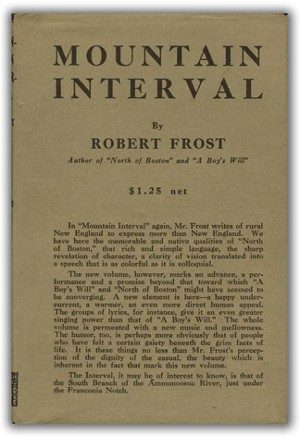
From the bookMountain IntervalFirst-edition dust jacket, Henry Holt, 1916
Analysis
Hyla Brook: analysis
Introduction
A brook has almost vanished by June. Its sound and visible current are gone, leaving plants and dried leaves where water ran before. The speaker describes that diminished place closely, then asks what remains of a brook for someone who remembers it.
The final declaration about loving things for what they are grows out of this particular scene. The poem values attachment that survives a disappointing appearance. It also contrasts the remembered local brook with the more satisfying streams that songs might lead a reader to expect.
Summary
The speaker begins by saying that the brook has lost both song and speed by June. Anyone searching for it later will find one of two possible conditions. It may have gone underground, taking with it the Hyla creatures that were calling in the mist a month earlier.
Alternatively, its presence appears to have changed into jewel-weed. This weak foliage bends in the wind, even against the direction in which the water used to flow. The speaker moves from the absent current to the dry bed that remains.
Dead leaves have been pressed together by heat into something resembling faded paper. The place is now a brook only to people whose memories extend beyond its present appearance. To other observers, the visible stream may no longer be there.
The speaker notes that this brook differs from brooks found elsewhere in song. The final sentence then broadens the account into a statement about love. It says that people love the things they love for what those things are.
Themes and meaning
The opening gives the brook a familiar sign of life: a song. Its disappearance involves both lost movement and lost sound. The remembered calls of the Hyla creatures preserve another layer of that earlier activity. The dry place is therefore not described as empty of history. Its present quiet can be understood only beside the remembered noise.
Memory changes what can be recognized. The line about people who remember long makes the observer's relation to the place decisive. Someone encountering the leaves for the first time might not see a brook. Someone attached to it can retain its identity through seasonal change. The poem does not claim that memory makes the missing water physically present.
The alternatives of underground movement and transformation into plants resist a simple account of disappearance as total destruction. The water is no longer visibly running, but the scene contains suggestions of continuation elsewhere or in another form. These are possibilities offered through the speaker's figurative account, not a detailed scientific explanation.
The last two sentences distinguish love from an idealized picture. A brook valued only for constant music and flowing beauty would be disappointing here. The final assertion may instead affirm affection for the particular place through its changes. The word what remains open enough to include remembered life, present limitation, and an identity that cannot be reduced to one attractive moment.
Tone
The tone begins matter-of-factly with a seasonal observation. Calling the brook's flow a song introduces affection, but the speaker does not pretend that the water remains visible. The possible explanations for its disappearance give the description a lightly speculative quality.
The remembered bells and the dry paper of leaves add a more wistful sound and texture. Near the end, the voice becomes corrective toward expectations formed by songs about brooks. The last sentence is calm and declarative. Its confidence follows a detailed account of loss, so it can sound accepting rather than casually optimistic about the scene.
Form and structure
The poem has fifteen lines in one stanza, moving broadly in iambic pentameter with local variations. Its length is one line beyond a conventional fourteen-line sonnet. Interlaced opening rhymes give way to the pairs bent/went and sheet/heat. The last four lines alternate long/song with far/are.
Parentheses enclose the remembered Hyla calls and their comparison with sleigh-bells. The syntactic alternative begun with Either reaches its corresponding Or after that parenthesis. This suspension lets memory interrupt the account of the brook's present condition. The final sentence occupies one complete line, giving the general statement a distinct closing emphasis.
Poetic devices
Personification line 1
By June our brook's run out of song and speed. The brook’s sound becomes song. The phrase joins physical depletion to the loss of something a listener could once enjoy.
Metaphor line 3
Either to have gone groping underground The vanished current is imagined as feeling its way beneath the surface. The tentative motion fits the speaker’s inability to inspect it directly.
Auditory imagery line 5
That shouted in the mist a month ago, The remembered calls fill the dry present with an earlier sound. The time phrase marks how quickly the scene has changed.
Simile line 6
Like ghost of sleigh-bells in a ghost of snow)-- A faint remembered call is compared with another distant seasonal sound. The repeated ghost makes both bell and snow seem insubstantial.
Enjambment line 8
Weak foliage that is blown upon and bent The line continues into a description of direction. That movement contrasts the plants’ bending with the vanished course of the stream.
Metaphor line 10
Its bed is left a faded paper sheet The flattened leaves become a pale sheet of paper. The image records dryness and fragility rather than the fullness expected of flowing water.
Qualification line 12
A brook to none but who remember long. The place’s identity now depends on a history of attention. The line distinguishes present appearances from what a familiar observer can recognize.
Generalization line 15
We love the things we love for what they are. The final statement enlarges the particular attachment without abandoning its difficult example. The brook’s diminished state supplies the test of the assertion.
Words worth knowing
Hyla
A name associated with tree frogs, whose calls the poem recalls.
jewel-weed
A plant growing where the water has been, named as part of the brook’s changed appearance.
foliage
The leaves of plants.
otherwhere
Elsewhere, or in another place.
What readers have said
Ray connects the poem with loving a long-term partner for a history and a future as well as a present condition. Ray, 2006
Tom reads the personified singing and shouting as inviting a comparison with a sustaining relationship, possibly marriage. Tom, 2006
Alex & Amy emphasize seasonal return and continuing affection despite changes in the brook’s appearance. Alex & Amy, 2005
I am studying this poem for my ALevels and I am doing a presentation on it. I was just wondering what other people thought Frost was talking about and refering to in this poem. If you could help me that would be really good. Thanks
jaideUnited Kingdom
Hey im studying this poem for Alevel as well and i don't understand it. i have to write a easay on it, im finding it hard. Please help!
ishaUnited Kingdom
hey im also doing an essay on it, it is about a brook and he is telling us that no matter how horrible this brook may seem he will always love it, and in the last line he also says "we love the things we love the most for what they are." not only is he refering to the brook but there is a deeper meaning as well. Good luck, i know its hard and i do feel your pain
hey, im also studying this poem for a-levels, and i also dont understand it at all. i have to right an essay about it. i think i may just ramble for 1500 words..... good luck
im also doing this poem for a levels. its about a brook which dies in the summer (june) but it says just june so maybe it comes back to life when it starts to rain again?? i dont know. i agree with isha. its about uglyness. even though the brook maybe ugly you can still love it. and there is a deeper feeling. the last line seems to sum up the poem.
Alex & AmyUnited Kingdom
We're doing this poem for our AS level a year early :P and well here's what we think about it: - we believe that it is about the brook running out but we still know that it will be back again. it may appear to have gone in different ways but it will always come back. we also think that the last line signifies that we dont like things to change because we already love them for what they are and that is how we're supposed to view it. Hope this helps folks ;) Alex and Amy :)
im meant to be doing this for as level and doing a presentation about it imj finding it pretty hard to do but ive got so far as the brook is running dry because the summer months r coming but yet it will no die and no matter how many times this happened we will still love the brook for what it is and what it once was no for how it looks
ELLIEUnited Kingdom
i have read all your thoughts on the poems, but i think there must be some more to the poem than just this. if any of you can help me by telling me what else the poem is about, please email me!! let me know, cos i have to do a presentation on this for As level, and im soo stuck as to what to write!!
janiceUnited States
I can find nothing that indicates the poem is about ugliness. More about transformations- the brook delves underground and reappears as jewelweed. It also becomes a memory.
saraUnited States
I think this poem is about to look at thingd in a different prospective then what it looks like and to exept things for what they are not how they look. I'm also stuck to !
I think the meaning of the poem is to look at things in a different prospected than what it really looks like and to love the things not by what they look like but by what they are
I am studying this for as level as well and i think the deeper meaning is that the brook represents a poet entering the mid-summer of his life and he has lost his inspiration. Therefore we are to remember him and to love him for what he once was, not the ordinary diminished thing he has become.
RianneUnited Kingdom
I'm studying this poem along with many other of Frost's poems for A level. I think Hyla Brook is about human memory. I think Frost uses memory to transform things and create love. The idea of the frogs (Hyla's)are the memory of the human. Has anyone got any other ideas?
RachelUnited Kingdom
i think this is sooo difficult!my teacher teaches out of a book n we have 2do this one ourselves!howver u think that no matter how much somethimgs changes it is still beautiful to the person who loves it and deep down it hasn't changed!hope that helps xox
RayUnited States
Frost reminds the individual that he/she is part of a natural cycle. Frost encourages the reader to view loving something or someone not just for what they are in the present. When you get to be older, hopefully you will love your life's partner for not only what your partner is, but also for what your partner has been to you in the past and will be to you in the future.
I too am studying this for A.S! i think it links with the Oven Bird, and the whole 'diminished thing' theme. In the case of the Oven Bird one interpretation is that Frost is alluding to contemporary world affairs, but in the case of this poem all of the verbs used that are usually associated with people, like 'sing' and 'shout' make me think he is talking about a personal relationship of his, perhaps marriage, and the final line sums it up, he loves the relationship for what it is; that supporting force, not because it is fresh and exciting and nourishing in itself, but just to honour his memories of it, and the good times that have been had.
roseUnited Kingdom
As in The Oven Bird, maybe frost is commenting on the cessation of Victorian poetry and it's embellishment. It will always be enjoyed for what it is, but poetry is evolving. It can also link to "Out, Out", as is is also about the acceptance of circumstances, and the continuance of life.
sophieUnited Kingdom
i think hyla brook is based on the recurring theme throughout alot of frosts poetry which is the changing of seasons and how this reflects of human life!(human life hyla breed brook was life brook gone therefore so has that human life) the brook shows the continuity of not only the cycle of the seasons but also the cycle of life and how life has to continue. the fact that its death is in june is noteable in many of frosts poems, spring is the time for rebirth and renewal where as summer is the decline into death, the new has come and is now dying off again. this poem is frost stating we should be happy with the way our lives are dealt."we love the things we love for what they are"
There are brooks. There are raging rivers. Some are life out loud. Some are quiet. Some demand attention. Some command attention and deeper thought. Robert Frost has always spoken to my heart!
AnnieUnited Kingdom
I am studying Robert Frost Poetry for a level and so far i have really enjoyed it. He shows deep meanings throught his poems which has a real affect on the reader. I think hyla brook represents the change in his life, which is shown through the changing seasons. Good lucky everyone with all the poems!
I am studying this poem for my ALevels and I am doing a presentation on it. I was just wondering what other people thought Frost was talking about and refering to in this poem. If you could help me that would be really good.
Thanks
Hey im studying this poem for Alevel as well and i don't understand it. i have to write a easay on it, im finding it hard. Please help!
hey im also doing an essay on it, it is about a brook and he is telling us that no matter how horrible this brook may seem he will always love it, and in the last line he also says "we love the things we love the most for what they are." not only is he refering to the brook but there is a deeper meaning as well. Good luck, i know its hard and i do feel your pain
hey, im also studying this poem for a-levels, and i also dont understand it at all. i have to right an essay about it. i think i may just ramble for 1500 words..... good luck
im also doing this poem for a levels. its about a brook which dies in the summer (june) but it says just june so maybe it comes back to life when it starts to rain again?? i dont know. i agree with isha. its about uglyness. even though the brook maybe ugly you can still love it. and there is a deeper feeling. the last line seems to sum up the poem.
We're doing this poem for our AS level a year early :P and well here's what we think about it:
- we believe that it is about the brook running out but we still know that it will be back again. it may appear to have gone in different ways but it will always come back. we also think that the last line signifies that we dont like things to change because we already love them for what they are and that is how we're supposed to view it.
Hope this helps folks ;) Alex and Amy :)
im meant to be doing this for as level and doing a presentation about it imj finding it pretty hard to do but ive got so far as the brook is running dry because the summer months r coming but yet it will no die and no matter how many times this happened we will still love the brook for what it is and what it once was no for how it looks
i have read all your thoughts on the poems, but i think there must be some more to the poem than just this. if any of you can help me by telling me what else the poem is about, please email me!! let me know, cos i have to do a presentation on this for As level, and im soo stuck as to what to write!!
I can find nothing that indicates the poem is about ugliness. More about transformations- the brook delves underground and reappears as jewelweed. It also becomes a memory.
I think this poem is about to look at thingd in a different prospective then what it looks like and to exept things for what they are not how they look. I'm also stuck to !
I think the meaning of the poem is to look at things in a different prospected than what it really looks like and to love the things not by what they look like but by what they are
I am studying this for as level as well and i think the deeper meaning is that the brook represents a poet entering the mid-summer of his life and he has lost his inspiration. Therefore we are to remember him and to love him for what he once was, not the ordinary diminished thing he has become.
I'm studying this poem along with many other of Frost's poems for A level. I think Hyla Brook is about human memory. I think Frost uses memory to transform things and create love. The idea of the frogs (Hyla's)are the memory of the human. Has anyone got any other ideas?
i think this is sooo difficult!my teacher teaches out of a book n we have 2do this one ourselves!howver u think that no matter how much somethimgs changes it is still beautiful to the person who loves it and deep down it hasn't changed!hope that helps xox
Frost reminds the individual that he/she is part of a natural cycle. Frost encourages the reader to view loving something or someone not just for what they are in the present. When you get to be older, hopefully you will love your life's partner for not only what your partner is, but also for what your partner has been to you in the past and will be to you in the future.
I too am studying this for A.S!
i think it links with the Oven Bird, and the whole 'diminished thing' theme. In the case of the Oven Bird one interpretation is that Frost is alluding to contemporary world affairs, but in the case of this poem all of the verbs used that are usually associated with people, like 'sing' and 'shout' make me think he is talking about a personal relationship of his, perhaps marriage, and the final line sums it up, he loves the relationship for what it is; that supporting force, not because it is fresh and exciting and nourishing in itself, but just to honour his memories of it, and the good times that have been had.
As in The Oven Bird, maybe frost is commenting on the cessation of Victorian poetry and it's embellishment. It will always be enjoyed for what it is, but poetry is evolving. It can also link to "Out, Out", as is is also about the acceptance of circumstances, and the continuance of life.
i think hyla brook is based on the recurring theme throughout alot of frosts poetry which is the changing of seasons and how this reflects of human life!(human life hyla breed brook was life brook gone therefore so has that human life) the brook shows the continuity of not only the cycle of the seasons but also the cycle of life and how life has to continue. the fact that its death is in june is noteable in many of frosts poems, spring is the time for rebirth and renewal where as summer is the decline into death, the new has come and is now dying off again.
this poem is frost stating we should be happy with the way our lives are dealt."we love the things we love for what they are"
There are brooks. There are raging rivers. Some are life out loud. Some are quiet. Some demand attention. Some command attention and deeper thought. Robert Frost has always spoken to my heart!
I am studying Robert Frost Poetry for a level and so far i have really enjoyed it. He shows deep meanings throught his poems which has a real affect on the reader.
I think hyla brook represents the change in his life, which is shown through the changing seasons.
Good lucky everyone with all the poems!
Lol you commented this 3 days before I was born, how old are you now
um this is 15 years later...did u get a good grade on it?