I found a dimpled spider, fat and white,
On a white heal-all, holding up a moth
Like a white piece of rigid satin cloth --
Assorted characters of death and blight
Mixed ready to begin the morning right,
Like the ingredients of a witches' broth --
A snow-drop spider, a flower like a froth,
And dead wings carried like a paper kite.
What had that flower to do with being white,
The wayside blue and innocent heal-all?
What brought the kindred spider to that height,
Then steered the white moth thither in the night?
What but design of darkness to appall?--
If design govern in a thing so small.
✦
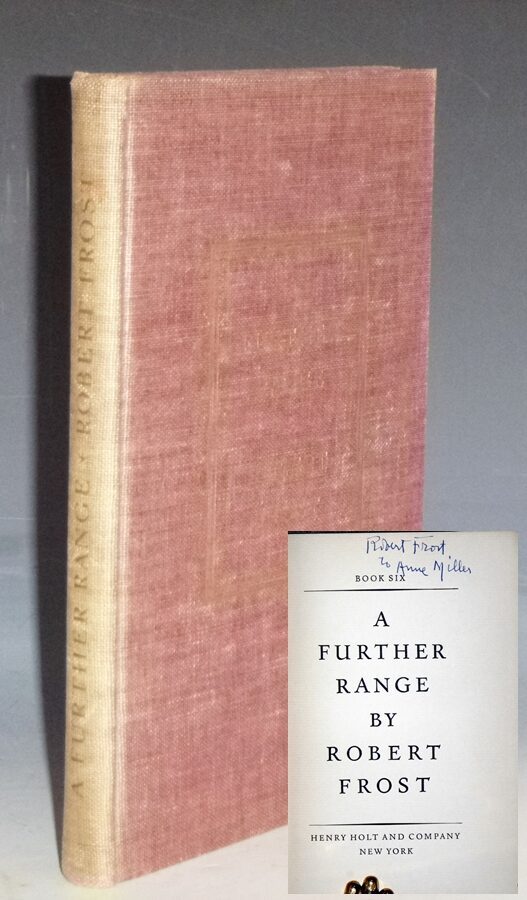
From the bookA Further Range1936 edition, Henry Holt; binding and inscribed title page (Alcuin Books)
Analysis
Design: analysis
Introduction
"Design" is a sonnet by Robert Frost, collected in A Further Range. Its speaker finds a white spider on a white flower, holding a dead white moth. The octave describes the scene with an odd mix of cheer and horror. The sestet asks what brought the three together.
The questions turn a small find by the roadside into a test of an old idea. That idea holds that the order of nature shows a designer's hand. The poem's answer is unsettling. Either a dark design arranged the killing, or nothing governs such small things at all.
Summary
In the octave the speaker reports finding a fat, white, "dimpled" spider on a white heal-all. The spider is holding up a moth, which looks like a stiff piece of white satin. The speaker calls the three "Assorted characters of death and blight" mixed as if for a morning meal. The speaker compares them to the ingredients of a witches' broth. The list then comes again: the spider like a snow-drop, the flower like froth, and the moth's dead wings held up like a paper kite.
The sestet is a series of questions. The speaker asks what the flower had to do with being white, since the roadside heal-all is usually "blue and innocent". Two more questions ask what brought the spider, white like the flower, up to that height, and what steered the moth there in the night. The speaker's answer comes as another question: what but a "design of darkness" meant to appall? The last line adds a condition, if design governs anything so small.
Themes and meaning
The title names the poem's central question. The poem tests the idea that nature's order shows a purpose behind it. Three white things meet, and the meeting ends in a death. The speaker asks "What brought" the spider and what "steered" the moth, verbs that imply an agent. If an agent did this, the only purpose visible is a "design of darkness to appall".
The final line undercuts even that dark answer. "If design govern in a thing so small" allows that nothing arranged the scene at all. The poem therefore offers two bleak options rather than one. Either a designer plans such deaths, or no plan reaches small things. The text does not choose between them.
White usually signals purity. Here it is the color of the killer, the victim and the flower that hosts the killing. The repeated "white" of lines 1, 2, 3, 9 and 12 ties the three together as "kindred". The flower's own name, heal-all, promises cure, yet it holds a corpse. The poem can be read as showing that innocent appearances say nothing about what happens beneath them.
Death is described in homely, even pretty terms. The spider is "dimpled" and "fat", the moth is "satin cloth", and the wings are a "paper kite". The phrase "begin the morning right" makes the killing sound like breakfast. This mismatch makes the scene more disturbing, not less.
Smallness is a theme in its own right. The last word of the poem is "small". The poem asks whether large questions of purpose reach down to a spider on a wayside flower. It leaves open whether they do.
Tone
The tone begins as calm, almost playful observation. "I found" is casual, and "dimpled" and "fat" sound almost fond. The cheer of "ready to begin the morning right" is ironic. The "witches' broth" simile adds a note of the macabre.
In the sestet the tone turns questioning and uneasy. Three questions begin with "What", and each presses harder than the last. The word "appall" in line 13 marks the height of the dread.
The last line drops back into a quiet, dry condition. It can be heard as relief, as deeper doubt, or as irony. The speaker never names a feeling directly.
Form and structure
"Design" is a sonnet of 14 lines, set as 2 stanzas: an octave of 8 lines and a sestet of 6. The octave rhymes ABBAABBA, the pattern of the Italian sonnet. The sestet rhymes ACAACC and reuses the octave's rhyme on "white". The whole poem therefore runs on only three rhyme sounds.
The metre is iambic pentameter, and it is very regular. Lines have 10 or 11 syllables, and most have exactly 10. The two longer lines, line 7 and line 9, contain "flower", which can be said as one syllable or two. The sestet ends in a couplet on "appall" and "small". This gives the conditional last line the weight of a verdict.
Poetic devices
imagery line 1
dimpled spider, fat and white The words suit a baby more than a predator. The soft, well-fed look makes the killer seem harmless, which sharpens the horror that follows.
simile line 3
Like a white piece of rigid satin cloth The dead moth is seen as stiff fabric. Satin can suggest a wedding dress or the lining of a coffin. That second sense is a reading.
metaphor line 4
Assorted characters of death and blight The spider, flower and moth become actors cast in a play about death. "Assorted" sounds like a shop display, which keeps the tone oddly light.
irony line 5
Mixed ready to begin the morning right The phrase echoes cheerful talk about a good breakfast. Applied to a killing, the cheer turns grim.
simile line 6
Like the ingredients of a witches' broth The comparison casts the scene as sinister magic. It hints that someone mixed these things on purpose, which prepares the question of design.
simile line 8
dead wings carried like a paper kite The moth's wings are light, stiff and held aloft like a toy. A child's plaything is set against death.
repetition line 9
What had that flower to do with being white The word "white" recurs through the poem. Here it becomes the subject of a question, so the color itself looks suspicious.
irony line 10
blue and innocent heal-all The flower's usual color and its healing name promise innocence and cure. This one is white and holds a dead moth.
rhetorical question line 11
What brought the kindred spider to that height The question assumes that something brought the spider. "kindred" stresses that spider and flower match, as if chosen for each other.
diction line 12
steered the white moth thither in the night "steered" implies a hidden pilot guiding the moth. The verb gives the unseen force a will of its own.
alliteration line 13
design of darkness The repeated d sound binds design to darkness. It is the poem's harshest phrase.
qualification line 14
If design govern in a thing so small The conditional pulls back from the dark answer just given. It raises a second possibility, that nothing governs such small events at all.
Words worth knowing
heal-all
A wildflower whose name promises healing. Line 10 says it is normally blue, so a white one is unusual.
characters
Figures in a play. The octave treats the three as actors cast in a drama of death.
kindred
Related or alike. The spider is kin to the flower in its whiteness.
thither
An old word for 'to that place'.
appall
To fill with horror. The word also contains "pall", the cloth laid over a coffin. That echo is a reading.
govern
A subjunctive form, "govern" rather than 'governs'. It marks the clause as a supposition, not a statement of fact.
Context
"Design" appeared in Frost's book A Further Range, published in 1936. It has been on americanpoems.com since February 2003. It was the site's Poem of the Day on September 14, 2006. Readers left 32 comments on it between 2004 and 2011.
What readers have said
Brian read the poem as weighing God's will against chance, and saw the last line as allowing that no deity exists. Brian, 2005
Emily read it as about God's greater plan, with the harmless white spider caught up in a darker design it cannot control. emily, 2006
Gina argued that the poem denies divine design and presents the killing as a natural event that happens without a plan. Gina, 2005
Benosnje read it as a poem about nature's evenhandedness rather than good and evil, noting that nature attaches no moral meaning to white or black. benosnje, 2005
An anonymous reader found no biblical allusion in the lines apart from the title, and so doubted that the poem criticizes God. Anonymous, 2008
Ea explained that the heal-all is a flower that is normally blue, so the speaker is first of all wondering why this one is white. ea, 2007
this poem"Design" is a beautiful poem by Robert Frost . i have ever seen such intresting poem like this one. we can compare this poem with "In White"
Nasir yousifSudan
The poem questions the classes differences.A rich powerful spider hunts a tiny small moth.This suggests that every thing in this world is up side down so that the flower is no lon ger symble of peace and love as it is used as stage where the act of killing and hunting take place.What behind all this is the power of darkness.
BrianUnited States
This poem represents the idea of free thought versus Gods will. What or better yet, whose design would force a spider to eat a fly in order to survive. Was the stage set perfectly by an ultimate power or was everything by chance. The most intriguing aspect of the poem is the last line, as though suggesting the possibility of a non-existent diety.
TenzinUnited States
I think that Frost is trying to articulate that looks can be deceiving. I mean the moth, spider, and the flower are all described white in color which obviously signifies purity and innocence. Thus, the moth was deceived by this white appearance of the spider and got killed. Moreover, all of this took place on the white heal-all(flower).
From the very first line, the spider in Robert Frost’s Design is quite unusual. A white spider is something most people don’t see everyday meaning- pay attention to that detail. Is the intense irony of the all white flower, moth and spider just an incredible coincidence? White in this poem could be a symbol of purity or innocence. In the life process, nature just happens; making it pure and neutral. This situation…
Read the whole comment
From the very first line, the spider in Robert Frost’s Design is quite unusual. A white spider is something most people don’t see everyday meaning- pay attention to that detail. Is the intense irony of the all white flower, moth and spider just an incredible coincidence? White in this poem could be a symbol of purity or innocence. In the life process, nature just happens; making it pure and neutral. This situation makes the reader wonder how three very unusually colored beings are all interacting in the same place at the same time. The poem suggests “ultimate design”- that these three pure things, just going about their business, are not engaged in an evil practice but involved in something so much bigger than themselves. The three beings are engaged in this completely beautiful, intriguing and terrifying “ultimate design”. Frost could have made all of these things black- a symbol for all of the death and darkness that this event is. However, by choosing to make these beings white, the poet decides to play off the irony of three things, so pure of color committing an act so dark. The unintentional cruelty of nature is being displayed in this poem.
benosnjeUnited States
I think Frost is asking us to question stereotypes in this poem. "What had that flower to do with being white?" he asks, as if to be white demands living up to the stereotype of innocence. The drama and beauty of nature applies to creatures of all colors. The spider is no more guilty than the moth, no more evil. This is not a poem about good and evil, it is about nature and its equanimity. Though we think of black as the color of death, nature has no such bias.
I believe this poem is showing everything happens for a reason, or as suggested by the title design.
DaveUnited States
Frost in the poem "Design" builds on the literal natural situation to build an argument for critical and existential thought. The grand metaphor of the "small"-ness of the events compared to our own smallness and aloneness in the universe builds on ideas of life as meaningless. The poem certainly calls into question the existance of a god. Pascal said "the silence of these infinite spaces frighten me"... it seems to me that Frost is questioning these same ideas.
GinaUnited States
This poem was written at the time when the concept of divine "design" was prevalent; this "design" is the ultimate control over life and death. Robert Frost, by portraying this gruesome scene of a spider devouring a moth as a beautiful, natural phenomenon, denies this concept and conveys his message that everything happens spontaneously and without any "design" behind it.
SherwinUnited States
This poem is reflective. It makes fearful images to life and turns negative images arround to a positive one. Nice poem!
Griffin
HAHA, none of you myopic poetry psychos regognized the inverted sonnet form the poem is written in. This shows that frost is trying to convey the "inverted" nature of...nature. Further proof that poetry is too abstract and intentionally vague to be a real art form.
JIMMYUnited States
NOT BAd i liked how frost displays da spyder
MarrahUnited States
I think that those views are all good, but when I read the poem I got a bit of a different perspective about it. When I read the line What had that flower to do with being white, I sat there and asked myself what did the flower to do with being white, why does he ask this?--then I thought hey maybe it's all in the design... the spider's design, the spider's evil design....I think that it was the spider's design/plan…
Read the whole comment
I think that those views are all good, but when I read the poem I got a bit of a different perspective about it. When I read the line What had that flower to do with being white, I sat there and asked myself what did the flower to do with being white, why does he ask this?--then I thought hey maybe it's all in the design... the spider's design, the spider's evil design....I think that it was the spider's design/plan to go to the white flower, because the spider himself was white (therefore the spider was camoflauged)and he knew that the white flower was rare and attractive to the moth so there was more chance of the moth going to that flower.I think that thats what the flower had to do with being white. and I think that in the lines What but design of darkness to appall?-- If design govern in a thing so small. It seems like he's saying if such design govern in a thing so small (as a spider), just think of the evil design that could exist in greater things. Thats just what came to mind when I read it.
the poem is about god and his greater plan. It is a paradoxical poem. The first stanza is explaining the spider and the heal-all and everything as white. The second stanza is a series of questions. if you'll notice the line that mentions "...darkness could appall" there is the sudden mention of darkness. The white spider is simple, and doing nothing wrong, but he is part of the darker plan. He cannot control himself; it lies in God.
Chua Hsieh WenSingapore
The meaning of white shifts from a pure, innocent and good one to that of a darker side. The spider being white is of little relative significance as compared to the flower being white and the moth being described as a white piece of rigid satin cloth. The heal-all does not occur naturally; a genetic defect is present. The poet also asks "what did that flower have to do with being white", which is ironic because…
Read the whole comment
The meaning of white shifts from a pure, innocent and good one to that of a darker side. The spider being white is of little relative significance as compared to the flower being white and the moth being described as a white piece of rigid satin cloth. The heal-all does not occur naturally; a genetic defect is present. The poet also asks "what did that flower have to do with being white", which is ironic because flowers, like humans, cannot change their colour on the outside. The white satin is connotated to the motif of death, as it is found in coffins.
On a more personal note, I did truly enjoy the poem. The question as to the designer's nature is rather open to the reader to interpret, and the reader is provocated to think because if the disturbing nature of the event rendered. However, some may see this simply as nature in its course (predatory relationships) and dismiss it, but as for me, I find it interesting to wonder about this philosophical and hypothetical theme of design.
" The wayside blue and innocent heal-all"? This complex sentence to me says even if every living thing stays on the right path, life itself makes us do wrong to something or someone. Therefore every living thing needs to be forgivin. No matter the kind of living creature.
Mary, "the way-side blue and innocent heal-all" is the flower "Brunella." (I tried including a link to it here but it triggered the spam filter.)
He is marveling over having found an aberrant one that is white. It may afford depper metaphors, but trust me -- he wonders why it's white and not blue.
Very nice and meaningful poem, really enhoyed it. The repeated use of 'white' conveys a lot of meaning.
Tim CusickUnited States
what do u think this poem means? what was robert frost trying to convey to us when he wrote this? is it supposed to be about good and evil, nature and the food chain, or what? i have always wondered so someone please help me out...thanks
art chapmanUnited States
It appears that Robert Frost is challenging the “argument from design” with respect to it’s use as proof of God’s existence. Frost seems to ask the question why a benevolent, loving god would design the world the way it is with the existence of evil and darkness, as represented by the spider’s mindless pursuit of the helpless moth. He sees this “designed” behavior as arising from an appalling darkness, if indeed…
Read the whole comment
It appears that Robert Frost is challenging the “argument from design” with respect to it’s use as proof of God’s existence. Frost seems to ask the question why a benevolent, loving god would design the world the way it is with the existence of evil and darkness, as represented by the spider’s mindless pursuit of the helpless moth. He sees this “designed” behavior as arising from an appalling darkness, if indeed design does govern in a thing so small. By the same token, one might ask why we humans will bash a cow in the head with a maul in order to kill it and eat its delectable carcass! There is no denying that survival of the most fit is an operating principle in nature, and asking why God chose such an order is as hopeless as asking why there was such a thing as a singularity before space, matter and time came into being with the theoretical “Big Bang.” It appears that we poets will be asking unanswerable questions as long as there is life, and its beauty and enigma that inspires great poetry!
Honestly, I do not see "God's" design in this as some previous comments have mentioned. Based on the contextual evidence, or the literal lines on the poem, I have yet to see any biblical allusions aside from, perhaps, the title of "Design." It's almost stretching it to say that there is anything biblical in this poem when nothing of the sort is mentioned in the lines. Because of this, I'm not quite sure I can agree…
Read the whole comment
Honestly, I do not see "God's" design in this as some previous comments have mentioned. Based on the contextual evidence, or the literal lines on the poem, I have yet to see any biblical allusions aside from, perhaps, the title of "Design." It's almost stretching it to say that there is anything biblical in this poem when nothing of the sort is mentioned in the lines. Because of this, I'm not quite sure I can agree that Frost is criticizing God.
What I found was that the speaker of this poem was questioning "what design" would cause such events to happen. The heal-all, which is a flower that is /supposed/ to be blue, is white. Not only that, but it concealed a spider, which is usually thought of to be black or some other color. The spider, which seems to have evil connotations, is the color of purity and innocence: white. The fact that this discolored flower hid a strangely colored spider is strange enough. The fact that a white moth, thinking that it would be concealed by the whiteness of the heal-all, is killed by a spider already hidden in that flower is horribly ironic.
The speaker then questions what "design" there is that could cause all this to happen. The timing is almost too perfect for the heal-all to change its color into white, the spider to be white, and for a white moth to come over. The poem line "...witches' broth" connotes that he believes that some sort of otherworldy, dark magic could've made such events occur. But he is unsure as to what exactly this design is. He questions it because it is so out of place. In the ending lines "What but design of darkness to appall?- If design govern in a thing so small" he continues to question what design of darkness could work even in something so small like this event. What "design" made the flower white, "brought the kindred spider to that height," and "steered the white moth" there all at the same time? The speaker questions what dark design there is that could govern in something so small as well as in other things.
I think this poem is really interesting...you all seem to have really good points, especially you, chua hsieh wen. :) good job! :) :) :)
KeithUnited States
Frost's "Design"
The piece is a commentary on "design" arguments for the existence of God. The argument proceeds simply as follows: Nature reveals a design so precise that a designer of that nature must exist, i.e., God. The poem's response: one being's design for good is another's design for evil. What works for the spider is a disaster for the moth...thus, the "God" that is argued for depends on t e perspective, whether the design enhances or collapses life.
Justin WagnerCanada
Design
The whole point of this poem is to make the reader wonder about what initially may seem like design in nature. Frost doesn't necessarily come down one way or the other. Frost was well-read on Darwinism, and in many of his writings he ponders what the fact of evolution would mean for humanity and our ideas about purpose and design. Of note is that Stephen Jay Gould (famous American paleontologist) quoted this poem in his keynote presentation at the Skeptics Society Gould Festschrift, when talking about the lack of design in nature.
negar hesariIran
loved it
I think the tone of the poem is absolutely the point of doubt and the poet wants us to doubt the same thing he doubts
LexUnited States
Frost illustrates in this poem a series of what appear to be rare coincidences: a heal-all that, while usually is a violet-blue, is white; a small white spider that is for some unknown reason, residing on said heal-all; a moth that happened to fly by the spider on the flower. He then asks whether there is any way this could be without some form of greater design. Did God design for a small white spider to cross a…
Read the whole comment
Frost illustrates in this poem a series of what appear to be rare coincidences: a heal-all that, while usually is a violet-blue, is white; a small white spider that is for some unknown reason, residing on said heal-all; a moth that happened to fly by the spider on the flower. He then asks whether there is any way this could be without some form of greater design. Did God design for a small white spider to cross a rare white flower and climb it on the very night that moth happened to fly by? Then he brings up another thought, Would a higher Design worry about the small details, such as how that spider got its meal that night? These two questions consider two points of veiw on the matter of Predestination, not creationism. For those who are not aware, Predestination means that everything in our life is already been decided and we are already fated the path before us. on the one hand, how could the small unprobable coincidences happen without some sort of higher design. On the other why would a greater design worry about such details?
pegiIran
im pegai well i think i got confused by this poet i can underestand what it say!!!!!
MickeyB.United States
Robert Frost Poem "Design"
I love all the interpretations of this exquisite poem. Could Frost have been a little tipsy at the time of writing this poem? Or just making it all up? I believe that the beautiful occurence in nature he saw he wrote about and then questioned why he had to be the one to witness it.
Hugo VidalUnited States
Poem "Design", by Robert Frost
In my opinion, what the poet wants to emphasize is the fact that the Designer cannot be reached by the human mind. Compared to Him, we are as small as the spider or the flower.I have seen a red cell amplified one million times in a microscope. It has so many different things, intertwined in such a perfect order! And there are four to five millions of red cells inside a cubic millimeter.The designer cannot be questioned. The mind of the poet was so advanced that he could be aware of this fact before the science discovered so many things about the microworld.He makes it known in the last two verses.The Designer has left free will so that we can choose to be atheistic, agnostic, or believer.
SomebodyUnited States
Design
The fat and dimpled spider represents a baby. Frost is playing off the seeming innocence of a child with its underlying need for self preservation in a kill or be killed world.
SomebodyUnited States
Uncertainty
I also wonder if Frost was influenced by the Heisenberg uncertainty principle (pub. 1927) which states that the normal laws of physics break down when you get to the atomic level (quantum physics).
this poem"Design" is a beautiful poem by Robert Frost .
i have ever seen such intresting poem like this one.
we can compare this poem with "In White"
The poem questions the classes differences.A rich powerful spider hunts a tiny small moth.This suggests that every thing in this world is up side down so that the flower is no lon ger symble of peace and love as it is used as stage where the act of killing and hunting take place.What behind all this is the power of darkness.
This poem represents the idea of free thought versus Gods will. What or better yet, whose design would force a spider to eat a fly in order to survive. Was the stage set perfectly by an ultimate power or was everything by chance. The most intriguing aspect of the poem is the last line, as though suggesting the possibility of a non-existent diety.
I think that Frost is trying to articulate that looks can be deceiving. I mean the moth, spider, and the flower are all described white in color which obviously signifies purity and innocence. Thus, the moth was deceived by this white appearance of the spider and got killed. Moreover, all of this took place on the white heal-all(flower).
From the very first line, the spider in Robert Frost’s Design is quite unusual. A white spider is something most people don’t see everyday meaning- pay attention to that detail. Is the intense irony of the all white flower, moth and spider just an incredible coincidence? White in this poem could be a symbol of purity or innocence. In the life process, nature just happens; making it pure and neutral. This situation…
Read the whole commentFrom the very first line, the spider in Robert Frost’s Design is quite unusual. A white spider is something most people don’t see everyday meaning- pay attention to that detail. Is the intense irony of the all white flower, moth and spider just an incredible coincidence? White in this poem could be a symbol of purity or innocence. In the life process, nature just happens; making it pure and neutral. This situation makes the reader wonder how three very unusually colored beings are all interacting in the same place at the same time. The poem suggests “ultimate design”- that these three pure things, just going about their business, are not engaged in an evil practice but involved in something so much bigger than themselves. The three beings are engaged in this completely beautiful, intriguing and terrifying “ultimate design”. Frost could have made all of these things black- a symbol for all of the death and darkness that this event is. However, by choosing to make these beings white, the poet decides to play off the irony of three things, so pure of color committing an act so dark. The unintentional cruelty of nature is being displayed in this poem.
I think Frost is asking us to question stereotypes in this poem. "What had that flower to do with being white?" he asks, as if to be white demands living up to the stereotype of innocence. The drama and beauty of nature applies to creatures of all colors. The spider is no more guilty than the moth, no more evil. This is not a poem about good and evil, it is about nature and its equanimity. Though we think of black as the color of death, nature has no such bias.
I believe this poem is showing everything happens for a reason, or as suggested by the title design.
Frost in the poem "Design" builds on the literal natural situation to build an argument for critical and existential thought. The grand metaphor of the "small"-ness of the events compared to our own smallness and aloneness in the universe builds on ideas of life as meaningless. The poem certainly calls into question the existance of a god. Pascal said "the silence of these infinite spaces frighten me"... it seems to me that Frost is questioning these same ideas.
This poem was written at the time when the concept of divine "design" was prevalent; this "design" is the ultimate control over life and death. Robert Frost, by portraying this gruesome scene of a spider devouring a moth as a beautiful, natural phenomenon, denies this concept and conveys his message that everything happens spontaneously and without any "design" behind it.
This poem is reflective. It makes fearful images to life and turns negative images arround to a positive one. Nice poem!
HAHA, none of you myopic poetry psychos regognized the inverted sonnet form the poem is written in. This shows that frost is trying to convey the "inverted" nature of...nature. Further proof that poetry is too abstract and intentionally vague to be a real art form.
NOT BAd i liked how frost displays da spyder
I think that those views are all good, but when I read the poem I got a bit of a different perspective about it. When I read the line What had that flower to do with being white, I sat there and asked myself what did the flower to do with being white, why does he ask this?--then I thought hey maybe it's all in the design... the spider's design, the spider's evil design....I think that it was the spider's design/plan…
Read the whole commentI think that those views are all good, but when I read the poem I got a bit of a different perspective about it. When I read the line
What had that flower to do with being white,
I sat there and asked myself what did the flower to do with being white, why does he ask this?--then I thought
hey maybe it's all in the design... the spider's design, the spider's evil design....I think that it was the spider's design/plan to go to the white flower, because the spider himself was white (therefore the spider was camoflauged)and he knew that the white flower was rare and attractive to the moth so there was more chance of the moth going to that flower.I think that thats what the flower had to do with being white.
and I think that in the lines
What but design of darkness to appall?--
If design govern in a thing so small.
It seems like he's saying if such design govern in a thing so small (as a spider), just think of the evil design that could exist in greater things. Thats just what came to mind when I read it.
the poem is about god and his greater plan. It is a paradoxical poem. The first stanza is explaining the spider and the heal-all and everything as white. The second stanza is a series of questions. if you'll notice the line that mentions "...darkness could appall" there is the sudden mention of darkness. The white spider is simple, and doing nothing wrong, but he is part of the darker plan. He cannot control himself; it lies in God.
The meaning of white shifts from a pure, innocent and good one to that of a darker side. The spider being white is of little relative significance as compared to the flower being white and the moth being described as a white piece of rigid satin cloth. The heal-all does not occur naturally; a genetic defect is present. The poet also asks "what did that flower have to do with being white", which is ironic because…
Read the whole commentThe meaning of white shifts from a pure, innocent and good one to that of a darker side. The spider being white is of little relative significance as compared to the flower being white and the moth being described as a white piece of rigid satin cloth. The heal-all does not occur naturally; a genetic defect is present. The poet also asks "what did that flower have to do with being white", which is ironic because flowers, like humans, cannot change their colour on the outside. The white satin is connotated to the motif of death, as it is found in coffins.
On a more personal note, I did truly enjoy the poem. The question as to the designer's nature is rather open to the reader to interpret, and the reader is provocated to think because if the disturbing nature of the event rendered. However, some may see this simply as nature in its course (predatory relationships) and dismiss it, but as for me, I find it interesting to wonder about this philosophical and hypothetical theme of design.
" The wayside blue and innocent heal-all"? This complex sentence to me says even if every living thing stays on the right path, life itself makes us do wrong to something or someone. Therefore every living thing needs to be forgivin. No matter the kind of living creature.
Mary, "the way-side blue and innocent heal-all" is the flower "Brunella." (I tried including a link to it here but it triggered the spam filter.)
He is marveling over having found an aberrant one that is white. It may afford depper metaphors, but trust me -- he wonders why it's white and not blue.
Very nice and meaningful poem, really enhoyed it. The repeated use of 'white' conveys a lot of meaning.
what do u think this poem means? what was robert frost trying to convey to us when he wrote this? is it supposed to be about good and evil, nature and the food chain, or what? i have always wondered so someone please help me out...thanks
It appears that Robert Frost is challenging the “argument from design” with respect to it’s use as proof of God’s existence. Frost seems to ask the question why a benevolent, loving god would design the world the way it is with the existence of evil and darkness, as represented by the spider’s mindless pursuit of the helpless moth. He sees this “designed” behavior as arising from an appalling darkness, if indeed…
Read the whole commentIt appears that Robert Frost is challenging the “argument from design” with respect to it’s use as proof of God’s existence. Frost seems to ask the question why a benevolent, loving god would design the world the way it is with the existence of evil and darkness, as represented by the spider’s mindless pursuit of the helpless moth. He sees this “designed” behavior as arising from an appalling darkness, if indeed design
does govern in a thing so small. By the same token, one might ask why we humans will bash a cow in the head with a maul in order to kill it and eat its delectable carcass! There is no denying that survival of the most fit is an operating principle in nature, and asking why God chose such an order is as hopeless as asking why there was such a thing as a singularity before space, matter and time came into being with the theoretical “Big Bang.” It appears that we poets will be asking unanswerable questions as long as there is life, and its beauty and enigma that inspires great poetry!
Honestly, I do not see "God's" design in this as some previous comments have mentioned. Based on the contextual evidence, or the literal lines on the poem, I have yet to see any biblical allusions aside from, perhaps, the title of "Design." It's almost stretching it to say that there is anything biblical in this poem when nothing of the sort is mentioned in the lines. Because of this, I'm not quite sure I can agree…
Read the whole commentHonestly, I do not see "God's" design in this as some previous comments have mentioned. Based on the contextual evidence, or the literal lines on the poem, I have yet to see any biblical allusions aside from, perhaps, the title of "Design." It's almost stretching it to say that there is anything biblical in this poem when nothing of the sort is mentioned in the lines. Because of this, I'm not quite sure I can agree that Frost is criticizing God.
What I found was that the speaker of this poem was questioning "what design" would cause such events to happen. The heal-all, which is a flower that is /supposed/ to be blue, is white. Not only that, but it concealed a spider, which is usually thought of to be black or some other color. The spider, which seems to have evil connotations, is the color of purity and innocence: white. The fact that this discolored flower hid a strangely colored spider is strange enough. The fact that a white moth, thinking that it would be concealed by the whiteness of the heal-all, is killed by a spider already hidden in that flower is horribly ironic.
The speaker then questions what "design" there is that could cause all this to happen. The timing is almost too perfect for the heal-all to change its color into white, the spider to be white, and for a white moth to come over. The poem line "...witches' broth" connotes that he believes that some sort of otherworldy, dark magic could've made such events occur. But he is unsure as to what exactly this design is. He questions it because it is so out of place. In the ending lines "What but design of darkness to appall?- If design govern in a thing so small" he continues to question what design of darkness could work even in something so small like this event. What "design" made the flower white, "brought the kindred spider to that height," and "steered the white moth" there all at the same time? The speaker questions what dark design there is that could govern in something so small as well as in other things.
This poem means innocence of a child. He wonders how things work and why things appears the way they do.
I think this poem is really interesting...you all seem to have really good points, especially you, chua hsieh wen. :) good job! :) :) :)
Frost's "Design"
The piece is a commentary on "design" arguments for the existence of God. The argument proceeds simply as follows: Nature reveals a design so precise that a designer of that nature must exist, i.e., God. The poem's response: one being's design for good is another's design for evil. What works for the spider is a disaster for the moth...thus, the "God" that is argued for depends on t e perspective, whether the design enhances or collapses life.
Design
The whole point of this poem is to make the reader wonder about what initially may seem like design in nature. Frost doesn't necessarily come down one way or the other. Frost was well-read on Darwinism, and in many of his writings he ponders what the fact of evolution would mean for humanity and our ideas about purpose and design.
Of note is that Stephen Jay Gould (famous American paleontologist) quoted this poem in his keynote presentation at the Skeptics Society Gould Festschrift, when talking about the lack of design in nature.
loved it
I think the tone of the poem is absolutely the point of doubt and the poet wants us to doubt the same thing he doubts
Frost illustrates in this poem a series of what appear to be rare coincidences: a heal-all that, while usually is a violet-blue, is white; a small white spider that is for some unknown reason, residing on said heal-all; a moth that happened to fly by the spider on the flower. He then asks whether there is any way this could be without some form of greater design. Did God design for a small white spider to cross a…
Read the whole commentFrost illustrates in this poem a series of what appear to be rare coincidences: a heal-all that, while usually is a violet-blue, is white; a small white spider that is for some unknown reason, residing on said heal-all; a moth that happened to fly by the spider on the flower. He then asks whether there is any way this could be without some form of greater design. Did God design for a small white spider to cross a rare white flower and climb it on the very night that moth happened to fly by? Then he brings up another thought, Would a higher Design worry about the small details, such as how that spider got its meal that night? These two questions consider two points of veiw on the matter of Predestination, not creationism. For those who are not aware, Predestination means that everything in our life is already been decided and we are already fated the path before us. on the one hand, how could the small unprobable coincidences happen without some sort of higher design. On the other why would a greater design worry about such details?
im pegai
well i think i got confused by this poet i can underestand what it say!!!!!
Robert Frost Poem "Design"
I love all the interpretations of this exquisite poem. Could Frost have been a little tipsy at the time of writing this poem? Or just making it all up? I believe that the beautiful occurence in nature he saw he wrote about and then questioned why he had to be the one to witness it.
Poem "Design", by Robert Frost
In my opinion, what the poet wants to emphasize is the fact that the Designer cannot be reached by the human mind. Compared to Him, we are as small as the spider or the flower.I have seen a red cell amplified one million times in a microscope. It has so many different things, intertwined in such a perfect order! And there are four to five millions of red cells inside a cubic millimeter.The designer cannot be questioned. The mind of the poet was so advanced that he could be aware of this fact before the science discovered so many things about the microworld.He makes it known in the last two verses.The Designer has left free will so that we can choose to be atheistic, agnostic, or believer.
Design
The fat and dimpled spider represents a baby. Frost is playing off the seeming innocence of a child with its underlying need for self preservation in a kill or be killed world.
Uncertainty
I also wonder if Frost was influenced by the Heisenberg uncertainty principle (pub. 1927) which states that the normal laws of physics break down when you get to the atomic level (quantum physics).