All out of doors looked darkly in at him
Through the thin frost, almost in separate stars,
That gathers on the pane in empty rooms.
What kept his eyes from giving back the gaze
Was the lamp tilted near them in his hand.
What kept him from remembering what it was
That brought him to that creaking room was age.
He stood with barrels round him -- at a loss.
And having scared the cellar under him
In clomping there, he scared it once again
In clomping off; -- and scared the outer night,
Which has its sounds, familiar, like the roar
Of trees and crack of branches, common things,
But nothing so like beating on a box.
A light he was to no one but himself
Where now he sat, concerned with he knew what,
A quiet light, and then not even that.
He consigned to the moon, such as she was,
So late-arising, to the broken moon
As better than the sun in any case
For such a charge, his snow upon the roof,
His icicles along the wall to keep;
And slept. The log that shifted with a jolt
Once in the stove, disturbed him and he shifted,
And eased his heavy breathing, but still slept.
One aged man -- one man -- can't keep a house,
A farm, a countryside, or if he can,
It's thus he does it of a winter night.
✦
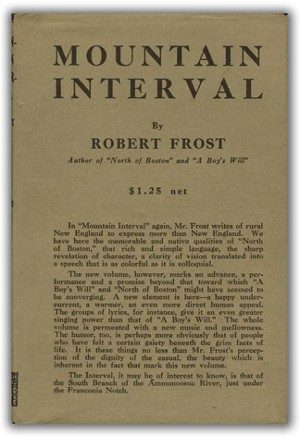
From the bookMountain IntervalFirst-edition dust jacket, Henry Holt, 1916
Analysis
An Old Man's Winter Night: analysis
Introduction
"An Old Man's Winter Night" follows an old man alone in a house through a few small actions. He walks into a room and forgets why. He stands among barrels, clomps away, sits, and falls asleep. A narrator tells this calmly from outside, with the winter dark pressing at the windows.
The poem then steps back and makes a claim: one aged man cannot really keep a house and a farm. If he can, this is how he does it. The poem is about age, solitude and what it means to keep a place, and its final line is dry and respectful at once.
Summary
Lines 1–8. Everything outdoors "looked darkly in at him" through the frost on the window. The lamp in his hand stops his eyes from returning the gaze. He has come to a creaking room and cannot remember why. He stands among barrels, "at a loss".
Lines 9–14. His clomping scares the cellar under him, both on his way there and on his way back. It also scares the "outer night". The night has sounds of its own, such as the roar of trees and the crack of branches. None of them is so like "beating on a box".
Lines 15–22. He now sits somewhere, "concerned with he knew what". He is a light only to himself, "A quiet light, and then not even that". He hands over to the moon the care of his snow on the roof and his icicles on the wall. The moon is late to rise and "broken", but better for this job than the sun.
Lines 23–25. He sleeps. A log shifts in the stove with a jolt. It disturbs him, and he shifts too. His heavy breathing eases, and he sleeps on.
Lines 26–28. The poem then steps back to a general statement. It says one aged man cannot keep a house, a farm or a countryside. It adds that if he can, this is how he does it, "of a winter night".
Themes and meaning
Age appears first as a loss of memory and purpose. Lines 6–7 say plainly what stopped him remembering: it "was age". He stands "at a loss" among barrels, a phrase that fits both his confusion and all that is gone. Even his walking is heavy, a matter of "clomping" and "beating on a box".
Isolation is the plainest fact of the poem. No one else appears, and the frost gathers on the pane in "empty rooms". "A light he was to no one but himself" states this bluntly. The line is metaphor as well as fact. The lamp that lets him see also stops him seeing what looks in.
The poem sets one small human noise against the great night. The night watches him in line 1, yet in lines 9–11 he is the one who frightens it. Its own sounds are "common things", and his are not. This reversal is half a joke. It also suggests how strange a single human sound is in so large a dark.
The key word is "keep". Lines 18–22 treat his snow and icicles as property, handed "to the moon" like goods. The business wording of "consigned" and "charge" is comic for things so slight. Line 26 then says one man "can't keep a house". What he offers in place of keeping is sleep and presence.
The ending is dry, and it is also respectful. A sleeping man keeps nothing, so "thus" has an edge. Yet he is still there, and the place is still, in a sense, held. The phrase "or if he can" lets that concession in. On this reading, keeping a place comes down to staying in it.
Tone
The narrator treats the old man with calm sympathy and some dry humour. Nothing is pitied aloud. The failure of his memory is stated in a flat clause ending "was age". The comedy is gentle: he scares a cellar by clomping, and he hands his icicles over to the moon.
The mood darkens as the light dims. "A quiet light, and then not even that" is the poem's most sombre phrase. Sleep arrives with a plain "And slept".
The last lines shift to a general claim and a firmer voice. The correction "One aged man -- one man" sounds carefully weighed. The phrase "or if he can" concedes something. "It's thus he does it" carries respect and a bleak joke together.
Form and structure
The poem is one stanza of 28 lines, in blank verse. Most lines have 10 syllables, and a few have 11. The metre is iambic pentameter with natural variations of speech. "He stood with barrels round him -- at a loss" keeps the beat and pauses near the end.
The poem does not rhyme. Only three end words return, "him", "was" and "night", and each simply repeats. Many lines run on, so the thought moves across the line ends without a stop. The steady verse suits the plain, careful narration, and it never rises to match the size of the dark outside.
Poetic devices
Personification line 1
All out of doors looked darkly in at him The whole outdoors becomes a single watcher. The opening makes the night a presence before the man has done anything.
Imagery line 2
almost in separate stars Frost crystals on the glass look like a small night sky. The hedge "almost" shows the narrator's exactness.
Pun line 8
at a loss The idiom means confused. Set after the dash, it also suggests how much the man has lost.
Onomatopoeia line 10
In clomping there The heavy word sounds like the boots themselves. Its repeat in line 11 makes the journey feel doubled.
Repetition line 11
and scared the outer night The verb "scared" comes for a third time. Its object jumps from the cellar to the whole night, and the comedy grows with it.
Simile line 14
But nothing so like beating on a box The man's noise is compared to a hollow, pointless sound. The alliterated b words make the blows audible.
Metaphor line 15
A light he was to no one but himself The inverted order puts the light first and the man last. The light helps no one else, which states his solitude.
Understatement line 17
and then not even that The dimming, or the man's own fading, is given in a few small words. The plainness makes it the darkest moment.
Personification line 18
such as she was The moon is called she and spoken of slightingly, like a poor helper given a job. The dry remark keeps the scene from solemnity.
Caesura line 23
And slept. The full stop mid-line stops the long sentence that began at line 18. The pause acts out his falling asleep.
Repetition line 26
One aged man -- one man Dropping the word "aged" strips him to the bare fact of being one. The dashes make the correction audible.
Irony line 28
It's thus he does it The word "thus" points back to a sleeping man as the method of keeping a farm. The claim mocks and respects him at once.
Words worth knowing
consigned
Handed over for safekeeping, as with goods given to a carrier or agent.
charge
A duty or responsibility entrusted to someone. Here it is the care of snow and icicles.
keep
To maintain and look after. It also carries the older sense of guarding a place.
clomping
Walking noisily and heavily.
Context
The poem is number 3 in Mountain Interval (1916). It was Poem of the Day on January 12, 2003.
What readers have said
wayne bailey finds it sad and haunting, and says it is best understood by anyone who has lived in an old wood-frame country house and heard its winter sounds. wayne bailey, 2005
grace mana-ay reads it as a picture of an old man's weary and empty days in the countryside, and admires its sound effects, such as the beating on the box. grace mana-ay, 2005
Stephanie finds loneliness too literal a meaning, and reads the old man's light and the moon as a yin-yang relation of opposites. Stephanie, 2005
It is a sad and haunting poem, an old man living his last days ..alone. The poem may be understood better if you have ever lived in an old wood frame house in the country. The sounds of winter; expansion and contraction of materials, inside an outside create a powerful atmosphere that both repels and attracts you at the same time. The reader is frighten, you want to escape this house and it's lonely occupant. The imagery invoked by the language is brilliant. I'm at a loss to imagine how poeple write like this. Poetry to me is the high ground of literature! If anyone knows where I can purchase this poem in "spoken word" by Robert Frost, please contact me.
grace mana-ayPhilippines
The poem clearly depicts an old man's empty life in the countryside. Being old, he feels wasted. Frost's use of imagery allures readers to imagine how weary and boring an old man's life is. The sound devices are effective! "The roar of trees, crack of branches and beating on the box," fully illustrate some of Frost's creative and vivid images. This poem highlights Frost's sensitivity to nature.
I took notice that the old man is in fact lonely, but that seemed to literal to be the meaning in one of Frost's poems. With a little analyzation I discovered that Frost could possibly be comparing the relationship in the "ying yang"; the remnants of evil in good having a small portion within one another. This is justified through the old man's light and his consignment with the moon on a winters night. The old man can only keep his house on a winter's night because he can't create darkness on a regular (sunny) day- he also has no planet to consign with durring the day except the sun (which isn't dark).. thus he can only complete one half of the ying-yang.
Asma shehzadiPakistan
i have read this poem many times and what i understand about this poem i would like to convey it to all of you.this poem by Frost is one of his best poems..
I took notice that the old man is in fact lonely, but that seemed to literal to be the meaning in one of Frost's poems. With a little analyzation I discovered that Frost could possibly be comparing the relationship in the "ying yang"; the remnants of evil in good having a small portion within one another. This is justified through the old man's light and his consignment with the moon on a winters night. The old man…
Read the whole comment
I took notice that the old man is in fact lonely, but that seemed to literal to be the meaning in one of Frost's poems. With a little analyzation I discovered that Frost could possibly be comparing the relationship in the "ying yang"; the remnants of evil in good having a small portion within one another. This is justified through the old man's light and his consignment with the moon on a winters night. The old man can only keep his house on a winter's night because he can't create darkness on a regular (sunny) day- he also has no planet to consign with durring the day except the sun (which isn't dark).. thus he can only complete one half of the ying-yang.
It is a sad and haunting poem, an old man living his last days ..alone. The poem may be understood better if you have ever lived in an old wood frame house in the country. The sounds of winter; expansion and contraction of materials, inside an outside create a powerful atmosphere that both repels and attracts you at the same time. The reader is frighten, you want to escape this house and it's lonely occupant. The imagery invoked by the language is brilliant. I'm at a loss to imagine how poeple write like this. Poetry to me is the high ground of literature! If anyone knows where I can purchase this poem in "spoken word" by Robert Frost, please contact me.
wayne bailey from
FAIZAPakistan
beautiful poem
this poem is the marvelous poem by frost. in this poem he gives us the picture of the old man in a very impressive way.
It is a sad and haunting poem, an old man living his last days ..alone. The poem may be understood better if you have ever lived in an old wood frame house in the country. The sounds of winter; expansion and contraction of materials, inside an outside create a powerful atmosphere that both repels and attracts you at the same time. The reader is frighten, you want to escape this house and it's lonely occupant. The imagery invoked by the language is brilliant. I'm at a loss to imagine how poeple write like this. Poetry to me is the high ground of literature! If anyone knows where I can purchase this poem in "spoken word" by Robert Frost, please contact me.
The poem clearly depicts an old man's empty life in the countryside. Being old, he feels wasted. Frost's use of imagery allures readers to imagine how weary and boring an old man's life is. The sound devices are effective! "The roar of trees, crack of branches and beating on the box," fully illustrate some of Frost's creative and vivid images. This poem highlights Frost's sensitivity to nature.
I took notice that the old man is in fact lonely, but that seemed to literal to be the meaning in one of Frost's poems. With a little analyzation I discovered that Frost could possibly be comparing the relationship in the "ying yang"; the remnants of evil in good having a small portion within one another. This is justified through the old man's light and his consignment with the moon on a winters night. The old man can only keep his house on a winter's night because he can't create darkness on a regular (sunny) day- he also has no planet to consign with durring the day except the sun (which isn't dark).. thus he can only complete one half of the ying-yang.
i have read this poem many times and what i understand about this poem i would like to convey it to all of you.this poem by Frost is one of his best poems..
I took notice that the old man is in fact lonely, but that seemed to literal to be the meaning in one of Frost's poems. With a little analyzation I discovered that Frost could possibly be comparing the relationship in the "ying yang"; the remnants of evil in good having a small portion within one another. This is justified through the old man's light and his consignment with the moon on a winters night. The old man…
Read the whole commentI took notice that the old man is in fact lonely, but that seemed to literal to be the meaning in one of Frost's poems. With a little analyzation I discovered that Frost could possibly be comparing the relationship in the "ying yang"; the remnants of evil in good having a small portion within one another. This is justified through the old man's light and his consignment with the moon on a winters night. The old man can only keep his house on a winter's night because he can't create darkness on a regular (sunny) day- he also has no planet to consign with durring the day except the sun (which isn't dark).. thus he can only complete one half of the ying-yang.
It is a sad and haunting poem, an old man living his last days ..alone. The poem may be understood better if you have ever lived in an old wood frame house in the country. The sounds of winter; expansion and contraction of materials, inside an outside create a powerful atmosphere that both repels and attracts you at the same time. The reader is frighten, you want to escape this house and it's lonely occupant. The imagery invoked by the language is brilliant. I'm at a loss to imagine how poeple write like this. Poetry to me is the high ground of literature! If anyone knows where I can purchase this poem in "spoken word" by Robert Frost, please contact me.
wayne bailey from
beautiful poem
this poem is the marvelous poem by frost. in this poem he gives us the picture of the old man in a very impressive way.