To Ridgely Torrence
On Last Looking into His 'Hesperides'
I often see flowers from a passing car
That are gone before I can tell what they are.
I want to get out of the train and go back
To see what they were beside the track.
I name all the flowers I am sure they weren't;
Not fireweed loving where woods have burnt--
Not bluebells gracing a tunnel mouth--
Not lupine living on sand and drouth.
Was something brushed across my mind
That no one on earth will ever find?
Heaven gives it glimpses only to those
Not in position to look too close.
✦
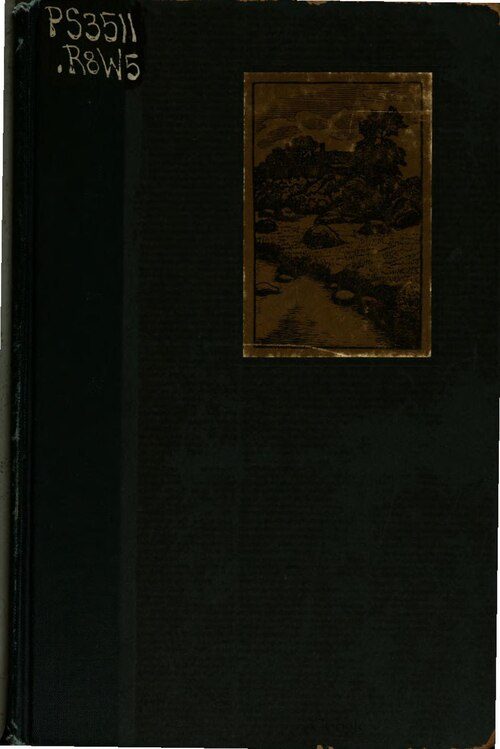
From the bookWest-Running BrookFront cover with pictorial label, Henry Holt, 1928; library copy
Analysis
A Passing Glimpse: analysis
Introduction
A passenger sees flowers from a moving train but cannot identify them before they disappear. The wish to look again becomes a question about experiences that cannot be recovered. What begins as a small failure of observation opens into uncertainty about knowledge itself.
The speaker names familiar flowers only to exclude them. That list brings the scene closer while leaving its central object unknown. The final claim suggests that the conditions preventing a closer look may also make the glimpse possible. The poem leaves that suggestion poised between consolation and frustration.
Summary
An italicized dedication precedes the verse. The speaker begins by describing a repeated experience: seeing flowers from a passing vehicle. They disappear before the speaker can determine their names. The opening therefore describes something noticed but never fully identified.
The speaker wants to leave the train and return to the place beside the track. The next two couplets list flowers that the speaker is certain were not there. Fireweed belongs to burned woodland, bluebells appear near a tunnel mouth, and lupine grows in sandy, dry ground. These possibilities are named and ruled out.
The speaker then asks whether something passed across the mind that nobody on earth will ever find. The question moves beyond the practical possibility of walking back along a railway line. In the final couplet, the speaker says that Heaven gives such glimpses only to people unable to examine them closely. The poem ends with that claim rather than with a return journey or an identified flower.
Themes and meaning
The poem distinguishes recognition from possession. The speaker has seen something but cannot supply a name. The list beginning with "Not fireweed" shows that knowledge is still at work. Familiar species and their habitats can be recalled, yet that knowledge does not recover the fleeting object. Naming what was absent cannot establish what was present.
Movement makes both the encounter and its loss possible. The train carries the speaker past a scene that might otherwise remain unseen. The same motion removes it before inspection can begin. The desire to "go back" is therefore more than curiosity about botany. It can suggest a wish to recover an experience under conditions that have already changed.
The question about something brushing across the mind keeps perception and imagination close together. The uncertain object may be a flower, an impression, or a thought prompted by the flowers. Nothing requires treating it as a definite symbol for a lost person. Its uncertainty is part of the poem's subject.
The last couplet offers an explanation without proving it. Perhaps a glimpse has a value that close examination would alter. Perhaps the claim consoles someone who cannot return. The speaker's earlier frustration prevents the ending from becoming a simple instruction to avoid looking carefully.
Tone
The voice begins conversationally. "I often see flowers" presents the difficulty as an ordinary event rather than an exceptional revelation. The wish to leave the train adds impatience and regret. The speaker wants a practical remedy for a small loss.
The list of rejected flowers sounds more confident, because each name brings a distinct habitat with it. That confidence falters in the question about what no one will ever find. The final couplet adopts a broader, almost proverbial tone. Its certainty exceeds what the preceding questions establish. That gap lets the ending sound either reassuring or wistfully self-persuading.
Form and structure
The verse consists of twelve lines arranged in six rhyming couplets. Two dedication lines precede it in the archive, so numbered references here include those lines. The first verse line is consequently line three. The dedication is not an additional verse stanza.
The rhythm flexes with conversational phrasing, while paired end rhymes give the passage a recurring framework. Each couplet ends a sentence, question, or closely connected unit of thought. The paired rhymes give brief closure to observations that remain unresolved. The final pair turns from the speaker's particular experience to a general claim.
Poetic devices
Enjambment line 3
I often see flowers from a passing car The first line leaves the flowers briefly in view. The following line supplies their disappearance before the speaker can identify them.
Rhyme line 4
That are gone before I can tell what they are. The final word answers car in the preceding line. That formal completion contrasts with the speaker’s incomplete knowledge of the flowers.
Repetition line 7
I name all the flowers I am sure they weren't; The repeated negatives in the following list define the flowers through exclusion. Certainty concerns what they were not, rather than what they were.
Imagery line 8
Not fireweed loving where woods have burnt-- The burned woodland gives a specific habitat to an excluded possibility. The speaker’s knowledge makes the remembered landscape more detailed without resolving it.
Alliteration line 10
Not lupine living on sand and drouth. The repeated initial l sounds connect the plant with its way of living. Sound helps make this rejected identification memorable.
Metaphor line 11
Was something brushed across my mind An impression becomes something that lightly touches a surface. The verb makes the mental encounter seem as fleeting as the passing view.
Rhetorical question line 12
That no one on earth will ever find? The question extends one person’s uncertainty to everyone. It enlarges a missed identification into the possibility of irrecoverable experience.
Paradox line 14
Not in position to look too close. The final condition makes restricted vision the qualification for receiving a glimpse. The obstacle to knowledge becomes part of the encounter’s value.
Words worth knowing
drouth
An older spelling of drought, meaning prolonged dryness.
What readers have said
Amritakripa Minimenon reads the flower as a beautiful past moment that the observer could not fully appreciate at the time. Amritakripa Minimenon, 2020
Mel suggests that close inspection might reveal flaws and destroy the beauty preserved in a first impression. Mel, 2005
Kimberly k connects the wish to return with remembering lost family members. That is the reader’s personal interpretation, rather than a biographical fact supplied by the poem. Kimberly k, 2005
I think this poe is talking about how Robert Frost wants to go back in time and see how his children and his wife were befor they died.I think in his last phrase of the poem he is saying that people doin't appresate thier loved ones untill they are gone. and we only get glipses of what they were like becasue it would be to paiful to get anything more.
i think this poem is great .. i think Robert Frost is trying to tell us how much you should be greatfull of wht u have because you can lose them anytime.. and later you'd wish you could go back..
JessUnited States
this is a great poem. I sugesst it for young readers. I do Not sugest this website though. Ever since i sent this poem to my friends, they all have gotten countless spam, we are sure it was from here. DO NOT USE THIS WEBSITE!
luis ramosUnited States
te mando este poema para desirte gue te guiero mucho con todo mi corazon y espero gue tu tanbien me guieras loi mismo
KimUnited States
I don't know about anyone else, but I thought of love when I read this poem.
MonicaNew Zealand
We are assesing this poem at school; my teacher read it out to us and told us it sounded like the train tracks :)
MelCanada
I think his poem talks about how the first impression of something that's attractive is usually over-glorified and inaccurate, but if we leave our impression as-is, then we can be left with that sense of beauty. However, once we look deep enough, we can soon notice the flaws and forget the beauty which we once saw was. So question is, should we enjoy things the way they are? Or should we go back to critique, only to be disappointed because nothing is perfect?
ishanIndia
passing glimpse
A very nice poem telling us about our own lives. Robert Lee Frost was a name which will always be remembered in English Literature.
apsara pokharelNepal
this poem is very nice poem. when i read this poem first tears were trickled from my eyes. in the remebrance of his best friend he had dedicated this poem to his dead friend. if we try to understand this poem from our heart then we feel happy and sad as well. i
Amritakripa Minimenon
In this poem, Robert Frost explores, among other things, the theme of the amazing beauty of nature. The title mentions the idea of time quickly passing by. In the work, the poet expresses a desire to return, to go back in his life and look closer to a flower he once saw as he quickly passed by. The flower probably is a symbol for a beautiful moment in life that he feels he was not able to fully appreciate at the…
Read the whole comment
In this poem, Robert Frost explores, among other things, the theme of the amazing beauty of nature. The title mentions the idea of time quickly passing by. In the work, the poet expresses a desire to return, to go back in his life and look closer to a flower he once saw as he quickly passed by. The flower probably is a symbol for a beautiful moment in life that he feels he was not able to fully appreciate at the time. It may be a moment in his past to which he would now like to return but knows he can not. He wonders whether all beautiful things are given only to those who can not come close enough to appreciate them fully. The voyage in this poem is to one's past and it really takes place in the mind. This poem is dedicated to Frost’s friend Ridgely Torrence.
yes we all are....this poem is about life and to truly understand you have to connect with it. The main theme is mutability which is relentless change.
I think this poe is talking about how Robert Frost wants to go back in time and see how his children and his wife were befor they died.I think in his last phrase of the poem he is saying that people doin't appresate thier loved ones untill they are gone. and we only get glipses of what they were like becasue it would be to paiful to get anything more.
i think this poem is great .. i think Robert Frost is trying to tell us how much you should be greatfull of wht u have because you can lose them anytime.. and later you'd wish you could go back..
this is a great poem. I sugesst it for young readers. I do Not sugest this website though. Ever since i sent this poem to my friends, they all have gotten countless spam, we are sure it was from here. DO NOT USE THIS WEBSITE!
te mando este poema para desirte gue te guiero mucho con todo mi corazon y espero gue tu tanbien me guieras loi mismo
I don't know about anyone else, but I thought of love when I read this poem.
We are assesing this poem at school; my teacher read it out to us and told us it sounded like the train tracks :)
I think his poem talks about how the first impression of something that's attractive is usually over-glorified and inaccurate, but if we leave our impression as-is, then we can be left with that sense of beauty. However, once we look deep enough, we can soon notice the flaws and forget the beauty which we once saw was. So question is, should we enjoy things the way they are? Or should we go back to critique, only to be disappointed because nothing is perfect?
passing glimpse
A very nice poem telling us about our own lives. Robert Lee Frost was a name which will always be remembered in English Literature.
this poem is very nice poem. when i read this poem first tears were trickled from my eyes. in the remebrance of his best friend he had dedicated this poem to his dead friend. if we try to understand this poem from our heart then we feel happy and sad as well. i
In this poem, Robert Frost explores, among other things, the theme of the amazing beauty of nature. The title mentions the idea of time quickly passing by. In the work, the poet expresses a desire to return, to go back in his life and look closer to a flower he once saw as he quickly passed by. The flower probably is a symbol for a beautiful moment in life that he feels he was not able to fully appreciate at the…
Read the whole commentIn this poem, Robert Frost explores, among other things, the theme of the amazing beauty of nature. The title mentions the idea of time quickly passing by. In the work, the poet expresses a desire to return, to go back in his life and look closer to a flower he once saw as he quickly passed by. The flower probably is a symbol for a beautiful moment in life that he feels he was not able to fully appreciate at the time. It may be a moment in his past to which he would now like to return but knows he can not. He wonders whether all beautiful things are given only to those who can not come close enough to appreciate them fully. The voyage in this poem is to one's past and it really takes place in the mind. This poem is dedicated to Frost’s friend Ridgely Torrence.
Are you from GMA
Please dont reply to that
I am from GMA (GEMS Modern Academy Dubai)
Thnx Amrita
Hi! I'm from California and I'm studying this. I'm 18
This is a weird poem
Are you from India?
I love this poem!
It is my favourite and my daughter loves it too!
Even me!
yes we all are....this poem is about life and to truly understand you have to connect with it. The main theme is mutability which is relentless change.
But what is the theme??
Btw hi amrita, yes she is from GMA
Yes we are, but we dont study in India
I agree! Wait...
This comment was made like 15 years ago...
Woah
This www made before I was born
Hey Amrita
Yea