I have wished a bird would fly away,
And not sing by my house all day;
Have clapped my hands at him from the door
When it seemed as if I could bear no more.
The fault must partly have been in me.
The bird was not to blame for his key.
And of course there must be something wrong
In wanting to silence any song.
✦
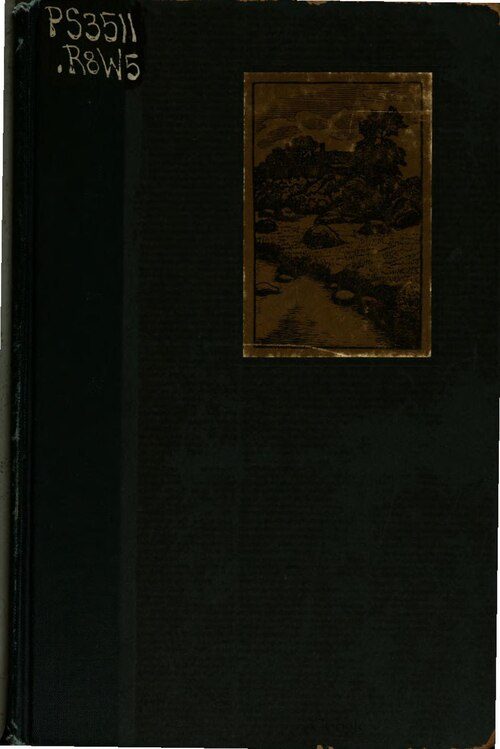
From the bookWest-Running BrookFront cover with pictorial label, Henry Holt, 1928; library copy
Analysis
A Minor Bird: analysis
Introduction
A Minor Bird is a short poem of eight lines in four rhyming couplets. A speaker admits to wishing that a singing bird would go away. The speaker has even clapped at it from the door.
Then the poem turns on itself. The speaker concedes that the fault lay "partly" within, not in the bird. The last couplet widens this into a general rule: there is "something wrong" in wanting to silence "any song". The words are plain, but the title and the word "key" also point to music, where minor names a mode as well as a size.
Summary
The first couplet is a confession. The speaker says, "I have wished a bird would fly away". The wish was that the bird would stop singing near the house. The complaint is that it sang "all day".
The second couplet reports an action. The speaker has "clapped my hands at him from the door". This happened at a moment when the singing seemed too much to bear. The poem does not say whether the bird flew off.
The third couplet turns from action to judgement. The speaker decides that "The fault must partly have been in me." The bird, the speaker says, "was not to blame for his key". The key is the pitch or mode of its song.
The final couplet draws a general conclusion. The speaker says that "of course" something must be wrong in wanting to silence a song. The rule covers "any song", not only this bird's. The poem ends on this statement and does not return to the bird or the house.
Themes and meaning
The first theme is self-examination. The poem moves from irritation to self-judgement. Lines 1–4 record the annoyance and the small act it led to. Line 5 turns the inquiry inward. The word "partly" keeps the admission measured, so the speaker takes some of the blame but not all.
A second theme is the right to sing. The last couplet moves from one bird to "any song". It can be read as a claim that every voice deserves a hearing, liked or not. The phrase "something wrong" stays vague. The speaker names no rule, which leaves readers free to apply it to people, art or speech.
A third theme is nature against human impatience. The bird does only what birds do. It "was not to blame for his key", so its song is its nature, not a choice made to annoy. The speaker stands at the door, a human boundary, and claps at the world outside. The poem can be read as a quiet reproach to that impatience.
A fourth theme lies in the title, where minor can mean small and unimportant. It can also mean a minor key, the mode often heard as sad. The word "key" in line 6 supports the musical reading. On that reading, the speaker may have disliked the song's mood as much as its noise. Either way, a small incident carries a moral weight larger than itself.
Tone
The tone opens as a plain, rueful confession. "I have wished" admits a small unkindness without drama. Line 4 carries real strain, since the speaker could "bear no more". The words "seemed as if" already hint that the feeling was out of proportion.
The third couplet turns reflective and fair. The phrase "must partly have been" is careful, hedged speech. The speaker weighs the case rather than confessing wholesale.
The final couplet sounds calm and a little wry. "And of course" makes the conclusion seem obvious, as if conceded with a sigh. It can be read as gentle self-mockery. It can also be read as a sincere moral. The plain words support both readings.
Form and structure
The poem has 8 lines in 4 stanzas of 2 lines each. Each stanza is a rhymed couplet, so the scheme is AABBCCDD. All four rhymes are full: away and day, door and more, me and key, wrong and song. Lines run from 8 to 10 syllables, and most have nine.
The metre is a loose tetrameter with four main stresses per line. The base is iambic, as in line 2. Other lines add extra unstressed syllables, which gives an anapestic lilt, as in line 4. The steady beat and closed couplets give the poem the neat sound of a short song.
Poetic devices
Rhyming couplet line 2
all day Rhymes with "away" in line 1. The closed couplet makes the complaint sound complete and settled, like the bird's own repeated song.
Ellipsis line 3
Have clapped my hands The subject I is left out and carried over from line 1. The list of admissions runs on, as if the speaker is owning up to one thing after another.
Imagery line 3
clapped my hands at him from the door A concrete, slightly comic picture. The door marks the line between the house and the bird's world outside.
Personification line 3
him The bird is "him", not it. This treats the bird as a person, which prepares for the talk of fault and blame.
Hyperbole line 4
I could bear no more The speaker's strain is overstated for a bird's song. The words "seemed as if" before it quietly admit the exaggeration.
Understatement line 5
must partly have been in me The admission is hedged twice, by "must" and "partly". The speaker concedes fault in a careful, measured way.
Pun line 6
his key Key means the pitch or mode of a song. With the title's minor, it suggests a minor key, a sad-sounding mode, as well as a small bird.
Repetition line 7
there must be something wrong Repeats "must" from line 5. The speaker reasons by inference, reaching conclusions rather than stating certainties.
Alliteration line 8
silence any song The repeated s sound links silence and song. The two opposites are bound together in the closing phrase.
Symbol line 8
any song The bird's song becomes a stand-in for any voice or expression. The word "any" turns one incident into a general rule.
Words worth knowing
key
In music, the pitch or mode in which a song is sung. Here it names the kind of song the bird sings, which it cannot help.
minor
In the title. It means small or unimportant, and also suggests a minor key in music, a mode often heard as sad.
Context
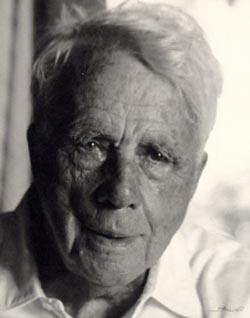
A Minor Bird appeared in West-Running Brook, a collection by Robert Frost (1874–1963) published in 1928. It is the fourteenth poem in that book. Readers left 34 comments on it between 2004 and 2023.
What readers have said
Stephen Rodriguez reads the poem as about freedom of expression: any singer or artist, good or not, has a right to be heard. Stephen Rodriguez, 2010
Isuri reads the bird as a symbol of nature, and the speaker as a busy modern person who finds nature annoying and wasteful. isuri, 2010
Maria finds the poem beautiful but sad, because it reminds her of pushing away people who tried to help her while she was depressed. Maria, 2006
Ranuga reads it as a poem about depression, assumes the clapping drove the bird away, and sees line 5 as the first sign of regret. Ranuga, 2019
Wheaton Griffin reads the poem politically, asking which other minor voices, such as children or marginalised groups, people want to silence. Wheaton Griffin, 2023
Grayson Phillips read it twice, still did not understand it, and so did not like it. grayson phillips, 2010
soy estudiante de ingle, y tengo que presentar un trabajo sobre este poema A minor Bird by Robert Frost. I would like that alguien me ayudara o me dirar informacion sobre el symbolic meaning de este poema. favor cualquier ayuda a la direccion de correa antes mencionada. Se agradece antes del viernes 29 de octubre. muchas gracias
sylvia miscoiUnited States
i think this poem is really interesting because it is basically based on true things it is kind of hard to express in words....
Natalin RectoPhilippines
i love this poem because it exist in our world.
fredNamibia
me like it
ajitCanada
Life goes on but memories linger
MariaSweden
I think it's a very beautiful poem, but sad. It reminds me of when I was depressed and didn't see any happines in anything and pushed people, who tried to help me and make me happy, away.
jenniferUnited States
I think it is a very lovely poem. It shows the beauty of music that one hears.
Ethan TrustyUnited States
This poem touched my heart and soul in a very moving and warming way.
BobbyAustralia
i am beyong amazing...
Anusha NishanthiSri Lanka
Robert Frost is a poet who starts his poems in delight and ends in wisdom and this poem touches our hearts as it reveals the reality of the world. We are always attracted towards the material things than natural things.I loved by reading this wonderful poem
NazeemaSri Lanka
It touches my heart really.Frost reminds me the value of enjoyment with the promises to keep in future.
SueUnited States
Frost's A Minor Bird
I just read this poem in a book on birds. To me, it has meaning that relates to the hopes and dreams we have in our lives and how one must not disparage but respect them. Also, I like the poem just cause its cute and about birds!
ashleyNew Zealand
peepee
this poem sucks
lalith dayanandaSri Lanka
melancholy
This poem is one of the greatest pieces of poetry with which the works of Robert Frost are always associated. Though it is not that much easy to discern the meaning out of this, one can do so if he or she ponder on it. One must read it over and over again to understand the philosophy of the poet that is exactly what eludes us from coming to a satisfactory analysis of this poem which can be accepted by many a…
Read the whole comment
This poem is one of the greatest pieces of poetry with which the works of Robert Frost are always associated. Though it is not that much easy to discern the meaning out of this, one can do so if he or she ponder on it. One must read it over and over again to understand the philosophy of the poet that is exactly what eludes us from coming to a satisfactory analysis of this poem which can be accepted by many a readers. you may have you own idea of this poem. It has to be. One may see it from different point of views. Whatever you may have, you have to prove your comment, that is what is expected in analyzing poetry. Now let me explain how i can perceive the speaker's attitude found in this poem. It's something like he, the speaker is so miserable that he can not see the world any more as he used to be. It may be because he has been depressed and have no hope. He does not seem to be feeling like home. Feelings such as love might make us feel blue that makes us see the world not the same as before. The things found in nature that we normally enjoy seeing, hearing & etc. no longer be so attractive, now you start to hate them that may be because they remind you of the past happenings which you are trying to erase from your mind as soon as posible. You do not like company and you want to be alone, that's why you clap your hand at the bird to chase away it. You are mentally not in a position to appreciate the beauty of nature, even though it is not the fault of nature. You know well, a part of the fault of your behaviour can be attributed to your depression. Then, the rest of the fault must go to whom? Should the blame be placed on nature? No it should go the society in which we live or to your self for not being able to deal with the world. This reminds me the words of Shakespear " Dear Brutes the fault is not in our stars but in our selves" We all are part of nature and inseparable. Animate & inanimate things are closely bound together, we have interact with each other. After all we can not always be happy. Sad & happy moments come in our way. That is what the life is all about. I personally believe the philosophy found in this poem is that truth.
when i first read this poem i really didnt understand it, so i read it again.and i still didnt understand it so therefore i dont really like this poem at all
Stephen RodriguezUnited States
C'mon, people
This poem isn't too hard to understand. It's about freedom of expression and appreciation of the arts. There's this bird that's been singing all day and it's getting on his nerves. He eventually snaps and tries to put an end to the bird's dreadful singing. It's only then that he realizes what he's done. He's put himself before the bird's self-expression and happiness. A bird (or any artist) may not be good at what…
Read the whole comment
This poem isn't too hard to understand. It's about freedom of expression and appreciation of the arts.
There's this bird that's been singing all day and it's getting on his nerves. He eventually snaps and tries to put an end to the bird's dreadful singing. It's only then that he realizes what he's done. He's put himself before the bird's self-expression and happiness.
A bird (or any artist) may not be good at what s/he does, but everyone has a right to self-expression, and as caring human beings, we should show a person appreciation at least for the effort that s/he puts into his/her work.
That's my take. You don't have to agree, but let's at least agree that it's a very beautiful poem.
upekaSri Lanka
comment
good
isuriSri Lanka
insignificant
this poem is not hard to understand but it has many layers of meanings which is very philosophical. he tries to let the common people understand how this minor issue become an annoyance to the modern men like us who are busy with the newly modernized world and have no time to enjoy the nature but finds it very annoying and wasteful. it is just the nature of the bird to sing and the bird simply symbolizes the nature.…
Read the whole comment
this poem is not hard to understand but it has many layers of meanings which is very philosophical. he tries to let the common people understand how this minor issue become an annoyance to the modern men like us who are busy with the newly modernized world and have no time to enjoy the nature but finds it very annoying and wasteful. it is just the nature of the bird to sing and the bird simply symbolizes the nature. the part which he cannot bear the singing of the bird, shows the difference and how the men have changed with the modern world and totally forgets the nature. it is not the fault of the bird whyhe gets annoyed but it is his won fault.this poem mainly says how we have failed to appreciate the nature.
sulaihaSri Lanka
hi
supper it really makes us to think about the nature and creation of it
ManeeshaSri Lanka
English Literature
I think this is very very good poem by Roebert Frost who was a great poet in america.This poem is not hard to understand but it has a very deeper meaning.He tried to let the common people understand how this minor point become a very serious issue.he tried to convince very powerful and meaningful idea in very simple and imaginal way.I also like to the persantation.the persantation is very very nice.I this i love to this poem very much because of the simplysity and powerful meaning.
shenal
love this poem
i love love love this poem very very very much brillint from shenal in srilanka
sreebaIndia
a miner bird
I LIKE THIS POEM. I THINK IT IS VERY GOOD POEM. FROM BANU IN INDIA
JOYIndia
love this poem
ilike very nice.the author used to very simple words.
sheelaIndia
a miner bird
i love this poem. i like its meaning
SamalyaSri Lanka
English
I like this poem.
SamalyaSri Lanka
English
I have wished a bird would fly away And not sing by my house all day Have clapped my hands at him from the door When it seemed as if I could bear no more The fault must be partly have been in me The bird was not to blame for his key And of course there must be something wrong I wanting to silence any song
I like this poem very much. This poem have deep meaning.
Dineth FernandoSri Lanka
English
This poem is a wonderful nature poem that i have read
Ranuga
The theme of this poem to me personally is to do with depression. The person perceives the bird singing as a nuisance and wishes for it to go away where he’ll later come to regret the decision. Have clapped my hands at him from the door when it seemed as if i could bare no more. The person has finally gotten rid of the bird by clapping his hands because he had had enough of it.The fault must partly be in me the bird…
Read the whole comment
The theme of this poem to me personally is to do with depression. The person perceives the bird singing as a nuisance and wishes for it to go away where he’ll later come to regret the decision. Have clapped my hands at him from the door when it seemed as if i could bare no more. The person has finally gotten rid of the bird by clapping his hands because he had had enough of it.The fault must partly be in me the bird was not to blame for his key, this is the first sign of regret shown by the poet. The person would now ponder at first but later on he would come to realize that the fault was in him to silence nature, this reflects upon the last stanza “ and of course there must be something wrong in wanting to silence any song”.
This is of course just how i perceive the poem different mindsets could differ how you would put it as.
what other "minor" bird's songs do we want to stop? Our children's? Native Americans' (say the specific Ghost Dance song - or any of Their" songs)? African American's, Trans children's, or anyone's song other than White heterosexual, God-fearing, Christian, Pledge of Allegiance chanting, Governor Santos-voting, assault weapon-loving, concealed weapon carrying, long-time American.
soy estudiante de ingle, y tengo que presentar un trabajo sobre este poema A minor Bird by Robert Frost. I would like that alguien me ayudara o me dirar informacion sobre el symbolic meaning de este poema. favor cualquier ayuda a la direccion de correa antes mencionada. Se agradece antes del viernes 29 de octubre. muchas gracias
i think this poem is really interesting because it is basically based on true things it is kind of hard to express in words....
i love this poem because it exist in our world.
me like it
Life goes on but memories linger
I think it's a very beautiful poem, but sad. It reminds me of when I was depressed and didn't see any happines in anything and pushed people, who tried to help me and make me happy, away.
I think it is a very lovely poem. It shows the beauty of music that one hears.
This poem touched my heart and soul in a very moving and warming way.
i am beyong amazing...
Robert Frost is a poet who starts his poems in delight and ends in wisdom and this poem touches our hearts as it reveals the reality of the world. We are always attracted towards the material things than natural things.I loved by reading this wonderful poem
It touches my heart really.Frost reminds me the value of enjoyment with the promises to keep in future.
Frost's A Minor Bird
I just read this poem in a book on birds. To me, it has meaning that relates to the hopes and dreams we have in our lives and how one must not disparage but respect them. Also, I like the poem just cause its cute and about birds!
peepee
this poem sucks
melancholy
This poem is one of the greatest pieces of poetry with which the works of Robert Frost are always associated. Though it is not that much easy to discern the meaning out of this, one can do so if he or she ponder on it. One must read it over and over again to understand the philosophy of the poet that is exactly what eludes us from coming to a satisfactory analysis of this poem which can be accepted by many a…
Read the whole commentThis poem is one of the greatest pieces of poetry with which the works of Robert Frost are always associated. Though it is not that much easy to discern the meaning out of this, one can do so if he or she ponder on it. One must read it over and over again to understand the philosophy of the poet that is exactly what eludes us from coming to a satisfactory analysis of this poem which can be accepted by many a readers.
you may have you own idea of this poem. It has to be. One may see it from different point of views. Whatever you may have, you have to prove your comment, that is what is expected in analyzing poetry.
Now let me explain how i can perceive the speaker's attitude found in this poem. It's something like he, the speaker is so miserable that he can not see the world any more as he used to be. It may be because he has been depressed and have no hope. He does not seem to be feeling like home. Feelings such as love might make us feel blue that makes us see the world not the same as before.
The things found in nature that we normally enjoy seeing, hearing & etc. no longer be so attractive, now you start to hate them that may be because they remind you of the past happenings which you are trying to erase from your mind as soon as posible. You do not like company and you want to be alone, that's why you clap your hand at the bird to chase away it. You are mentally not in a position to appreciate the beauty of nature, even though it is not the fault of nature. You know well, a part of the fault of your behaviour can be attributed to your depression. Then, the rest of the fault must go to whom? Should the blame be placed on nature? No it should go the society in which we live or to your self for not being able to deal with the world.
This reminds me the words of Shakespear " Dear Brutes the fault is not in our stars but in our selves"
We all are part of nature and inseparable. Animate & inanimate things are closely bound together, we have interact with each other. After all we can not always be happy. Sad & happy moments come in our way. That is what the life is all about. I personally believe the philosophy found in this poem is that truth.
woah
when i first read this poem i really didnt understand it, so i read it again.and i still didnt understand it so therefore i dont really like this poem at all
C'mon, people
This poem isn't too hard to understand. It's about freedom of expression and appreciation of the arts. There's this bird that's been singing all day and it's getting on his nerves. He eventually snaps and tries to put an end to the bird's dreadful singing. It's only then that he realizes what he's done. He's put himself before the bird's self-expression and happiness. A bird (or any artist) may not be good at what…
Read the whole commentThis poem isn't too hard to understand. It's about freedom of expression and appreciation of the arts.
There's this bird that's been singing all day and it's getting on his nerves. He eventually snaps and tries to put an end to the bird's dreadful singing. It's only then that he realizes what he's done. He's put himself before the bird's self-expression and happiness.
A bird (or any artist) may not be good at what s/he does, but everyone has a right to self-expression, and as caring human beings, we should show a person appreciation at least for the effort that s/he puts into his/her work.
That's my take. You don't have to agree, but let's at least agree that it's a very beautiful poem.
comment
good
insignificant
this poem is not hard to understand but it has many layers of meanings which is very philosophical. he tries to let the common people understand how this minor issue become an annoyance to the modern men like us who are busy with the newly modernized world and have no time to enjoy the nature but finds it very annoying and wasteful. it is just the nature of the bird to sing and the bird simply symbolizes the nature.…
Read the whole commentthis poem is not hard to understand but it has many layers of meanings which is very philosophical. he tries to let the common people understand how this minor issue become an annoyance to the modern men like us who are busy with the newly modernized world and have no time to enjoy the nature but finds it very annoying and wasteful. it is just the nature of the bird to sing and the bird simply symbolizes the nature. the part which he cannot bear the singing of the bird, shows the difference and how the men have changed with the modern world and totally forgets the nature. it is not the fault of the bird whyhe gets annoyed but it is his won fault.this poem mainly says how we have failed to appreciate the nature.
hi
supper it really makes us to think about the nature and creation of it
English Literature
I think this is very very good poem by Roebert Frost who was a great poet in america.This poem is not hard to understand but it has a very deeper meaning.He tried to let the common people understand how this minor point become a very serious issue.he tried to convince very powerful and meaningful idea in very simple and imaginal way.I also
like to the persantation.the persantation is very very nice.I this i love to this poem very much because of the simplysity and powerful meaning.
love this poem
i love love love this poem very very very much brillint
from shenal in srilanka
a miner bird
I LIKE THIS POEM. I THINK IT IS VERY GOOD POEM. FROM BANU IN INDIA
love this poem
ilike very nice.the author used to very simple words.
a miner bird
i love this poem. i like its meaning
English
I like this poem.
English
I have wished a bird would fly away And not sing by my house all day Have clapped my hands at him from the door When it seemed as if I could bear no more The fault must be partly have been in me The bird was not to blame for his key And of course there must be something wrong I wanting to silence any song
sinhala
a minor bird I like this poem .
english literature
cool poem i like this.
litreture
I like this poem very much. This poem have deep meaning.
English
This poem is a wonderful nature poem that i have read
The theme of this poem to me personally is to do with depression. The person perceives the bird singing as a nuisance and wishes for it to go away where he’ll later come to regret the decision. Have clapped my hands at him from the door when it seemed as if i could bare no more. The person has finally gotten rid of the bird by clapping his hands because he had had enough of it.The fault must partly be in me the bird…
Read the whole commentThe theme of this poem to me personally is to do with depression. The person perceives the bird singing as a nuisance and wishes for it to go away where he’ll later come to regret the decision. Have clapped my hands at him from the door when it seemed as if i could bare no more. The person has finally gotten rid of the bird by clapping his hands because he had had enough of it.The fault must partly be in me the bird was not to blame for his key, this is the first sign of regret shown by the poet. The person would now ponder at first but later on he would come to realize that the fault was in him to silence nature, this reflects upon the last stanza “ and of course there must be something wrong in wanting to silence any song”.
This is of course just how i perceive the poem different mindsets could differ how you would put it as.
Such a nice poem to hear wow
I love this poem,it have a lot of meaning
what other "minor" bird's songs do we want to stop? Our children's? Native Americans' (say the specific Ghost Dance song - or any of Their" songs)? African American's, Trans children's, or anyone's song other than White heterosexual, God-fearing, Christian, Pledge of Allegiance chanting, Governor Santos-voting, assault weapon-loving, concealed weapon carrying, long-time American.