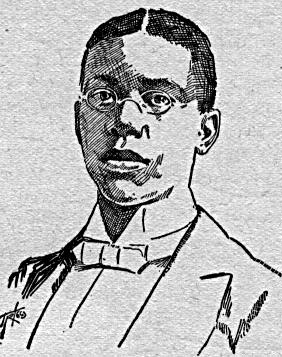
Paul Laurence Dunbar

Portrait of Paul Laurence Dunbar
Paul Laurence Dunbar 1872–1906
1872Born

Paul Laurence Dunbar (June 27, 1872 - February 9, 1906) was a seminal African-American poet in the late 19th and early 20th century. Dunbar gained national recognition for his 1896 Lyrics of a Lowly Life. Born in Dayton, Ohio to parents who had escaped from slavery, Dunbar died from tuberculosis at 34.

Dunbar's father was a veteran of the American Civil War, having served in the 55th Massachusetts Infantry Regiment and the 5th Massachusetts Colored Cavalry Regiment. His parents instilled in him a love of learning and history. He was the only black student at Dayton Central High School, but he participated actively as a student. He wrote his first poem at age 6 and gave his first public recital at age 9. Dunbar's first published work came in a newspaper put out by his high-school friends, Wilbur and Orville Wright, who owned a printing plant. The Wright Brothers later invested in the Dayton Tattler, a newspaper aimed at the black community edited and published by Dunbar.

His first collection of poetry, Oak and Ivy was published in 1892 and attracted the attention of James Whitcomb Riley, the popular "Hoosier Poet". Both Riley and Dunbar wrote poems in both standard English and dialect. His second book, Majors and Minors (1895) brought him national fame and the patronage of William Dean Howells, the novelist and critic and editor of Harper's Weekly. After Howells' praise, his first two books were combined as Lyrics of a Lowly Life and Dunbar started on a career of international literary fame that was cut short by his death.

Read the full biography

He kept a lifelong friendship with the Wrights, and was also closely associated with Frederick Douglass and Booker T. Washington. He was honored with a ceremonial sword by President Theodore Roosevelt.

He wrote a dozen books of poetry, four books of short stories, and five novels and a play. His essays and poems were published widely in the leading journals of the day. During his life, considerable emphasis was laid on the fact that Dunbar was of pure black descent, with no white ancestors.

Reading closely

Analyses

A full analysis sits under 3 of these poems: what each poem says, how it is built and how readers here have read it. About the analyses

  • We Wear the MaskA smiling mask over torn hearts, a debt to guile, and the cry to Christ behind it
  • A Golden DayA love found and lost in one day, kept golden by memory as an endless May

From readers

What readers say about Paul Laurence Dunbar

  1. On Sympathy

    “Dunbar feels that the caged bird sings for not that he is happy, but that he is crying and awaiting to be saved from the torture he has endured for so long. But then my thoughts are, why be sympathetic. Why not instead rescue the caged bird from its depression and conflictions, why must one watch…”

  2. On A Negro Love Song

    “This is a fun piece to work especilly with the youth. The "hook" in this song is "Jump back, honey, jump back!" If presented to a crowd, allowing the "audience" to recite the "hook" in unison creates a lasting impression. It is often requested!”

  3. On The Lawyers' Ways

    “This is a really good poem. It expresses how lawyers can use their words to paint any sort of picture they want about a person. As was said in the poem (though not literaly) the lawyer made the accused appear guilty by saying just the right things, and everyone believed him. Then the other lawyer…”

  4. On We Wear the Mask

    “woow!!! this poem really tuched me.It has been said many times that "you can not judge a book by it's cover" and "do not judge a man untill you have walkd a mile in his shoes." A person may appear one way on the out side but is feeling the opposite on the inside. We waer diffrent mask every day and…”

  5. On A Golden Day

    “Beautiful love poem, of course. Publish it further, by all means. I'd say juxtaposed with "Jump Back" as evidence of the range of Dunbar's talent, sometimes lost on the broader public - as well as the African-American community. But give appropriate attribution, PLEASE!”

  6. On When Malindy Sings

    “This is one of Mr. Dunbar's favorite pieces. I've imagined that Malindy must have had a voice that captured the essence and quality of Mahalia, Patty, Aretha, Gladys, Yolanda, Mary J., Beyonce, Fantasia, Alicia, Celine, Dolly, Barbara Streisand, Whitney and Billie Holiday all rolled up into one!…”

Where readers gather

Most discussed

  1. Sympathy26 comments
  2. We Wear the Mask25 comments
  3. A Golden Day6 comments
  4. A Negro Love Song4 comments
  5. Little Brown Baby4 comments
  6. When Malindy Sings4 comments
  7. The Paradox3 comments
  8. Encouraged2 comments
  9. Life's Tragedy2 comments
  10. Morning2 comments

All 38 poems

Oak and Ivy · 1893 · 1 poem
Lyrics of the Hearthside · 1899 · 1 poem
Other poems · 36