When I was young and bold and strong,
Oh, right was right, and wrong was wrong!
My plume on high, my flag unfurled,
I rode away to right the world.
"Come out, you dogs, and fight!" said I,
And wept there was but once to die.
But I am old; and good and bad
Are woven in a crazy plaid.
I sit and say, "The world is so;
And he is wise who lets it go.
A battle lost, a battle won--
The difference is small, my son."
Inertia rides and riddles me;
The which is called Philosophy.
✦
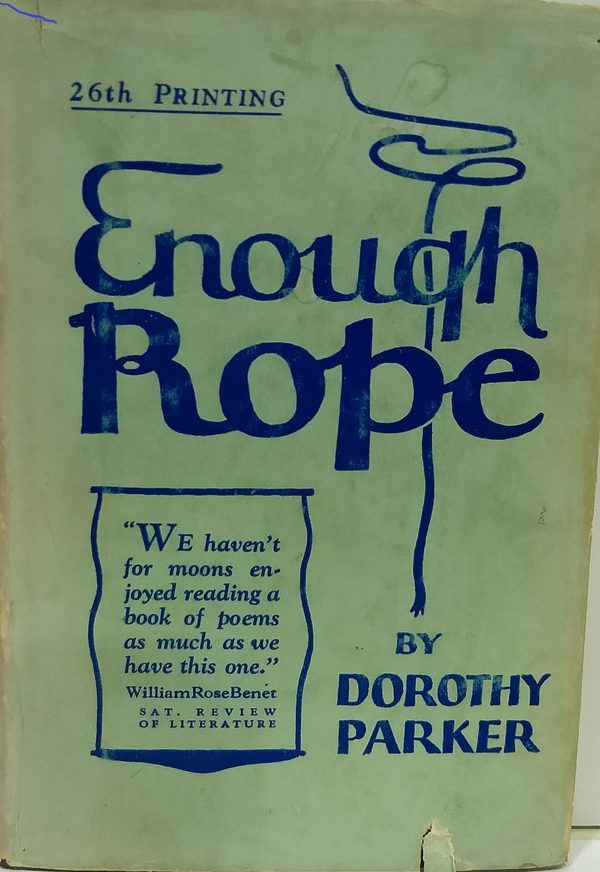
From the bookEnough RopeDust jacket, Boni & Liveright, 1926 design (a later printing)
Analysis
The Veteran: analysis
Introduction
"The Veteran" is a fourteen-line poem in which an old speaker compares youth with age. When young, the speaker saw the world in black and white and rode out to fight for right. Now old, the speaker sees good and bad as tangled and advises letting the world go.
The last couplet delivers the twist. What the speaker has been calling wisdom is really "Inertia," dressed up as "Philosophy." The poem mocks the calm detachment that age likes to present as insight.
Summary
The first stanza looks back to youth. The speaker was "young and bold and strong," and right and wrong were clear. With plume held high and flag unfurled, the speaker "rode away to right the world." The young fighter challenged enemies, "Come out, you dogs, and fight!" The speaker even wept that one could die only once.
The second stanza turns to the present. "But I am old," the speaker says, and good and bad are now woven together "in a crazy plaid." The old speaker sits and says that the world is as it is. The wise man, the speaker says, "lets it go." Winning or losing a battle makes little difference, the speaker tells a listener addressed as "my son."
The closing couplet stands apart. The speaker admits, "Inertia rides and riddles me." The final line adds that this inertia is what is called "Philosophy." The poem ends on that word.
Themes and meaning
The first theme is the change from youth to age. The young speaker is full of certainty, as in "right was right, and wrong was wrong!" The old speaker sees moral questions as a tangle. The two stanzas are built as a matched pair to make the contrast plain.
The second theme is moral complexity. The image of good and bad "woven in a crazy plaid" suggests that the world cannot be sorted neatly. This view has some truth in it. The old speaker's advice, "he is wise who lets it go," sounds calm and mature.
The third theme is self-deception. The final couplet undercuts the old speaker's wisdom. The real cause of the detachment is "Inertia," plain lack of energy. "Philosophy" is only the name given to it. The poem suggests that people may dress up tiredness as insight.
The poem can be read as mocking both ages. The youth is absurdly eager, weeping that "there was but once to die." The old speaker is merely idle. Neither stance comes out as the right one.
Tone
The first stanza has a tone of mock-heroic zeal. The plume, flag and challenge to "you dogs" sound like an old romance of knights. The speaker's youthful ardour is recalled with amused exaggeration.
The second stanza is calm and sage-like. "The world is so" has the weary ring of proverb. The address to "my son" makes the speaker sound like a mentor passing on wisdom.
The closing couplet shifts to dry self-mockery. "Inertia rides and riddles me" is a frank admission. "The which is called Philosophy" has a mock-learned pomposity. The speaker sees through the pose even while holding it. The tone ends ironic but not bitter.
Form and structure
The poem has 14 lines in 3 stanzas, of 6, 6 and 2 lines. Every line has 8 syllables, in regular iambic tetrameter. "I rode away to right the world" shows the steady beat.
The lines rhyme in couplets. The computed scheme ends GH, treating "me" and "Philosophy" as unrhymed. By ear they rhyme on the final syllable, a light rhyme that suits the anticlimax.
The two sestets are built in parallel, youth then age. The short final couplet stands apart like the tail of an epigram. It delivers the ironic verdict on all that came before.
Poetic devices
Polysyndeton line 1
young and bold and strong The repeated "and" piles up youthful qualities. It gives the opening a rush of energy.
Repetition line 2
right was right, and wrong was wrong The tautology shows the young speaker's black-and-white thinking. Nothing needed explaining.
Imagery line 3
My plume on high, my flag unfurled The picture is of a knight or cavalier riding to war. The romantic image makes youthful zeal look theatrical.
Hyperbole line 6
wept there was but once to die The young speaker regrets having only one life to give. The overstatement mocks youthful heroics.
Metaphor line 8
woven in a crazy plaid Good and bad become crossed threads in a fabric. The image says they cannot be pulled apart.
Antithesis line 11
A battle lost, a battle won Opposite outcomes are set side by side as equal. The balance expresses the old speaker's indifference.
Personification line 13
Inertia rides and riddles me Inertia becomes a rider on the speaker's back. The verb "rides" echoes the young speaker who once "rode away."
Pun line 13
riddles It means both to pierce full of holes and to puzzle. Both senses fit a mind worn through and confused.
Irony line 14
The which is called Philosophy A grand name is pinned on mere laziness. The capital letter adds mock dignity.
Words worth knowing
plume
A large feather worn on a helmet or hat, a sign of a knight or soldier.
unfurled
Unrolled and spread out, as a flag is in the wind.
plaid
A cloth woven in a crossing pattern of coloured stripes, like tartan.
Inertia
Resistance to change or action. It also means sluggishness.
riddles
Pierces with many holes, and also puzzles.
which
In "The which is called" the old form means which, or that which.
Context
The poem appears in Dorothy Parker's collection Enough Rope, published in 1926, as number 47 in the book. Parker lived from 1893 to 1967. The poem has been on americanpoems.com since February 2004. Readers left 6 comments on it between 2004 and 2020.
What readers have said
Sandy Cox reads the poem as a tribute to military veterans and thanks them for their sacrifice. Sandy Cox, 2004
Rich Ferguson, a Marine veteran, feels few people understand duty, service, sacrifice and honour. This reader believes the poet did. Rich Ferguson, 2005
Jojo reads the poem as showing the difference between being young and being old. Jojo, 2011
Mason, a veteran, finds in it a lesson learned in service. Life cannot be sorted into neat bins of right and wrong, and the lines between sides blur. Mason, 2020
Thanks for the poem. We are so proud and grateful for our veterans who risks all for our freedom. thank you is not enough but I am very appreciative of your sacrifice. Sandy Cox
Rich FergusonUnited States
I rewrote my resume today. The last item included was: MILITARY United States Marine Corps, Purple Heart It should have been first, but my experience since Vietnam (1969) has been too few people understand or appreciate the concepts duty, service, sacrifice and honor. Dotty Parker did.
JojoUnited Kingdom
the veteran
I think that this poem shows us the differences of being old and young... we have to be wise for our selves, aware our presents....
husnulIndonesia
confusing
i think that it is good, but i get confuse how to paraphrase it... so, please tell me about it
Mason
I am a veteran, and I'm extremely impressed with Ms. Parker's crystallization of one of the most important lessons I have ever learned. In summary, as I served and matured in the Armed Forces, I found that life was not easily separated into nice neat little bins with labels like right, wrong, good, or bad. Often enough, after taking up a cause to right a wrong or because good was battling evil, the lines between the…
Read the whole comment
I am a veteran, and I'm extremely impressed with Ms. Parker's crystallization of one of the most important lessons I have ever learned. In summary, as I served and matured in the Armed Forces, I found that life was not easily separated into nice neat little bins with labels like right, wrong, good, or bad. Often enough, after taking up a cause to right a wrong or because good was battling evil, the lines between the sides were so blurry as to be indistinguishable. Victors and losers were that in name only, with no real difference in the end. Not that I’m jaded: I just got better at determining which battles were worth fighting. I’m sure that when I’m old and grey, trying to pass my life lessons to a future generation, some might scoff and call me an existential philosopher. I rest easy knowing that, eventually, we all get there, one way or another.

I loved this poem you are awsome
Thanks for the poem. We are so proud and grateful for our veterans who risks all for our freedom. thank you is not enough but I am very appreciative of your sacrifice.
Sandy Cox
I rewrote my resume today. The last item included was:
MILITARY United States Marine Corps, Purple Heart
It should have been first, but my experience since Vietnam (1969) has been too few people understand or appreciate the concepts duty, service, sacrifice and honor. Dotty Parker did.
the veteran
I think that this poem shows us the differences of being old and young... we have to be wise for our selves, aware our presents....
confusing
i think that it is good, but i get confuse how to paraphrase it... so, please tell me about it
I am a veteran, and I'm extremely impressed with Ms. Parker's crystallization of one of the most important lessons I have ever learned. In summary, as I served and matured in the Armed Forces, I found that life was not easily separated into nice neat little bins with labels like right, wrong, good, or bad. Often enough, after taking up a cause to right a wrong or because good was battling evil, the lines between the…
Read the whole commentI am a veteran, and I'm extremely impressed with Ms. Parker's crystallization of one of the most important lessons I have ever learned. In summary, as I served and matured in the Armed Forces, I found that life was not easily separated into nice neat little bins with labels like right, wrong, good, or bad. Often enough, after taking up a cause to right a wrong or because good was battling evil, the lines between the sides were so blurry as to be indistinguishable. Victors and losers were that in name only, with no real difference in the end. Not that I’m jaded: I just got better at determining which battles were worth fighting. I’m sure that when I’m old and grey, trying to pass my life lessons to a future generation, some might scoff and call me an existential philosopher. I rest easy knowing that, eventually, we all get there, one way or another.