God fashioned the ship of the world carefully.
With the infinite skill of an All-Master
Made He the hull and the sails,
Held He the rudder
Ready for adjustment.
Erect stood He, scanning His work proudly.
Then -- at fateful time -- a wrong called,
And God turned, heeding.
Lo, the ship, at this opportunity, slipped slyly,
Making cunning noiseless travel down the ways.
So that, forever rudderless, it went upon the seas
Going ridiculous voyages,
Making quaint progress,
Turning as with serious purpose
Before stupid winds.
And there were many in the sky
Who laughed at this thing.
✦
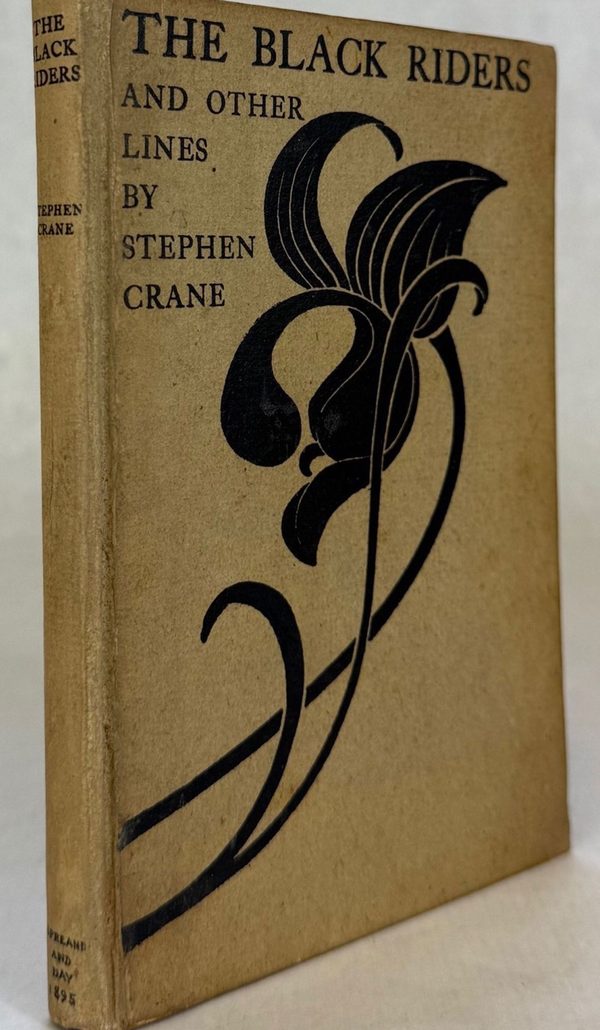
From the bookThe Black Riders & Other LinesFirst edition, Copeland and Day, Boston, 1895; orchid design by Frederic C. Gordon (L. W. Currey)
Analysis
God fashioned the ship of the world carefully.: analysis
Introduction
"God fashioned the ship of the world carefully." is a seventeen-line parable of creation. God builds the world as a ship, with great skill and pride. At the moment of launch he turns away, and the ship slides off without its rudder.
The poem is about a world that drifts without direction. It describes that drift as foolish, and it ends with watchers in the sky laughing. The tone mixes the solemn language of scripture with mockery. Readers disagree whether the target is God, humanity, or the idea of a guided world.
Summary
Lines 1–5 describe the building. God fashions "the ship of the world carefully". He works with "the infinite skill of an All-Master" (line 2). He makes the hull and the sails. He holds the rudder, "Ready for adjustment" (line 5), about to fit it.
In line 6 God stands upright and looks over his work "proudly". Then, "at fateful time", a wrong calls to him (line 7). God turns to attend to it.
In lines 9–10 the ship takes its chance. It slips away "slyly". It makes "cunning noiseless travel down the ways", the slope from which ships are launched. The ship moves by itself, as if it had planned the escape.
Lines 11–15 describe what follows. The ship is now "forever rudderless" (line 11). It goes on "ridiculous voyages" and makes "quaint progress". It turns "as with serious purpose", but only before "stupid winds" (line 15).
The last two lines add an audience. "there were many in the sky / Who laughed at this thing." The poem does not say who these watchers are.
Themes and meaning
A world without guidance. The rudder is the part that steers, and God still holds it when the ship leaves. The world therefore sails "forever rudderless". Its movement looks purposeful but is driven by "stupid winds". The poem pictures a world that only seems to have direction.
A flawed or distracted creator. God is careful, skilled and proud. Yet a single distraction, "a wrong called", is enough to lose the ship. The poem can be read as questioning a God who is all-mastering but not all-attentive. The irony is that the "All-Master" cannot keep hold of his own work.
The world's own will. The ship is given motives. It slips "slyly" and travels with "cunning". This suggests the world escapes on purpose. One reading sees human freedom here, the choice to leave God's control. Another sees rebellion or sin.
The folly of human progress. The ship's journeys are "ridiculous" and its progress "quaint". It turns "as with serious purpose", which marks the purpose as only apparent. The poem mocks activity that takes itself seriously but has no aim.
Mockery from above. The watchers "in the sky" laugh (line 17). They could be angels, gods, or simply observers. Their laughter makes the world's voyage a spectacle of foolishness. It also leaves the reader unsure whether to laugh along or to pity the ship.
Tone
The opening is grand and reverent. The inverted phrases "Made He", "Held He" and "Erect stood He" imitate the style of scripture. God is capitalised and praised as an "All-Master".
The tone shifts at line 7. The dashes around "at fateful time" create suspense. The word "Lo" in line 9 keeps the biblical manner, but what follows is almost comic: a ship sneaking off "slyly".
From line 11 on the tone turns openly mocking. Words like "ridiculous", "quaint" and "stupid" are blunt and belittling. They do not belong to the grand style of the opening. The last line, "Who laughed at this thing", ends the poem on scorn. Calling the world "this thing" is the final belittling touch.
Form and structure
The poem is a single stanza of 17 lines in free verse. The lines vary from 5 to 14 syllables, with no regular metre and no rhyme.
The syntax does much of the shaping. Early lines invert subject and verb, which gives a formal, scriptural sound. The long line 11, the longest in the poem, carries the ship out to sea.
The poem then breaks into short participial phrases: "Going", "Making", "Turning". These describe the drift without ever reaching a main verb of purpose. The last two lines return to plain narrative. The structure moves from building, to distraction, to escape, to aimless voyage, to laughter.
Poetic devices
Extended metaphor line 1
the ship of the world The world is a ship throughout the poem. Hull, sails, rudder and voyage all belong to this one figure.
Inversion line 3
Made He the hull and the sails The verb comes before the subject, in the manner of scripture. It lends the building a solemn, biblical sound.
Symbol line 4
Held He the rudder The rudder stands for guidance or control. God holds it but never fits it, so the world goes unsteered.
Irony line 6
scanning His work proudly God's pride comes just before the loss. The moment of satisfaction sets up the failure.
Personification line 9
slipped slyly The ship acts with cunning, like a creature escaping. It gives the world a will of its own.
Alliteration line 9
slipped slyly The repeated s sounds are soft and sliding. They mimic the ship's quiet escape.
Diction line 12
Going ridiculous voyages The blunt word "ridiculous" breaks the grand style. It signals open mockery of the world's course.
Irony line 14
Turning as with serious purpose The words "as with" show the purpose is only apparent. The ship looks decisive but is steered by wind.
Oxymoron line 13
Making quaint progress Progress is called quaint, which makes it sound small and old-fashioned. The pairing belittles the idea of advance.
Words worth knowing
fashioned
Made or shaped by hand, with care and skill.
All-Master
A coined title for God, meaning master of everything, including all crafts.
heeding
Paying attention, here to the wrong that called.
Lo
An old word meaning look or behold, often used in the Bible to announce something surprising.
ways
In shipbuilding, the sloping timbers down which a newly built ship slides into the water at launch.
quaint
Oddly old-fashioned or curious. Applied to progress it is mocking.
Context
The poem is number 6 in The Black Riders & Other Lines by Stephen Crane (1871–1900). It has been on americanpoems.com since 2004 and was a Poem of the Day on February 2, 2004. Readers have left 28 comments on it, from 2004 to 2024.
What readers have said
Mike read the ship as the world, which God made and then ignored, and saw hostility towards God in the poem. Mike, 2007
Anachronism found it ironic that God still holds the rudder, all-powerful in name yet powerless to steer. Anachronism, 2007
Nikkij argued that God chooses not to steer, so the rudder shows free will and God's greatness rather than failure. Nikkij, 2011
Nikkij also took the laughers in the sky as angels, amused that people fail although God made them greater. nikkij, 2011
Luis Diaz read the poem as arguing that mankind needs God, without whom society is directionless. Luis Diaz, 2024
Grace was unsure whether the poem says we need God or can steer ourselves, since the drift is also called ridiculous. Grace, 2024
The ship must be a metaphor, but what is it to represent? A rebellious teen, perhaps, who has yet to recieve guidance? What is there in life, that which wanders aimlessly? Perhaps this ship is to resemble a greater ideal, who has not yet to be put to use. It simply floats around on peoples minds, and they fail to use it. It has not yet been given direction by the person. But then, who or what would that make God? Is…
Read the whole comment
The ship must be a metaphor, but what is it to represent? A rebellious teen, perhaps, who has yet to recieve guidance? What is there in life, that which wanders aimlessly? Perhaps this ship is to resemble a greater ideal, who has not yet to be put to use. It simply floats around on peoples minds, and they fail to use it. It has not yet been given direction by the person. But then, who or what would that make God? Is God meant to resemble people's minds, in this respect? Perhaps God is only then each and every one of us, in our own minds, and yet our thoughts slip through before we give them direction. And if this aimless thought is to be voiced, why, everyone would laugh at it. So what then is this wrong?
JayceUnited States
And here I was, taking the obvious route and viewing the ship as a metaphor for the world. It's a lot easier than pigeon-holing a meaning into a poet whose style relies heavily on blunt metaphors, but to each their own.
JeremiahSweden
Yes, the ship must be (is) a metaphor for the world, but probably more specific; the western part of the world -- Europe especially. Not that God would fail to rule the world, but many in the west have abandoned God and is now, according to the "God-less" themselves, sailing without a goal.
MikeUnited States
I think the ship is a definite metaphore of the world. It is stating that God made it and ignored it. Then he or angels laughed at it for going in a sinful nature. This poem shows hostility towards God.
lady mystiqueUnited States
I believe that this poem is a metaphor of me, i am imperfect in this world of perfection. i am rudderless in this world of perfect navigation, as these GPS devices guide hopeless wanderers from invisible places just as people claim God guides us. i am left with no GPS or cellular phone i am distant from this world of communication. Civillization is leaving me in its wake, i have no technology therefore in this modern world i am imperfect.
Anachronism
It's very ironic that God still has the rudder. It's as though he has the power to steer the world, but the can't use it. While it says god is all-powerful, an "All-Master" he is also powerless.
Analysis on "God fashioned the ship of the world carefully."
This poem unquestionably metaphorically represent the ship as the world God had created. The main idea the author is trying to imply is that God had created and then lost control of His creation, and now laughs at the chaos of the world. This idea is however completely contradictory to the Scripture regarding His creation...
NikkijUnited States
Yes I believe the ship represents the world God has created, and the fact that he holds the rudder but CHOOSES not to use it and lets us go our own paths and have free will and make our own choices shows how great he is. He is all powerful but he lets us decide our fates if we are to follow him or let ourselves stay lost at sea.
nikkijUnited States
Those who laughed from the sky I think are the angels, because it is said that God made us to be greater than his angels, and because we fail and falter at many things and go astray they laugh at us and how God could think we are better than them.
In his defiant poem "God Fashioned the Ship of the World Carefully" Stephen Crane utilizes imagery to argue that society has gone past the word of God because of his carelessness. Crane uses the imagery of a ship in the ocean as the lives of society going through God’s path. At the single chance humanity had in the blind eye of God, they “slipped slyly” to achieve their own wants and desires which was because God decided to not focus on his creation. The way humanity deviated from the correct path only to make “quaint progress” is almost laughable to others. In Crane’s eyes, the creation of God has not only been tainted but also changed due to his mistake of trusting the idea of humanity.
Paris
In his introspective poem” God Fashioned the Ship of the World Carefully” Stephen Crane utilized imagery and metaphors to declare that the correlation between God & Man is complicated and fraught with a lack of understanding. Crane portrays God as a meticulous creator, making the world with care, but the poem emphasizes that the man is the one that navigates the “Ship” through life’s turmoil waters without fully…
Read the whole comment
In his introspective poem” God Fashioned the Ship of the World Carefully” Stephen Crane utilized imagery and metaphors to declare that the correlation between God & Man is complicated and fraught with a lack of understanding. Crane portrays God as a meticulous creator, making the world with care, but the poem emphasizes that the man is the one that navigates the “Ship” through life’s turmoil waters without fully understanding the creator’s godly intention. Crane used imagery of the sea and the ship to show the idea of life journey, with God as the ship builder and Man as the sailor. The Man is seem to be questioning and challenging the creator’s design/plan, showing the tension and disconnection between humanity perception and god’s motive. This is emphasize by the tone of the poem. The poem also reflects on the complex compromises of trust, doubt and looking for meaning in the human-divine life relationship.
Hector Benavides
In his evocative poem "God Fashioned the Ship of the World Carefully," Stephen Crane utilizes imagery to argue that the relationship between God and Man is marked by a blend of reverence and insignificance. The poem opens with a bold assertion: "God fashioned the ship of the world carefully." Here, Crane employs personification to attribute the act of creation to God, portraying Him as a meticulous creator. This…
Read the whole comment
In his evocative poem "God Fashioned the Ship of the World Carefully," Stephen Crane utilizes imagery to argue that the relationship between God and Man is marked by a blend of reverence and insignificance. The poem opens with a bold assertion: "God fashioned the ship of the world carefully." Here, Crane employs personification to attribute the act of creation to God, portraying Him as a meticulous creator. This portrayal conveys a sense of divine mastery and purpose, suggesting that every aspect of existence is intricately designed by God. Crane's use of the ship metaphor symbolizes the journey of life and the human experience. The ship, representing the world, sails through the vast expanse of existence, encountering both calm seas and stormy waters. This reflects the complexities and challenges of human existence as individuals navigate the unpredictable course of life.
Luis Diaz
In his story-like poem "God Fashioned the Ship of the World Carefully," Stephen Crane utilizes extended metaphors, hyperbatons, and symbolism to argue that mankind needs God in their life or else society is left directionless, fooled by the devil's false promises of progress, freedom, and happiness. Crane uses the “ship” as an extended metaphor for mankind. God is the “All-Master” who created this ship (mankind)…
Read the whole comment
In his story-like poem "God Fashioned the Ship of the World Carefully," Stephen Crane utilizes extended metaphors, hyperbatons, and symbolism to argue that mankind needs God in their life or else society is left directionless, fooled by the devil's false promises of progress, freedom, and happiness. Crane uses the “ship” as an extended metaphor for mankind. God is the “All-Master” who created this ship (mankind) perfectly and “proudly.” It is important to note Crane’s use of hyperbatons, like in the line “Held He the rudder,” in which he inverts the words purposely to emphasize that it was “He” (God) who sailed the ship “carefully.” I believe that Crane's word choice is meant to highlight his belief that society is best when it has God in its stead. Crane reveals that, at least to him, God's ways lead to good destinations. Furthermore, the rudder represents people's interest in religion and God. However, Crane illustrates people's disinterest in God as the ship is left “rudderless.” It was not until God let the ship “slip” that the ship went on "ridiculous”, "quaint”, and “stupid” voyages. Put differently, Crane attempts to convey that without God at the forefront of our lives, mankind is left with directness. However, Crane humbles and ridicules society for its foolishness. We are this ship that turns “as with serious purpose.” We are fooled that we can be the gods of our lives, but we truly find that it destroys us. Although we might think we do not need God and that he is useless, we are left unfulfilled and unhappy, tricked by the devil.
In his unmitigated poem “God Fashioned the Ship of the world carefully” Stephen Crane utilizes the imagery of the boat to symbolize that there is not always a perfect path in life. A “stupid wind” can get in your way and affect your trajectory of life. Everything might be perfect except for that road block that gets in the way. We are in a ship that will encounter different obstacles, it is up to us to over come those obstacles. Crane uses words like “cunning” and “heeding” to emphasize that if you really wanted you you would be able to get over anything and continue with your perfect path.
In his biblically inspired poem "God Fashioned the Ship of the World Carefully Stephen Crane utilizes an extended metaphor of a ship to compare the world to a ship that has been carefully crafted by God. The ship is mainly representing the world, and it's a symbol of the complex and interconnected nature of life. In the poem, the line "God fashioned the ship of the world carefully" implies that the ship was created with a purpose and to suggest that God took great care into creating the world.
Mia
In his reflective poem, "God Fashioned the Ship of the World Carefully," Stephen Crane uses vivid imagery and metaphor to show how God created the world meticulously but then allowed it to drift aimlessly due to human mistakes, revealing a complex relationship between God and humanity. This reveals a complex dynamic where God's initial pride in creation is overshadowed by a subsequent detachment, allowing for human error and aimlessness.
Joseph Mata
In his allegorical and premeditated poem,”God Fashioned the Ship of the World Carefully”, Stephen Crane utilizes a metaphor of the ship, irony, and the symbolism of the boat parts to describe that even though it is thought that god created a perfect universe and he is above it, what is often overlooked is that it still required a process. God himself had attempted to create a ship “carefully, with the infinite skill…
Read the whole comment
In his allegorical and premeditated poem,”God Fashioned the Ship of the World Carefully”, Stephen Crane utilizes a metaphor of the ship, irony, and the symbolism of the boat parts to describe that even though it is thought that god created a perfect universe and he is above it, what is often overlooked is that it still required a process. God himself had attempted to create a ship “carefully, with the infinite skill of an All-Master” putting all the parts such as the rudder, the sail, and the hull. These parts of a ship are fairly important and can be seen as a sort of symbol considering that this boat is supposed to be the universe. The rudder is supposed to be what steers the ship, the sail is what helps it move with the help of the wind and finally the hull is what maintains all the objects within the ship. The symbolism is that the universe is still at the will of a natural power that can be indeterminate which is why at around the end of the poem he states,”forever rudderless, it went upon the seas going on ridiculous voyages. Making quaint progress, turning as with serious purpose”. The poem also has some parts of irony because the point of a boat is to travel to a destined location but in this case it isn’t going to a desired destination it is going to a fateful one. It is not determined by the person themselves but by what happens throughout the journey
In his thought-provoking poem "God Fashioned the Ship of the World Carefully," Stephen Crane utilizes imagery to argue that God is leaving humanity to their own devices. He has already built the ship for us to live in before turning around and leaving us to fend for ourselves. We're allowed to travel wherever we want, but without God, we're directionless and just wander.
janelle
In his contemplative poem “God fashioned the Ship of the World carefully” Stephen Crane utilizes allusion like biblical stories to argue the complex relationship between God and man. In his poem he references the bible and how God created the world. He mentions “making cunning noises… so that, forever rudderless, it went upon the seas.” By mentioning rudderless it gives us the notion on how humans don’t know what to do and are adrift in their own lives. The complex relationship between God and man is that man whines about their troubles but doesn't praise the god making it a trouble relationship.
In his ruminate, symbolic poem "God Fashioned the Ship of the World Carefully" Stephen Crane utilizes a extensive methaphor to argue that the ship is the juxtaposition of the world being carried away from the control of the God. It appeals to our eye seen the rudder being destroyed and the boat without a destination "going ridiculous voyages" through "stupid winds" to the arrival of an end. The ship is humanity betrying the creator by blasting the world's nature and the essense of our creation. "There are many in the sky who laughed" because we where god's greater creation but at the end humans prove to be inferior than an angel.
In his intricate poem “God Fashioned the Ship of the World Carefully” Stephen Crane utilizes metaphors to argue that the relationship between God and men is not only complex but carefully crafted to be unique form soul to soul. Crane states, “God fashioned the ship of the world carefully, with the infinite skill of an All-Master, made he the hull and the sails,”. To suggest that Gods magnificent creation of human…
Read the whole comment
In his intricate poem “God Fashioned the Ship of the World Carefully” Stephen Crane utilizes metaphors to argue that the relationship between God and men is not only complex but carefully crafted to be unique form soul to soul. Crane states, “God fashioned the ship of the world carefully, with the infinite skill of an All-Master, made he the hull and the sails,”. To suggest that Gods magnificent creation of human life, as mighty ships meant for grand voyages. However, he also states, “ Making cunning noiseless travel down the ways, going ridiculous voyages, before stupid winds.” To emphasize how we choose to use our mighty ships not for greatness but instead venture into treacherous waters. Since God created us in his image to do grand things, and to be better than the angels in the sky. Yet they laugh at us and God for thinking theses foolish creatures could possibly be better than them. Crane writes, “ and there were many in the sky who laughed at this thing.” but he also states how God carefully created this world and gave us free will to choose our paths, “held he the rudder, ready for adjustment, then at fateful time a wrong called, and God turned heeding, slipped slyly, forever rudderless it went upon the seas.” God all knowingly gave us free will intentionally because he knew that yes many will fail but just as many will triumph. Leaving the relationship between him and us to be, to each it’s own.
I feel as if the poem is positing the blasphemous thought that we do not require God or some great authority "in the sky" to dictate or direct our lives since we are capable of navigating life's problems and discovering meaning on our own. However, at the same time, Crane also seems to be saying that, without God, we are led by what we think are "serious purpose[s]" which result in "ridiculous voyages and [make] quaint progress" in the world. I am not sure whether Crane is saying we need or don't need guidance.
extremely funny
The ship must be a metaphor, but what is it to represent? A rebellious teen, perhaps, who has yet to recieve guidance? What is there in life, that which wanders aimlessly? Perhaps this ship is to resemble a greater ideal, who has not yet to be put to use. It simply floats around on peoples minds, and they fail to use it. It has not yet been given direction by the person. But then, who or what would that make God? Is…
Read the whole commentThe ship must be a metaphor, but what is it to represent? A rebellious teen, perhaps, who has yet to recieve guidance? What is there in life, that which wanders aimlessly? Perhaps this ship is to resemble a greater ideal, who has not yet to be put to use. It simply floats around on peoples minds, and they fail to use it. It has not yet been given direction by the person. But then, who or what would that make God? Is God meant to resemble people's minds, in this respect? Perhaps God is only then each and every one of us, in our own minds, and yet our thoughts slip through before we give them direction. And if this aimless thought is to be voiced, why, everyone would laugh at it. So what then is this wrong?
And here I was, taking the obvious route and viewing the ship as a metaphor for the world. It's a lot easier than pigeon-holing a meaning into a poet whose style relies heavily on blunt metaphors, but to each their own.
Yes, the ship must be (is) a metaphor for the world, but probably more specific; the western part of the world -- Europe especially. Not that God would fail to rule the world, but many in the west have abandoned God and is now, according to the "God-less" themselves, sailing without a goal.
I think the ship is a definite metaphore of the world. It is stating that God made it and ignored it. Then he or angels laughed at it for going in a sinful nature. This poem shows hostility towards God.
I believe that this poem is a metaphor of me, i am imperfect in this world of perfection. i am rudderless in this world of perfect navigation, as these GPS devices guide hopeless wanderers from invisible places just as people claim God guides us. i am left with no GPS or cellular phone i am distant from this world of communication. Civillization is leaving me in its wake, i have no technology therefore in this modern world i am imperfect.
It's very ironic that God still has the rudder. It's as though he has the power to steer the world, but the can't use it. While it says god is all-powerful, an "All-Master" he is also powerless.
Analysis on "God fashioned the ship of the world carefully."
This poem unquestionably metaphorically represent the ship as the world God had created. The main idea the author is trying to imply is that God had created and then lost control of His creation, and now laughs at the chaos of the world. This idea is however completely contradictory to the Scripture regarding His creation...
Yes I believe the ship represents the world God has created, and the fact that he holds the rudder but CHOOSES not to use it and lets us go our own paths and have free will and make our own choices shows how great he is. He is all powerful but he lets us decide our fates if we are to follow him or let ourselves stay lost at sea.
Those who laughed from the sky I think are the angels, because it is said that God made us to be greater than his angels, and because we fail and falter at many things and go astray they laugh at us and how God could think we are better than them.
i think our ship is broken
Ok blue monkey that gotta be the most cringe thing I have ever heard
and it has only gotten worse
Yippee we be sinkin
This poem is one of my favorites
In his defiant poem "God Fashioned the Ship of the World Carefully" Stephen Crane utilizes imagery to argue that society has gone past the word of God because of his carelessness. Crane uses the imagery of a ship in the ocean as the lives of society going through God’s path. At the single chance humanity had in the blind eye of God, they “slipped slyly” to achieve their own wants and desires which was because God decided to not focus on his creation. The way humanity deviated from the correct path only to make “quaint progress” is almost laughable to others. In Crane’s eyes, the creation of God has not only been tainted but also changed due to his mistake of trusting the idea of humanity.
In his introspective poem” God Fashioned the Ship of the World Carefully” Stephen Crane utilized imagery and metaphors to declare that the correlation between God & Man is complicated and fraught with a lack of understanding. Crane portrays God as a meticulous creator, making the world with care, but the poem emphasizes that the man is the one that navigates the “Ship” through life’s turmoil waters without fully…
Read the whole commentIn his introspective poem” God Fashioned the Ship of the World Carefully” Stephen Crane utilized imagery and metaphors to declare that the correlation between God & Man is complicated and fraught with a lack of understanding. Crane portrays God as a meticulous creator, making the world with care, but the poem emphasizes that the man is the one that navigates the “Ship” through life’s turmoil waters without fully understanding the creator’s godly intention. Crane used imagery of the sea and the ship to show the idea of life journey, with God as the ship builder and Man as the sailor. The Man is seem to be questioning and challenging the creator’s design/plan, showing the tension and disconnection between humanity perception and god’s motive. This is emphasize by the tone of the poem. The poem also reflects on the complex compromises of trust, doubt and looking for meaning in the human-divine life relationship.
In his evocative poem "God Fashioned the Ship of the World Carefully," Stephen Crane utilizes imagery to argue that the relationship between God and Man is marked by a blend of reverence and insignificance. The poem opens with a bold assertion: "God fashioned the ship of the world carefully." Here, Crane employs personification to attribute the act of creation to God, portraying Him as a meticulous creator. This…
Read the whole commentIn his evocative poem "God Fashioned the Ship of the World Carefully," Stephen Crane utilizes imagery to argue that the relationship between God and Man is marked by a blend of reverence and insignificance. The poem opens with a bold assertion: "God fashioned the ship of the world carefully." Here, Crane employs personification to attribute the act of creation to God, portraying Him as a meticulous creator. This portrayal conveys a sense of divine mastery and purpose, suggesting that every aspect of existence is intricately designed by God. Crane's use of the ship metaphor symbolizes the journey of life and the human experience. The ship, representing the world, sails through the vast expanse of existence, encountering both calm seas and stormy waters. This reflects the complexities and challenges of human existence as individuals navigate the unpredictable course of life.
In his story-like poem "God Fashioned the Ship of the World Carefully," Stephen Crane utilizes extended metaphors, hyperbatons, and symbolism to argue that mankind needs God in their life or else society is left directionless, fooled by the devil's false promises of progress, freedom, and happiness. Crane uses the “ship” as an extended metaphor for mankind. God is the “All-Master” who created this ship (mankind)…
Read the whole commentIn his story-like poem "God Fashioned the Ship of the World Carefully," Stephen Crane utilizes extended metaphors, hyperbatons, and symbolism to argue that mankind needs God in their life or else society is left directionless, fooled by the devil's false promises of progress, freedom, and happiness. Crane uses the “ship” as an extended metaphor for mankind. God is the “All-Master” who created this ship (mankind) perfectly and “proudly.” It is important to note Crane’s use of hyperbatons, like in the line “Held He the rudder,” in which he inverts the words purposely to emphasize that it was “He” (God) who sailed the ship “carefully.” I believe that Crane's word choice is meant to highlight his belief that society is best when it has God in its stead. Crane reveals that, at least to him, God's ways lead to good destinations. Furthermore, the rudder represents people's interest in religion and God. However, Crane illustrates people's disinterest in God as the ship is left “rudderless.” It was not until God let the ship “slip” that the ship went on "ridiculous”, "quaint”, and “stupid” voyages. Put differently, Crane attempts to convey that without God at the forefront of our lives, mankind is left with directness. However, Crane humbles and ridicules society for its foolishness. We are this ship that turns “as with serious purpose.” We are fooled that we can be the gods of our lives, but we truly find that it destroys us. Although we might think we do not need God and that he is useless, we are left unfulfilled and unhappy, tricked by the devil.
In his unmitigated poem “God Fashioned the Ship of the world carefully” Stephen Crane utilizes the imagery of the boat to symbolize that there is not always a perfect path in life. A “stupid wind” can get in your way and affect your trajectory of life. Everything might be perfect except for that road block that gets in the way. We are in a ship that will encounter different obstacles, it is up to us to over come those obstacles. Crane uses words like “cunning” and “heeding” to emphasize that if you really wanted you you would be able to get over anything and continue with your perfect path.
In his biblically inspired poem "God Fashioned the Ship of the World Carefully Stephen Crane utilizes an extended metaphor of a ship to compare the world to a ship that has been carefully crafted by God. The ship is mainly representing the world, and it's a symbol of the complex and interconnected nature of life. In the poem, the line "God fashioned the ship of the world carefully" implies that the ship was created with a purpose and to suggest that God took great care into creating the world.
In his reflective poem, "God Fashioned the Ship of the World Carefully," Stephen Crane uses vivid imagery and metaphor to show how God created the world meticulously but then allowed it to drift aimlessly due to human mistakes, revealing a complex relationship between God and humanity. This reveals a complex dynamic where God's initial pride in creation is overshadowed by a subsequent detachment, allowing for human error and aimlessness.
In his allegorical and premeditated poem,”God Fashioned the Ship of the World Carefully”, Stephen Crane utilizes a metaphor of the ship, irony, and the symbolism of the boat parts to describe that even though it is thought that god created a perfect universe and he is above it, what is often overlooked is that it still required a process. God himself had attempted to create a ship “carefully, with the infinite skill…
Read the whole commentIn his allegorical and premeditated poem,”God Fashioned the Ship of the World Carefully”, Stephen Crane utilizes a metaphor of the ship, irony, and the symbolism of the boat parts to describe that even though it is thought that god created a perfect universe and he is above it, what is often overlooked is that it still required a process. God himself had attempted to create a ship “carefully, with the infinite skill of an All-Master” putting all the parts such as the rudder, the sail, and the hull. These parts of a ship are fairly important and can be seen as a sort of symbol considering that this boat is supposed to be the universe. The rudder is supposed to be what steers the ship, the sail is what helps it move with the help of the wind and finally the hull is what maintains all the objects within the ship. The symbolism is that the universe is still at the will of a natural power that can be indeterminate which is why at around the end of the poem he states,”forever rudderless, it went upon the seas going on ridiculous voyages. Making quaint progress, turning as with serious purpose”. The poem also has some parts of irony because the point of a boat is to travel to a destined location but in this case it isn’t going to a desired destination it is going to a fateful one. It is not determined by the person themselves but by what happens throughout the journey
In his thought-provoking poem "God Fashioned the Ship of the World Carefully," Stephen Crane utilizes imagery to argue that God is leaving humanity to their own devices. He has already built the ship for us to live in before turning around and leaving us to fend for ourselves. We're allowed to travel wherever we want, but without God, we're directionless and just wander.
In his contemplative poem “God fashioned the Ship of the World carefully” Stephen Crane utilizes allusion like biblical stories to argue the complex relationship between God and man. In his poem he references the bible and how God created the world. He mentions “making cunning noises… so that, forever rudderless, it went upon the seas.” By mentioning rudderless it gives us the notion on how humans don’t know what to do and are adrift in their own lives. The complex relationship between God and man is that man whines about their troubles but doesn't praise the god making it a trouble relationship.
In his ruminate, symbolic poem "God Fashioned the Ship of the World Carefully" Stephen Crane utilizes a extensive methaphor to argue that the ship is the juxtaposition of the world being carried away from the control of the God. It appeals to our eye seen the rudder being destroyed and the boat without a destination "going ridiculous voyages" through "stupid winds" to the arrival of an end. The ship is humanity betrying the creator by blasting the world's nature and the essense of our creation. "There are many in the sky who laughed" because we where god's greater creation but at the end humans prove to be inferior than an angel.
In his intricate poem “God Fashioned the Ship of the World Carefully” Stephen Crane utilizes metaphors to argue that the relationship between God and men is not only complex but carefully crafted to be unique form soul to soul. Crane states, “God fashioned the ship of the world carefully, with the infinite skill of an All-Master, made he the hull and the sails,”. To suggest that Gods magnificent creation of human…
Read the whole commentIn his intricate poem “God Fashioned the Ship of the World Carefully” Stephen Crane utilizes metaphors to argue that the relationship between God and men is not only complex but carefully crafted to be unique form soul to soul. Crane states, “God fashioned the ship of the world carefully, with the infinite skill of an All-Master, made he the hull and the sails,”. To suggest that Gods magnificent creation of human life, as mighty ships meant for grand voyages. However, he also states, “ Making cunning noiseless travel down the ways, going ridiculous voyages, before stupid winds.” To emphasize how we choose to use our mighty ships not for greatness but instead venture into treacherous waters. Since God created us in his image to do grand things, and to be better than the angels in the sky. Yet they laugh at us and God for thinking theses foolish creatures could possibly be better than them. Crane writes, “ and there were many in the sky who laughed at this thing.” but he also states how God carefully created this world and gave us free will to choose our paths, “held he the rudder, ready for adjustment, then at fateful time a wrong called, and God turned heeding, slipped slyly, forever rudderless it went upon the seas.” God all knowingly gave us free will intentionally because he knew that yes many will fail but just as many will triumph. Leaving the relationship between him and us to be, to each it’s own.
I feel as if the poem is positing the blasphemous thought that we do not require God or some great authority "in the sky" to dictate or direct our lives since we are capable of navigating life's problems and discovering meaning on our own. However, at the same time, Crane also seems to be saying that, without God, we are led by what we think are "serious purpose[s]" which result in "ridiculous voyages and [make] quaint progress" in the world. I am not sure whether Crane is saying we need or don't need guidance.