The poem
Black riders came from the sea. There was clang and clang of spear and shield, And clash and clash of hoof and heel, Wild shouts and the wave of hair In the rush upon the wind: Thus the ride of sin.
The poem
Black riders came from the sea. There was clang and clang of spear and shield, And clash and clash of hoof and heel, Wild shouts and the wave of hair In the rush upon the wind: Thus the ride of sin.
"Black riders came from the sea." is a six-line poem that describes a charge of dark horsemen. Five lines build a scene of noise and speed. The sixth line names what the scene is: "the ride of sin."
The poem works as an allegory. It gives sin the body of a raiding army that rises out of the sea. Most of its force comes from sound, through repeated words and hard consonants. It never says who the riders are or whom they attack.
Line 1 states the event in one plain sentence. "Black riders came from the sea." The line gives who, what and where, and nothing more. It uses the past tense, as if reporting something already seen.
Lines 2–3 describe the noise of the charge. There is "clang and clang of spear and shield". There is "clash and clash of hoof and heel". Weapons strike and horses' feet pound. Each line pairs a doubled sound with a pair of objects.
Lines 4–5 turn from sound to sight and motion. The poem gives "Wild shouts and the wave of hair", moving "In the rush upon the wind". The riders' hair streams as they go. The colon at the end of line 5 signals that an explanation follows.
Line 6 gives it. "Thus the ride of sin." The whole charge is named as sin in motion. The poem ends at once, without saying where the riders go or whom they reach.
Sin as an invading force. The last line turns the scene into allegory. Sin is not shown as a quiet temptation. It is a violent army that arrives from outside, loud and fast. The word "Thus" asks the reader to read everything before it as a picture of sin.
Violence and war. The imagery is military: "spear and shield", horses, a charge. The poem presents sin through the language of battle. Some readers take the poem as being about war itself, and about how each side sees the enemy as sinful.
The sea as a source. The riders come "from the sea" (line 1). The sea is vast and hard to see into. It can suggest the unknown or the depths of the mind. It can also suggest a literal landing by raiders or invaders. The poem does not decide.
Wildness and loss of control. The riders give "Wild shouts" and their hair waves "In the rush upon the wind". Nothing about them is ordered or calm. Sin appears as abandon, a surge of energy with no restraint.
The colour black. The riders are "Black", and the colour is set beside sin in the last line. This uses an old association of darkness with evil. Some readers object to that association. Others read it as the colour of night, armour or mystery.
The tone is urgent and ominous. The poem opens with a flat statement, then speeds up into noise. There is no pause for comment until the end.
The middle lines are loud. The doubled words "clang and clang" and "clash and clash" imitate the din of battle. The pace quickens with "rush" and "wind".
The last line changes the tone. It is short and quiet, and it judges. "Thus the ride of sin" sounds like a preacher's summing up after a vision. The speaker stands outside the scene and names it. That shift from noise to verdict gives the poem a solemn, warning close.
The poem is a single stanza of 6 lines. The lines run from 5 to 9 syllables. There is no rhyme.
There is a strong beat, though not a strict metre. Line 3, "And clash and clash of hoof and heel", falls into regular iambic tetrameter. Line 2 carries four heavy stresses with an extra syllable. The last lines shorten toward three beats, so the poem slows as it ends.
Sound does the work that rhyme usually does. Alliteration on c, h, sh and w binds the lines. The poem is one long description followed by a colon and a short summary line. That shape sets up the allegory.
Black riders came from the seaThe dark horsemen stand for sin, as the last line reveals. The sea gives them a mysterious, deep origin.
clang and clang of spear and shieldThe word "clang" imitates metal striking metal. Its repetition makes the noise continuous.
spear and shieldThe paired s sounds link weapon and defence. They add to the line's hard, driving sound.
clash and clash of hoof and heelThe pattern of line 2 is repeated exactly. It gives the poem a pounding, galloping rhythm.
hoof and heelThe breathy h sounds suggest the thud of hooves and the rush of movement.
Wild shouts and the wave of hairSound and sight combine. The streaming hair shows speed and wildness.
In the rush upon the windThe w of "wind" picks up "Wild" and "wave" from line 4. The sound suggests rushing air.
Thus the ride of sinThe final line names the charge as sin. It turns the whole description into a figure for moral evil.
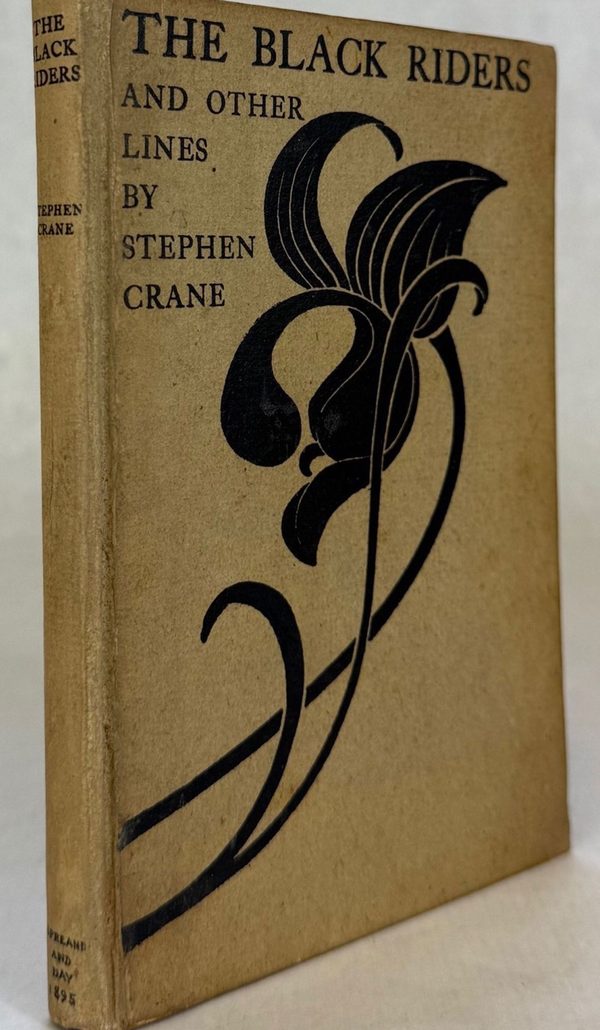
The poem is number 1 in The Black Riders & Other Lines by Stephen Crane (1871–1900). The book takes its title from it. It has been on americanpoems.com since 2004 and was a Poem of the Day on March 10, 2006. Readers have left 22 comments on it, from 2004 to 2022.
Keep reading
Readers
I feel Mr. Crane was describing men comong off of ships and attacking the indians. The long hair and hoofs and heels. I believe he called them black riders to show the evil they came to cause.
This poem seems to me like it is about a wicked bunch of pirates that swarm across the seas andplunder villages. They seem to be like savages with "Wild shouts and the wave of hair." And they have chosen the path of treachery and dark deeds and god has stamped "sin" across their foreheads.
I believe that this can represent any time one culture travels to another culture and forces change apon it.
The "spear" representing the new cultures ways, the "shield" representing rebellion from the natives.
Missionary work is, to me at least, a "sin".
Reece Klat is a mindless wambat with no foresight and perception
I think It was a great poem!!!!!!!
Dont take things to literly, Dont think(I know this sounds stupid so laugh away)Feel, poems arnt meant to mean one thing there meant to mean diffierent things to different people. So just except that its a great poem and dont try to change others perspective.
i think this was a really cool poem,i dont fully understand but these comments helped me a little.thanks/
god bless u all.
This is a good poem (he can do way better) but it really needs more life to it.
I don't think Crane is specifically adressing one single event. After reading some of his poems I think he was changed by the wars he covered. I do think there is some reference to culutral invasion, settlers, and pirates but I belive the underlying message is that war is horrid and no matter the situation it can only breed sin (and evil.)
Crane is a well digger as well as a jeweler and this short poem is meant to include the solid geometry of a diamond as well as the disquieting depth of a dry well. Behold ! The glittering diamond is down there in the bottom of the well!
this poem really reminds me of big juicy tits and people named lauren
My take on this is that it's a meditation on the horrors of war, the fierceness of it's execution, and how one side will always view their enemy as commiting Sin.
By way of emendation, this poem was actually published in 1895, as the first poem in Crane's first book of poems: _The Black Riders and Other Lines_. It was written at the request of Crane's publisher. In any case, it's very different from the other poems in the book, which (in my opinion) are much better. Here are several examples of what I mean: III In the desert I saw a creature, naked, bestial, who, squatting…
Read the whole commentBy way of emendation, this poem was actually published in 1895, as the first poem in Crane's first book of poems: _The Black Riders and Other Lines_. It was written at the request of Crane's publisher. In any case, it's very different from the other poems in the book, which (in my opinion) are much better. Here are several examples of what I mean:
III
In the desert
I saw a creature, naked, bestial,
who, squatting upon the ground,
Held his heart in his hands,
And ate of it.
I said, "Is it good, friend?"
"It is bitter, bitter," he answered;
"But I like it
Because it is bitter,
And because it is my heart."
IX
I stood upon a high place,
And saw, below, many devils
Running, leaping,
and carousing in sin.
One looked up, grinning,
And said, "Comrade! Brother!"
XXIV
I saw a man pursuing the horizon;
Round and round they sped.
I was disturbed at this;
I accosted the man.
"It is futile," I said,
"You can never-"
"You lie," he cried,
And ran on.
XXXII
Two or three angels
Came near to the earth.
They saw a fat church.
Little black streams of people
Came and went in continually.
And the angels were puzzled
To know why the people went thus,
And why they stayed so long within.
XLII
I walked in a desert.
And I cried,
"Ah, God, take me from this place!"
A voice said, "It is no desert."
I cried, "Well, But-
The sand, the heat, the vacant horizon."
A voice said, "It is no desert."
XLIV
I was in the darkness;
I could not see my words
Nor the wishes of my heart.
Then suddenly there was a great light-
"Let me into the darkness again."
XLVI
Many red devils ran from my heart
And out upon the page,
They were so tiny
The pen could mash them.
And many struggled in the ink.
It was strange
To write in this red muck
Of things from my heart.
The poem is an example of Crane's economy: a lot is said in so few words. I think 'black' is (unfortunately)used here in the conventional sense to symbolize evil. (I am saying 'unfortunately' because this kind of image keeps stereotyping and traumatizing the black race as being replicas of the devil, yet some of the most heart-rending atrocities in the world have been committed by the devil dressed in white, not…
Read the whole commentThe poem is an example of Crane's economy: a lot is said in so few words. I think 'black' is (unfortunately)used here in the conventional sense to symbolize evil. (I am saying 'unfortunately' because this kind of image keeps stereotyping and traumatizing the black race as being replicas of the devil, yet some of the most heart-rending atrocities in the world have been committed by the devil dressed in white, not black. Slavery, the Jewish holocaust, colonialism of Africa, the invasion of Vietnam and Iraq are just examples). The words 'clang' and 'clash' onomatopaeically represent the raid (or ride as the poet prefers to call it). The alliteration in lines 2, 3 and 4 also contributes to the structural unity of the poem: the spear is pitted against the shield (conjuring up a society less technologically endowed: a spear, not a bomb), the hoof against the heel (an animal versus a human or perhaps a savage versus a civilized person?), and wild shouts against the wave of hair. The concluding line serves to underline the 'spirituality' of Crane's poem, which I think is unfortunate because we do not miss much if the line is deleted altogether. In fact the word 'thus' in that line tends to 'dilute' the seriousness of the poem: it makes it sound like some mini-theological pamplet.
The poem is ediffying
Wonderful poem, great description. Short but sweet.
Love it.
i had to read this one twice but i understand it and i loved the meaning behind it!!!
I love this poem, it helped me with my life, great poem, if it wasnt for this poem i would be living in my parents basement
I love this poem!!!!!!!!! =)
This poem is so great I really enjoyed this poem....
Comment
The poem Black riders came from the sea ,-is a social criticism . In an ironical vein Crane exhibits the diabolic crimes of civilized people .
thank u very much good sir ur splendid analysis of this poem has brought light to my day in this horrific english glass i abid u a good day.