"Speak! speak! thou fearful guest
Who, with thy hollow breast
Still in rude armor drest,
Comest to daunt me!
Wrapt not in Eastern balms,
But with thy fleshless palms
Stretched, as if asking alms,
Why dost thou haunt me?"
Then, from those cavernous eyes
Pale flashes seemed to rise,
As when the Northern skies
Gleam in December;
And, like the water's flow
Under December's snow,
Came a dull voice of woe
From the heart's chamber.
"I was a Viking old!
My deeds, though manifold,
No Skald in song has told,
No Saga taught thee!
Take heed, that in thy verse
Thou dost the tale rehearse,
Else dread a dead man's curse;
For this I sought thee.
"Far in the Northern Land,
By the wild Baltic's strand,
I, with my childish hand,
Tamed the gerfalcon;
And, with my skates fast-bound,
Skimmed the half-frozen Sound,
That the poor whimpering hound
Trembled to walk on.
"Oft to his frozen lair
Tracked I the grisly bear,
While from my path the hare
Fled like a shadow;
Oft through the forest dark
Followed the were-wolf's bark,
Until the soaring lark
Sang from the meadow.
"But when I older grew,
Joining a corsair's crew,
O'er the dark sea I flew
With the marauders.
Wild was the life we led;
Many the souls that sped,
Many the hearts that bled,
By our stern orders.
"Many a wassail-bout
Wore the long Winter out;
Often our midnight shout
Set the cocks crowing,
As we the Berserk's tale
Measured in cups of ale,
Draining the oaken pail,
Filled to o'erflowing.
"Once as I told in glee
Tales of the stormy sea,
Soft eyes did gaze on me,
Burning yet tender;
And as the white stars shine
On the dark Norway pine,
On that dark heart of mine
Fell their soft splendor.
"I wooed the blue-eyed maid,
Yielding, yet half afraid,
And in the forest's shade
Our vows were plighted.
Under its loosened vest
Fluttered her little breast
Like birds within their nest
By the hawk frighted.
"Bright in her father's hall
Shields gleamed upon the wall,
Loud sang the minstrels all,
Chanting his glory;
When of old Hildebrand
I asked his daughter's hand,
Mute did the minstrels stand
To hear my story.
"While the brown ale he quaffed,
Loud then the champion laughed,
And as the wind-gusts waft
The sea-foam brightly,
So the loud laugh of scorn,
Out of those lips unshorn,
From the deep drinking-horn
Blew the foam lightly.
"She was a Prince's child,
I but a Viking wild,
And though she blushed and smiled,
I was discarded!
Should not the dove so white
Follow the sea-mew's flight,
Why did they leave that night
Her nest unguarded?
"Scarce had I put to sea,
Bearing the maid with me,
Fairest of all was she
Among the Norsemen!
When on the white sea-strand,
Waving his armed hand,
Saw we old Hildebrand,
With twenty horsemen.
"Then launched they to the blast,
Bent like a reed each mast,
Yet we were gaining fast,
When the wind failed us;
And with a sudden flaw
Came round the gusty Skaw,
So that our foe we saw
Laugh as he hailed us.
"And as to catch the gale
Round veered the flapping sail,
Death! was the helmsman's hail,
Death without quarter!
Mid-ships with iron keel
Struck we her ribs of steel
Down her black hulk did reel
Through the black water!
"As with his wings aslant,
Sails the fierce cormorant,
Seeking some rocky haunt
With his prey laden,
So toward the open main,
Beating to sea again,
Through the wild hurricane,
Bore I the maiden.
"Three weeks we westward bore,
And when the storm was o'er,
Cloud-like we saw the shore
Stretching to leeward;
There for my lady's bower
Built I the lofty tower,
Which, to this very hour,
Stands looking seaward.
"There lived we many years;
Time dried the maiden's tears
She had forgot her fears,
She was a mother.
Death closed her mild blue eyes,
Under that tower she lies;
Ne'er shall the sun arise
On such another!
"Still grew my bosom then.
Still as a stagnant fen!
Hateful to me were men,
The sunlight hateful!
In the vast forest here,
Clad in my warlike gear,
Fell I upon my spear,
O, death was grateful!
"Thus, seamed with many scars,
Bursting these prison bars,
Up to its native stars
My soul ascended!
There from the flowing bowl
Deep drinks the warrior's soul,
Skoal! to the Northland! skoal!"
Thus the tale ended.
The Skeleton in Armor is a ballad in which a dead Viking tells his own story. A speaker challenges an armoured skeleton that haunts him, and the skeleton answers.
He recalls a boyhood in the North and years as a sea-raider. He falls in love with a chieftain's daughter, and her father refuses him. He carries her off by sea, sinks the pursuing ship, and sails west to a new shore. There he builds her a tower and lives with her until she dies.
Grief drives him to fall on his spear, and his soul rises to a warriors' afterlife. The poem is about fame and memory, love across rank, violence, and grief.
Summary
In lines 1–8 the speaker challenges a fearful guest in rough armour. The figure has a hollow breast and fleshless palms, stretched out as if begging. The speaker asks why it haunts him. In lines 9–16 pale flashes rise from its empty eyes, and a dull voice answers from within.
In lines 17–24 the skeleton says he was a Viking. No Skald or Saga has told his many deeds. He orders the speaker to retell the tale in verse, or fear a dead man's curse. That is why he has come.
In lines 25–40 he recalls his boyhood by the Baltic. He tamed a gerfalcon and skated on a half-frozen Sound where a hound feared to walk. He followed the were-wolf through the forest until the lark sang.
In lines 41–56 he joins a corsair's crew and raids across the sea. Many die by the raiders' orders. Winters pass in drinking bouts, where they tell the Berserk's tale over ale until the cocks crow.
In lines 57–72 a girl gazes at him as he tells sea-tales. Her look falls on his dark heart like starlight on a pine. He woos the blue-eyed maid in the forest, and they exchange vows.
In lines 73–96 he asks her father, old Hildebrand, for her hand in his hall. Hildebrand laughs in scorn over his drinking-horn. She is a Prince's child and the suitor only a Viking, so he is refused.
In lines 97–128 he sails off with her. Hildebrand appears on the shore with twenty horsemen and gives chase. The wind fails the lovers, and the enemy laughs as he hails them. The Viking rams the pursuing ship amidships and sinks it. Like a cormorant with its prey, he carries the maiden out through the storm.
In lines 129–144 they sail west for three weeks and sight a shore. He builds her a tower, which he says still stands looking seaward. They live there many years. Her tears dry and she becomes a mother. Then she dies and is buried under the tower.
In lines 145–160 his heart grows still, and he hates men and sunlight. In the forest, in his armour, he falls on his spear and welcomes death. His soul rises to its native stars, where warriors drink from the flowing bowl. He ends with a toast to the Northland, and the tale ends.
Themes and meaning
Fame and memory. The skeleton's first demand is to be remembered. He complains that "No Skald in song has told" his deeds. He threatens "a dead man's curse" unless the speaker will "the tale rehearse" in verse. The poem can be read as the verse he demanded. His story survives only because a poet writes it down.
Love across rank. The lovers are divided by status. The girl is "a Prince's child", and the suitor is "but a Viking wild". Her father answers the proposal with "the loud laugh of scorn". The Viking takes by force what he is refused.
Consent is left open. The elopement can be read as a romance or as an abduction, and the text supports both. She is "Yielding, yet half afraid", and she "blushed and smiled". Yet the Viking compares himself to a cormorant "With his prey laden". Later "Time dried the maiden's tears", and "She had forgot her fears".
Violence and wildness. The Viking's life is shaped by war. As a raider he boasts "Many the hearts that bled". He meets the pursuit with "Death without quarter!" and sinks the enemy ship. Love softens his "dark heart", but it does not end the violence. It prompts the worst of it.
Grief and death. The woman's death ends his reason to live. His heart becomes "Still as a stagnant fen!", and even the sunlight grows "hateful". He takes his own life without apology, and says "O, death was grateful!" The ending is a warrior's triumph, not a mourning. His soul rises "Up to its native stars" to drink with other warriors.
Tone
The poem opens in dread. The speaker faces a "fearful guest" and asks "Why dost thou haunt me?" The ghost's voice is "a dull voice of woe", but his tale is proud and loud.
The boyhood stanzas are brisk and nostalgic. The raiding stanzas boast, with "Wild was the life we led" and midnight shouts over ale. The love stanzas turn tender, with "soft splendor" and a fluttering heart.
Bitterness enters at the father's scorn. The chase and sinking are told with exultation, in a run of exclamations. After the woman's death the voice drops into grief, with "Still grew my bosom then." The dead man's final toast rises again to triumph.
The frame narrator closes flatly with "Thus the tale ended." That plain line sets the ghost's passion at a distance.
Form and structure
The poem has 160 lines in 20 stanzas, each stanza 8 lines long. It is a ballad told almost entirely in the ghost's voice, inside a short frame. The frame speaker has the first two stanzas and the last line.
The lines are very short, from 3 to 7 syllables. Most long lines have six syllables, and the fourth and eighth lines of a stanza usually have five. Each line carries two stresses in a falling, largely dactylic rhythm, as in "Who, with thy hollow breast". The metre is dactylic dimeter, used with some freedom.
Most stanzas rhyme aaabcccb. Three lines rhyme, then a shorter line, then three more rhymes, then a line that rhymes with the first short one. These short lines often end on a falling or slant rhyme, as in "December" and "chamber".
Poetic devices
Imagery line 9
from those cavernous eyes The empty eye sockets become caves. The image makes the skeleton eerie before it speaks.
Enjambment line 21
Take heed, that in thy verse The command runs on into the next line. The demand for a poem spills over the line break, as the ghost presses his claim.
Simile line 36
Fled like a shadow The hare's flight is quick and soundless. The simile shows the boy's speed and mastery in the wild.
Anaphora line 47
Many the hearts that bled The line repeats the pattern of line 46. The repetition makes the killing sound routine and boastful.
Simile line 71
Like birds within their nest The girl's fluttering heart is a bird in a nest. Line 72 adds the hawk, casting the Viking as the predator.
Metaphor line 93
Should not the dove so white The girl is a white dove and the Viking a sea-mew. The image claims she belongs with him, and the nest returns as an unguarded home.
Repetition line 120
Through the black water! The word black echoes the black hulk of line 119. The doubling darkens the sinking of the enemy ship.
Simile line 122
Sails the fierce cormorant An extended simile spans lines 121–128. The seabird carrying prey matches the Viking carrying the maiden.
Alliteration line 146
Still as a stagnant fen! The repeated s and st sounds slow the line. The stagnant fen gives grief the image of dead, unmoving water.
Irony line 152
O, death was grateful! Death is welcomed as a relief. The exclamation turns suicide into release.
Metaphor line 154
Bursting these prison bars The ribs and armour become prison bars. The body is a cage the soul breaks out of.
Repetition line 159
Skoal! to the Northland! skoal! The toast is repeated at both ends of the line. It closes the ghost's tale as a drinking cheer.
Words worth knowing
Skald
A Norse court poet who sang the deeds of heroes.
gerfalcon
A large northern falcon, usually spelled gyrfalcon, prized for hunting.
wassail-bout
A bout of heavy drinking and toasting.
flaw
Here a sudden gust or squall of wind, not a defect.
Skaw
A headland at the northern tip of Denmark, where the Baltic meets the North Sea.
skoal
A Scandinavian drinking toast, meaning 'to your health'.
Context
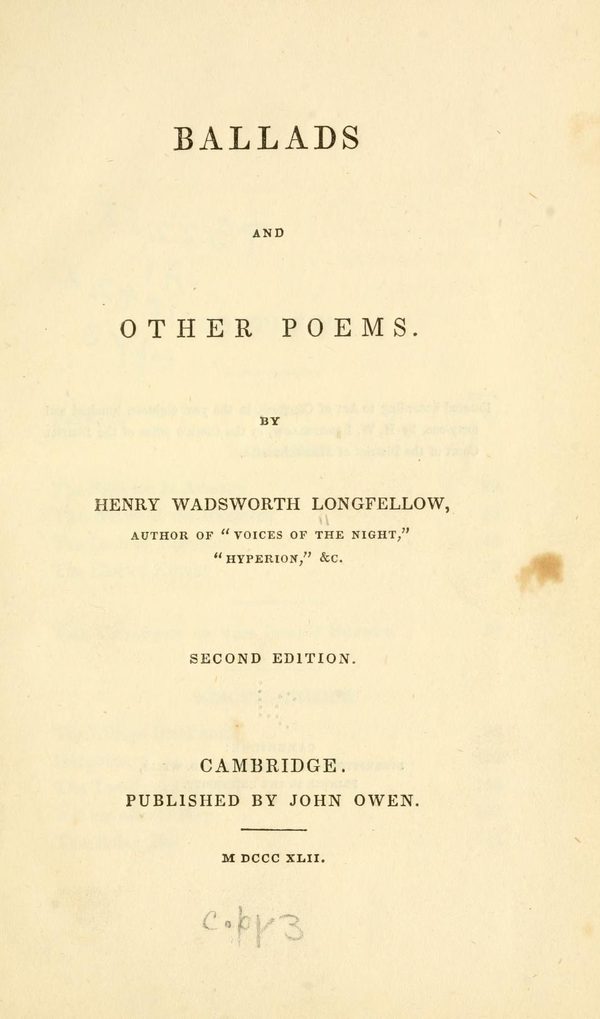
The poem appears in Longfellow's collection Ballads and Other Poems, where it is the first poem in the book.
What readers have said
Natalie finds every element of a great tale here: adventure, warfare, forbidden love and death. Natalie, 2004
Daniel's mother read the poem to the family in the evening, and it was his first introduction to romance and tragedy. daniel, 2004
Cheryl Hamilton follows the Viking from a child at play to a fierce pirate, and sees his love for one woman as both his reckoning and the reason he died. Cheryl Hamilton, 2005
Bill reads the Viking's suicide as having two motives: he could find no one else like her, or he wanted to be with her in heaven. bill, 2005
Jim remembers learning in grade school that the poem was based on the discovery of a skeleton in armor somewhere in New England, and guesses Massachusetts. Jim, 2005
Tim notes an apparent typo in the opening line, which his printed copy gives as 'Speak! speak! thou fearful guest'. Tim, 2005
Keep reading
Discover more of Henry Wadsworth Longfellow’s poetry.
This has all the elements of a great tale - adventure, warfare, forbidden love, and death. It is beautifully crafted, like so many of Longfellow's works, and I find it quite inspiring.
danielUnited States
this is a poem my mother used read to us in the evening.my first intro into romance and tragaty.
shaniquaAlgeria
i really enjoyed reading this poem. i do not read a lot of poetry, but i think that this is a poem worth reading
JimUnited States
I seem to remember, from reading this poem in grade school, that it was based on the discovery of a skeleton dressed in armor somewhere in New England. I would assume in Massachusetts.
lucas mannUnited States
This poem is very deep in what he feels for this one person.
CatherineUnited Kingdom
Longfellow's poetry seems to be underappreciated by the modern world. perhaps it is hard to pigeon-hole him as readable by a certain age group, or that blind patriotism is unpopular. He should be anthologized and read by students ages 5th grade through college. His poetry adds something to each reader's life...it is his gift to us.
billUnited States
This poem is my most favorite poem. longfellow was a great poet even if he does spell tragety wrong. and true he does show great love for his wife. he must have there for he wouldn't had killed his self. i believe when he kills his self in the poem that he done it for two reasons. He could have killed his self because he can't find anyone else like her. Second he just wanted to be with her. (in heaven)
Tim
I think there's a typo in the beginning of it; according to a copy of it I have in a book, the opening is supposed to be "Speak! speak! thou fearful guest". I don't know if anyone else noticed.
l love this poem.but i hope a lot studies involoved
Cheryl HamiltonUnited States
This poem was brilliant. Longfellow did a good job portraying this viking that was once a child that enjoyed playing to this fierce pirate who found love on one of his escapades. THe love for this one woman was his reckoning as well as the cause for his death.
rachelUnited States
oh my gosh!!! you are my great great great great great great great great (8) grandfather!! even though your dead...yea well i think thts just awesome!! well bye!
bill trebinrgUnited States
After more than sixty years portions of this great poem come to mind. I have always loved poems and when I read them I project my image and my thoughts into the heart of them, The Raven, by Poe, is another that keeps repeating in my mind. Being alone with my favorite poems is my way to stay at peace with the world. Long may they be remembered and read over and over again.
ron marroccoUnited States
wanting to share (brag) with the group my find of a first edition of the skeleton in armor. I purchased a large quanity of books at a moving sale..wow!! what a surprise. you never know :)
janelleUnited States
the poem wuz great i loved it alot
TotoUnited States
-new to poetry. didn't know it but write some lousy stuff myself in form of lyrics. never gonna be this good but love to read it!-
nicky gBolivia
lovin it
great poem love it sooooooooooooooooo much made me cry
This has all the elements of a great tale - adventure, warfare, forbidden love, and death. It is beautifully crafted, like so many of Longfellow's works, and I find it quite inspiring.
this is a poem my mother used read to us in the evening.my first intro into romance and tragaty.
i really enjoyed reading this poem. i do not read a lot of poetry, but i think that this is a poem worth reading
I seem to remember, from reading this poem in grade school, that it was based on the discovery of a skeleton dressed in armor somewhere in New England. I would assume in Massachusetts.
This poem is very deep in what he feels for this one person.
Longfellow's poetry seems to be underappreciated by the modern world. perhaps it is hard to pigeon-hole him as readable by a certain age group, or that blind patriotism is unpopular. He should be anthologized and read by students ages 5th grade through college.
His poetry adds something to each reader's life...it is his gift to us.
This poem is my most favorite poem. longfellow was a great poet even if he does spell tragety wrong. and true he does show great love for his wife. he must have there for he wouldn't had killed his self. i believe when he kills his self in the poem that he done it for two reasons. He could have killed his self because he can't find anyone else like her. Second he just wanted to be with her. (in heaven)
I think there's a typo in the beginning of it; according to a copy of it I have in a book, the opening is supposed to be "Speak! speak! thou fearful guest".
I don't know if anyone else noticed.
l love this poem.but i hope a lot studies involoved
This poem was brilliant. Longfellow did a good job portraying this viking that was once a child that enjoyed playing to this fierce pirate who found love on one of his escapades. THe love for this one woman was his reckoning as well as the cause for his death.
oh my gosh!!! you are my great great great great great great great great (8) grandfather!! even though your dead...yea well i think thts just awesome!! well bye!
After more than sixty years portions of this great poem come to mind. I have always loved poems and when I read them I project my image and my thoughts into the heart of them, The Raven, by Poe, is another that keeps repeating in my mind. Being alone with my favorite poems is my way to stay at peace with the world. Long may they be remembered and read over and over again.
wanting to share (brag) with the group my find of a first edition of the skeleton in armor. I purchased
a large quanity of books at a moving sale..wow!! what a surprise. you never know :)
the poem wuz great i loved it alot
-new to poetry. didn't know it but write some lousy stuff myself in form of lyrics. never gonna be this good but love to read it!-
lovin it
great poem love it sooooooooooooooooo much made me cry