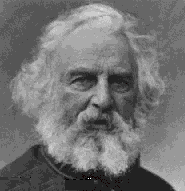
The poem
Should you ask me, whence these stories? Whence these legends and traditions, With the odors of the forest With the dew and damp of meadows, With the curling smoke of wigwams, With the rushing of great rivers, With their frequent repetitions, And their wild reverberations As of thunder in the mountains? I should answer, I should tell you, "From the forests and the prairies, From the great lakes of the Northland, From the land of the Ojibways, From the land of the Dacotahs, From the mountains, moors, and fen-lands Where the heron, the Shuh-shuh-gah, Feeds among the reeds and rushes. I repeat them as I heard them From the lips of Nawadaha, The musician, the sweet singer." Should you ask where Nawadaha Found these songs so wild and wayward, Found these legends and traditions, I should answer, I should tell you, "In the bird's-nests of the forest, In the lodges of the beaver, In the hoofprint of the bison, In the eyry of the eagle! "All the wild-fowl sang them to him, In the moorlands and the fen-lands, In the melancholy marshes; Chetowaik, the plover, sang them, Mahng, the loon, the wild-goose, Wawa, The blue heron, the Shuh-shuh-gah, And the grouse, the Mushkodasa!" If still further you should ask me, Saying, "Who was Nawadaha? Tell us of this Nawadaha," I should answer your inquiries Straightway in such words as follow. "In the vale of Tawasentha, In the green and silent valley, By the pleasant water-courses, Dwelt the singer Nawadaha. Round about the Indian village Spread the meadows and the corn-fields, And beyond them stood the forest, Stood the groves of singing pine-trees, Green in Summer, white in Winter, Ever sighing, ever singing. "And the pleasant water-courses, You could trace them through the valley, By the rushing in the Spring-time, By the alders in the Summer, By the white fog in the Autumn, By the black line in the Winter; And beside them dwelt the singer, In the vale of Tawasentha, In the green and silent valley. "There he sang of Hiawatha, Sang the Song of Hiawatha, Sang his wondrous birth and being, How he prayed and how be fasted, How he lived, and toiled, and suffered, That the tribes of men might prosper, That he might advance his people!" Ye who love the haunts of Nature, Love the sunshine of the meadow, Love the shadow of the forest, Love the wind among the branches, And the rain-shower and the snow-storm, And the rushing of great rivers Through their palisades of pine-trees, And the thunder in the mountains, Whose innumerable echoes Flap like eagles in their eyries;- Listen to these wild traditions, To this Song of Hiawatha! Ye who love a nation's legends, Love the ballads of a people, That like voices from afar off Call to us to pause and listen, Speak in tones so plain and childlike, Scarcely can the ear distinguish Whether they are sung or spoken;- Listen to this Indian Legend, To this Song of Hiawatha! Ye whose hearts are fresh and simple, Who have faith in God and Nature, Who believe that in all ages Every human heart is human, That in even savage bosoms There are longings, yearnings, strivings For the good they comprehend not, That the feeble hands and helpless, Groping blindly in the darkness, Touch God's right hand in that darkness And are lifted up and strengthened;- Listen to this simple story, To this Song of Hiawatha! Ye, who sometimes, in your rambles Through the green lanes of the country, Where the tangled barberry-bushes Hang their tufts of crimson berries Over stone walls gray with mosses, Pause by some neglected graveyard, For a while to muse, and ponder On a half-effaced inscription, Written with little skill of song-craft, Homely phrases, but each letter Full of hope and yet of heart-break, Full of all the tender pathos Of the Here and the Hereafter; Stay and read this rude inscription, Read this Song of Hiawatha!

Thank you for the poem
I am leaving this poem because it's a homwork, but it actually made me buy "To The Song Of Hiawatha". Thank you for posting up a poem for us so that everyone can learn. I am learning about poems right now.
-Thank You, Jack Yoon
I read this poem because I had to but really I did not find it all that interesting. In fact I thought it was really boring. Though it was boring it reminded me of the song this land is your land.
comments on poem
to appreciate this poem you have to love nature. The animals, plants, and man living with them like the indians did. If you do, you will want to read it a second time. Guaranteed!
Introduction to the Song of Hiawatha
This poem has a lot of meaning and tone. When you first start reading it it flows very nicely and when you start getting to the middle of the poem the poem becomes harder to read. I think that it was better that he made it harder to read because then you understand the meaning of the poem even more than you did before. This poems tone is very mellow and it has a lot of meaning to it. This poems meaning is that…
Read the whole commentThis poem has a lot of meaning and tone. When you first start reading it it flows very nicely and when you start getting to the middle of the poem the poem becomes harder to read. I think that it was better that he made it harder to read because then you understand the meaning of the poem even more than you did before. This poems tone is very mellow and it has a lot of meaning to it.
This poems meaning is that everything will be ok in the end hopefully. This poem says that all through the poem and it stays that way through the whole poem. The author does not skip back and forth from different meanings he stays with the same thing the whole time.
The tone of the poem is very clear. After reading the poem to me the tone is that this author is gonna do something that he has never done before. He wants to take a risk. But he does not want to get caught.