Whenever I walk to Suffern along the Erie track
I go by a poor old farmhouse with its shingles broken and black.
I suppose I've passed it a hundred times, but I always stop for a minute
And look at the house, the tragic house, the house with nobody in it.
I never have seen a haunted house, but I hear there are such things;
That they hold the talk of spirits, their mirth and sorrowings.
I know this house isn't haunted, and I wish it were, I do;
For it wouldn't be so lonely if it had a ghost or two.
This house on the road to Suffern needs a dozen panes of glass,
And somebody ought to weed the walk and take a scythe to the grass.
It needs new paint and shingles, and the vines should be trimmed and tied;
But what it needs the most of all is some people living inside.
If I had a lot of money and all my debts were paid
I'd put a gang of men to work with brush and saw and spade.
I'd buy that place and fix it up the way it used to be
And I'd find some people who wanted a home and give it to them free.
Now, a new house standing empty, with staring window and door,
Looks idle, perhaps, and foolish, like a hat on its block in the store.
But there's nothing mournful about it; it cannot be sad and lone
For the lack of something within it that it has never known.
But a house that has done what a house should do, a house that has sheltered life,
That has put its loving wooden arms around a man and his wife,
A house that has echoed a baby's laugh and held up his stumbling feet,
Is the saddest sight, when it's left alone, that ever your eyes could meet.
So whenever I go to Suffern along the Erie track
I never go by the empty house without stopping and looking back,
Yet it hurts me to look at the crumbling roof and the shutters fallen apart,
For I can't help thinking the poor old house is a house with a broken heart.
✦
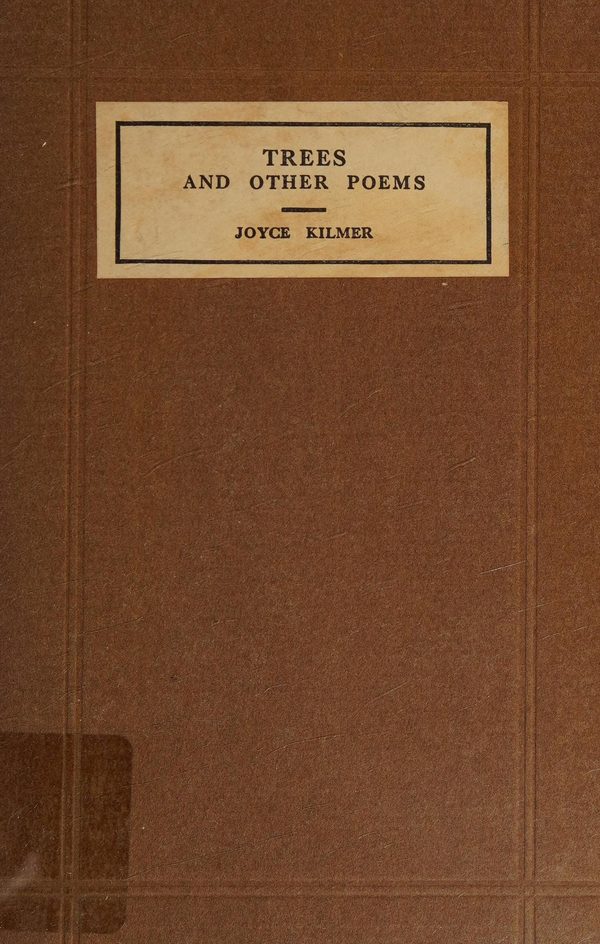
From the bookTrees and Other PoemsFirst edition with its paper label, George H. Doran, New York, 1914
Analysis
The House with Nobody in It: analysis
Introduction
In this poem from Trees and Other Poems (1914), a walker passes an abandoned farmhouse on the way to Suffern. He always stops to look at it. He wishes it were haunted so it would be less lonely, and he lists the repairs it needs. Most of all, he says, it needs people living inside.
The poem then draws a contrast. A new empty house cannot be sad, because it has never known life. An old house that once sheltered a family is "the saddest sight". The poem ends by calling the house a house with a broken heart.
Summary
The speaker walks to Suffern along the Erie track. He passes a poor old farmhouse with broken black shingles. He has passed it a hundred times, but he always stops for a minute to look at this tragic, empty house.
He has never seen a haunted house, though he hears they hold the talk of spirits. He knows this house is not haunted. He wishes it were, since a ghost or two would make it less lonely.
The house needs a dozen panes of glass. The walk needs weeding and the grass needs cutting. It needs paint, shingles and trimmed vines. Above all it needs people living in it.
If he had money and no debts, he would hire men to repair it. He would restore it to how it used to be. Then he would find people who wanted a home and give it to them free.
A new house standing empty, he says, only looks idle and a little foolish. It is like a hat on its block in a store. It cannot feel sad for something it has never known.
But a house that has sheltered life is different. It has held a couple in its arms and heard a baby laugh. Such a house, left alone, is the saddest sight there is.
So whenever he walks to Suffern he stops and looks back at the empty house. It hurts him to see the crumbling roof and the fallen shutters. He cannot help thinking that the old house has a broken heart.
Themes and meaning
Loneliness and absence are at the centre. The house is defined by what it lacks: it is "the house with nobody in it". The speaker even wishes for ghosts, since any company would be better than none.
The poem treats the house as a living thing. It has "loving wooden arms" and a "broken" heart. It can be lonely and sad. This personification lets the poem mourn a building the way one might mourn a person.
Memory is what makes the loss painful. The new empty house is not sad, because it has "never known" a family. The old house has "echoed a baby's laugh". Sorrow, the poem suggests, belongs to what has known love and then lost it.
The poem also carries a wish to help. The speaker imagines paying for repairs and giving the house away "free" to people who need a home. His compassion is practical as well as emotional. Readers have often extended this to people who are abandoned or forgotten.
Finally, the poem is about the act of looking. The speaker always stops and always looks back, even though it hurts. Paying attention is his way of honoring the house's past.
Tone
The tone is conversational and gentle. The speaker talks plainly, as if to a friend: "I suppose", "I do". The wish for a ghost is slightly whimsical.
The list of repairs is practical and homely. It shows a man who notices broken glass and long grass. His daydream of fixing the house is warm and generous.
The tone deepens in the passage on old and new houses. The images of the baby and the sheltering arms are tender. By the end the speaker admits that looking "hurts". The close is openly sad, but the sadness is soft and affectionate.
Form and structure
The poem has 28 long lines in a single stanza. Lines run from 12 to 20 syllables. The sentences fall into groups of four lines, each a step in the speaker's thought.
The poem is in rhymed couplets, such as "track" and "black" in lines 1–2. The long lines carry about seven beats each, with a lilting, ballad-like rhythm. That swing suits recitation.
Poetic devices
Repetition line 4
the house, the tragic house, the house with nobody in it The word house is repeated three times in one line. Each repetition adds weight, ending on the title phrase.
Irony line 8
it wouldn't be so lonely if it had a ghost or two Ghosts are usually feared. Here they are wished for as company, which shows how empty the house is.
Imagery line 10
take a scythe to the grass The practical detail shows long neglect. It also shows the speaker's eye for what needs doing.
Polysyndeton line 14
with brush and saw and spade The repeated and piles up tools. It conveys the speaker's eager, hands-on daydream of repair.
Simile line 18
like a hat on its block The new empty house is compared to a hat waiting in a shop. It is empty but has not yet been used, so it cannot grieve.
Personification line 22
its loving wooden arms The house embraces its family. The image turns walls into a parent's arms.
Auditory imagery line 23
echoed a baby's laugh The remembered sound fills the house with past life. It sharpens the silence of the present.
Metaphor line 28
the poor old house is a house with a broken heart The last line gives the house a broken heart. The poem ends by naming its grief.
Words worth knowing
sorrowings
Sorrows or grievings. An old-fashioned plural noun, paired here with mirth.
mirth
Laughter and merriment.
scythe
A long curved blade on a pole, used for cutting grass by hand.
block
A hat block, the wooden form on which a hat is shaped or displayed in a shop.
What readers have said
Having interpreted it in a college class, this reader takes the poem as a call to look back at abandoned and broken-hearted people and help them. Elizaabeth Garris, 2005
This reader sees lives becoming like old houses, and too often left behind before their importance is realized. tanya, 2005
Reciting it as a child in Brooklyn, this reader was frightened of ghosts by the refrain and still wonders why the speaker walked to Suffern. David Arturi, 2005
This reader always felt sorry for the house and imagines it remembering the love and laughter in its walls. joyce, 2006
Passing a house its owner kept empty for years, this reader came to read the poem as saying that life is to be lived, not wasted. Rita, 2006
This reader, who learned the poem from a mother's recitation, reads the house as an analogy for how the past stays part of us. Gayle Hoy, 2008
I learned this poem in the sixth grade, and since that date, I have never passed a similar site without feeling saddness at the plight of a house with nobody in it. I wish students today, instead of the endless preparation for testing, would be exposed to the beauty and depth of our nation's poetry.
M.J. COOKSEYUnited States
Stirs deep emotions not only for the deserted, rundown house, but for the person who memorized this when he was 14 and won State recognition during state competition - he died of cancer before he graduated from H.S., his mother's only son whom she adored. So sad for mom and the old house.
Bertie WhiskinCanada
My thanks to you. My sister and I also learned this poem in elemetary school. Unfortunately, time erased a couple of the verses and it has been driving us mad. We were both touched by Joyce Kilmer's words and the picture they imprinted in our minds. We wanted to share it with our next generation. I am elated to find it printed in full - it is going to make an excellent Christmas gift. Thank you again!
Elizaabeth GarrisUnited States
I learned this poem in grammar school many years ago and recently interpreted it for my college Oral Interpretation class. Analyzing it, I realized that Kilmer was telling us all to look back at those who are abandoned and who have broken hearts and fix them up. At least, that's what it says to me. He was a remarkable man and he died with so many poems unwritten. Our loss!
tanyaUnited States
How sad that our lives should become as old houses ~ but there is hope yet! Too often we leave things behind without the realization of their importance in our lives ~ "to look at the house, the tragic house, the house with nobody in it" ~
I was a 14 year old boy when I memorized this poem in the eighth grade for English Literature class. I remember practicing reciting it at home, before presenting it to the class. I loved it the first time I read it and have never forgotten it. I am now 57 years old.
Winn HornUnited States
My older brother, above all else, was a career soldier in the U.S. Army. He gave this poem to me one evening after we had not seen each other for a number of years, and as we shared a drink as an older and a younger adult, trying to get to know each other again. As I read it for the first time, my eyes welled up with emotion, and he said, "I just wanted to see what kind of man you have become. I see everything I need to know." I have been looking for this poem for over 20 years. Thank you.
JessicaColombia
I think this poem is very nice. It taught me that we need to show solidarity to to other people that don`t have. I am going to say this poem to my class in english class on monday. I hope my class enjoys it! I really enjoyed this poem.
Patti EngleUnited States
I remember this poem in a red book when I was a child. I just loved it and made my sister read it to me over and over again. I memorized the first stanza and by the time I could read it myself the book was no where to be found.... I finally have the entire poem ... it has stuck with me all these years. I plan to read it to all of my grandchildren.
JaneyiUnited States
I support this poem to the deep bottom. I mean I am just as lonely, well yea..I can't be as lonely..there are human beings around me..but I feel I am as lonely as it. Its a house, in this world a house deserves better than anyone.
As kids in Brooklyn, NY, roller-skating on the slate sidewalks, or sitting on the stoops, we recited snatches of the poem. The haunting refrain of the sad house with nobody in it left us petrified of ghosts. But, what always mystified me--and why I liked this poem above many others--was Kilmer's lonely and metaphysical walk along the Erie railroad tracks. Why did he want to walk to Suffern, NY from his home in New Jersey? That question has never been answered to my satisfaction. It is a rhetorical question, so please don't delete this comment. Joyce Kilmer should be recognized as, and given the honorable title of, America's poet laureate.
My Mum read poetry to us almost every night, from what I think is the same red book. I always loved this one, and still had most of it memorized until just recently. (I'm getting old, ok?) My imagination took me to that house time and time again, and the house looked sad, lonely. It imparts the idea that places are still alive when it is clear that something good and decent took place. I still have the same love for some special places and things that made a difference in my life. I feel lucky to have had a mum who knew a lot about literature, and by reading to us, we all learned to read well before kindergarten. I think it's early brain-training.
MargeauxUnited States
My grandma is now 85 and some dementia has set in, but of all the things that she remembers is this poem. She can recite it when everything else is upside down. This is what I will read at her funeral as she has told it to me so many times.
Lois MitchellUnited States
I've loved this poem since elementary school, when I was required to memorize it for english class. I lived in southwestern Connecticut and went through Suffern, NY years later looking for the house!! The memory of the words gripped me as much as my other favorite, "The Barefoot Boy" by John Greenleaf Whittier. To me it means we should always look back, and of course, try to make things better.
joyceUnited States
I too have loved this poem ever since I heard it in grammar school I always felt sad for the house.The house is longing for a family to live in it again. It remembers the days when there was love and laughter echoing from it's walls
JordanUnited States
I am doing a reserch project and I can't find any literary criticism and I don't really know what the poem means so if any body has any idea please explain and post thanks
I remember having to recite this poem in elementary school and now 40 years later my interpretation of the poem is much different from elementary school. I know someone who had a house and never rented it out or allowed anyone to live in it. I passed by this house everyday for 15 years and would always think about the poem "The House with Nobody in It". I felt exactly the way Kilmer may have felt. I used the analogy that like this house, life is to be lived and not wasted; don't have a "body and mind" and leave it idle; utilize your god given talents or they will become like the house on Suffern.(Tragic)
Vivian ClaytonUnited States
I heard this poem for the very first time last night. It was recited by a woman who is 87 years old. My grandparents lived in Suffern, and as a child we would walk the country roads after dinner in the summer, when the light was long and lingered. We would cross a wooden bridge that spanned that Erie track and there was, indeed, an old abandoned farm house that we kids would call 'haunted'....I wonder if it was the same house.......
alice daileyUnited States
I used to recite in plays and contests in school and this is one of my prize poems. I've always loved it and include this in poems I give as gifts. It's so sad to think of this house that did it's job and now is alone and so true to life, Isn't it?
CATHERINE DAVISUnited States
MY MOM(NELLIE RAY)RECITED THIS POEM AS A YOUNG GIRL IN SCHOOL IN NEEDVILLE,TX. SHE WON THE CONTEST. I HEARD HER RECITE THIS POEM IN HER LATE 70'S AND SHE REMEMBERED IT ALL. SHE PASSED AWAY IN MAY"05, AND THE HOME SHE LIVED IN, NOW HAS NOBODY IN IT. I WISH I HAD RECITED THIS POEM AT HER FUNERAL BECAUSE SHE LOVED IT!!!!
Elaine Ramsdell SebaUnited States
I had to learn this poem, too, in sixth grade at Parker School in Lexington, MA, 1939. Miss Margaret Keefe was my teacher and the whole class had the assignment of memorizing this poem. I really enjoyed reciting it in front of my class. I still tear up when I read it. During my youth I thought of this poem every time I saw an old farmhouse, especially in New Hampshire. I have passed this poem on to my own children.
Gayle HoyUnited States
I too learned this poem from my mother. As a child we often passed a broken hearted house on our way into New York City from the Kingston. Mimicking my mother's recitation of this poem, each and every time we passed by the house, eventually lead to my memorizing it too. I beliceve it is an anaolgy of life: how our past is a part of us and influences us. The house demands notice and is also recognized for its contributions and past. :)
DebiUnited States
The House with Nobody in It
My brother and I take mom riding a lot through the country. She always comments on how sad the abandoned houses are and what memories they must hold. I stumbled across this poem by accident and vowed to learn it so I could recite it the next time we came upon an abandoned house. It has become my favorite poem.
Leon ButlerUnited States
The House with Nobody in It
I was twelve years old. My speech teacher asked me to represent our school in the county declamation contest. I agreed, and chose this poem. I recited it and won second place (a blue ribbon, I still have.) I like poetry, and this poem has stuck in my memory all these years. I am eighty three years old.
Gloria H. BessUnited States
The House with Nobody in it
I have been searching for this poem. I learned a portion of this poem when I was in elementary school. I always think of it when travelling on the train.
Debby FaltermanUnited States
The House with Nobody in It
While rummaging through some papers, I found this poem that was hand-written to my Mother from her Mother. She went on to tell my Mother that she could relate to this house when you passed a certain empty house in their little town. My Grandmother had attached a picture of the empty house. My Mother had given her the Book "The Best Loved Poems of the American People" in December 1970. My Grandmother loved poems and…
Read the whole comment
While rummaging through some papers, I found this poem that was hand-written to my Mother from her Mother. She went on to tell my Mother that she could relate to this house when you passed a certain empty house in their little town. My Grandmother had attached a picture of the empty house. My Mother had given her the Book "The Best Loved Poems of the American People" in December 1970. My Grandmother loved poems and recited them to us all the time. I am so blessed that I found this poem, written in my Grandmother's handwriting. Both she and my Mother are deceased. It such a shame that I never learned much poetry in school and my children and grandchildren haven't a clue. I will pass this on to them, After I Learn to Recite It!
I have admired this poem every since I read it in a library book. This poem reminds me of all the empty houses in my neighborhood. Many have been torn down, but I always think about someone lived in it perhaps years ago. I live in East St. Louis, Ill This is a poem that tends to search the soul of man. Joyce may your spirit rest in peace. Your gift came from God.
I also had to memorize this people when I was in the 7th grade in Dalhart, Texas. For some reason I have always remembered the poem, not all of it but the first paragraph. Decided to see if I could find it and sure enough here it is. Sad but lovely.
jim oneilUnited States
poem
My mother read this to us as a small child. Everytime I read it now i well up with tears
Myrtie An
I had to learn this poem in the sixth-grade. I have never forgot it. I am 66 years old and I have recited it to my daughter and all my grandchildren. I have also recitd it to a lot of my friends. I have one friend that ask me to recite it still. It really touched my heart as a child and still does. Thank you for the poem.
I learned this poem in the sixth grade, and since that date, I have never passed a similar site without feeling saddness at the plight of a house with nobody in it. I wish students today, instead of the endless preparation for testing, would be exposed to the beauty and depth of our nation's poetry.
Stirs deep emotions not only for the deserted, rundown house, but for the person who memorized this when he was 14 and won State recognition during state competition - he died of cancer before he graduated from H.S., his mother's only son whom she adored. So sad for mom and the old house.
My thanks to you. My sister and I also learned this poem in elemetary school. Unfortunately, time erased a couple of the verses and it has been driving us mad. We were both touched by Joyce Kilmer's words and the picture they imprinted in our minds. We wanted to share it with our next generation. I am elated to find it printed in full - it is going to make an excellent Christmas gift. Thank you again!
I learned this poem in grammar school many years ago and recently interpreted it for my college Oral Interpretation class. Analyzing it, I realized that Kilmer was telling us all to look back at those who are abandoned and who have broken hearts and fix them up. At least, that's what it says to me. He was a remarkable man and he died with so many poems unwritten. Our loss!
How sad that our lives should become as old houses ~ but there is hope yet! Too often we leave things behind without the realization of their importance in our lives ~ "to look at the house, the tragic house, the house with nobody in it" ~
I was a 14 year old boy when I memorized this poem in the eighth grade for English Literature class. I remember practicing reciting it at home, before presenting it to the class. I loved it the first time I read it and have never forgotten it. I am now 57 years old.
My older brother, above all else, was a career soldier in the U.S. Army. He gave this poem to me one evening after we had not seen each other for a number of years, and as we shared a drink as an older and a younger adult, trying to get to know each other again. As I read it for the first time, my eyes welled up with emotion, and he said, "I just wanted to see what kind of man you have become. I see everything I need to know." I have been looking for this poem for over 20 years. Thank you.
I think this poem is very nice. It taught me that we need to show solidarity to to other people that don`t have. I am going to say this poem to my class in english class on monday. I hope my class enjoys it! I really enjoyed this poem.
I remember this poem in a red book when I was a child. I just loved it and made my sister read it to me over and over again. I memorized the first stanza and by the time I could read it myself the book was no where to be found.... I finally have the entire poem ... it has stuck with me all these years. I plan to read it to all of my grandchildren.
I support this poem to the deep bottom. I mean I am just as lonely, well yea..I can't be as lonely..there are human beings around me..but I feel I am as lonely as it. Its a house, in this world a house deserves better than anyone.
As kids in Brooklyn, NY, roller-skating on the slate sidewalks, or sitting on the stoops, we recited snatches of the poem. The haunting refrain of the sad house with nobody in it left us petrified of ghosts. But, what always mystified me--and why I liked this poem above many others--was Kilmer's lonely and metaphysical walk along the Erie railroad tracks. Why did he want to walk to Suffern, NY from his home in New Jersey? That question has never been answered to my satisfaction. It is a rhetorical question, so please don't delete this comment. Joyce Kilmer should be recognized as, and given the honorable title of, America's poet laureate.
My Mum read poetry to us almost every night, from what I think is the same red book. I always loved this one, and still had most of it memorized until just recently. (I'm getting old, ok?) My imagination took me to that house time and time again, and the house looked sad, lonely. It imparts the idea that places are still alive when it is clear that something good and decent took place.
I still have the same love for some special places and things that made a difference in my life. I feel lucky to have had a mum who knew a lot about literature, and by reading to us, we all learned to read well before kindergarten. I think it's early brain-training.
My grandma is now 85 and some dementia has set in, but of all the things that she remembers is this poem. She can recite it when everything else is upside down. This is what I will read at her funeral as she has told it to me so many times.
I've loved this poem since elementary school, when I was required to memorize it for english class. I lived in southwestern Connecticut and went through Suffern, NY years later looking for the house!! The memory of the words gripped me as much as my other favorite, "The Barefoot Boy" by John Greenleaf Whittier. To me it means we should always look back, and of course, try to make things better.
I too have loved this poem ever since I heard it in grammar school I always felt sad for the house.The house is longing for a family to live in it again. It remembers the days when there was love and laughter echoing from it's walls
I am doing a reserch project and I can't find any literary criticism and I don't really know what the poem means so if any body has any idea please explain and post thanks
I remember having to recite this poem in elementary school and now 40 years later my interpretation of the poem is much different from elementary school. I know someone who had a house and never rented it out or allowed anyone to live in it. I passed by this house everyday for 15 years and would always think about the poem "The House with Nobody in It". I felt exactly the way Kilmer may have felt. I used the analogy that like this house, life is to be lived and not wasted; don't have a "body and mind" and leave it idle; utilize your god given talents or they will become like the house on Suffern.(Tragic)
I heard this poem for the very first time last night. It was recited by a woman who is 87 years old. My grandparents lived in Suffern, and as a child we would walk the country roads after dinner in the summer,
when the light was long and lingered. We would cross a wooden bridge that spanned that Erie track and there was, indeed, an old abandoned farm house that we kids would call 'haunted'....I wonder if it was the same house.......
I used to recite in plays and contests in school and this is one of my prize poems. I've always loved it and include this in poems I give as gifts. It's so sad to think of this house that did it's job and now is alone and so true to life, Isn't it?
MY MOM(NELLIE RAY)RECITED THIS POEM AS A YOUNG GIRL IN
SCHOOL IN NEEDVILLE,TX. SHE WON THE CONTEST. I HEARD HER RECITE THIS POEM IN HER LATE 70'S AND SHE REMEMBERED IT ALL. SHE PASSED AWAY IN MAY"05, AND THE HOME SHE LIVED IN, NOW HAS NOBODY IN IT. I WISH I HAD RECITED THIS POEM AT HER FUNERAL BECAUSE SHE LOVED IT!!!!
I had to learn this poem, too, in sixth grade at Parker School in Lexington, MA, 1939. Miss Margaret Keefe was my teacher and the whole class had the assignment of memorizing this poem. I really enjoyed reciting it in front of my class. I still tear up when I read it. During my youth I thought of this poem every time I saw an old farmhouse, especially in New Hampshire. I have passed this poem on to my own children.
I too learned this poem from my mother. As a child we often passed a broken hearted house on our way into New York City from the Kingston. Mimicking my mother's recitation of this poem, each and every time we passed by the house, eventually lead to my memorizing it too. I beliceve it is an anaolgy of life: how our past is a part of us and influences us. The house demands notice and is also recognized for its contributions and past. :)
The House with Nobody in It
My brother and I take mom riding a lot through the country. She always comments on how sad the abandoned houses are and what memories they must hold. I stumbled across this poem by accident and vowed to learn it so I could recite it the next time we came upon an abandoned house. It has become my favorite poem.
The House with Nobody in It
I was twelve years old. My speech teacher asked me to represent our school in the county declamation contest. I agreed, and chose this poem. I recited it and won second place (a blue ribbon, I still have.) I like poetry, and this poem has stuck in my memory all these years. I am eighty three years old.
The House with Nobody in it
I have been searching for this poem. I learned a portion of this poem when I was in elementary school.
I always think of it when travelling on the train.
The House with Nobody in It
While rummaging through some papers, I found this poem that was hand-written to my Mother from her Mother. She went on to tell my Mother that she could relate to this house when you passed a certain empty house in their little town. My Grandmother had attached a picture of the empty house. My Mother had given her the Book "The Best Loved Poems of the American People" in December 1970. My Grandmother loved poems and…
Read the whole commentWhile rummaging through some papers, I found this poem that was hand-written to my Mother from her Mother. She went on to tell my Mother that she could relate to this house when you passed a certain empty house in their little town. My Grandmother had attached a picture of the empty house. My Mother had given her the Book "The Best Loved Poems of the American People" in December 1970.
My Grandmother loved poems and recited them to us all the time. I am so blessed that I found this poem, written in my Grandmother's handwriting. Both she and my Mother are deceased. It such a shame that I never learned much poetry in school and my children and grandchildren haven't a clue. I will pass this on to them, After I Learn to Recite It!
Thank you so much for such beautiful poetry.
Comment on:28,
I have admired this poem every since I read it in a library book. This poem reminds me of all the empty houses in my neighborhood. Many have been torn down, but I always think about someone lived in it perhaps years ago. I live in East St. Louis, Ill This is a poem that tends to search the soul of man. Joyce may your spirit rest in peace. Your gift came from God.
A House with Nobody In It
I also had to memorize this people when I was in the 7th grade in Dalhart, Texas. For some reason I have always remembered the poem, not all of it but the first paragraph. Decided to see if I could find it and sure enough here it is. Sad but lovely.
poem
My mother read this to us as a small child. Everytime I read it now i well up with tears
I had to learn this poem in the sixth-grade. I have never forgot it. I am 66 years old and I have recited it to my daughter and all my grandchildren. I have also recitd it to a lot of my friends. I have one friend that ask me to recite it still. It really touched my heart as a child and still does. Thank you for the poem.