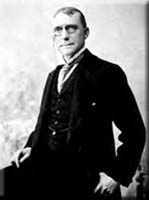
Biography
James Whitcomb Riley was born on October 7, 1849 in Greenfield, Indiana, surrounded by farmland and primitive forests. The wooden planked National Road, which American pioneers and settlers used to travel to the western half of the nation, ran right through Greenfield. The area was diverse in culture, with people from many different homelands, though outwardly appearing as rough wilderness and newly settled country.
The critic, Hamlin Garland, described it after a visit by saying, "To my eyes it was the most unpromising field for art, especially for the art of verse. The landscape had no hills, no lakes, no streams of any movement or beauty. Ragged fence-rows, flat and dusty roads, fields of wheat alternating with clumps of trees - these were the features of a country which to me was utterly commonplace - and yet from this dusty, drab, unpromising environment, Riley had been able to draw the honey of woodland poesy, a sweet in which a native fragrance as of basswood and buckwheat bloom mingled with hints of an English meadow and the tang of a Canada thistle."
Riley's father, being a frontier politician and lawyer, named his son after an Indiana governor, James Whitcomb. Riley's mother was, of course, a homemaker, and she also wrote poetry. Riley had a difficult time academically, but possessed a talent for language, especially that of his own people. His father wanted him to become a lawyer, but Riley did not apply himself to law. For a time he traveled the American Midwest as a sign painter. He also traveled with a medicine salesman, and drew crowds by playing songs and performing impersonations of people he had met in his travels.
Read the full biography
Riley's childhood and home were also great influences on him. His most famous poems were about people and situations from his real life. His poems, "The Raggedy Man," and "Little Orphant Annie," are about a hired hand and an orphan girl who helped on the family farm. The farmhand and Annie told the local children stories that Riley immortalized in his work. His poems, though of epic proportion in many senses, told of everyday things.
Riley, like many poets, published his first works in newspapers. At first he wrote under a pen name, "Benjamin F. Johnson of Boone." He often wrote in his own dialect, appealing to the majority of people with his common style and words. Garland held Riley alike to Mark Twain, for his ability to use natural dialect in his writing and speech, though also possessing the ability to speak in a more precise and standard English. After the success of his written work, Riley took to the road again, and traveled around the country to recite his poems in every city. This earned him great popularity, and people were fascinated by his dialect and use of the language, as well as his cheerful sense of humor.
In 1883, a collection of his poems was published, entitled "The Old Swimmin' Hole and 'Leven More Poems," followed by "Rhymes of Childhood" in 1890, "Poems Here at Home" in 1893, and "Knee Deep in June," in 1912. His most famous poems are "Little Orphant Annie," "The Raggedy Man," "When the Frost Is On the Punkin," and "The Runaway Boy." In Riley's later life, these volumes attracted both national and international readers, and he became the wealthiest writer of the time. He was honorably labeled as America's "Children's Poet," and as "The Hoosier Poet," in his home state.
James Whitcomb Riley died of a stroke on 22 July, 1916. The United States President, Woodrow Wilson, sent a note to the poet's family, saying Riley was "...a man who imparted joyful pleasure and a thoughtful view of many things that other men would have missed." Named after him in Indianapolis, the state capital, is Riley Hospital for Children.
In 1999, his hometown of Greenfield and his fans celebrated his 150th birthday, and Indiana governor, Frank O'Bannon, proclaimed October 7, 1999, "James Whitcomb Riley Day." Each year Greenfield hosts a "James Whitcomb Riley Festival," and the children of the area honor the poet by placing flowers on his statue at the Hancock County Courthouse. "With a cheery word and a wave of the hand He has wandered into a foreign land- He is not dead, he is just away!" --James Whitcomb Riley
On Little Orphant Annie
On At Broad Ripple
On The Raggedy Man
On Our Hired Girl
On The Old Guitar
On When the Frost is on the Punkin