The mountain and the squirrel
Had a quarrel,
And the former called the latter, "little prig":
Bun replied,
You are doubtless very big,
But all sorts of things and weather
Must be taken in together
To make up a year,
And a sphere.
And I think it no disgrace
To occupy my place.
If I'm not so large as you,
You are not so small as I,
And not half so spry:
I'll not deny you make
A very pretty squirrel track;
Talents differ; all is well and wisely put;
If I cannot carry forests on my back,
Neither can you crack a nut.
✦
Analysis
Fable: analysis
Introduction
"Fable" tells of a quarrel between a mountain and a squirrel. The mountain insults the squirrel as a "little prig." The squirrel, called Bun, answers with a calm and witty speech that takes up most of the poem.
Bun grants that the mountain is big, but argues that all kinds of things are needed to make up the world. Each has its own place and its own talent. The poem ends with a neat reversal. The mountain can carry forests, but it cannot crack a nut. Like a fable, it carries a lesson, though the lesson is spoken by a character rather than stated at the end.
Summary
The poem opens with a quarrel between a mountain and a squirrel. The mountain calls the squirrel a "little prig." The squirrel, named Bun, replies, and the rest of the poem is Bun's answer.
Bun begins by granting that the mountain is "doubtless very big." But all sorts of things and all kinds of weather must be taken together to make up a year and a sphere. Bun thinks it no disgrace to occupy a place in that whole. The squirrel's place is small, but it is still a proper place.
Bun then turns the comparison around. If the squirrel is not as large as the mountain, the mountain is not as small as the squirrel. Nor is it half as spry.
Bun admits that the mountain makes "A very pretty squirrel track." Talents differ, Bun says, and all is well and wisely arranged. The squirrel cannot carry forests on its back. Yet the mountain cannot crack a nut. The poem ends on that line.
Themes and meaning
The main theme is that every creature has a place in the whole. Bun argues that "all sorts of things and weather" are needed to make "a year" and "a sphere." Neither the world nor the calendar is made of one kind of thing. The small squirrel is as much a part of it as the mountain.
A second theme is that size is not worth. The mountain assumes that being big makes it better, and it insults the squirrel for being little. Bun accepts the facts of size but denies that they settle anything. Being "not so large" is balanced by being "not so small," and by being "spry."
The poem also teaches that talents differ. Line 17 states it outright: "Talents differ." The final couplet makes the point concrete. The mountain carries forests, and the squirrel cracks nuts. Neither ability is ranked above the other.
Self-respect is a further theme. Bun says "I think it no disgrace / To occupy my place." The squirrel does not claim to be greater than the mountain. It claims only that its own place is honourable. The poem can be read as a lesson in knowing one's worth without envy or pride.
Finally, the poem shows wit defeating arrogance. The mountain has the first insult, but Bun has the last word. The reversal in the final line leaves the proud mountain with no answer.
Tone
The tone is light, playful and good-humoured. The very idea of a mountain quarrelling with a squirrel is comic. The rhyme of "squirrel" and "quarrel" in the opening lines sets a jaunty sound.
Bun's reply is calm and reasonable. The squirrel does not return the insult. It concedes points politely, as in "You are doubtless very big" and "I'll not deny."
Under the politeness there is gentle mockery. Praising the mountain for making "A very pretty squirrel track" is a teasing compliment. It suggests the mountain's greatness is useful mainly to squirrels.
The tone sharpens slightly at the end. The last line lands like the punchline of a joke. It is still good-natured, but it wins the argument.
Form and structure
The poem is a single stanza of 19 lines. The lines are very uneven, running from 3 to 11 syllables. There is no regular metre. Short lines such as "Had a quarrel" and "And a sphere" sit beside long ones such as the last three lines.
Rhyme is frequent but loose. Many lines rhyme in pairs, as in "weather" and "together" or "disgrace" and "place." The computed scheme leaves "squirrel" and "quarrel" unmatched, though they sound alike. It also misses the eye rhyme of "put" and "nut." The free, conversational shape suits a spoken argument.
Poetic devices
Personification line 2
Had a quarrel A mountain and a squirrel are given speech and feelings. This is the basic device of the fable form.
Diction line 3
little prig The mountain's insult is fussy and odd for a squirrel. Its pettiness shows the mountain's pride before Bun even speaks.
Rhyme line 9
And a sphere The short line rhymes with "year" in line 8. The quick rhyme widens the argument from the calendar to the whole world.
Chiasmus line 13
You are not so small as I The line reverses line 12. The squirrel turns the mountain's advantage into a lack, using the mountain's own terms.
Irony line 16
A very pretty squirrel track Bun praises the mountain only as a path for squirrels. The compliment quietly shrinks the mountain.
Aphorism line 17
Talents differ The poem's moral is stated in two words. The brevity gives it the weight of a proverb.
Imagery line 18
carry forests on my back The mountain's size is shown in a vivid physical picture. It prepares the contrast with the tiny act in the last line.
Antithesis line 19
Neither can you crack a nut The huge task of line 18 is set against a small one the mountain cannot do. The hard "c" and "k" sounds make the punchline snap.
Words worth knowing
prig
A smug, self-righteous person who is fussy about correctness. Here it is a scornful insult.
Bun
An old pet name for a squirrel or rabbit. Here it is the squirrel's name.
spry
Lively and quick in movement.
sphere
A globe. Here it means the world, the whole globe on which all things live.
former
The first of two things just named. The former is the mountain, and the latter is the squirrel.
Context
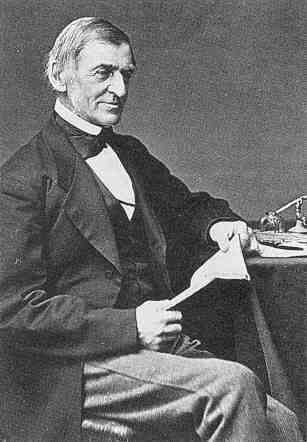
Ralph Waldo Emerson lived from 1803 to 1882. "Fable" has been on this site since 2003. It was the archive's Poem of the Day on August 28, 2012. Readers left 15 comments on it here between 2005 and 2011. Most of them take a moral lesson from it.
What readers have said
Ellie learned the poem by heart at school. This reader sees it as showing that everything in the world has its own strengths and uses, whatever its size or shape. Ellie, 2006
Majha Lanuza takes the moral to be that no one should judge others by appearance alone. majha lanuza, 2008
Renna Mabute applies the poem to how people judge those with less knowledge, and warns against rejecting them. renna mabute, 2010
John K. Thomas links the poem to the words of Jesus about regarding the least among us. John. K. Thomas, 2007
Alecs La Cuesta finds the poem simple on the surface but deeper underneath, teaching that each person is unique. Alecs La Cuesta, 2007
It is romantic loveable cute ona very manly hard to describe.
SamUnited States
This is the best poem I have ever read.
ElliotUnited States
its kinda weird
EllieMalaysia
I learned this poem by heart while in school, many, many years ago. It's a lovely poem pointing out that every thing in this world has it's strengths and uses, no matter the size or the shape.
Yo MamaUnited States
I think that this poem is a very good and nice poem to be written.
John. K. ThomasIndia
This is a precious gem among poems. raising in our insightedness the words of Jesus to regard the least among us that is the great thing you have done to me. Mighty we may think but you are a member of migty and weak which make our life joyous.
Alecs La CuestaPhilippines
This poem is yet simple but holds deeper meaning making readers realize that people have different characteristics or the essence of being unique.... I like the poem very much...and I guess Anyone who'll read it will feel the same....
ea
Yes, I realize that Emerson should be at the top of the list for the 5 most influential American poets.
bobBotswana
i like this poem because i like cheese and this poem reminds me of cheese!
majha lanuzaPhilippines
The poem is great for it communicates that no one has the right to judge someone or something by just merely looking at his/her appearance! The moral here is to be not judgmental!
leneyenPhilippines
fable
good
LeneyenPhilippines
a fable
nice poem,, it gives us lesson that every body on us has a unique abilities,, that could be special to our life!!!!
renna mabutePhilippines
i like this poem because it really touches the thoughts of the readers and it can prove our way of judging to others especially those person who have more knowledge,i know some of us easy to reject those people who have poorer knowledge and some of us think that "you are wiser than you know"
Pker4rrangePhilippines
ty for commenting cuz i have a english project and i need to explain the fable and all your comments helped me ty
It is romantic loveable cute ona very manly hard to describe.
This is the best poem I have ever read.
its kinda weird
I learned this poem by heart while in school, many, many years ago. It's a lovely poem pointing out that every thing in this world has it's strengths and uses, no matter the size or the shape.
I think that this poem is a very good and nice poem to be written.
This is a precious gem among poems. raising in our insightedness the words of Jesus to regard the least among us that is the great thing you have done to me. Mighty we may think but you are a member of migty and weak which make our life joyous.
This poem is yet simple but holds deeper meaning making readers realize that people have different characteristics or the essence of being unique....
I like the poem very much...and I guess Anyone who'll read it will feel the same....
Yes, I realize that Emerson should be at the top of the list for the 5 most influential American poets.
i like this poem because i like cheese and this poem reminds me of cheese!
The poem is great for it communicates that no one has the right to judge someone or something by just merely looking at his/her appearance! The moral here is to be not judgmental!
fable
good
a fable
nice poem,, it gives us lesson that every body on us has a unique abilities,, that could be special to our life!!!!
i like this poem because it really touches the thoughts of the readers and it can prove our way of judging to others especially those person who have more knowledge,i know some of us easy to reject those people who have poorer knowledge and some of us think that "you are wiser than you know"
ty for commenting cuz i have a english project and i need to explain the fable and all your comments helped me ty
:)
EVERYTHING is needed.