If the red slayer think he slays,
Or if the slain think he is slain,
They know not well the subtle ways
I keep, and pass, and turn again.
Far or forgot to me is near,
Shadow and sunlight are the same,
The vanished gods to me appear,
And one to me are shame and fame.
They reckon ill who leave me out;
When me they fly, I am the wings;
I am the doubter and the doubt,
And I the hymn the Brahmin sings.
The strong gods pine for my abode,
And pine in vain the sacred Seven;
But thou, meek lover of the good!
Find me, and turn thy back on heaven.
✦
Analysis
Brahma: analysis
Introduction
"Brahma" is a short poem spoken by a single divine voice. The speaker is never named inside the poem, and only the title identifies it. It claims to be present in everything, including the killer and the killed, the doubter and the doubt.
The poem sets pairs of opposites side by side and says they are one. Slaying and being slain, shadow and sunlight, shame and fame all collapse into the speaker. The last lines turn from boasts to an invitation. The "meek lover of the good" is told to find this power and turn away from heaven.
Summary
In the first stanza, "the red slayer" may think he kills, and the slain man may think he dies. Both are wrong. They do not understand the "subtle ways" in which the speaker keeps, passes and returns. The speaker then says that the far and the forgotten are near, and shadow and sunlight are the same. Vanished gods appear to it, and shame and fame are one.
The second stanza warns that anyone who leaves the speaker out of the reckoning is mistaken. If people try to flee from it, it is the wings they fly with. It is both the one who doubts and the doubt itself. It is also the hymn that the Brahmin sings.
The third stanza names beings who long for the speaker's dwelling. "The strong gods" pine for it, and so do "the sacred Seven," but in vain. The speaker then turns to address one person directly. This is the "meek lover of the good." That person is told to find the speaker and "turn thy back on heaven."
Themes and meaning
The central idea is unity behind apparent opposites. The poem pairs slayer and slain, far and near, shadow and sunlight, shame and fame. Each pair is declared the same, or "one," to the speaker (line 8). The difference people see between them is presented as a failure to know "the subtle ways" (line 3).
A second theme is the limit of human judgment. The slayer and the slain each "think" something that is not true. Line 9 says "They reckon ill who leave me out." Human accounts of death, fame and escape are shown as partial. They miss the one presence that runs through all of them.
The poem also treats death as illusion. The opening lines deny that killing ends anything. The speaker keeps, passes and will "turn again," which can be read as a cycle of return. Reader comments on this site read it this way, as a soul that changes bodies but does not die.
The speaker cannot be escaped. Line 10 turns flight into part of the thing fled: "When me they fly, I am the wings." Line 11 absorbs even unbelief, since the speaker is "the doubter and the doubt." Nothing stands outside it.
Finally, the poem sets humility above power and heaven. The "strong gods" and "the sacred Seven" pine for the speaker's abode and fail. The "meek lover of the good" is invited instead. The closing command to "turn thy back on heaven" suggests that this presence lies beyond heaven itself. A reader may take it as found within rather than above.
Tone
The tone is calm, assured and impersonal. The speaker makes large claims in plain statements, with no argument or proof. Phrases such as "Shadow and sunlight are the same" are simply announced. The effect is of a voice that has nothing to prove.
There is a note of gentle correction in the first and second stanzas. The slayer and slain "know not well," and those who leave the speaker out "reckon ill." The criticism is mild, almost patient, rather than angry.
The tone shifts in the last two lines. The "But" of line 15 turns from the pining gods to a single humble person. The exclamation "meek lover of the good!" brings warmth and direct address. The poem ends in an invitation rather than a claim.
Form and structure
The poem has 16 lines. They are set in 4 stanzas of 4 lines. The metre is iambic tetrameter, and it is very regular. Every line has 8 syllables except two lines of 9. Those two end on "Seven" and "heaven," which add an unstressed final syllable.
The lines rhyme alternately. The computed scheme marks the first line as unknown, because "slays" is not in its dictionary. By ear, "slays" rhymes with "ways." The pairs "slain" and "again," and "abode" and "good," are near rhymes that the computed scheme leaves unmatched. The short, even lines give each paradox the weight of a proverb.
Poetic devices
Paradox line 1
If the red slayer think he slays The killer only thinks he kills. The line denies what seems most obviously true, and sets up the poem's claim that death is not what it appears.
Imagery line 1
red slayer The single colour word gives the killer bloodied hands. It makes the abstract argument begin with a vivid, violent picture.
Polysyndeton line 4
I keep, and pass, and turn again The repeated "and" links three actions into a slow, continuous cycle. It suggests endless movement and return.
Antithesis line 6
Shadow and sunlight are the same Opposites are set side by side and declared equal. The alliteration on "s" binds the two words together in sound as well.
Antithesis line 8
And one to me are shame and fame Two opposite judgments are made one. The internal rhyme of "shame" and "fame" shows how close they are to the speaker.
Paradox line 10
When me they fly, I am the wings The means of escape is the thing being escaped. The line shows that the speaker cannot be fled.
Repetition line 11
I am the doubter and the doubt The echo of "doubter" and "doubt" places the speaker in both the person and the act. Even disbelief is part of it.
Alliteration line 14
the sacred Seven The repeated "s" sound gives the phrase a solemn, ritual weight. It also echoes the hissing sounds of "slayer" and "slays" in the first line.
Apostrophe line 15
But thou, meek lover of the good! The speaker turns to address one listener directly. The shift from "they" to "thou" makes the ending personal.
Inversion line 10
When me they fly The object comes before the verb. The word order keeps the metre regular and puts "me" in a stressed, early position.
Words worth knowing
Brahmin
A member of the Hindu priestly class. Here, a priest singing a sacred hymn.
reckon
To count or calculate. To "reckon ill" is to make a wrong reckoning.
fly
Here it means to flee, not to fly through the air, though line 10 plays on both senses with "wings."
pine
To long for something intensely, usually without getting it.
abode
A dwelling place or home.
slayer
One who kills. The word is old-fashioned and belongs to heroic or biblical language.
Context
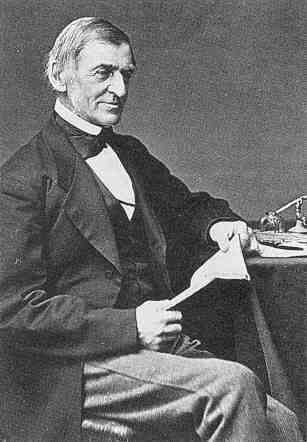
Ralph Waldo Emerson lived from 1803 to 1882. "Brahma" was the archive's Poem of the Day on December 20, 2003. Readers left 6 comments on it here between 2004 and 2014. Several of those comments explain the title from Hindu thought.
What readers have said
S S Samant reads the title as Brahm or Brahman, the self or soul, rather than the creator god. On this reading the poem teaches that the soul never dies but changes bodies until it reaches perfection. S S Samant, 2004
Aaron Quintana reads the ending as saying that once Brahma is found, the gods and conventional faith are no longer needed. Aaron Quintana, 2004
Sharika sees the poem as a summary of the Bhagavad Gita. This reader takes Brahma as the indestructible energy behind creation and hears a call to seek it within. sharika, 2010
Arun takes Brahma simply as the Hindu god, a presence standing everywhere. Arun, 2012
Brahma is pronounced as Brahm, means self. The poem explains the Hindu belief that soul never dies, body does. Soul just change bodies, leaves one and takes another. Until the soul attains perfection it keeps coming back to earth in some form or another. On getting perfection with good deeds, it reaches God, and becomes one with Him. Some critics wrongly ananlyze Brahma as Brahmaa - one of the Hindu God among Trinity. Here Brahma is Brahm, also spelled as Brahman that means the self, soul.
Aaron QuintanaUnited States
Brahma - the single absolute being pervading the universe and found within the individual; atman. I think that in "The vanished gods to me appear, And one to me are shame and fame.", it means that he doesn't care for the gods, for in saying "The strong gods pine for my abode, And pine in vain the sacred Seven; But thou, meek lover of the good! Find me, and turn thy back on heaven.", it means that if you find Brahma,…
Read the whole comment
Brahma - the single absolute being pervading the universe and found within the individual; atman.
I think that in "The vanished gods to me appear, And one to me are shame and fame.", it means that he doesn't care for the gods, for in saying "The strong gods pine for my abode, And pine in vain the sacred Seven; But thou, meek lover of the good! Find me, and turn thy back on heaven.", it means that if you find Brahma, you no longer need the "gods", or faith, because they are one in the same, & if you have found Brahma, you are self-fufiled, and need not faith, for you are above humanity, and in turn you are your own "god", or symbol of faith, so turn your back on primitive beliefs, or "heaven", for you are better, you are all in one.
i really agree with this poem. you dont god in your life
sharikaIndia
brahma
here goes my analysis: Emerson has very beautifully summarised the entire Bhagvath Gita in this poem.Brahma here refers to that universal energy that is behind this entire creation, that which is indestructible. Call it God, Big mindconsciousness, Self, Paramatman, Nature, Light.. and thta big mind is speaking to us, revealing itself that shadow and light are in fact same, ( opposite values are complementary) and my…
Read the whole comment
here goes my analysis: Emerson has very beautifully summarised the entire Bhagvath Gita in this poem.Brahma here refers to that universal energy that is behind this entire creation, that which is indestructible. Call it God, Big mindconsciousness, Self, Paramatman, Nature, Light.. and thta big mind is speaking to us, revealing itself that shadow and light are in fact same, ( opposite values are complementary) and my favourite bit is Find me.. all of us need to seek the brahma within us :)
the doubter and the doubt being one is basis for all the indian text. the actor and teh act is one, the dancer and the dance is one..when that happens there is true union ..( that is the actual meaning of yoga, union) If you are into any art form, you will realise at some point, there is a space where you becoem one with music, that is when you ar ein touch with the cosmos or the brahma
for more understanding of the poem, you may need to do sudarshan kriya ( the awesomest process ever invented by Sri Sri Ravi Shankar) in workshops conducted by the Art of Living :D
Arun
Brahma
I belive that Brahma is the god of hindhu.It is standing for every where.Especially it is seeing by a baby.
Brahma is pronounced as Brahm, means self. The poem explains the Hindu belief that soul never dies, body does. Soul just change bodies, leaves one and takes another. Until the soul attains perfection it keeps coming back to earth in some form or another. On getting perfection with good deeds, it reaches God, and becomes one with Him.
Some critics wrongly ananlyze Brahma as Brahmaa - one of the Hindu God among Trinity. Here Brahma is Brahm, also spelled as Brahman that means the self, soul.
Brahma - the single absolute being pervading the universe and found within the individual; atman. I think that in "The vanished gods to me appear, And one to me are shame and fame.", it means that he doesn't care for the gods, for in saying "The strong gods pine for my abode, And pine in vain the sacred Seven; But thou, meek lover of the good! Find me, and turn thy back on heaven.", it means that if you find Brahma,…
Read the whole commentBrahma - the single absolute being pervading the universe and found within the individual; atman.
I think that in "The vanished gods to me appear,
And one to me are shame and fame.", it means that he doesn't care for the gods, for in saying "The strong gods pine for my abode,
And pine in vain the sacred Seven;
But thou, meek lover of the good!
Find me, and turn thy back on heaven.", it means that if you find Brahma, you no longer need the "gods", or faith, because they are one in the same, & if you have found Brahma, you are self-fufiled, and need not faith, for you are above humanity, and in turn you are your own "god", or symbol of faith, so turn your back on primitive beliefs, or "heaven", for you are better, you are all in one.
i really agree with this poem. you dont god in your life
brahma
here goes my analysis: Emerson has very beautifully summarised the entire Bhagvath Gita in this poem.Brahma here refers to that universal energy that is behind this entire creation, that which is indestructible. Call it God, Big mindconsciousness, Self, Paramatman, Nature, Light.. and thta big mind is speaking to us, revealing itself that shadow and light are in fact same, ( opposite values are complementary) and my…
Read the whole commenthere goes my analysis:
Emerson has very beautifully summarised the entire Bhagvath Gita in this poem.Brahma here refers to that universal energy that is behind this entire creation, that which is indestructible. Call it God, Big mindconsciousness, Self, Paramatman, Nature, Light..
and thta big mind is speaking to us, revealing itself that shadow and light are in fact same, ( opposite values are complementary) and my favourite bit is Find me.. all of us need to seek the brahma within us :)
the doubter and the doubt being one is basis for all the indian text. the actor and teh act is one, the dancer and the dance is one..when that happens there is true union ..( that is the actual meaning of yoga, union) If you are into any art form, you will realise at some point, there is a space where you becoem one with music, that is when you ar ein touch with the cosmos or the brahma
for more understanding of the poem, you may need to do sudarshan kriya ( the awesomest process ever invented by Sri Sri Ravi Shankar) in workshops conducted by the Art of Living :D
Brahma
I belive that Brahma is the god of hindhu.It is standing for every where.Especially it is seeing by a baby.
it is different from other poems its amazing.