The poem
Me up at does out of the floor quietly Stare a poisoned mouse
still who alive is asking What have i done that You wouldn't have
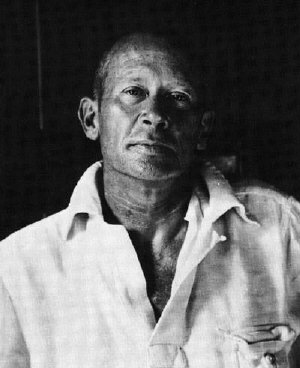
The poem
Me up at does out of the floor quietly Stare a poisoned mouse
still who alive is asking What have i done that You wouldn't have
"(Me up at does)" is an eight-line poem about a poisoned mouse that stares up at the speaker as it dies. Its words are out of order, so the reader has to reassemble them to see the scene.
Once sorted, the poem is a single event and a single question. The mouse seems to ask what it has done that the speaker would not have done. No answer comes. The poem is about guilt, and about the power of a large creature over a small one, with the excuses given for that power.
The first four lines describe one sight, with the words scrambled. In plain order, "a poisoned mouse" does stare up at the speaker. It stares "quietly", and it looks up "out of the floor", from somewhere down among the boards. The opening words, "Me up at does", give the object, the direction and the helping verb before anything else. The next lines give the place, the manner and the verb. The creature itself comes last, in line 4.
The last four lines add that the mouse is still alive. The words read "still who alive", which sorts into who is still alive. The mouse "is asking" something. Its question runs across the last three lines: "What / have i done that / You wouldn't have". The word order is nearly normal here. In plain words, the mouse asks what it has done that the one above it would not have done too. There is no question mark, and the speaker gives no reply.
Shared guilt, or shared nature, is the centre of the poem. The mouse's question does not plead innocence. It asks only whether the other party would have behaved differently. Put in the mouse's place, the "You" of line 8 would presumably have done the same. The mouse names no deed, so the question reaches any act done to stay alive.
Power and its scale matter just as much. The capital "Me" opens the poem, and the capital "You" opens its last line, while the mouse's own "i" on line 7 is small. The capitals can be read as showing how large the human stands and how small the victim is. Yet the small creature asks the only question, and the large one is silent.
The violence is quiet and domestic. There is no trap and no blow, only poison and a slow end. The speaker has not killed the mouse in any direct way, and now has to watch. The word "quietly" makes that watching harder, because there is nothing to drown it out.
The disorder of the words is part of the meaning. It may show the speaker's shock, or the mouse's poisoned confusion. Sense arrives only as the question arrives, so clarity comes with the accusation. Readers also extend the poem to social classes and to judging others, and the wide wording of the question allows it.
The tone is quiet and uneasy. The speaker makes no comment and uses no word of pity or regret. The small, flat words report a sight and no more.
That restraint gives the scrambled syntax its force. The tangled opening suggests someone unsettled. The mouse's question is calm too. It has no question mark and no exclamation, so it sounds less like a cry than like a level enquiry.
The tone shifts from disturbed seeing to moral pressure. By line 8, the word "You" turns on the speaker, and it also seems to turn on the reader. The silence after "have" is left for that listener to fill.
The poem has 8 lines, and every line has exactly 4 syllables. This strict count is a small, tight box around a scrambled sentence, and the syntax seems to fight it. There is no exact rhyme and no fixed metre. The endings do echo in pairs: "does" with "mouse", "floor" with "Stare", "What" with "that", and the eye rhyme of "alive" and "have". Most lines fall into two beats, but the pattern of stresses varies from line to line.
Punctuation is almost absent, with only the apostrophe in "wouldn't". Four words take unexpected capitals: "Me", "Stare", "What" and "You". Read alone, they almost form a summary of the poem. All the words are short, and only "quietly" and "poisoned" have much weight of sound.
Me up at doesThe sentence starts with its object and a verb with no subject. The reader has to hunt for meaning, and the speaker comes first in every sense.
MeThe large capital puts the human at the head of the poem. It sets up the contrast with the small "i" that the mouse uses on line 7.
out of the floorThe mouse seems to come from the structure of the house itself. The phrase also places the speaker above and the creature below.
quietly StareThe capital gives the look unusual weight, while the adverb takes all noise from it. The stare becomes the poem's one action.
a poisoned mouseThe subject is held back to the end of the opening sentence. The delay makes the reader wait, and the plain phrase lands all the harder for it.
still who aliveThe word "still" can mean motionless or even now. Both senses fit a poisoned creature that has stopped moving but has not yet died.
is asking WhatA mouse cannot put this question in words. So the question is what the speaker reads in its eyes, and that makes it a kind of conscience.
have i done thatThe small "i" gives the mouse a self while keeping it little. The line is all short words, and its plainness makes the question hard to avoid.
You wouldn't haveThe expected answer is that there is no difference. The missing question mark leaves it hanging as a challenge instead of a request.
It was Poem of the Day on March 6, 2005.
Keep reading
Readers
This is a wonderful poem and it begs a good question. I often wonder who we are to judge; to deal in mercy and cruelty. Am I the only one who's mixed up the words a million different ways and reread and reread looking for more? He could always say everything in a few short lines while so many dangle hopelessly behind him...
It just goes to show how distilled Cummings can write. in his writing I saw a much more fatalistic view. To me, the mouse seems to be questioning social classes. Even more so, the mouse seems to despair at the hand it was dealt.
I find it amazing that so many interpretations can be wrought from so few words.
personally i think the poem is about us looking down on a helpless creature.. we are so aggravated by this tiny thing living in our house but the mouse asks us "if you were me, what would you do?"... we wouldnt do anything differently... we all have to live, no matter how small we are.
He is on acid and many other drugs i read up on him during his teen life.
well even if he is on acid, he still produced something worth reading and that has been thought provoking. I'd like to see anyone write poetry like this while drugged.
Certain drugs can stimulate the imagination. I wonder if the acid permanetly altered his though processes...
I think that Cummings is trying to tell us about societies social classes and how people are so cruel to others.
It's an interesting poem. There's more to it than meets the eye. The mouse is poisoned, not dead. But it will die soon. I think cummings is thinking about, how could someone kill another thing. Be it a mouse. But it could go farther than that. I think the poem is about indifference to life. How we can so easily kill something else.
still who alive
is asking What
have i done that
You wouldn't have
acid wasnt discovered till after he wrote this and he was pretty old.
My interpretation would be that in the face of death we never exactly know what to do... no matter what life form it is... in this case a mouse
cummings has been my favorite poet since I was about 7 and I have his complete works but have just recently discovered this poem. It affected me a lot. I have been a vegetarian all my life and may have a particular sensitivity toward animals, but this poem made me think of pests, and of animals people eat, and of social classes. It seems to me that if we can keep this poem in mind at all times and live by it, we can…
Read the whole commentcummings has been my favorite poet since I was about 7 and I have his complete works but have just recently discovered this poem. It affected me a lot. I have been a vegetarian all my life and may have a particular sensitivity toward animals, but this poem made me think of pests, and of animals people eat, and of social classes. It seems to me that if we can keep this poem in mind at all times and live by it, we can be truly sensitive souls. There are people starving and people stealing and people we look down on who are the lower classes of society but ultimately we all want the same things: to survive, and the best for our offspring. When it comes down to survival every person is equal, we all want the same things.
sometimes nothing is said, that is exactly what he wants to bring accross, we stare passively, whilst doing nothing. we are essentially all poison, we like to stare at the death of others, not realizing we are dying too.
the poem me upat does is great, i read so many poems and this just stood out. who are we to judge who or what dies and lives. or am i reading to much into it coz i'm a artist. poem is just great.
this poem is really supposed to be looked at from the mouses view, you can rearrange the poem to be spoken from the mouse itself.
I think this poem has a great meaning and like someone said you can not judge people by how they dress, or how they look and I think that there are alot of people who do that at my school and it is just not at school it is very where you look they are judging. So I think that Me up at does it is a great poem.
This poem is very deep in the sense that I think it is talking about what you accomplish in life, stuff that NO one else has the courage to.
This poem is a first person narrative. The narrator has poisoned a mouse. The mouse is still alive and staring at the narrator through a crack in the floor. The mouse is quiet but seems, to the narrator, to be asking, "What have i done that you wouldn't have".
Like a lot of you, I agree that Cummings is commenting on social classes. I think he is raising the question who are we to think we're better than anyone else? Whether it be because of social classes or skin color (or even species), we are all more alike than what we may think. If we were that mouse we would have taken the cheese just like he did, so why is it up to us to play god and decides who lives and who dies? Or for that matter, who is more superior?
I'm just having trouble interepreting the line "Me up at does." Any ideas?
when you are reading a poem by cumming more than any thing you should be careful about the form.I don't want to influnce other's viwes but I do care the just words in capitale Me Stare What
The theme of human alienation in Me up at does, is one we cannot deny. Many times, we see others around us dying slowly, doing things that will lead to their doom and we actually encourage these acts by " providing cheese" through drugs, encouragement , envying them and hating them. Finally when their death comes, we feel a deep sorrow and think "what could i have done better". Undeniably the personna has a deep…
Read the whole commentThe theme of human alienation in Me up at does, is one we cannot deny. Many times, we see others around us dying slowly, doing things that will lead to their doom and we actually encourage these acts by " providing cheese" through drugs, encouragement , envying them and hating them. Finally when their death comes, we feel a deep sorrow and think "what could i have done better". Undeniably the personna has a deep sense of regret at the end. And this is evident in the abrupt end on the "imagined " words of the mouse. The words resound and resound in the personna and the reader's head. I believe this poem is a call to all races, nations and ppl in different neighbourhoods. DOnt wait till the shunned and neglected are about to die before you reflect on sorrow and what you could have done. NOw is the time to smile at someone, to speak to them about their misdeeds and to show them that Jesus is the savior. A few weeks ago, a boy in my college died. He was found with stabs and shots aallover him. Drugs maybe, who knows but "what had he done that we wouldnt have done" maybe if we didnt live in such an alienated society and we got to know each other.maybe then and just maybe if oneday i had spoken to Ricky about Jesus Christ and invited him to church. Maybe then we wouldnt be staring down at the haunting eyes on the bereavment T-shirt that students wear, the shirt in which the face of ricky asks.."what have i done that you wouldnt have"
I think this poem is about how during the great depression there were a lot of suicides and basically the mouse is saying "If you lost your money your job and everything that means somthing to you. wouldnt you do the same as me which is kill myself" and hes asking the "bigger" people of society that question.
I would agree that even though the narrator is a human, the mouse's perspective is still communicated. After all, from a human perspective no one would know what the mouse is saying. I also think that the rearranged word order communicates the chaotic state of the dying mouse's mind, especially since it's poisoned and not just trapped.
i think people overanalyze. could it be that he saw a mouse after eating rat poison? one thing that people like to do is overanalyze what famous people say as if they're the smartest person in the world. this could have been a scribbling on a napkin somewhere when that thought popped in his head. dont get me wrong, i know it could represent a higher society and suffering and such and so-on, but you sometimes you…
Read the whole commenti think people overanalyze. could it be that he saw a mouse after eating rat poison? one thing that people like to do is overanalyze what famous people say as if they're the smartest person in the world. this could have been a scribbling on a napkin somewhere when that thought popped in his head. dont get me wrong, i know it could represent a higher society and suffering and such and so-on, but you sometimes you have to realize that it may mean nothing. this happened a lot with the works and lyrics of Bob Dylan. he said that he just wrote down stories in his head or thought or whatever, and that people overanalyzed and made up their own stories with deep deep hidden backgrounds and messages that needed to be literarily decoded. It could be either. It's just that some people find famous people in such high regard that they hold their words as moe than they may be, because, after all, ee cumings was more or less just like you and I. Don't delve too deep people. Sometimes it's necessary, but not always.
The poem, i think, is essentially about the universality of human experience in the sense that we all feel subjected at some point in our lives. 'What have i done that you wouldn't have?' is the heart of the poem - across species, class, culture, nationality, religion & etc. it must be remembered that none of us want to be poisoned.
So simple a poem and at the same time so deep and so emotionally wrenching. Edgarian in nature, it points a finger straight out of the page at your face and makes you examine yourself. The focus of this poem can be summed up in one word: Hypocracy. No further explanation be needed. The world is full of it, and Cummings did an amazing job getting his point across in a way that was at the same time simple, moving, cutting, intelligent and artistic.
i belive that this peom is very awsome, i think that thoughts who do not understand his writing will learn more about him if you read more of this work. i enjoy every bit of what he has to offer in his writing.
The analysis and comments of this poem is one of my assignments of school.It's rather difficult for a Chinese college student ,like me, to understand it.
It is your website that helps me make it!
never have i read something so boring in my life
this gives a clear indication of the complete pattern of thought that e.e. cummings had. to me this showed a hold of the full days of experience in a short moment of time. and also of the competition that took place during some of the stages of any particlar day.
I think the poet is speaking throgh the mouth of a criminal. May be in war , in the street or any other place he had killed sb, unintetionally, That person is sad all the time and there is astorm at his mind, and even poisening a mouse makes him confused and distressed.
Prof.
I see considerable discussion about the last line of the poem. But what about the first line? It seems to me that the first line is the moment when the mouse gets poisoned, and loses all ability to use intelligible language. In this way, it contrasts with the profundity of the end. As he lies dying, the mouse regains his ability to speak, and says, in brief, 'I have no need to justify my life.'
(Me up at does)
Try taking the words and rearranging them into one or two sentences. It takes some effort, but this process can help with the understanding of his poem. Also look at the words he chose to capitalize. Besides that, this poem is a commentary on hypocrisy, how we judge others when they are only trying to survive. We all have a survival instinct, yet how quickly we forget. I love how the poet has distilled the very essence of what it means to be a hypocrite.
me up at does
He gains our interest of reading this poem over and over trying to make sence of his words. We want to understand and find his message eventhough the words are mixed up.
kOfmLPFV
When my dad was really sick with emmpesyha (he passed away 11 yrs aga) my mum bought him a get well card with this poem on the cover it really is a great poem to encourage positive thinkin during tough times xx
Almost identical to a white mans burden... if in my shoes, you would have fallen to the same actions and fate as I.
A poisoned mouse, which is out of the floor, does quietly stare at me.
Someone still alive, is asking “What have I done that you wouldn’t have?”