I will be the gladdest thing
Under the sun!
I will touch a hundred flowers
And not pick one.
I will look at cliffs and clouds
With quiet eyes,
Watch the wind bow down the grass,
And the grass rise.
And when lights begin to show
Up from the town,
I will mark which must be mine,
And then start down!
✦
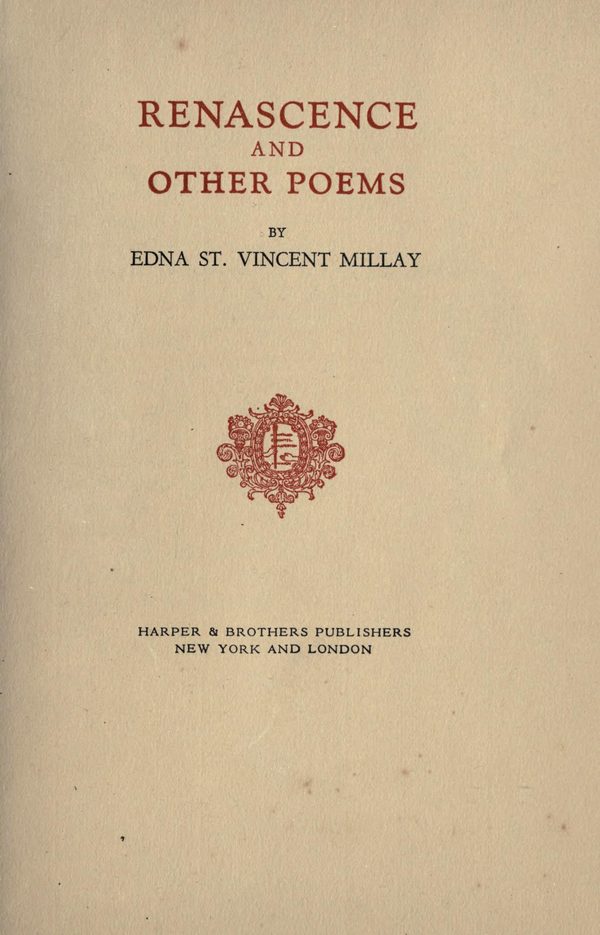
From the bookRenascence and Other PoemsTitle page, Harper & Brothers printing, 1917 (first published by Mitchell Kennerley the same year)
Analysis
Afternoon On A Hill: analysis
Introduction
"Afternoon On A Hill" is a short lyric of three quatrains. It appeared in Renascence and Other Poems in 1917. A speaker describes how an afternoon on a hill will be spent, from the first burst of joy to the walk home at dusk.
The poem is about delight that asks for nothing. The speaker touches flowers without picking them and watches the landscape with calm attention. At nightfall the speaker picks out a home light in the town below and heads toward it. Every main verb looks forward, so the whole poem is a promise of happiness.
Summary
The speaker declares, "I will be the gladdest thing / Under the sun!" The speaker then promises to touch "a hundred flowers" but not to pick a single one. The stanza sets out the plan for the afternoon. The first sentence ends with an exclamation mark. The second closes the stanza on a small act of holding back.
In the second stanza the speaker will look at "cliffs and clouds" with "quiet eyes." The speaker will also watch the wind bend the grass down. Then the speaker will watch the grass stand up again. The stanza is all looking, with no action by the speaker. The wind moves and the grass responds.
The third stanza moves to evening. Lights begin to show "Up from the town" below the hill. The speaker will pick out which of them "must be mine." Then, with an exclamation, the speaker will "start down" the hill toward home. The poem ends there, at the start of the descent.
Themes and meaning
The first theme is joy without possession. The speaker will "touch a hundred flowers / And not pick one." Picking would end the flowers' life and make them the speaker's property. The speaker's gladness does not depend on taking anything. It comes from contact and attention alone.
A second theme is calm observation of nature. The speaker looks "With quiet eyes" at cliffs and clouds. The grass is bowed down by the wind and then rises again. This movement can be read as an image of recovery. Whatever presses down on the grass, it returns to its place.
A third theme is belonging. At dusk the speaker looks for the light that "must be mine." The word "must" suggests the speaker is working it out from a distance, not seeing it plainly. The joy of the hill does not replace home. The afternoon ends in a willing return, marked by "And then start down!"
The poem is also about anticipation. Almost every clause is in the future tense, beginning "I will." The reader never learns whether the afternoon actually happens. The poem can be read as a plan, a wish, or a promise the speaker makes to itself. The happiness it describes is partly the happiness of looking forward.
Tone
The poem opens in exuberance. "I will be the gladdest thing / Under the sun!" is a boast of pure happiness, closed with an exclamation mark. The claim is large and childlike in its confidence.
The tone quiets at once. The restraint of "And not pick one" introduces gentleness. The second stanza is still and attentive, with its "quiet eyes" and the slow motion of the grass. Nothing in it is hurried.
The last stanza is content and warm. The speaker notices the town lights calmly and claims one of them. The final exclamation, "And then start down!", brings back some of the opening energy. The day ends in happiness, not in regret that it is over.
Form and structure
The poem has 12 lines in 3 stanzas of 4 lines each. Each stanza rhymes only its second and fourth lines, giving ABCB, DEFE and GHIH. The rhymes are "sun" and "one," "eyes" and "rise," "town" and "down."
The lines alternate long and short. The long lines run from 6 to 8 syllables, and every short line has 4. The long lines move mainly in trochees, as in "Watch the wind bow down the grass." The short lines have two stresses each, as in "Under the sun."
The short indented lines work like a refrain. Each one completes the thought of the line before it in a few words. The first and last short lines both end with an exclamation mark, framing the poem.
Poetic devices
Hyperbole line 1
I will be the gladdest thing The speaker claims more happiness than anything else alive. The overstatement shows the size of the speaker's joy.
Anaphora line 3
I will touch a hundred flowers "I will" opens lines 1, 3, 5 and 11. The repeated phrase keeps the poem in the future and gives it the sound of a vow.
Restraint as paradox line 4
And not pick one After a hundred flowers, the speaker takes none. The turn makes holding back part of the joy rather than a limit on it.
Alliteration line 5
cliffs and clouds The repeated hard c links the solid rock and the passing sky. The sound joins the two things the speaker will look at.
Transferred epithet line 6
With quiet eyes Eyes make no sound, so the quiet belongs to the speaker's mind. The phrase describes a calm, patient way of looking.
Personification line 7
Watch the wind bow down the grass The verb "bow" gives the grass a human gesture of respect or submission. The wind seems to have power over it.
Repetition line 8
And the grass rise The phrase "the grass" is repeated from line 7. The repetition makes the rising a direct answer to the bowing, as if the grass recovers.
Imagery line 10
Up from the town Lights rise toward the hill from the town below. The image shows the height of the hill and the coming of night.
Rhyme and exclamation line 12
And then start down! The word "down" rhymes with "town" and so points toward it. The exclamation mark echoes line 2 and ends the day in energy.
Words worth knowing
bow
To bend or bow down, like a person bowing. It rhymes with now, not with low.
mark
To notice and pick out. The speaker identifies a light by eye, not by writing anything.
Context
The poem appeared in Renascence and Other Poems, published in 1917. Edna St. Vincent Millay lived from 1892 to 1950. Readers commented on the poem on this site between 2004 and 2024.
What readers have said
amelia says the poem describes amelia exactly, taking the speaker's gladness as a personal portrait. amelia, 2004
Amber finds the poem relaxing and says it makes one want to find a hill and read. Amber does not think it is the poet's best work. Amber, 2004
steeven reads it as a lesson in seeing the beauty of nature by looking and touching. steeven feels like the speaker and contrasts the poem with people who ignore their surroundings. steeven, 2010
charina reads the poem as being about opportunities. On this reading, the speaker is free to choose among the good things on offer, whatever brings happiness. charina, 2011
Keep reading
Discover more of Edna St. Vincent Millay’s poetry.
i just love this poems it totally describes me your an awesome poet thanx!!!!!!!!!!!!!!!
AmberUnited States
it was a great poem. It makes you want to just go graba book and find a hill and read. It was no the best of her work but it was an interesting and relaxing poeml.
juanaHonduras
this poem was great..i loved it so much it remindes me of the afternoon and the hills at the time of the afternoon....it was amazing to sit and read just literature while smoking a blunt and masterbating with my 12inch dildo!
juana you are a disgusting man dont ever put that on a public sight you idiot! but i enjoyed this poem very much so and it very relaxing.
tanweerMauritius
this poem is really great because it describes nature
steevenPhilippines
reaction
The poem “Afternoon on a hill” shows how we should see the beauty of nature. The poem makes me feel refresh and relax. The make want to grab a book and find a hill and read. This poem let me see the beauty of our surroundings. The poem let me feel that I am the one who is speaking in the poem. The poem shows how some people appreciate the beauty of nature by just seeing and touching. Some people can be glad in…
Read the whole comment
The poem “Afternoon on a hill” shows how we should see the beauty of nature. The poem makes me feel refresh and relax. The make want to grab a book and find a hill and read. This poem let me see the beauty of our surroundings. The poem let me feel that I am the one who is speaking in the poem. The poem shows how some people appreciate the beauty of nature by just seeing and touching. Some people can be glad in simple things. But many people don’t care about their surrounding they do not appreciate the beauty of their environment. They are not contented on what they see. They only look at the negative side and not in the positive side. Example, some of our tourist spots are not really appreciated by the people. That shows how the people don’t appreciate the beauty of nature. The poem describes the beauty of nature.
charinaPhilippines
the poem
Well, for me it is simply about the opportunities that had arrived. Since you have received those opportunities, you are free to choose among those things were you find good and makes you happy.
i just love this poems it totally describes me your an awesome poet thanx!!!!!!!!!!!!!!!
it was a great poem. It makes you want to just go graba book and find a hill and read. It was no the best of her work but it was an interesting and relaxing poeml.
this poem was great..i loved it so much it remindes me of the afternoon and the hills at the time of the afternoon....it was amazing to sit and read just literature while smoking a blunt and masterbating with my 12inch dildo!
juana you are a disgusting man dont ever put that on a public sight you idiot! but i enjoyed this poem very much so and it very relaxing.
this poem is really great because it describes nature
reaction
The poem “Afternoon on a hill” shows how we should see the beauty of nature. The poem makes me feel refresh and relax. The make want to grab a book and find a hill and read. This poem let me see the beauty of our surroundings. The poem let me feel that I am the one who is speaking in the poem. The poem shows how some people appreciate the beauty of nature by just seeing and touching. Some people can be glad in…
Read the whole commentThe poem “Afternoon on a hill” shows how we should see the beauty of nature. The poem makes me feel refresh and relax. The make want to grab a book and find a hill and read. This poem let me see the beauty of our surroundings. The poem let me feel that I am the one who is speaking in the poem. The poem shows how some people appreciate the beauty of nature by just seeing and touching. Some people can be glad in simple things. But many people don’t care about their surrounding they do not appreciate the beauty of their environment. They are not contented on what they see. They only look at the negative side and not in the positive side. Example, some of our tourist spots are not really appreciated by the people. That shows how the people don’t appreciate the beauty of nature. The poem describes the beauty of nature.
the poem
Well, for me it is simply about the opportunities that had arrived. Since you have received those opportunities, you are free to choose among those things were you find good and makes you happy.
juana...
Juana why
what is the literal meeting
Why?