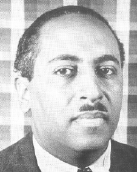
Biography
Arna Bontemps was born in Alexandria, Louisiana, the son of Creole parents. His father was a skilled brick mason who moved his family to Los Angeles when Arna was three years old. Tension developed between father and son when Arna refused to be apprenticed as a mason. He was sent away to a white boarding school in San Fernando with his father's command not to "go up there acting colored." Unhappy at what he saw as his father's effort to make him forget his racial heritage, Bontemps went on to Pacific Union College in Angwin, California, graduating in 1923.
A year later, Bontemps began to publish his poetry in magazines such as The Crisis and Opportunity, which encouraged the work of young African American writers. He had hoped to study for a Ph.D. in English, but after his marriage in 1926 and the subsequent birth of six children, he accepted teaching jobs to support his family. In 1926 he moved to New York City to teach at the Harlem Academy for five years, a period in which he was also close to several important figures of the Harlem Renaissance, including Langston Hughes and Jean Toomer. In 1931 he published his first book, God Sends Sunday, a novel about a black St. Louis jockey. That year Bontemps moved to Huntsville, Alabama, to teach at Oakwood Junior College.
He grew frustrated at trying to reach his own generation and decided to write to younger readers, "not yet insensitive to man's inhumanity to man." For the remaining forty years of his life, Bontemps wrote biographies, children's fiction, and black history, and compiled literary anthologies, often in collaboration with his close friends Langston Hughes and Jack Conroy. In 1943, after completing a master's degree in library science, he served until his retirement as head librarian at Fisk University, developing an archive of African American cultural materials that is a major resource for study in this field.
On Southern Mansion
On The Day-Breakers
On A Black Man Talks of Reaping
On God Give to Men