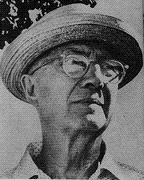
William Carlos Williams

Portrait of William Carlos Williams
William Carlos Williams 1883–1963
1883Born

Born in Rutherford, New Jersey, near the city of Paterson, William Carlos Williams studied medicine at the University of Pennsylvania. There he became friends with Ezra Pound and Hilda Doolittle (later known as H. D.) and started to think of his medical career as a means of supporting himself while he composed poetry, even as he interned in New York City and pursued postgraduate studies in Germany. Williams made Rutherford his lifelong home and practiced medicine until he retired, writing at night and spending weekends in New York City with other writers and artists.

Williams consciously wrote poetry that provided a counterpoint to that of [Frost](/poets/robertfrost), [Pound](/poets/ezrapound), and Eliot. In his work, he wished to speak like an American within an American context of small cities, immigrants, and workers. He wanted his poetic line to reflect the rhythm of everyday speech and drew his subject matter from ordinary surroundings -- a painting, a red wheelbarrow, a dish of plums. Williams's collections include Spring and All (both poetry and prose; 1923); Paterson, which was published in five books (1946, 1948, 1949, 1951, 1958); and Pictures from Brueghel (1962). Williams also wrote essays, some of which are collected in In the American Grain (1925).
Reading closely

Analyses

A full analysis sits under 10 of these poems: what each poem says, how it is built and how readers here have read it. About the analyses

  • This Is Just To SayAn apology for eating the plums that turns, in its last lines, into relish
  • The ThingA ringing thing that calls no one, and the bitter shared service it commands
  • Poem (As the cat)A cat's careful descent into an empty flowerpot, slowed down line by line
  • The Crowd At The Ball GameA ballpark crowd seen as both beautiful and venomous, joyful play and mob cruelty
  • A Sort Of A SongThe snake and the saxifrage as models for writing that waits, strikes and splits rock
  • Spring And AllA dead winter roadside and the slow, birth-like arrival of spring's first plants
  • The Widow's Lament In SpringtimeA widow's grief against spring's flowers, ending in a wish to sink into the marsh
  • The Young HousewifeA passing driver watches a young housewife, compares her to a leaf and crushes leaves
  • NantucketA clean sunlit room seen object by object, from flowers at the window to a white bed

From readers

What readers say about William Carlos Williams

  1. On The Red Wheelbarrow

    “*I love this poem.:) he he This really shows that William Carlos williams was an idealistic poet and used simple ideas and words to bring across very descriptive pictures. The way this poem is worded shows the deeper meaning greatly, like "so much depends upon the red wheelbarrow" shows that…”

  2. On The Young Housewife

    “William Carlos Williams uses very specific images in "The Young Housewife" to reveal not merely a particular circumstance or event, but to also suggest underlying themes and ideas of his subject matter. For example, he gives to the reader various real and imagined images, such her moving about in…”

  3. On This Is Just To Say

    “I'll tell you what this poem is about. It's about living in the moment. The narrator ate the plum which he knew that the "audience" was saving for breakfast. Instead of thinking about things and the audience's feelings, he decided to act in the moment and eat the plum. He didn't think about the…”

  4. On The Crowd At The Ball Game

    “This poem is quite referential to the works of Emily Dickinson. Use of hyphens is the first key. In addition, short microcosms consume each stanza. Finally, metaphor is apparent; such as: "a spirit of uselessness which delights them-". This compares the crowd to "uselessness".”

  5. On Spring And All

    “the peom works on two levels simultaneously. on the one hand, it celebrates the "rebirth" of spring. on the other hand, Williams pays tributes to his time as a physician, the time, he delivered over 2000 babies: "they enter the new worls naked, cold, uncertain of all,..."”

  6. On The Dance

    “I just looked this poem up online after not having seen it for several years because I thought I might set it to music; however, after reading it again I find it hardly needs musical setting, since William's rollicking rhythms already do such a great job of suggesting the blare of fiddles and the…”

Where readers gather

Most discussed

  1. This Is Just To Say90 comments
  2. The Red Wheelbarrow59 comments
  3. The Thing17 comments
  4. Poem (As the cat)14 comments
  5. The Crowd At The Ball Game11 comments
  6. A Sort Of A Song9 comments
  7. Spring And All9 comments
  8. The Widow's Lament In Springtime8 comments
  9. The Young Housewife8 comments
  10. Nantucket7 comments

All 59 poems

Poems · 1909 · 1 poem
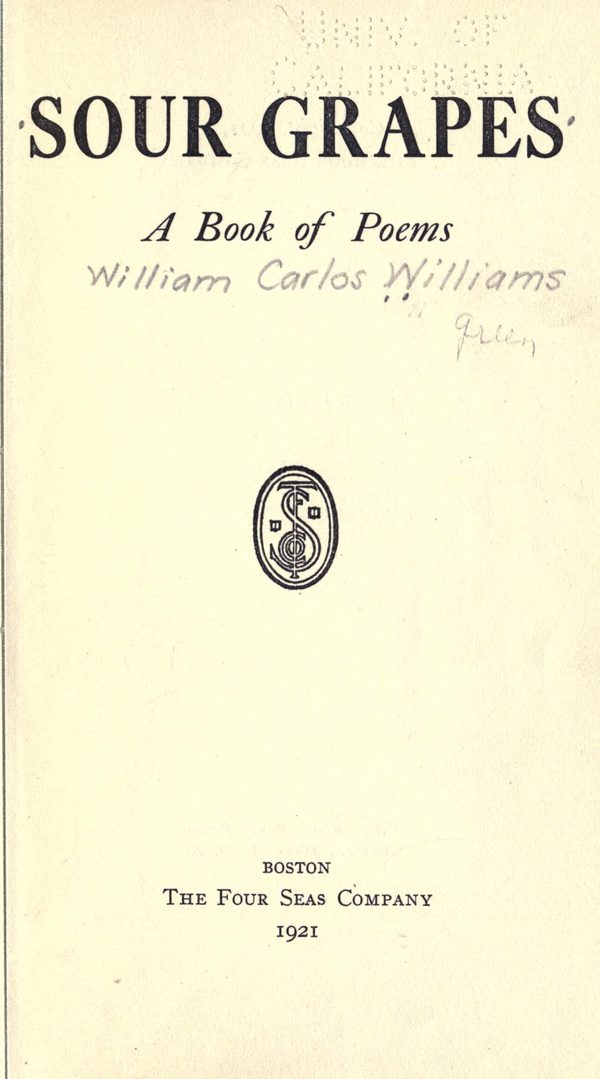
Sour Grapes · 1921 · 17 poems
An Early Martyr · 1935 · 1 poem
The Broken Span · 1941 · 1 poem
The Wedge · 1944 · 1 poem
The Clouds · 1948 · 1 poem
Journey to Love · 1955 · 1 poem
Other poems · 36