The poem
Flowers through the window lavender and yellow
changed by white curtains— Smell of cleanliness—
Sunshine of late afternoon— On the glass tray
a glass pitcher, the tumbler turned down, by which
a key is lying— And the immaculate white bed
The poem
Flowers through the window lavender and yellow
changed by white curtains— Smell of cleanliness—
Sunshine of late afternoon— On the glass tray
a glass pitcher, the tumbler turned down, by which
a key is lying— And the immaculate white bed
"Nantucket" is a ten-line poem that lists what is in a room in the late afternoon. It moves from flowers seen through a window to curtains, a smell, the light, a tray with a pitcher and a tumbler, a key, and a bed. The poem makes no statement about any of it.
It has only one finite verb, "is lying" in line 9. The title names the island, but the lines never mention the sea or the town. What the poem gives is a still, clean, sunlit room, set down in the order an eye might take it in.
Lines 1–2 begin outside the room. The speaker sees flowers through a window. Their colours are "lavender and yellow". There is no verb, and no speaker is named.
Lines 3–4 say the colours are "changed by white curtains". The light passing through the curtains alters how the flowers look. Line 4 then turns from sight to smell. The room has a "Smell of cleanliness", and the line ends with a dash.
Line 5 gives the time of day, "Sunshine of late afternoon". Line 6 brings the eye down to a surface inside the room. That surface is "the glass tray". The stanza ends mid-phrase, so the reader must go on to learn what the tray holds.
Lines 7–8 name the objects on the tray. There is a glass pitcher and a tumbler. The tumbler is "turned down", set upside down on the tray. The words "by which" at the end of line 8 point ahead to one more object.
Line 9 completes the phrase: beside the tumbler "a key is lying". After a dash, the words "And the" begin a new item. Line 10 names it as the "immaculate white bed". The poem ends on this noun phrase, with no full stop.
The first subject of the poem is looking itself. It records objects in the order the eye meets them. The view runs from outside to inside, from far to near, and last to the bed. Nothing is explained or judged, so the reader receives the room as bare perception and must supply the mood.
Whiteness and cleanliness run through the poem. The curtains are white in line 3, and the bed is "immaculate white" in line 10. Between them come the "Smell of cleanliness" and two glass objects. The room can be read as one freshly prepared for someone, perhaps a rented room on the island.
The poem also sets outside against inside. The flowers are beyond the window, and their colours reach the room only "changed by white curtains". Window and curtain stand between the natural world and the interior. After the lavender and yellow of line 2, the room holds almost no colour. One reader sees the glass as both a barrier and an opening.
No person appears, yet every object implies one. A tumbler is turned down, a key is laid beside it, and a bed is made. The key suggests an arrival or a departure. The bed suggests rest, and some may read in it the promise of intimacy. The poem stops at the bed and leaves what happens there unsaid.
The tone is calm and exact. The speaker names things plainly and adds no comment on them. The dashes at the ends of lines 3, 4 and 5 act as pauses, like a slow look moving from one thing to the next. The effect is quiet and unhurried.
The ending shifts the tone slightly. The words "And the" at the end of line 9 hold the reader in suspense across the line break. The last line then gives the one strongly charged adjective in the poem, "immaculate". The close can be read as serene, or as expectant, with the empty bed waiting for someone.
The poem has 10 lines in 5 stanzas of 2 lines each. None of the lines rhyme. The lines are short, from 4 to 7 syllables, and there is no regular metre. It is free verse shaped by the eye rather than the ear.
The line breaks often split a phrase. "the tumbler / turned down" and "And the / immaculate" both carry the reader over a break. Dashes do much of the punctuating, and the poem never reaches a full stop. Grammatically it is a string of noun phrases with a single finite verb.
lavender and yellowThe only colours in the poem other than white. They belong to the flowers outside, which makes the white room that follows seem paler.
Smell of cleanlinessThe poem shifts from sight to smell. Cleanliness is an abstract noun, so the line names a quality of the room rather than a particular scent.
changed by white curtainsWhite filters the colour of the flowers. The line starts the white that runs to the bed in the last line.
a glass pitcher"glass" repeats from the "glass tray" of line 6. The repetition stresses the clear, clean surfaces of the room.
turned down, by whichThe line ends on "by which", a phrase that cannot stand alone. The reader is carried over the break and the stanza break to the key.
a key is lying— And theThe dash splits the line. It closes the key's phrase and opens the last item with a pause before the bed.
immaculate white bed"immaculate" means spotless. The word is stronger than "clean" and can also carry a sense of purity. It is the most emphatic word in the poem.
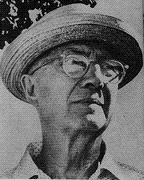
"Nantucket" is by William Carlos Williams (1883–1963). It has been on americanpoems.com since 2003 and was a Poem of the Day on September 20, 2011. Readers have left seven comments on it, from 2004 to 2013.
Keep reading
Readers
i love nantucket, i havnt been there for 3 years but i remember everything about it. William Carlos Williams captured exactly what its like to be there during the summer.
Blah blah blah this poem has nothing to do with Nantucket. There's no such place as Nantucket! What the buck! Daineineeneeinein
we'll be burnin, no consernan wat nobody got to say... jamaica is where its at
i like sex. hot and corney. it tickles my senses. i love you
sometimes on cold nights i sit on our space heater and pleasure myself for hours with golden flowers and gems scattered by my feet..spank me for my sinful thoughts...
Doctor/poet
William Carlos Williams was a medical doctor by profession, a poet by in-
nate talents. "Nantucket" fits the structure and emotion of many of his poems: images, above all, capture a mood. One need not ever have been to Nantucket. Any seaside shore town would do to evoke a magic moment of a summer day. Ah, beautiful.
Nantucket by William Carlos Williams
Mr. Williams employs great economy to describe looking out a bedroom window on a summer day. He compares the relative sterile bedroom separated from the colorful nature just outside the window. Glass of the window is both a barrier keeping nature out and a means to allow the colors of the flowers and the sunlight to enter. But in the bedroom, there is no color but the white curtains and the bed. There is only a…
Read the whole commentMr. Williams employs great economy to describe looking out a bedroom window on a summer day. He compares the relative sterile bedroom separated from the colorful nature just outside the window. Glass of the window is both a barrier keeping nature out and a means to allow the colors of the flowers and the sunlight to enter. But in the bedroom, there is no color but the white curtains and the bed. There is only a smell of cleanliness in the room, perhaps an lack of any smell, or the smell of some antiseptic or detergent in the air. The perfume of flowers do not enter the room. The glass pitcher is probably empty and the tumbler must be empty as it is upside down. The key expressed both that nature is locked out and yet available if the key is used to unlock the door. The bedroom though sterile, is a sanctuary. The bed is immaculate, pure and untouched. Not sure that Mr. Williams means anything more than observing our relationship with nature as somewhat removed, though not divorced.