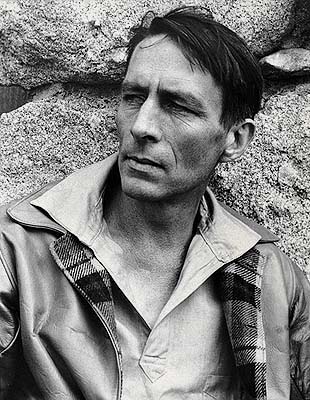
Robinson Jeffers

Portrait of Robinson Jeffers
Robinson Jeffers 1887–1962
1887Born

John Robinson Jeffers (January 10, 1887 - January 20, 1962) was an American poet who, after extensive travel in his youth, spent most of his life in Carmel, California, USA in a granite home he built for his family with his own hands, which included a large stone tower. He called them "Tor House" and "Hawk Tower".

His short verse includes "Hurt Hawks", "The Purse-Seine", and "Shine, Perishing Republic". His intense relationship with the physical world is described in often brutal and apocalyptic verse and demonstrates a preference for the natural world over what he sees as the negative influence of civilization. Quotes "There is no reason for amazement: surely one always knew that cultures decay, and life's end is death." ~ "The Purse-Seine" (1937)

"Long live freedom and damn the ideologies." ~ "The Stars Go Over The Lonely Ocean" (1940)

Read the full biography

"Corruption never has been compulsory; when the cities lie at the monster's feet there are left the mountains." ~ "Shine, Perishing Republic" (1941)

From readers

What readers say about Robinson Jeffers

  1. On Wise Men In Their Bad Hours

    “I have just begun reading poetry. Reading this poem a few times I have come to the conclusion it's about death. People who merely live because they have nothing better to do, how they don't care about the past nor the future. They live in the present with no thought about it, they live to be and…”

  2. On Natural Music

    “Jeffers points the way for us, out of the quagmire. We are not to despise the mess we are, but to hear in its anguish the same clear voice that we hear in nature. Nature does not despair, she cleanses herself. Her cleansing is an act of beauty and an adding of value (bladed green for brown), and…”

  3. On Rock And Hawk

    “this poem is a powerful play between two symbols. one of steadfast and unmoving... pride almost, and one of savage brilliant power. the rock and the hawk. the difference between the "bright power" and the "dark peace" is what, i feel, the poet is trying to bring across to his readers. and that…”

  4. On Ghost

    “Watching Ghost Adventures on television and they are discussing this poem and whether Jeffers has come back as a ghost like he predicted 50 years ago. Makes you wonder...Love the Poem.”

  5. On Divinely Superfluous Beauty

    “This poem expresses a belief in a God of love and beauty. It is a very positive poem that says life is worth living. It was shown to me by someone when I was depressed and it was a light in the darkness of my depression. It sees the love of a man and woman as symbolic of the creation of a beautiful…”

  6. On The Broken Balance

    “I was moved to read this poem by a reference to it in an essay by Edward Hoagland in the June/07 issue of Harper's. I was further moved by the date of the poem and how telling its descriptions are in light of the current state of our affairs. I consider myself an optimist by nature, but perhaps…”

Where readers gather

Most discussed

  1. Wise Men In Their Bad Hours3 comments
  2. Cassandra2 comments
  3. Ghost2 comments
  4. Natural Music2 comments
  5. Rock And Hawk2 comments
  6. The Machine2 comments
  7. Ave Caesar1 comment
  8. Carmel Point1 comment
  9. Divinely Superfluous Beauty1 comment
  10. End Of The World1 comment

All 58 poems

Tamar · 1924 · 4 poems
Cawdor And Other Poems · 1928 · 9 poems
Dear Judas And Other Poems · 1929 · 2 poems
Solstc And Other Poems · 1935 · 1 poem
Be Angry At The Sun · 2 poems
Hungerfield And Other Poems · 1954 · 1 poem
The Beginning and the End & Other Poems · 1963 · 3 poems
The Double Axe And Other Poems · 1 poem
Other poems · 35