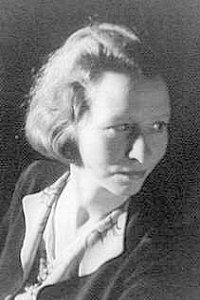
Edna St. Vincent Millay

Portrait of Edna St. Vincent Millay
Edna St. Vincent Millay 1892–1950
1892Born

Edna St. Vincent Millay, born in 1892 in Maine, grew to become one of the premier twentieth-century lyric poets. She was also an accomplished playwright and speaker who often toured giving readings of her poetry. All of that was in her public life, but her private life was equally interesting. An unconventional childhood led into an unconventional adulthood. She was an acknowledged bisexual who carried on many affairs with women, an affection for which is sometimes evident in her poems and plays. She did marry, but even that part of her life was somewhat unusual, with the marriage being quite open, and extramarital affairs, though not documented, are quite probable.

At the young age of seven, Edna's mother asked her husband to leave the family home. After that point he held a negligible role in the girl's life. Edna and her two sisters moved, with their mother, to Newburyport, Massachusetts where, to Edna's delight, she was given piano lessons. Edna (who insisted on being called Vincent and who even entered writing contests under that name) and her sisters were encouraged in their literary and musical leanings by their mother. Then, in highschool, Millay's interests expanded to include theater. She performed in numerous plays and wrote a Halloween play for her classmates to act out.

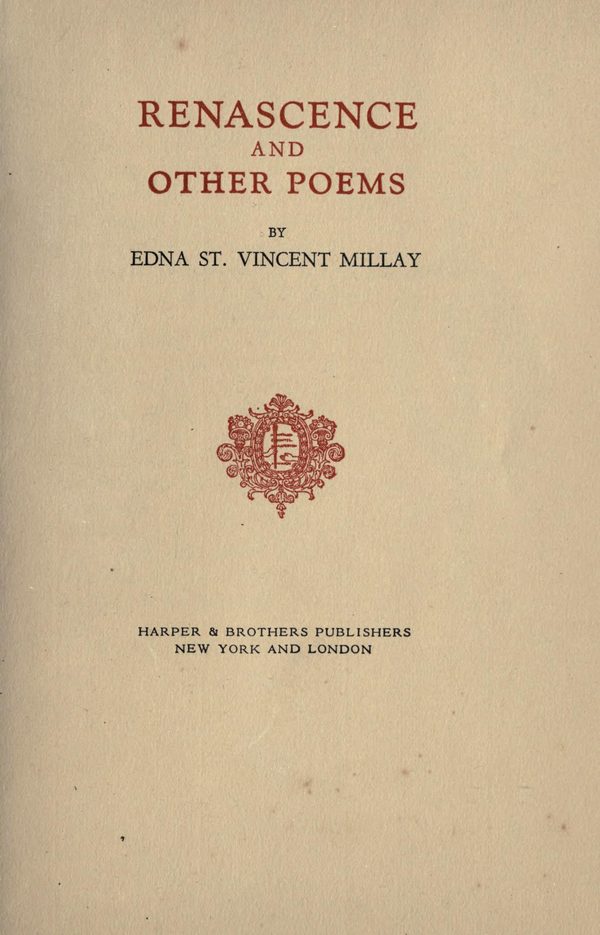
Millay enjoyed her free-spirited childhood and adolescence and the creativity that it inspired. At the age of twenty, she entered her poem "Renascence" into a poetry contest for the The Lyric Year, a contest from which 100 poems were to be chosen to be published. It was, at first, overlooked as being too simplistic, however, one of the judges took a second look at it and the poem, now one of her most well known, ended up winning fourth place. It was that poem which really started her on her literary career, beginning with a scholarship to the then all female college of Vassar.

Read the full biography

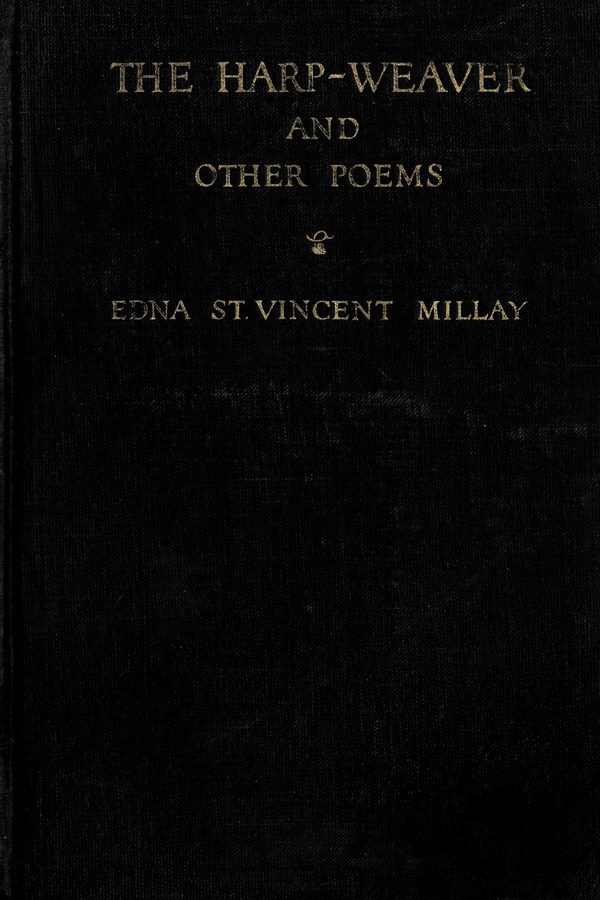
Millay kept up her writing, both poetic and dramatic while at Vassar. It was during this time that she was awarded the Pulitzer Prize for her book The Harp-Weaver and other Poems. Also during her college career she broadened her sexual horizons to include relationships with women. The most notable of these affairs was one with the English actress Wynne Matthison. Matthison was not the only woman she was involved with, though, and she kept in contact with some of them throughout her life.

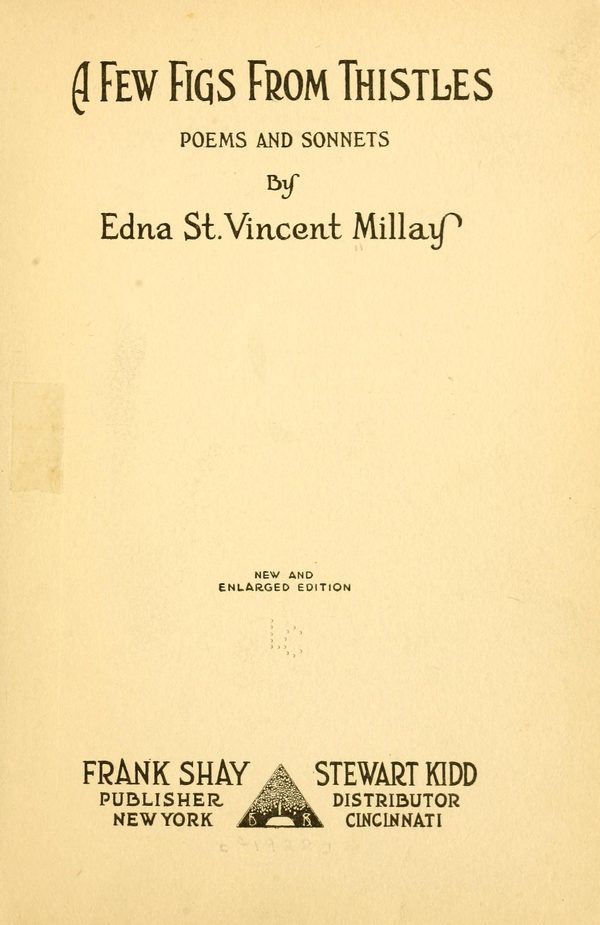
Millay's first book of poetry, Renascence and Other Poems was published in 1917 and well received. Then A Few Figs from Thistles was published in 1922 and sparked some attention as well as controversy with its feminist leanings. In particular the poems within maintained that the sexual freedom formerly commandeered by men was equally valid for women. This feeling is particularly obvious in the sonnet beginning "What lips my lips have kissed,".

Keep in mind that all of this was accomplished during Millay's college years! After graduation the woman moved to Greenwich Village in New York, a particularly free-thinking and artistic borough. She kept up her writing as well as her involvements with women, but also began to take men as lovers though it would seem that none of them were able to "sway" her from her natural lesbian leanings. The following paragraph is quoted from another web page dedicated to Edna St. Vincent Millay, which is located at Sappho.com. In Great Companions, Max Eastman relates an interesting story about Millay that, if true, reveals something of her attitude about own sexuality. According to Eastman, while at a cocktail party Millay discussed her recurrent headaches with a psychologist. He asked her, "I wonder if it has ever occurred to you that you might perhaps, although you are hardly conscious of it, have an occasional impulse toward a person of your own sex?" She responded, "Oh, you mean I'm homosexual! Of course I am, and heterosexual, too, but what's that got to do with my headache?" Millay did eventually marry Eugen Boissevain, who managed her career and was a great source of support. The marriage, as mentioned above, was agreed to be open and Millay herself said that they maintained their personal freedom, living more as great friends than as husband and wife. Millay, a smoker in an age of smokers, succumbed to her failure in 1950 at her home, Steepletop, in Austerlitz New York. Boissevain, who was considerably older, had died the previous year.
Reading closely

Analyses

A full analysis sits under 10 of these poems: what each poem says, how it is built and how readers here have read it. About the analyses

  • An Ancient GestureA woman's tears on her apron, Penelope's long wait, and Ulysses crying for the crowd
  • The Ballad Of The Harp-WeaverA mother's love, winter poverty, and a harp that weaves a king's clothes on Christmas Eve
  • Love Is Not AllLove's practical limits, the pain that might break it, and a quiet refusal to give it up
  • First FigA candle burning at both ends, and a short, bright life chosen over a long one
  • RecuerdoA sleepless ferry night, a golden dawn, and happiness that ends in a gift to a stranger
  • LamentA death told in one flat line, grief hidden in chores, and a last line that gives way
  • RenascenceA mind crushed by infinite knowledge, buried, then reborn by rain into a God-filled world
  • Well, I Have Lost YouA lover lost fairly, pride like kings in a tumbrel, and grace promised despite anguish
  • Afternoon On A HillJoy that takes nothing, calm watching of nature, and a willing walk home at dusk

From readers

What readers say about Edna St. Vincent Millay

  1. On An Ancient Gesture

    “I think there is more to the gesture than love or crying. The poem mentions "Ulysses did this too./ But only as a gesture". If the gesture is love, than Ulysses is simply doing it as if it is no big deal--I don't think the poem is trying to get a message across like that. A gesture most nearly…”

  2. On Recuerdo

    “I think the poem has a very sexual overtone. If you read the ferry ride as the act of love making back and forth to and fro, the exhaustion, the fruit, the newspaper is knowledge, you get a very specific theme. Perhaps it was their first time, but they definiately were in love, anyone agree with me?”

  3. On Dirge Without Music

    “it is interesting to see the political interpretation given by Je. This has made me re-read the poem. For me it has always been a helpful poem in grief, because it acknowledges the anger, and sense of unfairness that life must end. I do not approve, and I am not resigned.”

  4. On The Spring And The Fall

    “Beautifully sad poem. Very true that the introductory sweetness is also foreboding. I suspect that from 1920s vintage of her writing, that this relationship may not have ?broken-up?, as was not the custom of the times, but wore on into a loveless long relationship ? the reference to the fall being…”

  5. On Love Is Not All

    “I love how my first impression of the poem was completely wrong once I read the last line. Awesome way of being negative and then saying the sweetest possible words. "It well may be. I do not think I would."”

  6. On First Fig

    “Ryan was an active child and a very athletic teen. He was a fantastic soccer player, even playing for Teams USA. He played in seven countries and witnessed sites many of us only dream about, all before he was 18. Ryan graduated from Purdue University in 1995 as an Engineer. He learned among many…”

Where readers gather

Most discussed

  1. An Ancient Gesture33 comments
  2. What Lips My Lips Have Kissed, And Where, And Why (Sonnet XLIII)27 comments
  3. The Ballad Of The Harp-Weaver20 comments
  4. Love Is Not All17 comments
  5. No. 1First Fig15 comments
  6. No. 3Recuerdo15 comments
  7. Lament12 comments
  8. Renascence12 comments
  9. Well, I Have Lost You12 comments
  10. Afternoon On A Hill11 comments

All 155 poems

Renascence and Other Poems · 1917 · 20 poems
A Few Figs From Thistles · 1921 · 23 poems
The Harp-Weaver · 1923 · 1 poem
Cover of The Harp-Weaver
First edition, Harper & Brothers, 1923
Other poems · 111
  1. The Spring And The Fall19238
  2. Well, I Have Lost You193112
  3. A Visit To The Asylum3
  4. Alms1
  5. An Ancient Gesture33
  6. And do you think that love itself3
  7. Apostrophe To Man1
  8. Assault2
  9. Autumn Daybreak
  10. Being Young And Green2
  11. Bluebeard1
  12. Burial
  13. Chorus1
  14. City Trees
  15. Conscientious Objector5
  16. Departure1
  17. Dirge
  18. Dirge Without Music9
  19. Doubt No More That Oberon
  20. Ebb1
  21. Eel-Grass2
  22. Elegy2
  23. Elegy Before Death3
  24. Epitaph
  25. Exiled5
  26. Feast3
  27. Fontaine, Je Ne Boirai Pas De Ton Eau!1
  28. Here Is A Wound That Never Will Heal, I Know1
  29. I Dreamed I Moved Among The Elysian Fields1
  30. I Know I Am But Summer To Your Heart3
  31. I Know The Face Of Falsehood And Her Tongue
  32. If I Should Learn, In Some Quite Casual Way1
  33. If Still Your Orchards Bear
  34. Inland
  35. Intention To Escape From Him
  36. Invocation To The Muses
  37. Journey1
  38. Justice Denied In Massachusetts
  39. Lament12
  40. Lines Written In Recapitulation
  41. Love Is Not All17
  42. Low-Tide
  43. Make Bright The Arrows1
  44. Mariposa2
  45. Memorial To D.C.
  46. Menses1
  47. Mist In The Valley1
  48. Modern Declaration2
  49. My Most Distinguished Guest And Learned Friend
  50. Night Is My Sister, And How Deep In Love
  51. Not Even My Pride Shall Suffer Much
  52. Not In A Silver Casket Cool With Pearls4
  53. Ode To Silence
  54. Oh, Oh, You Will Be Sorry2
  55. Passer Mortuus Est
  56. Pastoral
  57. Pity Me Not Because The Light Of Day6
  58. Portrait By A Neighbour
  59. Prayer To Persephone5
  60. Renascence12
  61. Rosemary1
  62. Scrub1
  63. Song Of A Second April2
  64. Sonnet (Women Have Loved Before As I Love Now)
  65. Sonnets 01: We Talk Of Taxes, And I Call You Friend
  66. Sonnets 02: Into The Golden Vessel Of Great Song
  67. Sonnets 03: Not With Libations, But With Shouts And Laughter1
  68. Sonnets 04: Only Until This Cigarette Is Ended2
  69. Sonnets 05: Once More Into My Arid Days Like Dew
  70. Sonnets 06: No Rose That In A Garden Ever Grew
  71. Sonnets 07: When I Too Long Have Looked Upon Your Face
  72. Sonnets 08: And You As Well Must Die, Beloved Dust2
  73. Sonnets 09: Let You Not Say Of Me When I Am Old
  74. Sonnets 10: Oh, My Beloved, Have You Thought Of This
  75. Sonnets 11: As To Some Lovely Temple, Tenantless
  76. Sonnets 12: Cherish You Then The Hope I Shall Forget
  77. Sonnets From An Ungrafted Tree4
  78. Souvenir2
  79. Spring3
  80. Sweet Love, Sweet Thorn, When Lightly To My Heart3
  81. The Ballad Of The Harp-Weaver20
  82. The Bean-Stalk
  83. The Betrothal
  84. The Blue-Flag In The Bog1
  85. The Concert
  86. The Curse
  87. The Death Of Autumn
  88. The Fawn1
  89. The Fledgling
  90. The Goose-Girl2
  91. The Leaf And The Tree
  92. The Little Hill
  93. The Plaid Dress1
  94. The Poet And His Book2
  95. The Snow Storm
  96. The Suicide6
  97. The True Encounter1
  98. The Wood Road
  99. Think Not, Not For A Moment Let Your Mind
  100. To A Poet That Died Young
  101. To Those Without Pity
  102. Travel7
  103. Two Sonnets In Memory
  104. Underground System
  105. Weeds1
  106. What Lips My Lips Have Kissed, And Where, And Why (Sonnet XLIII)27
  107. When We Are Old And These Rejoicing Veins1
  108. Whereas At Morning In A Jeweled Crown
  109. Wild Swans
  110. Witch-Wife3
  111. Wraith1