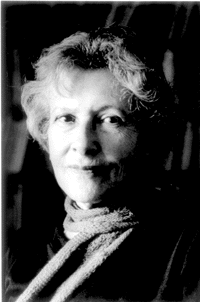
Denise Levertov

Portrait of Denise Levertov
Denise Levertov 1923–1997
1923Born

Denise Levertov (October 24, 1923 - December 20, 1997) was a British born American poet. Born in Ilford, Essex, England, her mother was Welsh, and her father was an Anglican parson who had immigrated from Germany, and had been raised a Hasidic Jew.

She was educated at home, had an early childhood enthusiasm for writing, and at the age of 12 sent some of her poetry to T. S. Eliot who replied with a two page letter of encouragement.

She served as a civilian nurse in London during the bombings of World War II.

Read the full biography

Her first book of poetry, The Double Image, was published in 1946.

She married an American writer, Mitchell Goodman, in 1947, and moved to the United States in 1948, living primarily in New York City, and in Maine during the summer.

She published her first American book Here and Now in 1956, and with the publication of With Eyes at the Back of our Heads in 1959 she began to gain wide acclaim. She went on to publish many prize-winning volumes of poetry, become involved in anti-war movements, and for eleven years, from 1982 to 1993 taught at Stanford University.

She died on December 27, 1997 at the age of 74, from complications of lymphoma.

Reading closely

Analyses

A full analysis sits under one of these poems: what the poem says, how it is built and how readers here have read it. About the analyses

From readers

What readers say about Denise Levertov

  1. On What Were They Like?

    “I personally love this poem. Me myself, I sort of see it as some kind of interrogation. "Did the people of vietnam use lanterns of stone? Sir, their kind hearts turned to stone" We used levels to establish the context...who would you call 'sir', then we studied other aspects of levels, had a few…”

  2. On The Secret

    “Denise Levertov was a very special poet. When a pair of teenage girls met her, likley at a book signing, they told her one of the lines of her poems had taught them the secret of life. However, they could not tell her the name of the poem, nor the line. Rather than be offended, she found delight in…”

  3. On The Avowal

    “Ever since my first reading of this tribute to George Herbert I have cherished it as it is, but I wish I could have asked Denise Levertov whether she would agree that two more words of her final line would convey an even deeper meaning. She writes "no effort earns" and I would ask her to consider a…”

  4. On Adam's Complaint

    “I think this poem is talking about the first men on earth, according to the bible. Adam and Eve had everything they could want. However, even though God told them they could not have the fruit from that tree, they still ate that fruit. That is where man got its greed. Whatever someone has they…”

  5. On Settling

    “I love this poem. It reminds me of why I love Seattle so much-- yes, it's cold and rainy and foggy and half the time you don't even know the Mountain is there.... but wow, every now and then it appears and you realize how close we all are here to nature and that the world is full of magic. "Grey is…”

  6. On People at Night

    “it seems to me that poem says the split between reason and emotion,night makes me see something emotional i don't like to see, night is mad and emotional i is lost at night.”

Where readers gather

Most discussed

  1. What Were They Like?22 comments
  2. People at Night3 comments
  3. The Avowal3 comments
  4. The Secret3 comments
  5. Adam's Complaint2 comments
  6. Aware2 comments
  7. Living2 comments
  8. Pleasures2 comments
  9. The Mutes2 comments
  10. A Tree Telling of Orpheus1 comment

All 56 poems

Oblique Prayers · 1984 · 1 poem
Poems 1968-1972 · 1988 · 1 poem
Sands of the Well · 1996 · 1 poem
Other poems · 53