WEBSTER was much possessed by death
And saw the skull beneath the skin;
And breastless creatures under ground
Leaned backward with a lipless grin.
Daffodil bulbs instead of balls
Stared from the sockets of the eyes!
He knew that thought clings round dead limbs
Tightening its lusts and luxuries.
Donne, I suppose, was such another
Who found no substitute for sense,
To seize and clutch and penetrate;
Expert beyond experience,
He knew the anguish of the marrow
The ague of the skeleton;
No contact possible to flesh
Allayed the fever of the bone.
. . . . .
Grishkin is nice: her Russian eye
Is underlined for emphasis;
Uncorseted, her friendly bust
Gives promise of pneumatic bliss.
The couched Brazilian jaguar
Compels the scampering marmoset
With subtle effluence of cat;
Grishkin has a maisonette;
The sleek Brazilian jaguar
Does not in its arboreal gloom
Distil so rank a feline smell
As Grishkin in a drawing-room.
And even the Abstract Entities
Circumambulate her charm;
But our lot crawls between dry ribs
To keep our metaphysics warm.
✦
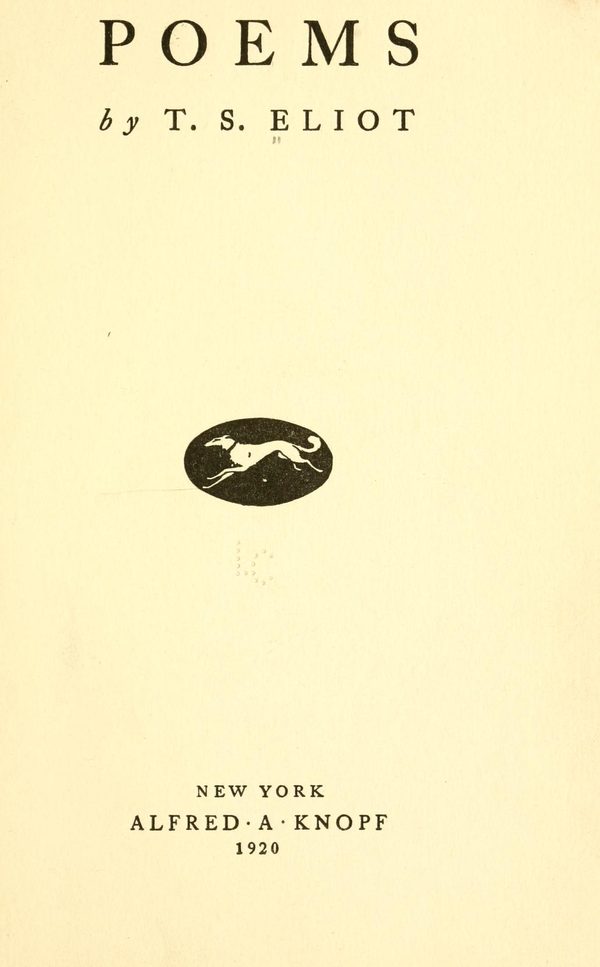
From the bookPoemsTitle page, first US edition, Alfred A. Knopf, New York, 1920
Analysis
Whispers of Immortality: analysis
Introduction
"Whispers of Immortality" is a short poem by T.S. Eliot about death, the body and desire. A row of dots splits it into two halves. The first half names two men, Webster and Donne, who were "much possessed by death" and felt thought and longing in their very bones. The second half turns to Grishkin, a woman of frank physical charm, and compares her to a hunting jaguar.
The last stanza sets "our lot" against all of them. We crawl "between dry ribs / To keep our metaphysics warm." The poem sets mind against body and leaves open which one it mocks. Its manner is dry, witty and hard to pin down.
Summary
The poem opens with Webster, who "was much possessed by death." He "saw the skull beneath the skin" of the living. The stanza adds a picture of buried bodies. These "breastless creatures under ground" lean back "with a lipless grin."
In the second stanza, daffodil bulbs take the place of eyeballs in the skulls. The bulbs "Stared from the sockets of the eyes!" Webster knew that thought "clings round dead limbs." There it goes on "Tightening its lusts and luxuries."
The third stanza turns to Donne. The speaker says, "I suppose," that Donne was a man of the same kind. Donne "found no substitute for sense." He needed "To seize and clutch and penetrate." Line 12 calls him "Expert beyond experience."
The fourth stanza describes Donne's pain. He knew "the anguish of the marrow" and "The ague of the skeleton." No touch of flesh could calm it. In the poem's words, nothing "Allayed the fever of the bone." A row of dots then breaks the poem in two.
The second half begins with Grishkin. The speaker says flatly, "Grishkin is nice." Her "Russian eye" is "underlined for emphasis." Without a corset, her "friendly bust" gives "promise of pneumatic bliss."
The next stanza sets a "couched Brazilian jaguar" beside her. Its "subtle effluence of cat" draws in the "scampering marmoset." The stanza ends on a plain fact about Grishkin. She has "a maisonette."
The jaguar returns as "The sleek Brazilian jaguar." Even in "its arboreal gloom" it does not give off so strong a smell. The speaker says it cannot "Distil so rank a feline smell" as Grishkin does "in a drawing-room."
In the last stanza, even "the Abstract Entities" are drawn to her. They "Circumambulate her charm," walking round it. The final two lines turn to "our lot." We crawl "between dry ribs" to keep our "metaphysics warm."
Themes and meaning
Death inside life runs through the first half. Webster "saw the skull beneath the skin," so the skeleton stays in view under every living face. The daffodil bulbs in the eye sockets join growth and decay in one image. Thought itself "clings round dead limbs." For these men, the mind does not leave the body even in the grave.
The first half also sets thought against sensation, for Donne "found no substitute for sense." He wants to know things by touch, "To seize and clutch and penetrate." Yet his pain lies deeper than flesh, in "the anguish of the marrow." No "contact possible to flesh" can cure "the fever of the bone." The poem pictures a hunger for the physical that the physical cannot satisfy.
The second half treats sexual charm as an animal force. Grishkin is set beside a jaguar that "Compels the scampering marmoset" by its scent. The comparison makes her attraction a kind of hunting. Her "rank" smell in "a drawing-room" is stronger than the jaguar's in the forest. The language mocks her, but the power it describes is real within the poem.
The last stanza turns to the life of the mind. Even "the Abstract Entities" circle round Grishkin's charm. The speaker's "our lot," by contrast, crawls "between dry ribs" to keep its "metaphysics warm," as if thought were cold without the body. The last stanza can be read as envy of Grishkin and of the older men's passion. It can also be read as scorn for all of them, the speaker included.
The title adds irony. It promises "Whispers of Immortality," yet the poem offers skulls, bulbs, bones and a scented woman. Immortality appears only faintly, in "Abstract Entities" and "metaphysics." Whatever lasts, the poem suggests, is hard to find in either flesh or thought.
Tone
The tone is dry, ironic and hard to fix. The first half is grave and bodily. Words like "anguish," "ague" and "fever" give it the weight of illness. The exclamation mark in line 6 adds a note of grim wonder.
The tone shifts sharply after the dots. "Grishkin is nice" is flat, almost childish, after the talk of marrow and bone. The jaguar stanzas mock through overblown language, such as "subtle effluence of cat." The line "Grishkin has a maisonette" drops from the jungle to plain gossip.
The last stanza turns the irony inward with "our lot." Its closing image is comic and bleak at once. The speaker does not say whether he admires or despises what he describes.
Form and structure
The computed count gives 33 lines in 7 stanzas. Most stanzas are quatrains. One block has 9 lines, because the row of dots at line 17 joins two quatrains. The dots mark the turn from Webster and Donne to Grishkin.
The lines are short, mostly 7 to 9 syllables with four stresses. The metre is a loose iambic tetrameter, as in "And saw the skull beneath the skin." Many lines vary it with extra or missing syllables.
Rhyme is sparse and irregular in this poem. The computed scheme finds full rhyme only in the first stanza, "skin" and "grin," and in the sixth, "gloom" and "drawing-room." Elsewhere the second and fourth lines come close without matching, as with "charm" and "warm." The loose rhyme suits the poem's offhand, ironic manner.
Poetic devices
Alliteration line 2
the skull beneath the skin The repeated "sk" sound ties the living surface to the bone beneath it. The phrase states the first half's vision in five words.
Imagery line 5
Daffodil bulbs instead of balls Spring bulbs fill the empty eye sockets. The image joins new growth and decay in a single grotesque picture.
Personification line 7
thought clings round dead limbs Thought is given a body that can cling. It suggests that desire and thinking do not let go of the flesh even after death.
Alliteration line 8
lusts and luxuries The paired "l" sounds link bodily craving with pleasure. The sound slows the line and lingers on the words.
Polysyndeton line 11
To seize and clutch and penetrate The repeated "and" piles up verbs of grasping. It makes Donne's need for touch sound urgent and insistent.
Paradox line 12
Expert beyond experience Donne knows more than experience could teach him. The phrase suggests knowledge that reaches past the senses he craves.
Metaphor line 16
the fever of the bone Longing becomes an illness lodged in the skeleton. It places desire deeper than the flesh that might satisfy it.
Bathos line 25
Grishkin has a maisonette After the jaguar and marmoset, the stanza drops to a plain domestic fact. The sudden flatness is comic.
Mock-elevated diction line 24
subtle effluence of cat A grand Latin word is spent on an animal smell. The mismatch makes the comparison with Grishkin sound both lofty and rude.
Repetition line 26
The sleek Brazilian jaguar The jaguar returns with a new adjective. The echo of line 22 keeps the comparison going and builds to the drawing-room punchline.
Metaphor line 32
crawls between dry ribs Thinkers are pictured as creatures moving inside a skeleton. It links "our lot" back to the bones of the first half.
Words worth knowing
ague
A fever with fits of shivering. Here it is a shaking sickness felt in the skeleton.
pneumatic
Filled with air, like a tyre. Here it is a mocking joke about the springy softness of Grishkin's body.
effluence
Something that flows out. Here it means the jaguar's scent.
maisonette
A small flat or apartment, often on two floors. It places Grishkin in an ordinary modern home.
Circumambulate
To walk around something, as in a ritual procession. Here the abstractions circle Grishkin's charm.
metaphysics
Philosophy about the nature of being and reality. Here it stands for abstract thought, which needs keeping warm.
Context
The archive's records place this poem in Eliot's book Poems, dated 1920, where it is the tenth poem. It has been on this site since 2004. Readers have left 11 comments on it between 2005 and 2023.
What readers have said
Sarah read the poem as biblical, taking the "breastless creatures under ground" as a picture of hell and the devil. Sarah, 2005
One reader, posting as Grishkin, called the poem sexual repression and self-loathing dressed up as cultural commentary. Grishkin, 2007
Mickey liked the talk of death but found the jaguar ending made no sense. Mickey, 2008
Wally found the poem confusing and asked what the Grishkin stanzas were meant to say. wally, 2007
This reader read the poem as being about mortality, sex and death, and the way death is present in the midst of life. B, 2023
Whispers of immortality by T.S.Eliot and also, Burkbank with a baedequer
kurioAustralia
The line from the first stanza, "The Skull beneath the Skin" is also the title of a crime fiction novel, by PD James. This is immediately conveyed through the epigraph, which acts as a preface to the responder.
this poem was awesome. i really like the way that it was put together. Thanks for all the help. YOu helped me with a big project.
SarahUnited States
I like the poem. although it is very vintage. it holds a lot of meaning. I think it can be biblical. Because it talks about limbo aka. hell, and the devil ( Breastless Creatures Underground leaned back toward a lipless grin") which makes sense since some of his other poems are like that. sarah-
this poem makes no sense, why is he talking about a the ballet dancer that he meet in london and what he trying to tell through this poem.
GrishkinIreland
A fever of sexual repression and self-loathing dressed up as cultural commentary. Guaranteed to appeal to adolescents, and catchy to boot.
MickeyUnited States
I like how the poem is put together how he talks about death or hell but i didnt like the way he ended it with the jaguar that made no cense. But other then that it was an awsome poem.
leeUnited States
it talks about the deavil when it says "breastless creatures under ground Leaned backward with a lipless grin"
you wrote this before I was born. But let me explain. perhaps you will see it. This poem is about mortality. How death pervades all, even in the midst of life death is ever present. it is about the duality of the human existence, and prompts us to face the reality that we all live only to die. It is about sex and death. It is about how in the face of death everything of physical sustenance falls away and all we are left with are complex emotions. Eliot references Webster and Donne. Webster was a tragedian, and Donne a metaphysical poet hence the reference.

Whispers of immortality by T.S.Eliot and also, Burkbank with a baedequer
The line from the first stanza, "The Skull beneath the Skin" is also the title of a crime fiction novel, by PD James. This is immediately conveyed through the epigraph, which acts as a preface to the responder.
this poem makes no sense...
this poem was awesome. i really like the way that it was put together. Thanks for all the help. YOu helped me with a big project.
I like the poem. although it is very vintage. it holds a lot of meaning. I think it can be biblical. Because it talks about limbo aka. hell, and the devil ( Breastless Creatures Underground leaned back toward a lipless grin") which makes sense since some of his other poems are like that.
sarah-
this poem makes no sense, why is he talking about a the ballet dancer that he meet in london and what he trying to tell through this poem.
A fever of sexual repression and self-loathing dressed up as cultural commentary. Guaranteed to appeal to adolescents, and catchy to boot.
I like how the poem is put together how he talks about death or hell but i didnt like the way he ended it with the jaguar that made no cense. But other then that it was an awsome poem.
it talks about the deavil when it says "breastless creatures under ground Leaned backward with a lipless grin"
awkward........
I think this poem is about Donne and Webster. Donne hates Webster and wants him to go to hell.
Watch South Park
you wrote this before I was born. But let me explain. perhaps you will see it. This poem is about mortality. How death pervades all, even in the midst of life death is ever present. it is about the duality of the human existence, and prompts us to face the reality that we all live only to die. It is about sex and death. It is about how in the face of death everything of physical sustenance falls away and all we are left with are complex emotions. Eliot references Webster and Donne. Webster was a tragedian, and Donne a metaphysical poet hence the reference.