You do not do, you do not do
Any more, black shoe
In which I have lived like a foot
For thirty years, poor and white,
Barely daring to breathe or Achoo.
Daddy, I have had to kill you.
You died before I had time ----
Marble-heavy, a bag full of God,
Ghastly statue with one gray toe
Big as a Frisco seal
And a head in the freakish Atlantic
Where it pours bean green over blue
In the waters off the beautiful Nauset.
I used to pray to recover you.
Ach, du.
In the German tongue, in the Polish town
Scraped flat by the roller
Of wars, wars, wars.
But the name of the town is common.
My Polack friend
Says there are a dozen or two.
So I never could tell where you
Put your foot, your root,
I never could talk to you.
The tongue stuck in my jaw.
It stuck in a barb wire snare.
Ich, ich, ich, ich,
I could hardly speak.
I thought every German was you.
And the language obscene
An engine, an engine,
Chuffing me off like a Jew.
A Jew to Dachau, Auschwitz, Belsen.
I began to talk like a Jew.
I think I may well be a Jew.
The snows of the Tyrol, the clear beer of Vienna
Are not very pure or true.
With my gypsy ancestress and my weird luck
And my Taroc pack and my Taroc pack
I may be a bit of a Jew.
I have always been scared of you,
With your Luftwaffe, your gobbledygoo.
And your neat mustache
And your Aryan eye, bright blue.
Panzer-man, panzer-man, O You ----
Not God but a swastika
So black no sky could squeak through.
Every woman adores a Fascist,
The boot in the face, the brute
Brute heart of a brute like you.
You stand at the blackboard, daddy,
In the picture I have of you,
A cleft in your chin instead of your foot
But no less a devil for that, no not
Any less the black man who
Bit my pretty red heart in two.
I was ten when they buried you.
At twenty I tried to die
And get back, back, back to you.
I thought even the bones would do.
But they pulled me out of the sack,
And they stuck me together with glue.
And then I knew what to do.
I made a model of you,
A man in black with a Meinkampf look
And a love of the rack and the screw.
And I said I do, I do.
So daddy, I'm finally through.
The black telephone's off at the root,
The voices just can't worm through.
If I've killed one man, I've killed two ----
The vampire who said he was you
And drank my blood for a year,
Seven years, if you want to know.
Daddy, you can lie back now.
There's a stake in your fat black heart
And the villagers never liked you.
They are dancing and stamping on you.
They always knew it was you.
Daddy, daddy, you bastard, I'm through.
✦
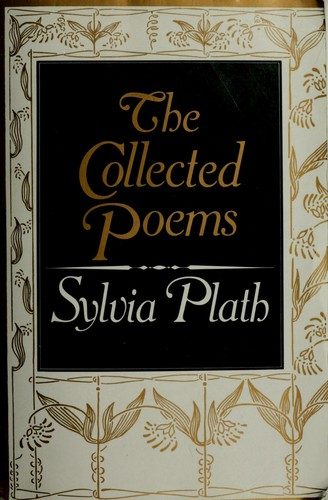
From the bookThe Collected PoemsFirst US edition, Harper & Row, 1981, in its dust jacket
Analysis
Daddy: analysis
Introduction
"Daddy" is an eighty-line poem in which a speaker addresses her dead father and declares herself finished with him. She calls him a black shoe, a statue, a Nazi, a devil and a vampire. She casts herself as a Jew and as his victim.
Midway, the poem turns to a second man, a husband figure who is "a model of you". It ends with a stake through the father's heart. A chanting rhythm and a relentless 'oo' rhyme give the anger the sound of a nursery rhyme. The poem is about grief, fear, silence and the effort to break free of a figure who has ruled the speaker's inner life.
Summary
The speaker tells "you" that "You do not do" any more. She compares him to a black shoe. She has lived in it for thirty years, barely daring to breathe or sneeze.
She says she has had to kill Daddy, though he died before she had time. She pictures him as a huge statue, "a bag full of God". It has one gray toe and a head in the Atlantic off Nauset. She used to pray to recover him. The stanza ends in German: "Ach, du."
His origins lie in a Polish town flattened by wars. A friend says the town's name is common, so she cannot trace his root. She could never talk to him. Her tongue stuck in "a barb wire snare." She stammers "Ich, ich, ich, ich" and thinks every German is him.
The German language becomes an engine carrying her off like a Jew to the camps. She begins to talk like a Jew and thinks she may be one. The snows of the Tyrol and the beer of Vienna are not pure. Her gypsy ancestress, her luck and her Taroc pack make her "a bit of a Jew."
She says she has always been scared of him. She lists his Luftwaffe, his neat mustache and his blue Aryan eye. She calls him "Panzer-man" and then "a swastika" that blocks the sky. She declares that "Every woman adores a Fascist," loving the boot in the face.
She describes a picture of him standing at a blackboard. He has a cleft in his chin, not his foot, but is still a devil. He bit her heart in two. She was ten when he was buried. At twenty she tried to die to get back to him.
She was pulled out of the sack and stuck together with glue. Then she made a model of him, a man in black with "a Meinkampf look". She said "I do, I do" to this man. Now she is through. The telephone is cut off, so the voices cannot get through.
She says that if she has killed one man, she has killed two. The second is a vampire who drank her blood for seven years. She tells Daddy he can lie back now. There is a stake in his heart, and the villagers dance on him. The poem closes: "Daddy, daddy, you bastard, I'm through."
Themes and meaning
The first theme is a father who is too large to escape. He is a shoe the speaker has lived inside, then a statue stretching across a continent. He is "a bag full of God". Grief turns into fixation. She "used to pray to recover you", and at twenty she tried to die to "get back, back, back to you".
Silence and speech form a second theme. The speaker "never could talk to you." Her tongue is stuck "in a barb wire snare." The German "Ich" repeats like a stammer, and the language itself is "obscene". The poem can be read as the speech she never managed. It ends by cutting the telephone, so "The voices just can't worm through."
The third theme is victimhood, told through images of the Holocaust. The father becomes a Nazi, a "Panzer-man" and "a swastika". The speaker becomes a Jew carried to "Dachau, Auschwitz, Belsen." The comparison is extreme and deliberate. It measures how absolute his power feels to her. The line "Every woman adores a Fascist" adds a darker claim, that the victim is drawn to the oppressor.
A fourth theme is repetition. The speaker makes "a model of you" and marries him with "I do, I do." That vow echoes the opening "You do not do". So "If I've killed one man, I've killed two". The vampire "who said he was you" can be read as the husband standing in for the father.
The last theme is exorcism and release. The stake, the dancing villagers and the final "I'm through" stage a ritual killing. Yet the ending is ambiguous. The speaker still addresses "Daddy" in the last line. The word "through" can mean finished, but it also echoes the voices that cannot get "through".
Tone
The tone starts as a taunting chant. "You do not do" sounds like a child's rhyme. Words such as "Achoo" and "gobbledygoo" keep a nursery sound under the horror.
Fear then enters. The speaker is "Barely daring to breathe", and she stammers "Ich, ich, ich, ich". The line "I have always been scared of" states the fear plainly.
As the Nazi images build, fear turns to rage and bitter irony. "Every woman adores a Fascist" is sarcastic and self-accusing at once. The repeated "brute" hammers the point home.
The last stanzas are fierce and triumphant. "Daddy, you can lie back now" sounds almost gentle, then the stake follows. The final line mixes a child's "Daddy, daddy" with an adult curse, "you bastard". That mix leaves the tone between victory and a wound still open.
Form and structure
The poem has 80 lines in 16 stanzas of 5 lines each. Lines range from 4 to 12 syllables. It has no fixed metre. The lines are loose and accentual, mostly with three or four strong beats, and the beat is heavy enough to chant.
One rhyme sound dominates: the 'oo' of "do", "shoe", "you", "Jew" and "through". It appears in every stanza, often several times, while other rhymes are rare. Sentences often run across stanza breaks, as at lines 20–21 and lines 55–56. Repetition of words ("wars, wars, wars", "back, back, back") drives the rhythm. The strict five-line stanzas contain speech that keeps spilling over them.
Poetic devices
repetition line 1
You do not do, you do not do The doubled phrase opens with a chant. It sets up the 'oo' sound that runs through the whole poem and returns in the vow of line 67.
metaphor line 2
black shoe The father is a shoe the speaker has lived in like a foot. It shows how tightly he has confined her, and for how long.
hyperbole line 10
Big as a Frisco seal The dead father's toe alone is the size of a seal. The exaggeration shows how monstrous and vast he looms in her mind.
repetition line 27
Ich, ich, ich, ich, The German word for 'I' repeats like a stammer. It acts out the speech the speaker says she cannot manage.
simile line 32
Chuffing me off like a Jew. The German language becomes a train carrying her to the camps. The simile ties her silence to the Holocaust imagery that follows.
allusion line 33
Dachau, Auschwitz, Belsen. The list of concentration camps names the scale of suffering the speaker uses to describe her own position.
irony line 48
Every woman adores a Fascist, The sweeping claim is bitter and sarcastic. It can also be read as the speaker's accusation against herself for loving her oppressor.
enjambment line 55
Any less the black man who The sentence runs over the stanza break into line 56. The pause before 'Bit' makes the violence land harder.
pun line 67
And I said I do, I do. The marriage vow echoes the opening 'You do not do'. It links the husband figure to the father he was modelled on.
metaphor line 72
The vampire who said he was you The second man is a vampire posing as the father. It shows the husband figure as a substitute who drained her.
imagery line 76
There's a stake in your fat black heart The stake is the folk way to kill a vampire. It turns the ending into a ritual exorcism of both men.
Words worth knowing
Ach, du
German for 'Oh, you'. The speaker slips into her father's language.
Ich
German for 'I'. Its repetition makes a stammer.
Taroc
An old spelling of tarot, the fortune-telling cards. It fits her 'gypsy ancestress' and 'weird luck'.
Luftwaffe
The German air force of the Second World War.
Panzer-man
From Panzer, German for an armoured tank. It makes the father a man of armour and war.
gobbledygoo
A play on 'gobbledygook', meaning meaningless jargon. It mocks the father's speech in a childish sound.
Context
The archive's records list "Daddy" in The Collected Poems of Sylvia Plath (1932–1963), with the year 1962. The poem has been on americanpoems.com since February 2003. It was Poem of the Day on June 26, 2014. It has drawn 65 reader comments, written between 2004 and 2013.
What readers have said
Jen argues the poem is about the father, not the husband, and reads the black toe of the opening stanzas as the father's gangrene. Jen, 2005
Ashley holds the opposite view, that the poem is really about the husband, and that calling it 'Daddy' was a way to address the father of her children. ashley, 2004
Laila reads it as about both men at once, pointing to the twelfth and fifteenth stanzas, where the speaker slips between them as if they were one. Laila, 2004
Jennifer rejects the husband reading as unoriginal Freudian criticism and says every stanza shows the poem is about the father. Jennifer, 2005
Julie reads the Holocaust imagery as a way of describing inner turmoil, and sees the poem as about triumph over suffering more than suffering itself. julie, 2004
Mjaye Mazwi argues that 'daddy' is less a real person than a metaphor for the ways the past constrains the present. Mjaye Mazwi, 2005
Have you ever thought about how life can possible go on for those who have experienced real atrocities? Whether this is truth to Sylvia or to be taken as a metaphor it tells volumes about life in the shadow of badly placed beliefs.
emma
Sylvia was a very strong lady and is a great poet
Vi
Sylvia is a wonderful poet and a strong woman. Most of her poems are deep and outstanding. Daddy is one of my favorite.
julie
The worst things anyone has ever been through in his or her own life are the only real atrocities he or she can really know. Everyone has their own internal Hell to deal with, just some deal differently than others. She used the imagery of the Holocaust to describe that inner turmoil. It's the evils we face in life given a twentieth centry face. It's also the courage and strength in surviving it. "Daddy", I think,…
Read the whole comment
The worst things anyone has ever been through in his or her own life are the only real atrocities he or she can really know. Everyone has their own internal Hell to deal with, just some deal differently than others. She used the imagery of the Holocaust to describe that inner turmoil. It's the evils we face in life given a twentieth centry face. It's also the courage and strength in surviving it. "Daddy", I think, is about triupmhing over that more than the suffering. I find strength in this poem. The anger as a necessary process in the healing. She's not the first, nor the last, to use the Holocaust as a metaphor. It's as much a process of learning from history as it is to simply study it in the context it occurred.
HeatherUnited States
I think that the poem is about Plath's own personal experiences. She was known to do that. Plath's father and husband were both very dominating and this poem represents how she felt about them.
ashleyUnited States
this poem isnt about her dad. its really about her husband. she didnt like him, didnt love him, she loved his poems, she fell in love with his poems, so married him. she knew that she couldnt write a poem about him directly, so she called it "daddy" to talk about the father of her children.
AliceAustralia
Sylvia Plath's outstanding poem 'Daddy' is evidently based on memories of her father Otto Plath, who died when she was eight years of age.It emphasises the many similarities he shared with her husband, Ted Hughes.Many terms described throughout WW2 suggest hatred for her father as if he was a Nazi.This powerful poem is one to be remembered because of its uniqueness and talented writer Sylvia Plath, who sadly felt the need to end her life at the age of thirty.
MikeUnited States
In a time of need, this poem can be great to read. A very angry poem I think, however, anger is one of the ways people deal with stress and internal struggle. This poem is about Plath's personal life, it has nothing to do with her father. She compares "Daddy" as an image of evil, of hate. She's using this Daddy character also as a nazi who persecuted Jews. This connection to the holocaust is very powerful. Reading this poem is great when your depressed or have depression problems. The anger expressed in this poem is very healing and soothing.
CheddarbobUnited Kingdom
Well, I have read the poem, and after careful thought I can conclude that it was indeed written by Sylvia Plath, and not by a purple alien dressed in women's clothing and putting on a fake American accent, as rumour has it. I believe whoever started this ridiculous rumour is an utter nincompoop, they know who they are, and I should think they are feeling mighty sheepish right about now.
Victoria M
This poem about her emotional struggles, and i personaly think is about her father and husband. She puts herself in a nazi's childs view and release her anger of men and society into this poem. Though it is very angery i think it is very powerful and well written
BrianUnited States
tran-D is obviously very well educated and we should all listen to his view of the poem.....
Dannielle AustinUnited States
i don't think that i have eever read any of Sylvia Plath's poems.
GwenUnited States
i had to do a project on Sylvia Plath and i wasnt very excited at first but after i read 'daddy' it truely inspired me. i really enjoyed it and actually understood it. i do believe 'daddy' is about her father and how she had to deal with a his death. she related the vampire to him as a dead soul in a human form. her father was an immigrant from Germany so she called him a Nazi because of his rough and unfair treatment. she called herself the Jew, being the victim. i think this may be the first poem i can really ralate to and understand. i thought this truly was a great poem.
LailaUnited Kingdom
Daddy is neither soley concerned with Otto (Sylvia's father) nor Ted but rather a combination of both. This is particularly evident in the twelfth and fifteenth stanzas where she slips freely between discussing the two- thus showing her perception of both of the predominant male influences in her life as being one and the same. An example of this point is when the speaker declares, "I made a model of you, A man in…
Read the whole comment
Daddy is neither soley concerned with Otto (Sylvia's father) nor Ted but rather a combination of both. This is particularly evident in the twelfth and fifteenth stanzas where she slips freely between discussing the two- thus showing her perception of both of the predominant male influences in her life as being one and the same. An example of this point is when the speaker declares, "I made a model of you, A man in black with a Meinkampf look" Here she implies that she deliberately sought a husband to reflect the memory of her father and replace his presence in her life. As such although much of the poem may superfluously seem concerned with simple slander of her father's persona it is much deeper than this, as the psychoanalytic imago of her Daddy shows, and it is an amalgamation of both the psychological archetype of the speaker's memories of him and her own psychic oppression.
Personally after reading critics on several of her poems it about not only her father Otto but also about her husband who left her for a younger girl when it sayd 7 years, she was married to her husband for 7 years for some reason she feels the need to make herself older when her father dies he died when she was 8 not 10 when she was 20 she tries to comment suicide thats why that part is in there and the vampire is…
Read the whole comment
Personally after reading critics on several of her poems it about not only her father Otto but also about her husband who left her for a younger girl when it sayd 7 years, she was married to her husband for 7 years for some reason she feels the need to make herself older when her father dies he died when she was 8 not 10 when she was 20 she tries to comment suicide thats why that part is in there and the vampire is her husband, she wants to let go of him but can't until she said she was through, she never really gets over him though((((i don't belive this poems about anger, stress, but more about hopelesses ness and abandement from the men in her life, they controlled her future not the other way around))))
maniIndia
wellthe poem is masterly sewed and the important aspecyt abt this is that it is abt *HITLER the great* and her deep emotional attachement with her father.so a sweet gal /boy can understand this if really he had been loved . if u r one u can get it
DanielleUnited States
I think this poem is about Both her Husband ted and about her Dad,it seems to say more about her dad but truly a lot more about her husband,its almost like you have to be in a certain mood and time of your life to understand the every true meaning of her words,making a connection with your heart and feelings.The anger and passion in her words touch me so strong...I have been absolutely in love w/ her work since the first time I read about her.
AshlynnUnited States
Sylvia Plath is my favorite poet. Her poems are so deep and real. She spoke her mind about things that were really happening to her. "Daddy" speaks to me in that I understand the feelings of anger that she poured into it. In the process of accepting her father's death, she felt deserted and alone. I believe anger is great fuel for writing poetry.
JenUnited States
To those who think this is not about her Dad let me give you some info, her dad taught German at Boston University, he died from gangrene complications (his toe turned black look at first stanza), he was born in Poland, and was of German decent...thus all the Nazi comments...she may not have loved her husband at this point, but I definately think this poem was about her father.
LenoreUnited States
Qtto who’s ancestral German name had been Platt was a professor of German and biology, (his specialty was bees) Otto became ill and was convinced it was cancer. He refused treatment because of the lack of a cure for cancer. His illness became so advanced it threatened his life. He discovered he had diabetes’s and had to have his leg amputated due to gangrene. ( This directly explains the German thoughts and the one…
Read the whole comment
Qtto who’s ancestral German name had been Platt was a professor of German and biology, (his specialty was bees) Otto became ill and was convinced it was cancer. He refused treatment because of the lack of a cure for cancer. His illness became so advanced it threatened his life. He discovered he had diabetes’s and had to have his leg amputated due to gangrene. ( This directly explains the German thoughts and the one shoe from the beginning of this poem.) Her living like a foot in this shoe reflects her grief with his passing. She was 8 years old when he died and obviously felt abandoned She was also suicidal for a vast majority of her life. As described in the “Bell Jar”. Her fathers death and life itself became a burden to her. She references her father and his bees in many poems. This is a huge part of her angst. The photo she describes is the only picture of her father she had. ( This is intensely described in the “Bell Jar”) As is the fact she was not allowed by her mother to attend the funeral or his gravesite. The poem then turns to her first suicide attempt which once again the “Bell Jar” is based upon. She then turns the poem towards Ted. She looked for the closest thing she could find to her father in a man. Someone to fill the grieving void. She trusted this would last forever. Although, she feared it would not. Abandonment seemed her greatest fear. She sowed this at times with jealousy. Sylvia discovered Ted’s affair with Assia via a phone call to him that she answered. She recognized the disguised voice on the other end of the line. This represents the line referring to the black phone. And the voice trying to worm through. The last lines refer to her giving up on both burdens I mentioned earlier. I have an annoying habit of reading various biographies of any writers I feel fit to do so to. I would recommend the “ Bell Jar” to anyone whom really admires this writer. I also would recommend looking into her life further after reading that. At that point all of her writings begin to make sense in accordance to her own life. Thank you for taking the time to read my comments.
Yea as i've heard from my Poetry teacher, her greatest works were created in her darkest and worst of times, the months leading up to her suicide. Her works are great, such raw emotion and talent
Josh Host.Cuba
I think that this poem is weird and only weirdo's read it when they are not forced.
This poem has really brought out my sensitive side. I have been living all my life in a circus juggling with one arm because I lost my right arm...well basically I lost my right shoulder. It happened in the civil war when a quarter jew, quarter nazi, quarter samari warrior chopped my arm off in the battle of Gettysburg. I was fighting a laughing Hyena when all of the sudden the cheap blastard of a samari chopped my shoulder off from behind. So I blew his head off with a bazooka. In the end this trauma has made me feel inferior to Josh Hostetler and his double shoulder personality.
This poem has really brought out my sensitive side of me. All my life I have been working in harsh conditions, in the circus juggleing balls, all because my right shoulder was chopped off in the battle of YetiGoatFace(also known as gettysburg) in the civil war by a crazy quarter Jew, quarter Nazi, quarter flamingo, quarter samari. Ok, I was fighting a luaghing hyena when this cheap son of a blastard (flamingo samari…
Read the whole comment
This poem has really brought out my sensitive side of me. All my life I have been working in harsh conditions, in the circus juggleing balls, all because my right shoulder was chopped off in the battle of YetiGoatFace(also known as gettysburg) in the civil war by a crazy quarter Jew, quarter Nazi, quarter flamingo, quarter samari. Ok, I was fighting a luaghing hyena when this cheap son of a blastard (flamingo samari warrior) chopped my arm off with his samari sword. So I turned around and blasted his head of with my bazooka. In the end, I feel like I can truly relate to this poem because of my feeling inferior to Josh Host I have been overly ready give up all competing right to him. THEREFORE JOSH WINS!!!
Jessica PageUnited States
breathtaking.absolutely one of the greatest poets of all time.
polti nCanada
my dad will love it thanks
DianaUnited States
This poemis about her emotional struggle. the point that she just wanted to trow everything out the window and let her anger out.
IsraelUnited States
i think that if the poem is to be about both Ted and her father, that they must have something in common. Did Ted have German ancestry or have something else in common with Otto?
Overall, i think the poem is about her father, hence the title of the poem..i really enjoyed this poem, just like im enjoying her other works
KerriUnited States
most likely-though we can never be certain unless she comes back from the grave-plath is first referring to her father in the poem and then hughes who she believed was an impersonation, clone of her daddy
BlondieUnited States
This poem is really sad. She had such a hard time with her Dad and he died when she was 10. And she hated him sol much and compared him to Hitler, the Devil and a vampire that is horrible! and then she tried to kill herself at 20 years old and was only stuck together with glue in a way. She also met a guy that reminded her of her dad so she married him and lived with him for 7 years which is really sad. Her dad must have been a horrible man
Her father is the reason why she found Hughes. She knows that the other men in her past could and would not live up to the mythological archetype that her father created in her head, so because of this she hates him.
Mjaye MazwiUnited States
If the poem has one quality it is the ability to elude an easy interpretation. I would argue that "daddy" was to Sylvia Plath less a real being and much more a metaphor that she uses to rage against all the subtle ways the past can constrain our experience of the present.
jamie mcginlayAustralia
As an immense fan of plath's work, having read it some number of times, i have to say that reading all poems once, is simply not enough. everytime read her poems seem to express more depth, thing you may not have picked up reading one for the first time around. daddy is one of my all time favrate poems ever! as a child my own mother suffured from depression also, so i know of such things first hand, or second as it…
Read the whole comment
As an immense fan of plath's work, having read it some number of times, i have to say that reading all poems once, is simply not enough. everytime read her poems seem to express more depth, thing you may not have picked up reading one for the first time around. daddy is one of my all time favrate poems ever! as a child my own mother suffured from depression also, so i know of such things first hand, or second as it were. i thing, though the poems speak of her betreyal by husban Ted Hughes and is also about her invarable relationship with her late father, it is also about her mothers betreyal and adultry expireance. this is very subtle and may well be seeing to much into things. though if you are so inclined to look into it, towards the end of the poem, the line (they always knew it was you) i thing speaks this subtle and not often acknowelaged issue.
I'm currently researching Sylvia Plath for a senior English assignment and have decided to anylise "Daddy" as well as five other of Sylvia's poems. Not only is Plath comparing her suffering to that of the Jews, I believe that deeper down she is trying to sort out her emotions concerning her father's ethnic race. How would a child feel to hear about the horrific actions of the Nazis and know that her father is…
Read the whole comment
I'm currently researching Sylvia Plath for a senior English assignment and have decided to anylise "Daddy" as well as five other of Sylvia's poems.
Not only is Plath comparing her suffering to that of the Jews, I believe that deeper down she is trying to sort out her emotions concerning her father's ethnic race. How would a child feel to hear about the horrific actions of the Nazis and know that her father is German? It is easy, especially for young people, to group all German's together, need I remind you of the line "I thought every German was you."
I also would like to comment on Daddy from Russia's inappropriate babble. I am from Australia and would just like to say that we have some of the worlds most intelligent people right here on our doorstep and i'm sorry to hear that your country did, infact, come second in the great arms race against America after WWII. Also, please keep your comments concerning Cancer and other incurable diseases to a disease forum as it is disgustingly inappropriate and inconsiderate. My grandfather and mother have both recently died from Cancer and let me tell you also that i am next in line and am insulted by your callis attitude.
Why is it when woman writes about her father there is a tie to her husband/boyfried, etc? Daddy is about her father, not Ted. It is clear in every stanza, the way it flows on and on with a rhythm that isn't going to be interrupted with the intrusion of Ted. Any comparisons or allusions to Ted are just more unoriginal Freudian b-s from a reviewer who can't conceive of a woman NOT writing about the man in her life.
LalehUnited States
She has developed a hatred for Germans. Thinking that every German is like her father. She compares herself to a person of Jewish decent. The vicitim of a hanous crime comitted by her father. She seems to tie her husband into this poem as well.
EnolaUnited Kingdom
i think its a beautifuly written poem like the rest , and it did bring a tear or two to my eye when i read it, the last sentence just shows how much hurt she was... x x x x
AngelUnited States
To hear read Sylvia's works of art, is such a soothing thing, to know that there were writers like that back then in 20th century just gives me chills. I have not read another authos writings that have anazed me since I've found out about Sylvia Plath about four years ago, her works of literature austounded me. I am a junior in high school and I have to write about an American author and of course as I always…
Read the whole comment
To hear read Sylvia's works of art, is such a soothing thing, to know that there were writers like that back then in 20th century just gives me chills. I have not read another authos writings that have anazed me since I've found out about Sylvia Plath about four years ago, her works of literature austounded me. I am a junior in high school and I have to write about an American author and of course as I always choose, I chose Sylvia Plath, although ever year I get to research an author and it usually ends up being her I am still amazed in reading more of her life styles and workds or art. Daddy has got ot be my favorite poem of hers and The Bell Jar is my most favorite book EVER! I cannot fathom the thought that another author would take her space, because there is none that can be as in depth as Sylvia was.
I had never heard of Sylvia Plath until I was up all night watching t.v. trying to distract my own depressed thoughts, due to finding out that my boyfriend had been cheating on me, when a movie called Sylvia came on, and you can imagine the emotions I felt as I watched her life's story unfold. I started reading her poetry and learning more about her life and have become a great admirer of her works. My comment is…
Read the whole comment
I had never heard of Sylvia Plath until I was up all night watching t.v. trying to distract my own depressed thoughts, due to finding out that my boyfriend had been cheating on me, when a movie called Sylvia came on, and you can imagine the emotions I felt as I watched her life's story unfold. I started reading her poetry and learning more about her life and have become a great admirer of her works. My comment is for Lenore from United States. I just wanted to say that your interpetation of this poem is excellent! Your research and knowledge of her life is very extensive and I believe you've nailed it! For a lack of better words. It's very early in the morning and my brain is a bit fried. Great Job, you've explained this poem so well, as I go back and read it, I can see how it all fits and comes together, that it now makes sense. Thank you, I hope you've commented on all of her poetry.
amberUnited States
i think the jew and german thing is a metaphor. jews are persecuted for their beleifs and germans were the ones doing the persecuting. i think plath felt like an outsider due to her dad's actions and the way she felt she was treated but i do not think it was completely literal that she was jew and he was a nazi!
YellyUnited States
I cannot say how much I love this poem. I know it is bout what she says, her father. But to me, it is about many men I have known. My favorite part is, "...every woman adores a Facist, the boot in the face, the brute, Brute heart of a brute like you..." I sweat, that is it in a shell. I could go on forever about how I understand that line....this is a fabulous poem GREAT and if anyone else has opinions to share with me, please do!
This poem is about Sylvia finally letting go of all her hurtfull memories of her father. she constintly compares her father to her husband, thus at the end of the poem stating how she has lost all trust and love for all men universaly. when she says how she killed her father, she is saying how she has killed her memories of him. It is important to realize her father was not a nazi. please feel free to send any quiestion and statments to [email removed]
Thank you Grant
priyankaIndia
the line in the poem 'I thought every German was like you' is in the past tense hinting that probably its abt her entrapment by' and then triumph over the past, the demons in her past. I HTINK like many poets, she creates personal myths that express most powerfully her sense of reality- the jew and german relatoinship is a very powerful myth she uses.
Sylvia's father died when she was 8 years old. Despite the first impression of the poem "Daddy", Plath adorded her father and did not have major problems with her husband.
Sylvia was upset that she did not get to say goodbye to her father before he died.
We must look beyond the immediate impressions of the poem's lyrics before understanding it.
'Plath did not have major problems with her husband'.
Um, yes she did. In fact, he was already having an affair with a woman he later married, when Plath wrote this.
The line 'coming through the telephone(sic)' is rumouredly a reference to overhearing her husband's lover on the telephone.
Do you actually know anything about Plath or have you just seen the movie and think you do? Incidentally, the film was not endorsed by Plath's family who hated it enough to prevent the studio using any of Plath's poems in the film. That fact alone, should give you an answer as to how accurate the film is.
Elle
DianeUnited States
In the 10th stanza she says "Not God but a swastika" what does this mean? This is obviously referencing her father but I do not understand the meaning behind it. Is she just using a visual symbol to reiterate her feelings toward her father to the reader?
Amber, please realize that the Nazis persecuted the Jews. Not the Germans.
Katie Leigh
This poem "DADDY" shows how much she really did hate her dad. And that he must have done something to make her feel this way and that is what she is trying to tell everyone!
PipUnited States
A collage of childhood images of the father, a single shoe, the accent, the foreign phrases, and the legacy of living with a fear of sickness leading to death, afraid to even sneeze. The pain of the child's unresolved grief, not permitted to say goodbye or have closure, abandoned and insecure. The feeling of that the body has somehow been lost and is just missing and needs to be found and put back together. Later in…
Read the whole comment
A collage of childhood images of the father, a single shoe, the accent, the foreign phrases, and the legacy of living with a fear of sickness leading to death, afraid to even sneeze. The pain of the child's unresolved grief, not permitted to say goodbye or have closure, abandoned and insecure. The feeling of that the body has somehow been lost and is just missing and needs to be found and put back together. Later in therapy, an image of the father is sculpted, to facilitate dialogue with the father, and perhaps a trip to Germany or Poland is taken, to trace the family roots, finding familiarity in the accents and names, but no direct connection with the father. The trip is an attempt to bring closure, but it is the train ride, so evocative of the images of Jews and Gypsies going to the camps, that provides the key to bring closure. The child 'demonizes' the father as the Nazi, thus justifying her anger at the abandonment of death and enabling her to 'kill' the demon and it's hold upon her life and emotions. Grief and abandonment looms again at the death of her marriage and evokes her earlier grief, as she struggles once more to 'kill' the new demon of abandonment and release it's 7-year grip on her heart, mind and energies.
I do not BELIEVE some of these comments. "Elle" BRAGS about her double (dble) degree in English & Psychology, and denigrates a 14 year old (? how does she know the age?) for her "not graspoing the English language", while her own comments are replte with English errors in spelling, grammar ans capitalizations. Talk about being BLIND to yourself!! Maybe she should have concentrated on ONE major, and definitely…
Read the whole comment
I do not BELIEVE some of these comments. "Elle" BRAGS about her double (dble) degree in English & Psychology, and denigrates a 14 year old (? how does she know the age?) for her "not graspoing the English language", while her own comments are replte with English errors in spelling, grammar ans capitalizations. Talk about being BLIND to yourself!! Maybe she should have concentrated on ONE major, and definitely neither one of those two, 'cause she sucks at both. She confuses inappropriate & base insults ad hominem with good criticism and slams "misuse" of the language by Jennifer with an atrociously written polemic. Bah. Oh - and she reeks with unjustified and unjustifiable arrogance. I side with Jennifer. Go, girl. Incidentally, I never saw so many gross mistakes in the writing of comments devoted to a poem in the English language, and so much misinformation and misinterpretation, as in what I just read. YAAAWN. Genevieve from the US
MichaelUnited Kingdom
First, I'd say this poem is striking- it's tone and rhythm really build up an atmosphere of anger which is so uncomfortably intense that I almost feel I'm intruding. Such deep, candid emotions are actually (in my opinion), rarely seen in 20th century poetry in such a stark way. The unusual public fascination with Plath's life (not given to many other poets) makes the poem easier to make sense of and somehow more…
Read the whole comment
First, I'd say this poem is striking- it's tone and rhythm really build up an atmosphere of anger which is so uncomfortably intense that I almost feel I'm intruding. Such deep, candid emotions are actually (in my opinion), rarely seen in 20th century poetry in such a stark way. The unusual public fascination with Plath's life (not given to many other poets) makes the poem easier to make sense of and somehow more emotionally accessible, as we know exactly what emotional damage she had sustained (and, of course the irony of us knowing her ultimate fate). I'd also say that I think it's a real shame that people post half-baked and, even worse, badly written comments on here. This website is a great idea and I've yet to find a similar one for all poetry with the possibility of posting comments. At least the humorous ones make for light-reading, especially the purple alien one which actually made me chuckle, but there's a lot of badly thought out stuff on here, probably as a result of people's ignorance and lack of intelligence really. I think these guys are out of their depth here- back to Roald Dahl, people! Anyhoo, e-mail me if you're in London and are interested in discussing this kind of stuff.
elle, for someone who has a degree you say some remarkably stupid things, this is a forum where you discuss and voice ideas even if they seem wrong, that is the whole point. to openly insult someone else is moronic, you actually suck the big willy.
nonaUnited States
The reference to "the black telephone's off at the root" is a symbol of her disconnecting to reality and to this world", her way of turning her back on these memories.
This poem is exquisite! I love the diction that Plath uses. Although this poem is quite disturbing and upsetting, I love the drama and the hatred. I am a very appealing person.
Stacey
Does anybody know the month and year this poem was published?
Daniel Haney
Has anyone noticed the "anti-Christ" images in this poem? Line 46 includes the words "Not God"-i.e. anti-God, anti-Christ to allude to whatever authoritative male figure she has in mind; In lines 55-56 and 73 there is a "black man" (55) who partakes in a perverse "communion" when he bites the speaker's "pretty red heart in two" (56) and "[drinks] [her] blood for a year" (73); and in numerous lines 31-35, 43-48, and 65 (to name a few) there are allusions to Adolf Hitler--the man many believed was THE "anti-Christ" Just thought I'd share that little tangent
I understand the whole poem except de lines where she say:
"The snows of the Tyrol, the cler beer of Vienna Are not very pure, or true"
What does this mean? Does it symbolise her mother from Austria? Tyrol is an alpine region in Austria, and Vienna the capital. This idiotic symbolism is the only one i can imagine. Someone here who have understood those sentences?
Why must everyone insist that this poem is about Plath's life? Whether or not it is indeed true, we as readers can only assume that the speaker isn't the author, but rather a persona created to tell a story. Isn't it always the first rule to never say the poet is the speaker?
MichelleUnited States
Eva, you asked about this line? "The snows of the Tyrol, the cler beer of Vienna Are not very pure, or true"
I actually just spent a lot of time researching what this refers to. Before WWII, the breweries of Vienna were all owned and ran by Jewish people. However, when the Nazi occupation began, these breweries were taken away and put under German management, forcing the Jews from their businesses.
I am not completely sure if this is what Plath is referring to, but it is the only logical explanation I can make out of these lines.
An other possibility is that she is representing herself by the colour white. Just like her father is described in the colour black. The contrast.
A GIRLUnited Kingdom
Why are you breaking the most important rule of reading poetry? Even if there are direct references and correlation to Plath's real life. YOU CAN NOT ASSUME THE POEM IS ABOUT HER.You should refer to the PERSONA !!!
GraceNew Zealand
It is ignorant for one not to assume that the persona Plath refers to in this poem is herself. This is confessional poetry!! Plath studied Robert Lowell's work (Lowell even wrote the foreword to the first American edition of Ariel) and herself acknowledged that the majority of her works were written to document and attempt to relieve personal trauma. The nature of confessional poetry often means that the subject matter may be fictionalised somewhat in order to bend to suit the author's purpose, however the feelings are not tampered with. With "Daddy" Plath gives the reader an intimate window into her own head, never altering the intense feelings of hatred and resentment she feels toward men.
EdenUnited States
in theis poem she is i think refeering to her hate of her father and the way he was strict but at the same time she could be talking bout the way her father died when she was young
Princes UbPakistan
This is a very nice poem i have ever read.. m going to have a presentation on this poem:)
Have you ever thought about how life can possible go on for those who have experienced real atrocities? Whether this is truth to Sylvia or to be taken as a metaphor it tells volumes about life in the shadow of badly placed beliefs.
Sylvia was a very strong lady and is a great poet
Sylvia is a wonderful poet and a strong woman. Most of her poems are deep and outstanding. Daddy is one of my favorite.
The worst things anyone has ever been through in his or her own life are the only real atrocities he or she can really know. Everyone has their own internal Hell to deal with, just some deal differently than others. She used the imagery of the Holocaust to describe that inner turmoil. It's the evils we face in life given a twentieth centry face. It's also the courage and strength in surviving it. "Daddy", I think,…
Read the whole commentThe worst things anyone has ever been through in his or her own life are the only real atrocities he or she can really know. Everyone has their own internal Hell to deal with, just some deal differently than others. She used the imagery of the Holocaust to describe that inner turmoil. It's the evils we face in life given a twentieth centry face. It's also the courage and strength in surviving it.
"Daddy", I think, is about triupmhing over that more than the suffering. I find strength in this poem. The anger as a necessary process in the healing.
She's not the first, nor the last, to use the Holocaust as a metaphor. It's as much a process of learning from history as it is to simply study it in the context it occurred.
I think that the poem is about Plath's own personal experiences. She was known to do that. Plath's father and husband were both very dominating and this poem represents how she felt about them.
this poem isnt about her dad. its really about her husband. she didnt like him, didnt love him, she loved his poems, she fell in love with his poems, so married him. she knew that she couldnt write a poem about him directly, so she called it "daddy" to talk about the father of her children.
Sylvia Plath's outstanding poem 'Daddy' is evidently based on memories of her father Otto Plath, who died when she was eight years of age.It emphasises the many similarities he shared with her husband, Ted Hughes.Many terms described throughout WW2 suggest hatred for her father as if he was a Nazi.This powerful poem is one to be remembered because of its uniqueness and talented writer Sylvia Plath, who sadly felt the need to end her life at the age of thirty.
In a time of need, this poem can be great to read. A very angry poem I think, however, anger is one of the ways people deal with stress and internal struggle. This poem is about Plath's personal life, it has nothing to do with her father. She compares "Daddy" as an image of evil, of hate. She's using this Daddy character also as a nazi who persecuted Jews. This connection to the holocaust is very powerful. Reading this poem is great when your depressed or have depression problems. The anger expressed in this poem is very healing and soothing.
Well, I have read the poem, and after careful thought I can conclude that it was indeed written by Sylvia Plath, and not by a purple alien dressed in women's clothing and putting on a fake American accent, as rumour has it. I believe whoever started this ridiculous rumour is an utter nincompoop, they know who they are, and I should think they are feeling mighty sheepish right about now.
This poem about her emotional struggles, and i personaly think is about her father and husband. She puts herself in a nazi's childs view and release her anger of men and society into this poem. Though it is very angery i think it is very powerful and well written
tran-D is obviously very well educated and we should all listen to his view of the poem.....
i don't think that i have eever read any of Sylvia Plath's poems.
i had to do a project on Sylvia Plath and i wasnt very excited at first but after i read 'daddy' it truely inspired me. i really enjoyed it and actually understood it. i do believe 'daddy' is about her father and how she had to deal with a his death. she related the vampire to him as a dead soul in a human form. her father was an immigrant from Germany so she called him a Nazi because of his rough and unfair treatment. she called herself the Jew, being the victim. i think this may be the first poem i can really ralate to and understand. i thought this truly was a great poem.
Daddy is neither soley concerned with Otto (Sylvia's father) nor Ted but rather a combination of both. This is particularly evident in the twelfth and fifteenth stanzas where she slips freely between discussing the two- thus showing her perception of both of the predominant male influences in her life as being one and the same. An example of this point is when the speaker declares, "I made a model of you, A man in…
Read the whole commentDaddy is neither soley concerned with Otto (Sylvia's father) nor Ted but rather a combination of both. This is particularly evident in the twelfth and fifteenth stanzas where she slips freely between discussing the two- thus showing her perception of both of the predominant male influences in her life as being one and the same. An example of this point is when the speaker declares,
"I made a model of you,
A man in black with a Meinkampf look"
Here she implies that she deliberately sought a husband to reflect the memory of her father and replace his presence in her life. As such although much of the poem may superfluously seem concerned with simple slander of her father's persona it is much deeper than this, as the psychoanalytic imago of her Daddy shows, and it is an amalgamation of both the psychological archetype of the speaker's memories of him and her own psychic oppression.
this poem is good but it is crazy!!!!
Personally after reading critics on several of her poems it about not only her father Otto but also about her husband who left her for a younger girl when it sayd 7 years, she was married to her husband for 7 years for some reason she feels the need to make herself older when her father dies he died when she was 8 not 10 when she was 20 she tries to comment suicide thats why that part is in there and the vampire is…
Read the whole commentPersonally after reading critics on several of her poems it about not only her father Otto but also about her husband who left her for a younger girl when it sayd 7 years, she was married to her husband for 7 years for some reason she feels the need to make herself older when her father dies he died when she was 8 not 10 when she was 20 she tries to comment suicide thats why that part is in there and the vampire is her husband, she wants to let go of him but can't until she said she was through, she never really gets over him though((((i don't belive this poems about anger, stress, but more about hopelesses ness and abandement from the men in her life, they controlled her future not the other way around))))
wellthe poem is masterly sewed and the important aspecyt abt this is that it is abt *HITLER the great* and her deep emotional attachement with her father.so a sweet gal /boy can understand this if really he had been loved . if u r one u can get it
I think this poem is about Both her Husband ted and about her Dad,it seems to say more about her dad but truly a lot more about her husband,its almost like you have to be in a certain mood and time of your life to understand the every true meaning of her words,making a connection with your heart and feelings.The anger and passion in her words touch me so strong...I have been absolutely in love w/ her work since the first time I read about her.
Sylvia Plath is my favorite poet. Her poems are so deep and real. She spoke her mind about things that were really happening to her. "Daddy" speaks to me in that I understand the feelings of anger that she poured into it. In the process of accepting her father's death, she felt deserted and alone. I believe anger is great fuel for writing poetry.
To those who think this is not about her Dad let me give you some info, her dad taught German at Boston University, he died from gangrene complications (his toe turned black look at first stanza), he was born in Poland, and was of German decent...thus all the Nazi comments...she may not have loved her husband at this point, but I definately think this poem was about her father.
Qtto who’s ancestral German name had been Platt was a professor of German and biology, (his specialty was bees) Otto became ill and was convinced it was cancer. He refused treatment because of the lack of a cure for cancer. His illness became so advanced it threatened his life. He discovered he had diabetes’s and had to have his leg amputated due to gangrene. ( This directly explains the German thoughts and the one…
Read the whole commentQtto who’s ancestral German name had been Platt was a professor of German and biology, (his specialty was bees) Otto became ill and was convinced it was cancer. He refused treatment because of the lack of a cure for cancer. His illness became so advanced it threatened his life. He discovered he had diabetes’s and had to have his leg amputated due to gangrene. ( This directly explains the German thoughts and the one shoe from the beginning of this poem.) Her living like a foot in this shoe reflects her grief with his passing. She was 8 years old when he died and obviously felt abandoned She was also suicidal for a vast majority of her life. As described in the “Bell Jar”. Her fathers death and life itself became a burden to her. She references her father and his bees in many poems. This is a huge part of her angst.
The photo she describes is the only picture of her father she had. ( This is intensely described in the “Bell Jar”) As is the fact she was not allowed by her mother to attend the funeral or his gravesite. The poem then turns to her first suicide attempt which once again the “Bell Jar” is based upon. She then turns the poem towards Ted. She looked for the closest thing she could find to her father in a man. Someone to fill the grieving void. She trusted this would last forever. Although, she feared it would not. Abandonment seemed her greatest fear. She sowed this at times with jealousy. Sylvia discovered Ted’s affair with Assia via a phone call to him that she answered. She recognized the disguised voice on the other end of the line. This represents the line referring to the black phone. And the voice trying to worm through. The last lines refer to her giving up on both burdens I mentioned earlier.
I have an annoying habit of reading various biographies of any writers I feel fit to do so to. I would recommend the “ Bell Jar” to anyone whom really admires this writer. I also would recommend looking into her life further after reading that. At that point all of her writings begin to make sense in accordance to her own life. Thank you for taking the time to read my comments.
Yea as i've heard from my Poetry teacher, her greatest works were created in her darkest and worst of times, the months leading up to her suicide. Her works are great, such raw emotion and talent
I think that this poem is weird and only weirdo's read it when they are not forced.
YO. just kidding... i love it. It's got soul.
This poem has really brought out my sensitive side. I have been living all my life in a circus juggling with one arm because I lost my right arm...well basically I lost my right shoulder. It happened in the civil war when a quarter jew, quarter nazi, quarter samari warrior chopped my arm off in the battle of Gettysburg. I was fighting a laughing Hyena when all of the sudden the cheap blastard of a samari chopped my shoulder off from behind. So I blew his head off with a bazooka. In the end this trauma has made me feel inferior to Josh Hostetler and his double shoulder personality.
This poem has really brought out my sensitive side of me. All my life I have been working in harsh conditions, in the circus juggleing balls, all because my right shoulder was chopped off in the battle of YetiGoatFace(also known as gettysburg) in the civil war by a crazy quarter Jew, quarter Nazi, quarter flamingo, quarter samari. Ok, I was fighting a luaghing hyena when this cheap son of a blastard (flamingo samari…
Read the whole commentThis poem has really brought out my sensitive side of me. All my life I have been working in harsh conditions, in the circus juggleing balls, all because my right shoulder was chopped off in the battle of YetiGoatFace(also known as gettysburg) in the civil war by a crazy quarter Jew, quarter Nazi, quarter flamingo, quarter samari. Ok, I was fighting a luaghing hyena when this cheap son of a blastard (flamingo samari warrior) chopped my arm off with his samari sword. So I turned around and blasted his head of with my bazooka. In the end, I feel like I can truly relate to this poem because of my feeling inferior to Josh Host I have been overly ready give up all competing right to him. THEREFORE JOSH WINS!!!
breathtaking.absolutely one of the greatest poets of all time.
my dad will love it thanks
This poemis about her emotional struggle. the point that she just wanted to trow everything out the window and let her anger out.
i think that if the poem is to be about both Ted and her father, that they must have something in common. Did Ted have German ancestry or have something else in common with Otto?
Overall, i think the poem is about her father, hence the title of the poem..i really enjoyed this poem, just like im enjoying her other works
most likely-though we can never be certain unless she comes back from the grave-plath is first referring to her father in the poem and then hughes who she believed was an impersonation, clone of her daddy
This poem is really sad. She had such a hard time with her Dad and he died when she was 10. And she hated him sol much and compared him to Hitler, the Devil and a vampire that is horrible! and then she tried to kill herself at 20 years old and was only stuck together with glue in a way. She also met a guy that reminded her of her dad so she married him and lived with him for 7 years which is really sad. Her dad must have been a horrible man
Her father is the reason why she found Hughes. She knows that the other men in her past could and would not live up to the mythological archetype that her father created in her head, so because of this she hates him.
If the poem has one quality it is the ability to elude an easy interpretation. I would argue that "daddy" was to Sylvia Plath less a real being and much more a metaphor that she uses to rage against all the subtle ways the past can constrain our experience of the present.
As an immense fan of plath's work, having read it some number of times, i have to say that reading all poems once, is simply not enough. everytime read her poems seem to express more depth, thing you may not have picked up reading one for the first time around. daddy is one of my all time favrate poems ever! as a child my own mother suffured from depression also, so i know of such things first hand, or second as it…
Read the whole commentAs an immense fan of plath's work,
having read it some number of times, i have to say that reading all poems once, is simply not enough.
everytime read her poems seem to express more depth,
thing you may not have picked up reading one for the first time around. daddy is one of my all time favrate poems ever!
as a child my own mother suffured from depression also, so i know of such things first hand, or second as it were.
i thing, though the poems speak of her betreyal by husban Ted Hughes and is also about her invarable relationship with her late father, it is also about her mothers betreyal and adultry expireance. this is very subtle and may well be seeing to much into things. though if you are so inclined to look into it, towards the end of the poem, the line (they always knew it was you) i thing speaks this subtle and not often acknowelaged issue.
I'm currently researching Sylvia Plath for a senior English assignment and have decided to anylise "Daddy" as well as five other of Sylvia's poems. Not only is Plath comparing her suffering to that of the Jews, I believe that deeper down she is trying to sort out her emotions concerning her father's ethnic race. How would a child feel to hear about the horrific actions of the Nazis and know that her father is…
Read the whole commentI'm currently researching Sylvia Plath for a senior English assignment and have decided to anylise "Daddy" as well as five other of Sylvia's poems.
Not only is Plath comparing her suffering to that of the Jews, I believe that deeper down she is trying to sort out her emotions concerning her father's ethnic race. How would a child feel to hear about the horrific actions of the Nazis and know that her father is German? It is easy, especially for young people, to group all German's together, need I remind you of the line "I thought every German was you."
I also would like to comment on Daddy from Russia's inappropriate babble. I am from Australia and would just like to say that we have some of the worlds most intelligent people right here on our doorstep and i'm sorry to hear that your country did, infact, come second in the great arms race against America after WWII. Also, please keep your comments concerning Cancer and other incurable diseases to a disease forum as it is disgustingly inappropriate and inconsiderate. My grandfather and mother have both recently died from Cancer and let me tell you also that i am next in line and am insulted by your callis attitude.
Why is it when woman writes about her father there is a tie to her husband/boyfried, etc? Daddy is about her father, not Ted. It is clear in every stanza, the way it flows on and on with a rhythm that isn't going to be interrupted with the intrusion of Ted. Any comparisons or allusions to Ted are just more unoriginal Freudian b-s from a reviewer who can't conceive of a woman NOT writing about the man in her life.
She has developed a hatred for Germans. Thinking that every German is like her father. She compares herself to a person of Jewish decent. The vicitim of a hanous crime comitted by her father. She seems to tie her husband into this poem as well.
i think its a beautifuly written poem like the rest , and it did bring a tear or two to my eye when i read it, the last sentence just shows how much hurt she was... x x x x
To hear read Sylvia's works of art, is such a soothing thing, to know that there were writers like that back then in 20th century just gives me chills. I have not read another authos writings that have anazed me since I've found out about Sylvia Plath about four years ago, her works of literature austounded me. I am a junior in high school and I have to write about an American author and of course as I always…
Read the whole commentTo hear read Sylvia's works of art, is such a soothing thing, to know that there were writers like that back then in 20th century just gives me chills. I have not read another authos writings that have anazed me since I've found out about Sylvia Plath about four years ago, her works of literature austounded me. I am a junior in high school and I have to write about an American author and of course as I always choose, I chose Sylvia Plath, although ever year I get to research an author and it usually ends up being her I am still amazed in reading more of her life styles and workds or art. Daddy has got ot be my favorite poem of hers and The Bell Jar is my most favorite book EVER! I cannot fathom the thought that another author would take her space, because there is none that can be as in depth as Sylvia was.
I had never heard of Sylvia Plath until I was up all night watching t.v. trying to distract my own depressed thoughts, due to finding out that my boyfriend had been cheating on me, when a movie called Sylvia came on, and you can imagine the emotions I felt as I watched her life's story unfold. I started reading her poetry and learning more about her life and have become a great admirer of her works. My comment is…
Read the whole commentI had never heard of Sylvia Plath until I was up all night watching t.v. trying to distract my own depressed thoughts, due to finding out that my boyfriend had been cheating on me, when a movie called Sylvia came on, and you can imagine the emotions I felt as I watched her life's story unfold. I started reading her poetry and learning more about her life and have become a great admirer of her works. My comment is for Lenore from United States. I just wanted to say that your interpetation of this poem is excellent! Your research and knowledge of her life is very extensive and I believe you've nailed it! For a lack of better words. It's very early in the morning and my brain is a bit fried. Great Job, you've explained this poem so well, as I go back and read it, I can see how it all fits and comes together, that it now makes sense. Thank you, I hope you've commented on all of her poetry.
i think the jew and german thing is a metaphor. jews are persecuted for their beleifs and germans were the ones doing the persecuting. i think plath felt like an outsider due to her dad's actions and the way she felt she was treated but i do not think it was completely literal that she was jew and he was a nazi!
I cannot say how much I love this poem. I know it is bout what she says, her father. But to me, it is about many men I have known. My favorite part is, "...every woman adores a Facist, the boot in the face, the brute, Brute heart of a brute like you..." I sweat, that is it in a shell. I could go on forever about how I understand that line....this is a fabulous poem GREAT and if anyone else has opinions to share with me, please do!
This poem is about Sylvia finally letting go of all her hurtfull memories of her father. she constintly compares her father to her husband, thus at the end of the poem stating how she has lost all trust and love for all men universaly. when she says how she killed her father, she is saying how she has killed her memories of him. It is important to realize her father was not a nazi. please feel free to send any quiestion and statments to [email removed]
Thank you Grant
the line in the poem 'I thought every German was like you' is in the past tense hinting that probably its abt her entrapment by' and then triumph over the past, the demons in her past. I HTINK like many poets, she creates personal myths that express most powerfully her sense of reality- the jew and german relatoinship is a very powerful myth she uses.
Sylvia's father died when she was 8 years old. Despite the first impression of the poem "Daddy", Plath adorded her father and did not have major problems with her husband.
Sylvia was upset that she did not get to say goodbye to her father before he died.
We must look beyond the immediate impressions of the poem's lyrics before understanding it.
Jessica,
'Plath did not have major problems with her husband'.
Um, yes she did. In fact, he was already having an affair with a woman he later married, when Plath wrote this.
The line 'coming through the telephone(sic)' is rumouredly a reference to overhearing her husband's lover on the telephone.
Do you actually know anything about Plath or have you just seen the movie and think you do? Incidentally, the film was not endorsed by Plath's family who hated it enough to prevent the studio using any of Plath's poems in the film. That fact alone, should give you an answer as to how accurate the film is.
Elle
In the 10th stanza she says "Not God but a swastika" what does this mean? This is obviously referencing her father but I do not understand the meaning behind it. Is she just using a visual symbol to reiterate her feelings toward her father to the reader?
Amber, please realize that the Nazis persecuted the Jews. Not the Germans.
This poem "DADDY" shows how much she really did hate her dad. And that he must have done something to make her feel this way and that is what she is trying to tell everyone!
A collage of childhood images of the father, a single shoe, the accent, the foreign phrases, and the legacy of living with a fear of sickness leading to death, afraid to even sneeze. The pain of the child's unresolved grief, not permitted to say goodbye or have closure, abandoned and insecure. The feeling of that the body has somehow been lost and is just missing and needs to be found and put back together. Later in…
Read the whole commentA collage of childhood images of the father, a single shoe, the accent, the foreign phrases, and the legacy of living with a fear of sickness leading to death, afraid to even sneeze. The pain of the child's unresolved grief, not permitted to say goodbye or have closure, abandoned and insecure. The feeling of that the body has somehow been lost and is just missing and needs to be found and put back together. Later in therapy, an image of the father is sculpted, to facilitate dialogue with the father, and perhaps a trip to Germany or Poland is taken, to trace the family roots, finding familiarity in the accents and names, but no direct connection with the father. The trip is an attempt to bring closure, but it is the train ride, so evocative of the images of Jews and Gypsies going to the camps, that provides the key to bring closure. The child 'demonizes' the father as the Nazi, thus justifying her anger at the abandonment of death and enabling her to 'kill' the demon and it's hold upon her life and emotions. Grief and abandonment looms again at the death of her marriage and evokes her earlier grief, as she struggles once more to 'kill' the new demon of abandonment and release it's 7-year grip on her heart, mind and energies.
I do not BELIEVE some of these comments. "Elle" BRAGS about her double (dble) degree in English & Psychology, and denigrates a 14 year old (? how does she know the age?) for her "not graspoing the English language", while her own comments are replte with English errors in spelling, grammar ans capitalizations. Talk about being BLIND to yourself!! Maybe she should have concentrated on ONE major, and definitely…
Read the whole commentI do not BELIEVE some of these comments. "Elle" BRAGS about her double (dble) degree in English & Psychology, and denigrates a 14 year old (? how does she know the age?) for her "not graspoing the English language", while her own comments are replte with English errors in spelling, grammar ans capitalizations. Talk about being BLIND to yourself!! Maybe she should have concentrated on ONE major, and definitely neither one of those two, 'cause she sucks at both. She confuses inappropriate & base insults ad hominem with good criticism and slams "misuse" of the language by Jennifer with an atrociously written polemic. Bah.
Oh - and she reeks with unjustified and unjustifiable arrogance. I side with Jennifer. Go, girl.
Incidentally, I never saw so many gross mistakes in the writing of comments devoted to a poem in the English language, and so much misinformation and misinterpretation, as in what I just read. YAAAWN.
Genevieve from the US
First, I'd say this poem is striking- it's tone and rhythm really build up an atmosphere of anger which is so uncomfortably intense that I almost feel I'm intruding. Such deep, candid emotions are actually (in my opinion), rarely seen in 20th century poetry in such a stark way. The unusual public fascination with Plath's life (not given to many other poets) makes the poem easier to make sense of and somehow more…
Read the whole commentFirst, I'd say this poem is striking- it's tone and rhythm really build up an atmosphere of anger which is so uncomfortably intense that I almost feel I'm intruding. Such deep, candid emotions are actually (in my opinion), rarely seen in 20th century poetry in such a stark way. The unusual public fascination with Plath's life (not given to many other poets) makes the poem easier to make sense of and somehow more emotionally accessible, as we know exactly what emotional damage she had sustained (and, of course the irony of us knowing her ultimate fate).
I'd also say that I think it's a real shame that people post half-baked and, even worse, badly written comments on here. This website is a great idea and I've yet to find a similar one for all poetry with the possibility of posting comments. At least the humorous ones make for light-reading, especially the purple alien one which actually made me chuckle, but there's a lot of badly thought out stuff on here, probably as a result of people's ignorance and lack of intelligence really. I think these guys are out of their depth here- back to Roald Dahl, people!
Anyhoo, e-mail me if you're in London and are interested in discussing this kind of stuff.
elle, for someone who has a degree you say some remarkably stupid things, this is a forum where you discuss and voice ideas even if they seem wrong, that is the whole point. to openly insult someone else is moronic, you actually suck the big willy.
The reference to "the black telephone's off at the root" is a symbol of her disconnecting to reality and to this world", her way of turning her back on these memories.
This poem is exquisite! I love the diction that Plath uses. Although this poem is quite disturbing and upsetting, I love the drama and the hatred. I am a very appealing person.
Does anybody know the month and year this poem was published?
Has anyone noticed the "anti-Christ" images in this poem? Line 46 includes the words "Not God"-i.e. anti-God, anti-Christ to allude to whatever authoritative male figure she has in mind; In lines 55-56 and 73 there is a "black man" (55) who partakes in a perverse "communion" when he bites the speaker's "pretty red heart in two" (56) and "[drinks] [her] blood for a year" (73); and in numerous lines 31-35, 43-48, and 65 (to name a few) there are allusions to Adolf Hitler--the man many believed was THE "anti-Christ" Just thought I'd share that little tangent
I understand the whole poem except de lines where she say:
"The snows of the Tyrol, the cler beer of Vienna
Are not very pure, or true"
What does this mean? Does it symbolise her mother from Austria? Tyrol is an alpine region in Austria, and Vienna the capital. This idiotic symbolism is the only one i can imagine. Someone here who have understood those sentences?
Why must everyone insist that this poem is about Plath's life? Whether or not it is indeed true, we as readers can only assume that the speaker isn't the author, but rather a persona created to tell a story. Isn't it always the first rule to never say the poet is the speaker?
Eva, you asked about this line?
"The snows of the Tyrol, the cler beer of Vienna
Are not very pure, or true"
I actually just spent a lot of time researching what this refers to. Before WWII, the breweries of Vienna were all owned and ran by Jewish people. However, when the Nazi occupation began, these breweries were taken away and put under German management, forcing the Jews from their businesses.
I am not completely sure if this is what Plath is referring to, but it is the only logical explanation I can make out of these lines.
I hope I helped :)
An other possibility is that she is representing herself by the colour white. Just like her father is described in the colour black. The contrast.
Why are you breaking the most important rule of reading poetry? Even if there are direct references and correlation to Plath's real life. YOU CAN NOT ASSUME THE POEM IS ABOUT HER.You should refer to the PERSONA !!!
It is ignorant for one not to assume that the persona Plath refers to in this poem is herself. This is confessional poetry!! Plath studied Robert Lowell's work (Lowell even wrote the foreword to the first American edition of Ariel) and herself acknowledged that the majority of her works were written to document and attempt to relieve personal trauma. The nature of confessional poetry often means that the subject matter may be fictionalised somewhat in order to bend to suit the author's purpose, however the feelings are not tampered with. With "Daddy" Plath gives the reader an intimate window into her own head, never altering the intense feelings of hatred and resentment she feels toward men.
in theis poem she is i think refeering to her hate of her father and the way he was strict but at the same time she could be talking bout the way her father died when she was young
This is a very nice poem i have ever read.. m going to have a presentation on this poem:)