The buzz-saw snarled and rattled in the yard
And made dust and dropped stove-length sticks of wood,
Sweet-scented stuff when the breeze drew across it.
And from there those that lifted eyes could count
Five mountain ranges one behind the other
Under the sunset far into Vermont.
And the saw snarled and rattled, snarled and rattled,
As it ran light, or had to bear a load.
And nothing happened: day was all but done.
Call it a day, I wish they might have said
To please the boy by giving him the half hour
That a boy counts so much when saved from work.
His sister stood beside them in her apron
To tell them 'Supper'. At the word, the saw,
As if to prove saws knew what supper meant,
Leaped out at the boy's hand, or seemed to leap--
He must have given the hand. However it was,
Neither refused the meeting. But the hand!
The boy's first outcry was a rueful laugh.
As he swung toward them holding up the hand
Half in appeal, but half as if to keep
The life from spilling. Then the boy saw all--
Since he was old enough to know, big boy
Doing a man's work, though a child at heart--
He saw all spoiled. 'Don't let him cut my hand off
The doctor, when he comes. Don't let him, sister!'
So. But the hand was gone already.
The doctor put him in the dark of ether.
He lay and puffed his lips out with his breath.
And then -- the watcher at his pulse took fright.
No one believed. They listened at his heart.
Little -- less -- nothing! -- and that ended it.
No more to build on there. And they, since they
Were not the one dead, turned to their affairs.
✦
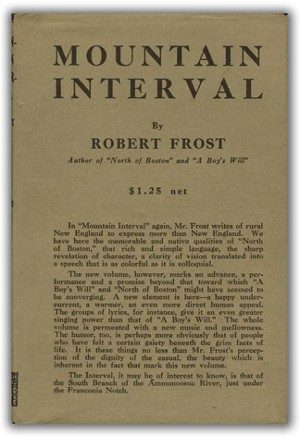
From the bookMountain IntervalFirst-edition dust jacket, Henry Holt, 1916
Analysis
'Out, Out--': analysis
Introduction
"'Out, Out--'" is a narrative poem of 34 lines in blank verse. It tells what happens one evening in a yard where a buzz-saw is cutting firewood. A boy is at work there as the day ends. When his sister calls them to supper, the saw catches his hand.
A doctor comes and puts him under ether, and the boy dies. The people around him then turn back to their own affairs. The poem is about how quickly a life can end, and it leaves the question of blame open. Its last two lines have divided readers more than anything else in it.
Summary
A buzz-saw snarls and rattles in a yard (line 1). It makes dust and drops sticks of wood cut to stove length. The wood smells sweet when the breeze passes over it. Anyone who looks up can count five mountain ranges under the sunset, reaching into Vermont (lines 4–6).
The saw keeps snarling and rattling, whether it runs free or cuts (lines 7–8). Nothing happens, and the day is nearly over. The speaker breaks in with a wish. The speaker wishes someone had said "Call it a day" and given the boy a spare half hour (lines 10–12).
The boy's sister comes out in her apron to call them to supper. At that word the saw leaps at the boy's hand, or seems to (lines 14–16). The speaker allows that the boy may have given the hand. Either way, neither boy nor saw "refused the meeting" (line 18).
The boy's first cry is a rueful laugh. He swings toward the others, holding up the hand half in appeal and half to keep the life from spilling. Then he sees everything, being old enough to know, a boy doing a man's work. He begs his sister not to let the doctor cut his hand off (lines 25–26).
The speaker states that the hand was gone already. The doctor puts the boy under ether, and he lies puffing his lips out with his breath. Then the person watching his pulse takes fright. No one can believe it, and they listen at his heart as it fades to nothing (lines 30–32).
There is no more to build on. The others, who are not the one dead, turn back to their own affairs (lines 33–34). The poem ends on that return to ordinary life.
Themes and meaning
The poem is about how suddenly a life can end. It spends nine lines on a calm scene where "nothing happened" (line 9). Then the boy is hurt and dead within about twenty lines. The fading pulse is given as "Little -- less -- nothing!", and "that ended it" closes the life in one clause (line 32). The title's repeated word Out, with its dashes, can be read as extinction cut short. Several readers hear in it Macbeth's words about a brief life put out like a candle.
A second theme is a child made to do adult work. The speaker calls him "big boy / Doing a man's work, though a child at heart" (lines 23–24). The wished-for half hour matters because "a boy counts so much" on time saved from work (line 12). When he "saw all", he sees it "all spoiled" (lines 22–25). A hand is what a worker needs, so the injury can be read as the end of his working future.
The poem also leaves blame open. The saw acts "As if to prove saws knew what supper meant" (line 15). The speaker at once corrects this to "or seemed to leap" and then offers "He must have given the hand" (lines 16–17). "However it was" sets both accounts aside without choosing. "Neither refused the meeting" treats boy and saw as two parties to one event, with no one at fault.
The ending asks how the living respond to a death. The others, "since they / Were not the one dead, turned to their affairs" (lines 33–34). One reading finds this cold, a household that valued the boy for his work. Another finds plain necessity: the work must go on, and they had done what they could. "No more to build on there" (line 33) supports both readings, meaning either that nothing more can be done or that the boy's future is gone.
The poem's field of view narrows as it goes. It opens on "Sweet-scented" wood and "Five mountain ranges" under the sunset (lines 3–5). That view is for "those that lifted eyes", and the working boy is not said to be among them. After the injury, attention contracts to the hand, the breath, the pulse and the heart. The mountains are never mentioned again.
Tone
The speaker's tone is mostly plain and reporting. Many lines start with "And", which gives the account the pace of a spoken story. Only once does the speaker step in with a feeling: "I wish they might have said" (line 10). That wish shows sympathy for the boy before anything has gone wrong.
As the accident happens, the tone grows grim and uneasy. The line about saws knowing "what supper meant" (line 15) has a bitter irony. The outburst "But the hand!" (line 18) is the speaker's one cry of shock. Then "So." (line 27) shuts the feeling down in a single word.
The last lines are flat and quick. The phrase "turned to their affairs" states what the others do without judging it. Readers disagree whether this flatness is coldness, or a restraint that makes the loss hit harder.
Form and structure
The poem is a single stanza of 34 lines. It does not rhyme. Most matches in the computed rhyme scheme are the same word repeated at line ends, such as "hand" (line 18 and line 20) and "heart" (line 24 and line 31). The one true chime is "leap" and "keep" (line 16 and line 21).
The metre is blank verse, which is unrhymed iambic pentameter, used loosely here. The first line scans as five regular iambs: "The buzz-saw snarled and rattled in the yard". Most lines have 10 or 11 syllables, within a range of 9 to 13. The saw's repeated noise swells line 7 to 13 syllables. Only 9 syllables fill line 27, and its shortness sets off the stark "So."
The stanza never breaks between the landscape, the accident, the doctor and the return to work. That continuity is part of the effect: the catastrophe enters an ordinary working day and the day goes on.
Poetic devices
personification and onomatopoeia line 1
The buzz-saw snarled and rattled Snarled gives the saw an animal's threat, and both verbs imitate its noise. The danger is present from the first line.
alliteration line 3
Sweet-scented stuff The soft repeated s-sounds make the wood pleasant and calm. They contrast with the harsh sounds of the saw in line 1.
repetition line 7
And the saw snarled and rattled, snarled and rattled, The doubled phrase echoes line 1 and stretches the line to 13 syllables. It makes the saw's noise feel constant and wearing.
irony line 9
And nothing happened: day was all but done. The speaker says nothing happened just before the worst thing happens. "all but done" hints that the day, and the boy's life, is nearly over.
personification line 15
As if to prove saws knew what supper meant The saw is given understanding and appetite, as if it too answers the call to supper. The grim joke makes the machine seem to choose its victim.
ambiguity line 16
or seemed to leap The speaker takes back the claim that the saw acted. This opens the question of who or what caused the accident.
caesura and exclamation line 18
But the hand! The full stop mid-line and the outcry break the narration. The speaker cannot say directly what has happened to the hand.
oxymoron line 19
rueful laugh Laughter and regret are joined in the boy's first reaction. It shows shock before the full meaning reaches him.
metaphor line 22
The life from spilling. Life becomes a liquid that can pour out of the injured hand. The wording joins the wound to the death that follows.
caesura line 30
And then -- The dash stops the line before the watcher's alarm. The pause marks the moment the scene turns from surgery to dying.
dashes and gradation line 32
Little -- less -- nothing! The words shrink step by step, and the dashes stand for the pauses between faint beats. The line enacts the pulse fading out.
enjambment and understatement line 33
And they, since they The sentence runs over the line break, delaying the reason until "Were not the one dead". The plain wording leaves the reader to judge the others' response.
Words worth knowing
stove-length
Cut short enough to fit into a wood-burning stove.
ran light
Ran without cutting anything, with no load on the blade.
Call it a day
An everyday phrase meaning to stop work for the day.
rueful
Regretful or sorrowful. The laugh carries dismay rather than amusement.
ether
A gas once used to make patients unconscious for surgery.
affairs
Their ordinary business and daily tasks, not love affairs.
What readers have said
Denise from Texas reads the title as an allusion to Macbeth and argues the last line need not be cruel, since life must go on after a death. Denise from texas, 2004
Grace, writing a paper, reads the ending as the boy losing his worth once his hands are gone, so society no longer cares for him. grace, 2005
Skenvoy argues the others walk away because they have to work to live, and most likely had tears on their faces. Skenvoy, 2005
Chris, saying he is no expert, reads the boy doing a man's work and losing a limb as a picture of the First World War. Chris, 2005
Cherry Quintel finds the personified saw almost cute at first, which makes the accident land like a blow, and admires the practical ending. Cherry Quintel, 2005
fisha reads the saw as an unthinking predator, set against the value of the hand, and takes the boy to be finished the moment he sees all spoiled. fisha, 2010
Rather morbid, but the imagery is wonderful. It makes you look at the lack of permanence on this plane.
N.DanielUnited States
Robert Frost is a naturalist poet, it seems that outdoors is his favorite place, but in this poem the outdoors is a place of work for a boy so young but yet in a man's place. The boy hears the sound of the saw as a rattle and a snarl, these things are sounds of harm or fear, but yet in light work or heavy, it had a job to do, just as the boy had a job to do. It ends with the boy and the saw, being happy to stop the chores, but not knowing which threw first to stop, ends the life of the boy, just like the blowing out of a candle, Out, Out- just a shadow.
I have to interpret this poem for class. ots seems silly to have to read this cruel poem. Nobody care that the boy dies. I wonder what kind of community the boy lives in.He worked to help the family out, loses his hands , so then he doenst become valuable anymore? Dumb!!!!!!
Denise from texasUnited States
the title to this poem is an allusion to shakespears mcbeth. i think they relate because nobody seems to take the life of the boy seriously. with this in mind, if you look at the end of mcbeth when the wife dies, the husband kind of blows off her death to by saying "out, out-brief candle, life is but a waking candle" Indeed the last line of this poem could be considered cruel, but it could be considered as an act of devotion. because he dies, life still must go on. the family was trying to go on and survive out of necessity. perhaps they couldnt mourn because they didnt have time, not because they didn't care. i love this poem!!!!
Daniel from FloridaUnited States
Alright i have analyzed this poem in the past but i cant rememeber what my past analysis was of the poem but when researching for my english class recently i have discovered that there is like no information on this poem and that more should be posted and that we need information on the rhythm of the poem and the feet of the poem.......neways all i have to say is that this poem i believe demonstrates how many people are in real life especially back during the time that Frost's lived. I think this is actually quite a good poem to read even though the poem is rather cruel in nature.
CindyUnited States
This poem is also about the contrast between the grief felt by the child (the loss of his hand) and the grief shown by the parents by the loss of their child.
kristenUnited States
I'm doing research on robert frost for school and i needed a summary of this poem so if someone could provide me with a summary by email i would really appricaite it. Thanks, Kristen
Nick from IndianaUnited States
I am doing a class presentation for my high school english CP class, and I chose to do a presentation on Robert Frost. Each student has to present two of the poet's poems and do and analisis on each one. This is one of the peoms that I chose and I think that it will be a very fun poem to present. I anyone has any ideas about what other peom that I should analise, then email me within the next week. Thank you.
SkenvoyAustralia
The reason the people simply watched the boy die and walked away is because they have to work to live and couldnt afford to "stick around and help". They most likely had tears running down their faces but knew they could do no more for the young boy.
On a metaphorical level however the poem represents the fact that life is short and unpredictable, live it to the fullest and don't deter yourself from your dreams
ChrisCanada
Although I am not an expert on the style of writing Robert Frost uses, I think that this poem could very possibly relate to the first world war. It was written half way through it, and many things relate to it. First of all, there is a boy taking the responsibilities of a man, very possibly because the man was sent to war. The people could not stand around and mourn because they had to carry on with their lives and support their families. Also, the boys hand getting cut off represents that of what happens to many in war, and many times they become useless in war or die, just like the boy. That is the way I interperet this poem anyways, and I like it!
ChrisCanada
I am not an expert on the writing style of Robert Frost, but I think that this poem represents World War 1, especially since it was written half way through the war. I think that the boy taking the responsibilities of a man represents the men going to war, and the sons taking their responsibilities. Also, the loss of the limb and the death of the boy represnets both the loss of limbs many soldiers suffer and the deaths the result in many cases, and the death of a part of someone deep inside when they physically lose a piece of themselves.
grace
I am writing a paper on robert frost and I read his Poem Out Out. ok so the boy is valued in the beginning because he's a boy and boy's are like men and men are good for fighting, defending and work, when a man is needed to be replace a boy is there, that's why he is worth much but when his hands(limbs) are cut off he's worth less and not cared for when his is dying, because society doesn't need him so that's why he is left to die. How ironic because in the beginning he is seen as good and valueable then in the end he is seen as less then trash.
RonUnited States
This poem is an interesting look at rural life at the turn of the century. Young men or boys were put to work doing mens work as soon as possible. The setting is described as a rural landscape with the mountains in the distance. The boy seems to be resentful that he has not had a childhood, and in losing his hand will lose his value to his family and community. He dies, both from the loss of blood and poor medical technology and because, maybe he just gave up. The family and community do not have time to grieve they must get back to surviving the harsh reality of their time.
KristinaUnited States
The buzz saw snarled and rattled in the yard... Robert Frost is using alliteration in this poem, in line 3 Sweet-scented stuff... the sss indicates in the "snarl of a snake, particularly a rattle snake in this case. in the second line, Stove-length sticks of wood indicates of moses's stick that turned into a cobra. i think there is a subliminal message in this poem; i think robert frost was trying to tell us somting…
Read the whole comment
The buzz saw snarled and rattled in the yard... Robert Frost is using alliteration in this poem, in line 3 Sweet-scented stuff... the sss indicates in the "snarl of a snake, particularly a rattle snake in this case. in the second line, Stove-length sticks of wood indicates of moses's stick that turned into a cobra. i think there is a subliminal message in this poem; i think robert frost was trying to tell us somting vey important. his sister stood next to him... another alliteration the word "supper." in wich meaning "the last supper." then the boy saw all... a major pun. on the forth to last sentence No one believed... as if saying, no one believes in jesus anymore. if anyone is following what I am saying then leave a comment.
I had never read any work by Robert Frost until I was placed in an advanced english course recently. I gathered nothing from this poem my first time reading it. As for my second and even third, I began to understnad that its placed in the first world war and is the story of boys taking on the responsibilites of a man for whatever reason. Its sad because the boy is "worthless" and dies once his hand is amputated. I'm not really a big fan of it, but it is good.
ivy mukubesaSweden
What do you think the poem is all about?
GazUnited Kingdom
hi to all of the people with the random guesses the only way to understand poetry is to under stand the context there is no sublininal meaning to the peom its very simple frost knew a family who his children used to play with called raymond fitzgerald who one day was cutting wood and worked a bitlonger than normal 'call it a day i wish they had said' he then cut his hand off with an electrical saw THE STORY IS SIMPLE! the olnly compliction is the end line what does he mean i belive that he believes that it is a waste of young life but also people need to mourn his death and have to move on but they never even consder this i think this poem is a poem of discust to the parents and ramond RIP
Though I am not a great fan of Robert Frost but this poem was really appealing as it showed that whatever happens,life moves on.One must do deeds such that he/she can contentfully leave this planet
JaimieAustralia
ok, i performed this lyrical poem at the gold coast eisteddfod and i believe it is just a representation of life - not all poem have deeper construed meanings - it is a reflection of the time that it was written, about events that could happen... it uses alliteration, onomatopoeia and a number of other literary techniques. It is a beautiful piece, despite it's eerie nature and traumatic events...
LauraUnited Kingdom
I think this poem may be a representation of Frost's life. specifically the death of his son. The boy in the poem enjoys life but dreams of becoming an adult. Taking on a man's job is good for society, but results in him losing his life- society then have no time to grieve because of the era in which they live in where work is more important than life itself
i think that perhaps the boy who dies in the poem maybe wants to injure himself to get out of work as he doesnt like it and because it says "a child at heart" he was foolish and didnt realise what the consequences would be, DEATH!
I am also researching this poem and I found something interesting that you guys should know. Frost wrote this poem after reading a artical in the newspaper. Here it is: Lancaster, Nov 18th-- John M. Adams, son of Mr. and Mrs. James Adams, Route 3, Riverton, died last Saturday evening as a result of injuries he received while operating a power saw on his parent's farm. The accident happened late Saturday afternoon…
Read the whole comment
I am also researching this poem and I found something interesting that you guys should know. Frost wrote this poem after reading a artical in the newspaper. Here it is: Lancaster, Nov 18th-- John M. Adams, son of Mr. and Mrs. James Adams, Route 3, Riverton, died last Saturday evening as a result of injuries he received while operating a power saw on his parent's farm. The accident happened late Saturday afternoon while young Adams, his brother Stephen, 12, and his father were sawing logs. Apparently the boy was momentarily distracted while feeding a piece of wood into the blade, which caught his hand and amputated it. The youth's sister, Maude, 17, was witness to the accident. She said that her mother had sent her to call her father and brother to supper. The accident occurred, she said, just as she called to them. Mr. Adams immediately drove to nearby Riverton for a doctor. He finally located Dr. E. L. White and drove him back to the farm. Dr. White said that when he arrived the boy was already in shock from loss of blood, and that it was impossible to save him. The cause of death was listed by the coroner as accidental. Funeral services on Tuesday were held in Riverton Congregational Church, and internment was in Good Hope Cemetery.
TjBUnited States
This poem is wonderfully written in verse befitting Shakespeare. The allusion to "MacBeth" is so powerful. It doesn't give an explanation of the soliloquy that partly inspired "Out, Out--", but it does present the same puzzle to the reader which he/she must figure out: The mystery of life, the contemplation of death, and the will to move on.
lucyUnited Kingdom
The poems about a young boy who gets his hand chopped off, his peers and other people around him MUST get on with life, they have no time to mourn, this is not aacceptable now a days but could have been common in 1916. The poem shows great resemblemence to macbeth an this is why the title is out out.
WillUnited States
i love how this poem reflects the dark thoughts in Macbeth. "Out, out, brief candle! Life's but a walking shadow, a poor player, That struts and frets his hour upon the stage, And then is heard no more..." Thats exactly what this poem is about. The boy has a short and unfulfiling life. He dies young and is "heard no more." I think its funny that he compares life to a candle and then says it is heard no more... lol... a candle was never "heard" in the first place...
jackUnited States
Besides being related to Shakespeare, one can also say that the poem is related to William Golding’s The Lord of the Flies, where the fall of innocence is present. In “Out, Out--”, the boy’s hand gets cut off and he sees all. He sees the real world as it really is, as a world of cold, almost heartless nature. In The Lord of the Flies, Ralph sees the innate evil nature of man and especially the loss of innocence in man. Ralph finally sees just how evil man is, and can no longer go back to his innocent phase of life. That is one the themes in The Lord of the Flies and, in “Out, Out--”, a main theme is how life goes on.
I love this poem; the end two lines are just so practical "No more to build on there. And they, since they Were not the one dead, turned to their affairs". And the personification of the saw, is just so cute and yet when you realise what’s happened it's like a blow. The reason that this poem is sooo good is that it deals with death with a sad practicality.
This is one of my more enjoyable poems. The way this poem ends is very to the point, one of Frosts best, definatley one for the ages.
Kristen TredreaAustralia
The poem has a very poignant ending that reinforces what the poem is about and shows emotion
mathewUnited States
this poem was a great poem and I really enjoyed it
MellisaUnited States
tihs poem was good one of my favorites by frost!!!!!
AlexisUnited States
It's significant that only 3 lines in the poem actually mention the boy dying. The other workers don't care about the boy because he was only valued as a worker, not as a person. Also, in the last 7 lines when the boy is dying, there is a notable absence of his family members.
ashleyFiji
this poem was ok, it was kind of weird cause it talks about a boy gettin his hand cut off by a chain saw but it was pretty interesting. Lets just say that it keep me reading it so that has to say something since i dont even like poetry and i would have never read this if my teacher wouldnt have made me. But ya know it was ok
I have an exam tomorrow on Frost so here goes my final attempts at understanding his poems. I defitely agree that it's not that the family are heartless but that because they live in a rural setting then they must move on. It was quite common for rural families to react in that way as it was also their way of grieving. If you look at Frost's other poem 'Home Burial' you will see two very different reactions of a…
Read the whole comment
I have an exam tomorrow on Frost so here goes my final attempts at understanding his poems. I defitely agree that it's not that the family are heartless but that because they live in a rural setting then they must move on. It was quite common for rural families to react in that way as it was also their way of grieving. If you look at Frost's other poem 'Home Burial' you will see two very different reactions of a child's death from a married man and woman. The man reacts in the same way as the rural family in 'Out, Out!" whereas the woman is deeply grieving and can't understand how her husband can just get on with things. It's definitely an interesting interpretation of rural life, especially since Frost himself did live in rural New England
MSAustralia
In looking at Frost's poem, we have to realize first that this poem uses Macbeth's famous soliloquy to reinforce the theme that life is "brief and uncertain." Now that we have the theme, we can try to apply certain literay term's importance to the poem including the onomatopoeia of the snarling and buzzing saw, the repetition of these words illustrates the malice of death, along with the act of the saw leaping at…
Read the whole comment
In looking at Frost's poem, we have to realize first that this poem uses Macbeth's famous soliloquy to reinforce the theme that life is "brief and uncertain." Now that we have the theme, we can try to apply certain literay term's importance to the poem including the onomatopoeia of the snarling and buzzing saw, the repetition of these words illustrates the malice of death, along with the act of the saw leaping at the boy's hand, not allowing the boy to cease his work to take a break for supper. The saw is a sort of metaphorical representation of the way the meaningless tasks of life (including sawing wood and doing waste of time essays like these) prevents us from living our lives, it is illstrated that the boy believes that his manly work has denied him life ("Then the boy saw all--/ Since he was old enough to know, big boy/ Doing a man's work, though a child at heart--/ He saw all spoiled.") We can possibly assume that the careless "child" that the boy was allowed his hand to meet with the say because of the way Frost show's the boy's meeting with the saw ("with a rueful laugh"). But most importantly the last line of the poem must be observed "And they, since they/ Were not the one dead, turned to their affairs," because this shows the emotionless, miserable life these people lived in order to put this boy to work, deny him even the half hour for relief from work.
im 15 and studying robert frost for GSCE. so if anyone could help i would be v. grateful. although i do think the poem shows great use of alliteration and personification.
rachelIreland
my fav line is 'sun set far into vermont' as it means a number of things such as the day is coming to an end and there is an end to the boys life. this is a great use of imagery as it gives you the nostalgic feeling.
i read it only because i had a presentation about a poem and i found this an read it.
amoolUnited Kingdom
can anyone help i would be v. grateful. although i do think the poem shows great use of alliteration and personification plz help
JaneUnited States
its sad that the boy had to die because he was trying to help the work and acted mature at work. Even though it was just for 30 minutes, he still got something done. There were lots of imageries, 5 sensories, and lilterary device. I didn't get when the family just saw and didn't say anything. It's a little bit confusing. But this poem was not a good poem on one of the Frost's poem. He writes way better than these poems that let us wonder about these life situation. =)
sarahUnited States
THANK YOU, GAZ!! (the guy from UK on page 3) dude, you know, most poets are drunks and everything- do you really think that there is some elaborate subliminal message that they hide in their poetry? they probably just go into a bar, write stuff down, then hand it to their publisher. Now, don't get me wrong, i like poetry just as much as the next guy, but, to psyco-analize the stuff is ridiculous!
johnnySri Lanka
i think this poem is about the countryside and its daily routine.the boy is doing his work to help the parents.wealso do household work to help our parents.the boy is tired and hungry and when the sister calls him for the supper he lost the attention and gives his hand to hte saw accidently.the poem is about the daily happennings in the countryside.maybe in new england country side where the poet lived.
Mr. PUnited States
When reading Frost, it's crucial that you don't interpret his poetry superficially. This poem in one sense is certainly about what literally happens: a boy meets with an unfortunate accident that eventually takes his life--an idea Frost probably extracted from a newspaper article that described such a situation. But on a larger level, look not at what the poem says, but instead at what it doesn't say. For example, I…
Read the whole comment
When reading Frost, it's crucial that you don't interpret his poetry superficially. This poem in one sense is certainly about what literally happens: a boy meets with an unfortunate accident that eventually takes his life--an idea Frost probably extracted from a newspaper article that described such a situation. But on a larger level, look not at what the poem says, but instead at what it doesn't say. For example, I noticed other responses talk about how the family is "cold" and "doesn't show emotion." This is a mistake. The speaker chooses NOT to tell us about that aspect of their reaction--that doesn't mean it didn't/wouldn't happen. What I think we're seeing is the utter helplessness and lack of control over meeting with death. One minute the boy smelled the sweet scented air permeated by the splinters of wood, next he was put in the dark of ether. LIFE can change that quickly, and not as a result of any conscious choices WE make. The speaker's frustration with this helplessness is evident in his matter-of-fact attitude: "So...No more to build on there." I also wonder about the sick sense of humor in the poem. The boy held up his hand "half in protest"--HALF? That's just cruel. And "No more to 'build' on there"? Even more ironic since the boy died as a result of doing work. "The boy 'SAW' all"? Even more irony, as the saw is what's responsible for his death. I agree with what one person above wrote about the "all" in that statement. The boy realizes in an instant his naivete and quickly recognizes how fragile life is, how our world is one ungoverned by order and subject to frequent uncontrollable collisions. These collisions often claim innocence--in both senses. Innocence as a virtue (almost) and innocence as in innocent people (young people in this case). The mountain ranges, 5 for 5 work days in a week perhaps, really emphasize just how small and impermanent this boy is. Sad though. I hope I don't meet with such an end. I would far prefer to die at 101 in a warm bed after a peaceful sleep.
my understanding of this poem is not full and proper and i need someone with the skills of imparting simple but evaluative expalnation coz my exam on it is near to come.
lollyBelgium
i don't lik this poem because it isn't modern enough
MeaganUnited States
I really don't completely understand poetry, but the words are nice and all. I just hate having to dig deep and figure out what in the world those crazy, weird people meant when they wrote all that. Frost is really morbid in this poem, but I know that it has a lot of meaning and I wanted to say thanks to every1 that has contributed something relevant and helpful. You're my heroes!
JennyUnited Kingdom
The irregular use of iambic pentameter and the frequent use of caesura and enjambement through out 'Out, Out-' conveys the spontaneity of impulsive thoughts. This is also indicated through the unconvential syntax (arragement of sentences) of certain lines, such as 'Call it a day, i wish they might have said' You may want to comment on the use of onomatopoeia and assonace in the first few lines especially...comment on the effect the poem has because of these devices. Hope this helps!! Good Luck all.
Fair point Gaz. but to say that this poem has no deeper meaning would mean there was no purposeful reason behind writing it. if it was just a story then why would Frost bother? why would he angonize over the creation of rhymth, alliteration etc? Besides, Frost was a thoughtful kinda guy. In his other Poems like Birches and The Road Not Taken, it seems like he is exploring a number of concepts and themes although on the surface, he tells a simplistic story.
Printninja
Reading this poem for the first time is a powerful experience, for if you simply surrender to the words, and let yourself feel the impact Frost is conveying, you can't help but shudder at the end, even after multiple reading. It's the "chills up your spine" emotional connectivity we seek. That's what poetry is all about. I don't want to over-analyze the meaning, I want to feel the connection, and in so doing, come…
Read the whole comment
Reading this poem for the first time is a powerful experience, for if you simply surrender to the words, and let yourself feel the impact Frost is conveying, you can't help but shudder at the end, even after multiple reading. It's the "chills up your spine" emotional connectivity we seek. That's what poetry is all about. I don't want to over-analyze the meaning, I want to feel the connection, and in so doing, come to a deeper level of understanding. This is the capacity that every one of us has - to appreciate genius and artistry even though we may not posses the raw talent ourselves. It's a uniquely human ability, and one that many people ignore because it does take effort and practice. It's the same thing that prevents someone from appreciating fine art, or classical music. It takes effort, but as anyone who makes the effort can tell you, there's nothing else like it on earth.
PaddyAustralia
firstly, the title of the poem is a quote from Macbeth. The techniques used include a speech, storylike narrative, and short tense setnances. There are also sounds such as "snarled and rattled" The language is also used to get acorss the meaning, eg: the use of "rueful laugh" is ornic. The meaning of the poem is about life and death, and the attitue of others. It is about a good life that has been wasted. Frost points out how precious life is, an dhow easiy things can change so quicky.
I love this poem. I think that Frost captures the reality of life in an out of the way place and the fragility of life. Its seems to me that mourning the death of the boy was a luxury that his family could not afford because of the hardship of their every day life. Its such a sad poem.
houdaMorocco
hi 1st. i wanna ask about "5 mountains ranges one behind the other" what does robert frost want to mean by 5 mountains, please?
i am not surprised at frost with his title that suggests a more in depth meaning than its surface. like lady macbeth in macbeth, a deed was already done that could not be undone. the title suggests the literal meaning of someone taken out of existence, life taken out of him, the blood taken out of him.it may sound morbid, but frosts speaks to reality a lot, using stories to redirect us to the morbid truthhs about…
Read the whole comment
i am not surprised at frost with his title that suggests a more in depth meaning than its surface. like lady macbeth in macbeth, a deed was already done that could not be undone. the title suggests the literal meaning of someone taken out of existence, life taken out of him, the blood taken out of him.it may sound morbid, but frosts speaks to reality a lot, using stories to redirect us to the morbid truthhs about our existence and our limitations as humans not to mention the inexperiences and innocence of a child no matter what role he takes on. frost demands that his readers dig deep for meaning and that a one time reading is never enough. thre is contrast as he sets this terrible mishap against the background of 5 mountain ranges. is there a deeper significance to these mountains.,do they signify hardships, or peace after death.we the reders are yet again drawn into the psychological warfare of anger vs empathy.why did this boy give up so easily/ is it the act that even though he is a boy he recognises that he will be useless and become a burden to hi family along with the fact that it was just a frightening experienc/ from the beginning of this dramatic piece of work we are made to expect something gruesom the snarl, like that of an untamed , wild beast, the rattling which again is an animal that moves fast and is dangerous, the snake.is there dramatic irony here/
hi i like this poem cause it show us how much life is a comedy , we spend it all on fighting and working hardly to reach our 'dreams'and needs that have no end and we forget that everything has an end an end that give no importance to our motivations or dreams or even age as in the peom above so i think it s better to"work for your dreams as if your living forever,and work for you god gd tings as if you will die tomorrow"
breiAustralia
what if a poet writes something just because its meaningful to them, what if they didnt intend to use language techniques, imagery, sound devices and so on? i have written poems, of course they are not brilliant but i didn't write them so they could be analysed or looked at like a specimen. i simply wrote them to evoke feelings and tell stories. what if a poet simply wants you to feel instead of looking for all the techniques used! at school we have pages and pages of notes on how to appreciate a poem! dosen't that sound silly? to anyone? i just want to know if im the only one who feels that not all poems are there to be analysed.
Personally, I doubt that this poem has ANYTHING to do with the World Wars, and really, what was the purpose of putting down what Frost got his idea from the poem from? It completely takes away from the analytical side of the poem, and the mystery that is hidden has been revealed. The POINT of almost all poems that anyone has written is the mystery that is in its depth, and you who told the truth about the poem has…
Read the whole comment
Personally, I doubt that this poem has ANYTHING to do with the World Wars, and really, what was the purpose of putting down what Frost got his idea from the poem from? It completely takes away from the analytical side of the poem, and the mystery that is hidden has been revealed. The POINT of almost all poems that anyone has written is the mystery that is in its depth, and you who told the truth about the poem has just ruined the entire thing! Before I learned the so called 'truth', I assumed that this BOY, boy being key word-as in-not MAN-, had no father and so, was doing a man's work to provide for his family. If so, then the reason that he so desperatly wanted his hand was so to keep his family from complete poverty. I think that the mountains described in the first few lines of the poem symbolize the barriers that have been put forth to the boy, that he CANNOT prevent what will happen to not. The SUNSET that is mentioned may symbolize the ending of life, that is quickly proven at the end of the poem, as the boy dies. The saw is portrayed as an animal, not exactly a snake, because a snake HISSES, but the repition of the '...snarled and rattled, snarled and rattled,' , has a major impression on this poem. I am not quite sure of why it is repeated (emphasis?) but I'm sure it is extremely important to the poem as a whole. I do not know what role the sister plays in this poem, (perhaps just a distraction) but as the reptition mentioned before, I am sure she has an important part as well.
I do not want to criticize this work of 'art'-The reason I like this poem is that,as I understand,the poet despises the callousness people show towards such incidents as this-I think this poem is dealing with a note of cruel callousness of things against man-against man by his own fellow-beings.This also convey ideas of bruteforce of mechines,and with it we see the boy's life dying 'out',which also captures the briefness of life.I do not know whether my understanding is wrong,but just thought of giving my opinion about it.
The emphasis on the words "Snarled and rattled", at the beginning of the poem, suggests to me a tragedy of some sort. Snarled.......like a dog, rattled....like someting not in working order, gives us a foreboding of something bad to come. The use of the word "Sunset", when all dies down can be linked to the end of the Boys life.
"Sweet scented stuff" This creates a soft quiet sound which sort of lulls you, also later in that line the poets word choice is effective because he says.. "breeze" which also creates a soft gentle atmosphere. But the repetition of "snarled and rattled" gives us a foreboding of something bad to come.
the key word of the poem is "Supper". the last supper requires a victim. after this sacrifice nobody took care, like Icarus, (you know another famous poem),it will be a myth for a while good to entertain the mob.
SAADIA KHANPakistan
I Like this poem very much
fishaSri Lanka
I feel that Robert Frost appreciates manual labour over the 'buzz saw' in this poem...he stresses on the unimaginative quality of the machine,its lack of thought. After all its a mechanical object programmed by man to "[make] dust and [drop] stove-length sticks of wood".he also personifies the 'buzz saw' to a wild predatory animal "The buzz-saw snarled and rattled in the yard". He finally shows the value of the…
Read the whole comment
I feel that Robert Frost appreciates manual labour over the 'buzz saw' in this poem...he stresses on the unimaginative quality of the machine,its lack of thought. After all its a mechanical object programmed by man to "[make] dust and [drop] stove-length sticks of wood".he also personifies the 'buzz saw' to a wild predatory animal "The buzz-saw snarled and rattled in the yard". He finally shows the value of the 'hand' by the unexpected death of the boy.."He saw all spoiled" he was dead the moment he lost his hand as he could work no more.he,without his hand,was useless to society.he could no longer play the role of the breadwinner too.there is a reference to child labour too. "...big boy Doing a man's work, though a child at heart" he was yet immature to do this task which he performs merely to earn a living...not for its joy or pleasure.his 'sister', too,is " in her apron ".perhaps she too was a child assigned to do a task beyond her age.I hope I'm not wrong!
I like this poem very much. It takes the mind away from concetration and it is very good.
hanaIran
analysis and comment on "out out" by Robert Frost
the theme of this poem is uncertainly and unpredictably of life which may be accidentally ended at any moment.the story of a boy who is doing hard work that is not suitable with his age,suddenly whose life destroyed. the poem has allusion to the "out out bref candle"of shakspeare and a reference to the "macbeth" story.another is the word "supper",it allusion to the "last supper painting of Leonardo da vinci"
DileeSri Lanka
The poem "Out Out" becomes realistic in sense.The lyrical of the poem is simply easy for the reader to get on."the buzz saw snarled..." describes the noise and the hardship in using the machine.Also the poem is sensual and more relaxed ,proved by the mention of "breeze"and"sweet scented stuff".The most sympathetic quote used by Frost is "though a child at heart..."
The poem is considered an industrial revolution( yes, Frost lived in that period). The saw is industrial revolution ,and the hand is the old traditional pastoral society
Rather morbid, but the imagery is wonderful. It makes you look at the lack of permanence on this plane.
Robert Frost is a naturalist poet, it seems that outdoors is his favorite place, but in this poem the outdoors is a place of work for a boy so young but yet in a man's place. The boy hears the sound of the saw as a rattle and a snarl, these things are sounds of harm or fear, but yet in light work or heavy, it had a job to do, just as the boy had a job to do. It ends with the boy and the saw, being happy to stop the chores, but not knowing which threw first to stop, ends the life of the boy, just like the blowing out of a candle, Out, Out- just a shadow.
I have to interpret this poem for class. ots seems silly to have to read this cruel poem. Nobody care that the boy dies. I wonder what kind of community the boy lives in.He worked to help the family out, loses his hands , so then he doenst become valuable anymore? Dumb!!!!!!
the title to this poem is an allusion to shakespears mcbeth. i think they relate because nobody seems to take the life of the boy seriously. with this in mind, if you look at the end of mcbeth when the wife dies, the husband kind of blows off her death to by saying "out, out-brief candle, life is but a waking candle" Indeed the last line of this poem could be considered cruel, but it could be considered as an act of devotion. because he dies, life still must go on. the family was trying to go on and survive out of necessity. perhaps they couldnt mourn because they didnt have time, not because they didn't care. i love this poem!!!!
Alright i have analyzed this poem in the past but i cant rememeber what my past analysis was of the poem but when researching for my english class recently i have discovered that there is like no information on this poem and that more should be posted and that we need information on the rhythm of the poem and the feet of the poem.......neways all i have to say is that this poem i believe demonstrates how many people are in real life especially back during the time that Frost's lived. I think this is actually quite a good poem to read even though the poem is rather cruel in nature.
This poem is also about the contrast between the grief felt by the child (the loss of his hand) and the grief shown by the parents by the loss of their child.
I'm doing research on robert frost for school and i needed a summary of this poem so if someone could provide me with a summary by email i would really appricaite it. Thanks, Kristen
I am doing a class presentation for my high school english CP class, and I chose to do a presentation on Robert Frost. Each student has to present two of the poet's poems and do and analisis on each one. This is one of the peoms that I chose and I think that it will be a very fun poem to present. I anyone has any ideas about what other peom that I should analise, then email me within the next week. Thank you.
The reason the people simply watched the boy die and walked away is because they have to work to live and couldnt afford to "stick around and help". They most likely had tears running down their faces but knew they could do no more for the young boy.
On a metaphorical level however the poem represents the fact that life is short and unpredictable, live it to the fullest and don't deter yourself from your dreams
Although I am not an expert on the style of writing Robert Frost uses, I think that this poem could very possibly relate to the first world war. It was written half way through it, and many things relate to it. First of all, there is a boy taking the responsibilities of a man, very possibly because the man was sent to war. The people could not stand around and mourn because they had to carry on with their lives and support their families. Also, the boys hand getting cut off represents that of what happens to many in war, and many times they become useless in war or die, just like the boy. That is the way I interperet this poem anyways, and I like it!
I am not an expert on the writing style of Robert Frost, but I think that this poem represents World War 1, especially since it was written half way through the war. I think that the boy taking the responsibilities of a man represents the men going to war, and the sons taking their responsibilities. Also, the loss of the limb and the death of the boy represnets both the loss of limbs many soldiers suffer and the deaths the result in many cases, and the death of a part of someone deep inside when they physically lose a piece of themselves.
I am writing a paper on robert frost and I read his Poem Out Out. ok so the boy is valued in the beginning because he's a boy and boy's are like men and men are good for fighting, defending and work, when a man is needed to be replace a boy is there, that's why he is worth much but when his hands(limbs) are cut off he's worth less and not cared for when his is dying, because society doesn't need him so that's why he is left to die. How ironic because in the beginning he is seen as good and valueable then in the end he is seen as less then trash.
This poem is an interesting look at rural life at the turn of the century. Young men or boys were put to work doing mens work as soon as possible. The setting is described as a rural landscape with the mountains in the distance. The boy seems to be resentful that he has not had a childhood, and in losing his hand will lose his value to his family and community. He dies, both from the loss of blood and poor medical technology and because, maybe he just gave up. The family and community do not have time to grieve they must get back to surviving the harsh reality of their time.
The buzz saw snarled and rattled in the yard... Robert Frost is using alliteration in this poem, in line 3 Sweet-scented stuff... the sss indicates in the "snarl of a snake, particularly a rattle snake in this case. in the second line, Stove-length sticks of wood indicates of moses's stick that turned into a cobra. i think there is a subliminal message in this poem; i think robert frost was trying to tell us somting…
Read the whole commentThe buzz saw snarled and rattled in the yard... Robert Frost is using alliteration in this poem, in line 3 Sweet-scented stuff... the sss indicates in the "snarl of a snake, particularly a rattle snake in this case.
in the second line, Stove-length sticks of wood indicates of moses's stick that turned into a cobra. i think there is a subliminal message in this poem; i think robert frost was trying to tell us somting vey important. his sister stood next to him... another alliteration the word "supper." in wich meaning "the last supper." then the boy saw all... a major pun. on the forth to last sentence No one believed... as if saying, no one believes in jesus anymore. if anyone is following what I am saying then leave a comment.
I had never read any work by Robert Frost until I was placed in an advanced english course recently. I gathered nothing from this poem my first time reading it. As for my second and even third, I began to understnad that its placed in the first world war and is the story of boys taking on the responsibilites of a man for whatever reason. Its sad because the boy is "worthless" and dies once his hand is amputated. I'm not really a big fan of it, but it is good.
What do you think the poem is all about?
hi to all of the people with the random guesses the only way to understand poetry is to under stand the context there is no sublininal meaning to the peom its very simple frost knew a family who his children used to play with called raymond fitzgerald who one day was cutting wood and worked a bitlonger than normal 'call it a day i wish they had said' he then cut his hand off with an electrical saw THE STORY IS SIMPLE! the olnly compliction is the end line what does he mean i belive that he believes that it is a waste of young life but also people need to mourn his death and have to move on but they never even consder this i think this poem is a poem of discust to the parents and ramond RIP
Though I am not a great fan of Robert Frost but this poem was really appealing as it showed that whatever happens,life moves on.One must do deeds such that he/she can contentfully leave this planet
ok, i performed this lyrical poem at the gold coast eisteddfod and i believe it is just a representation of life - not all poem have deeper construed meanings - it is a reflection of the time that it was written, about events that could happen... it uses alliteration, onomatopoeia and a number of other literary techniques. It is a beautiful piece, despite it's eerie nature and traumatic events...
I think this poem may be a representation of Frost's life. specifically the death of his son. The boy in the poem enjoys life but dreams of becoming an adult. Taking on a man's job is good for society, but results in him losing his life- society then have no time to grieve because of the era in which they live in where work is more important than life itself
i think that perhaps the boy who dies in the poem maybe wants to injure himself to get out of work as he doesnt like it and because it says "a child at heart" he was foolish and didnt realise what the consequences would be, DEATH!
I am also researching this poem and I found something interesting that you guys should know. Frost wrote this poem after reading a artical in the newspaper. Here it is: Lancaster, Nov 18th-- John M. Adams, son of Mr. and Mrs. James Adams, Route 3, Riverton, died last Saturday evening as a result of injuries he received while operating a power saw on his parent's farm. The accident happened late Saturday afternoon…
Read the whole commentI am also researching this poem and I found something interesting that you guys should know. Frost wrote this poem after reading a artical in the newspaper. Here it is: Lancaster, Nov 18th-- John M. Adams, son of Mr. and Mrs. James Adams, Route 3, Riverton, died last Saturday evening as a result of injuries he received while operating a power saw on his parent's farm.
The accident happened late Saturday afternoon while young Adams, his brother Stephen, 12, and his father were sawing logs. Apparently the boy was momentarily distracted while feeding a piece of wood into the blade, which caught his hand and amputated it.
The youth's sister, Maude, 17, was witness to the accident. She said that her mother had sent her to call her father and brother to supper. The accident occurred, she said, just as she called to them.
Mr. Adams immediately drove to nearby Riverton for a doctor. He finally located Dr. E. L. White and drove him back to the farm.
Dr. White said that when he arrived the boy was already in shock from loss of blood, and that it was impossible to save him. The cause of death was listed by the coroner as accidental.
Funeral services on Tuesday were held in Riverton Congregational Church, and internment was in Good Hope Cemetery.
This poem is wonderfully written in verse befitting Shakespeare. The allusion to "MacBeth" is so powerful. It doesn't give an explanation of the soliloquy that partly inspired "Out, Out--", but it does present the same puzzle to the reader which he/she must figure out: The mystery of life, the contemplation of death, and the will to move on.
The poems about a young boy who gets his hand chopped off, his peers and other people around him MUST get on with life, they have no time to mourn, this is not aacceptable now a days but could have been common in 1916. The poem shows great resemblemence to macbeth an this is why the title is out out.
i love how this poem reflects the dark thoughts in Macbeth. "Out, out, brief candle! Life's but a walking shadow, a poor player, That struts and frets his hour upon the stage, And then is heard no more..." Thats exactly what this poem is about. The boy has a short and unfulfiling life. He dies young and is "heard no more." I think its funny that he compares life to a candle and then says it is heard no more... lol... a candle was never "heard" in the first place...
Besides being related to Shakespeare, one can also say that the poem is related to William Golding’s The Lord of the Flies, where the fall of innocence is present. In “Out, Out--”, the boy’s hand gets cut off and he sees all. He sees the real world as it really is, as a world of cold, almost heartless nature. In The Lord of the Flies, Ralph sees the innate evil nature of man and especially the loss of innocence in man. Ralph finally sees just how evil man is, and can no longer go back to his innocent phase of life. That is one the themes in The Lord of the Flies and, in “Out, Out--”, a main theme is how life goes on.
I love this poem; the end two lines are just so practical "No more to build on there. And they, since they Were not the one dead, turned to their affairs". And the personification of the saw, is just so cute and yet when you realise what’s happened it's like a blow. The reason that this poem is sooo good is that it deals with death with a sad practicality.
This is one of my more enjoyable poems. The way this poem ends is very to the point, one of Frosts best, definatley one for the ages.
The poem has a very poignant ending that reinforces what the poem is about and shows emotion
this poem was a great poem and I really enjoyed it
tihs poem was good one of my favorites by frost!!!!!
It's significant that only 3 lines in the poem actually mention the boy dying. The other workers don't care about the boy because he was only valued as a worker, not as a person. Also, in the last 7 lines when the boy is dying, there is a notable absence of his family members.
this poem was ok, it was kind of weird cause it talks about a boy gettin his hand cut off by a chain saw but it was pretty interesting. Lets just say that it keep me reading it so that has to say something since i dont even like poetry and i would have never read this if my teacher wouldnt have made me. But ya know it was ok
Bah. writing an essay about this poem, Kristina on page 3 was quite helpful, got me thinking about some things.
I have an exam tomorrow on Frost so here goes my final attempts at understanding his poems. I defitely agree that it's not that the family are heartless but that because they live in a rural setting then they must move on. It was quite common for rural families to react in that way as it was also their way of grieving. If you look at Frost's other poem 'Home Burial' you will see two very different reactions of a…
Read the whole commentI have an exam tomorrow on Frost so here goes my final attempts at understanding his poems. I defitely agree that it's not that the family are heartless but that because they live in a rural setting then they must move on. It was quite common for rural families to react in that way as it was also their way of grieving. If you look at Frost's other poem 'Home Burial' you will see two very different reactions of a child's death from a married man and woman. The man reacts in the same way as the rural family in 'Out, Out!" whereas the woman is deeply grieving and can't understand how her husband can just get on with things. It's definitely an interesting interpretation of rural life, especially since Frost himself did live in rural New England
In looking at Frost's poem, we have to realize first that this poem uses Macbeth's famous soliloquy to reinforce the theme that life is "brief and uncertain." Now that we have the theme, we can try to apply certain literay term's importance to the poem including the onomatopoeia of the snarling and buzzing saw, the repetition of these words illustrates the malice of death, along with the act of the saw leaping at…
Read the whole commentIn looking at Frost's poem, we have to realize first that this poem uses Macbeth's famous soliloquy to reinforce the theme that life is "brief and uncertain." Now that we have the theme, we can try to apply certain literay term's importance to the poem including the onomatopoeia of the snarling and buzzing saw, the repetition of these words illustrates the malice of death, along with the act of the saw leaping at the boy's hand, not allowing the boy to cease his work to take a break for supper. The saw is a sort of metaphorical representation of the way the meaningless tasks of life (including sawing wood and doing waste of time essays like these) prevents us from living our lives, it is illstrated that the boy believes that his manly work has denied him life ("Then the boy saw all--/ Since he was old enough to know, big boy/ Doing a man's work, though a child at heart--/ He saw all spoiled.") We can possibly assume that the careless "child" that the boy was allowed his hand to meet with the say because of the way Frost show's the boy's meeting with the saw ("with a rueful laugh"). But most importantly the last line of the poem must be observed "And they, since they/ Were not the one dead, turned to their affairs," because this shows the emotionless, miserable life these people lived in order to put this boy to work, deny him even the half hour for relief from work.
im 15 and studying robert frost for GSCE. so if anyone could help i would be v. grateful. although i do think the poem shows great use of alliteration and personification.
my fav line is 'sun set far into vermont' as it means a number of things such as the day is coming to an end and there is an end to the boys life. this is a great use of imagery as it gives you the nostalgic feeling.
i read it only because i had a presentation about a poem and i found this an read it.
can anyone help i would be v. grateful. although i do think the poem shows great use of alliteration and personification plz help
its sad that the boy had to die because he was trying to help the work and acted mature at work.
Even though it was just for 30 minutes, he still got something done. There were lots of imageries, 5 sensories, and lilterary device. I didn't get when the family just saw and didn't say anything. It's a little bit confusing.
But this poem was not a good poem on one of the Frost's poem. He writes way better than these poems that let us wonder about these life situation.
=)
THANK YOU, GAZ!! (the guy from UK on page 3)
dude, you know, most poets are drunks and everything- do you really think that there is some elaborate subliminal message that they hide in their poetry? they probably just go into a bar, write stuff down, then hand it to their publisher. Now, don't get me wrong, i like poetry just as much as the next guy, but, to psyco-analize the stuff is ridiculous!
i think this poem is about the countryside and its daily routine.the boy is doing his work to help the parents.wealso do household work to help our parents.the boy is tired and hungry and when the sister calls him for the supper he lost the attention and gives his hand to hte saw accidently.the poem is about the daily happennings in the countryside.maybe in new england country side where the poet lived.
When reading Frost, it's crucial that you don't interpret his poetry superficially. This poem in one sense is certainly about what literally happens: a boy meets with an unfortunate accident that eventually takes his life--an idea Frost probably extracted from a newspaper article that described such a situation. But on a larger level, look not at what the poem says, but instead at what it doesn't say. For example, I…
Read the whole commentWhen reading Frost, it's crucial that you don't interpret his poetry superficially. This poem in one sense is certainly about what literally happens: a boy meets with an unfortunate accident that eventually takes his life--an idea Frost probably extracted from a newspaper article that described such a situation. But on a larger level, look not at what the poem says, but instead at what it doesn't say. For example, I noticed other responses talk about how the family is "cold" and "doesn't show emotion." This is a mistake. The speaker chooses NOT to tell us about that aspect of their reaction--that doesn't mean it didn't/wouldn't happen. What I think we're seeing is the utter helplessness and lack of control over meeting with death. One minute the boy smelled the sweet scented air permeated by the splinters of wood, next he was put in the dark of ether. LIFE can change that quickly, and not as a result of any conscious choices WE make. The speaker's frustration with this helplessness is evident in his matter-of-fact attitude: "So...No more to build on there." I also wonder about the sick sense of humor in the poem. The boy held up his hand "half in protest"--HALF? That's just cruel. And "No more to 'build' on there"? Even more ironic since the boy died as a result of doing work. "The boy 'SAW' all"? Even more irony, as the saw is what's responsible for his death. I agree with what one person above wrote about the "all" in that statement. The boy realizes in an instant his naivete and quickly recognizes how fragile life is, how our world is one ungoverned by order and subject to frequent uncontrollable collisions. These collisions often claim innocence--in both senses. Innocence as a virtue (almost) and innocence as in innocent people (young people in this case). The mountain ranges, 5 for 5 work days in a week perhaps, really emphasize just how small and impermanent this boy is. Sad though. I hope I don't meet with such an end. I would far prefer to die at 101 in a warm bed after a peaceful sleep.
my understanding of this poem is not full and proper and i need someone with the skills of imparting simple but evaluative expalnation coz my exam on it is near to come.
i don't lik this poem because it isn't modern enough
I really don't completely understand poetry, but the words are nice and all. I just hate having to dig deep and figure out what in the world those crazy, weird people meant when they wrote all that. Frost is really morbid in this poem, but I know that it has a lot of meaning and I wanted to say thanks to every1 that has contributed something relevant and helpful. You're my heroes!
The irregular use of iambic pentameter and the frequent use of caesura and enjambement through out 'Out, Out-' conveys the spontaneity of impulsive thoughts. This is also indicated through the unconvential syntax (arragement of sentences) of certain lines, such as 'Call it a day, i wish they might have said'
You may want to comment on the use of onomatopoeia and assonace in the first few lines especially...comment on the effect the poem has because of these devices.
Hope this helps!! Good Luck all.
Fair point Gaz. but to say that this poem has no deeper meaning would mean there was no purposeful reason behind writing it. if it was just a story then why would Frost bother? why would he angonize over the creation of rhymth, alliteration etc? Besides, Frost was a thoughtful kinda guy. In his other Poems like Birches and The Road Not Taken, it seems like he is exploring a number of concepts and themes although on the surface, he tells a simplistic story.
Reading this poem for the first time is a powerful experience, for if you simply surrender to the words, and let yourself feel the impact Frost is conveying, you can't help but shudder at the end, even after multiple reading. It's the "chills up your spine" emotional connectivity we seek. That's what poetry is all about. I don't want to over-analyze the meaning, I want to feel the connection, and in so doing, come…
Read the whole commentReading this poem for the first time is a powerful experience, for if you simply surrender to the words, and let yourself feel the impact Frost is conveying, you can't help but shudder at the end, even after multiple reading. It's the "chills up your spine" emotional connectivity we seek. That's what poetry is all about. I don't want to over-analyze the meaning, I want to feel the connection, and in so doing, come to a deeper level of understanding. This is the capacity that every one of us has - to appreciate genius and artistry even though we may not posses the raw talent ourselves. It's a uniquely human ability, and one that many people ignore because it does take effort and practice. It's the same thing that prevents someone from appreciating fine art, or classical music. It takes effort, but as anyone who makes the effort can tell you, there's nothing else like it on earth.
firstly, the title of the poem is a quote from Macbeth. The techniques used include a speech, storylike narrative, and short tense setnances. There are also sounds such as "snarled and rattled" The language is also used to get acorss the meaning, eg: the use of "rueful laugh" is ornic. The meaning of the poem is about life and death, and the attitue of others. It is about a good life that has been wasted. Frost points out how precious life is, an dhow easiy things can change so quicky.
I love this poem. I think that Frost captures the reality of life in an out of the way place and the fragility of life. Its seems to me that mourning the death of the boy was a luxury that his family could not afford because of the hardship of their every day life. Its such a sad poem.
hi 1st. i wanna ask about "5 mountains ranges one behind the other" what does robert frost want to mean by 5 mountains, please?
this is hard to read
i am not surprised at frost with his title that suggests a more in depth meaning than its surface. like lady macbeth in macbeth, a deed was already done that could not be undone. the title suggests the literal meaning of someone taken out of existence, life taken out of him, the blood taken out of him.it may sound morbid, but frosts speaks to reality a lot, using stories to redirect us to the morbid truthhs about…
Read the whole commenti am not surprised at frost with his title that suggests a more in depth meaning than its surface. like lady macbeth in macbeth, a deed was already done that could not be undone.
the title suggests the literal meaning of someone taken out of existence, life taken out of him, the blood taken out of him.it may sound morbid, but frosts speaks to reality a lot, using stories to redirect us to the morbid truthhs about our existence and our limitations as humans not to mention the inexperiences and innocence of a child no matter what role he takes on.
frost demands that his readers dig deep for meaning and that a one time reading is never enough.
thre is contrast as he sets this terrible mishap against the background of 5 mountain ranges. is there a deeper significance to these mountains.,do they signify hardships, or peace after death.we the reders are yet again drawn into the psychological warfare of anger vs empathy.why did this boy give up so easily/ is it the act that even though he is a boy he recognises that he will be useless and become a burden to hi family along with the fact that it was just a frightening experienc/
from the beginning of this dramatic piece of work we are made to expect something gruesom the snarl, like that of an untamed , wild beast, the rattling which again is an animal that moves fast and is dangerous, the snake.is there dramatic irony here/
hi i like this poem cause it show us how much life is a comedy , we spend it all on fighting and working hardly to reach our 'dreams'and needs that have no end and we forget that everything has an end an end that give no importance to our motivations or dreams or even age as in the peom above so i think it s better to"work for your dreams as if your living forever,and work for you god gd tings as if you will die tomorrow"
what if a poet writes something just because its meaningful to them, what if they didnt intend to use language techniques, imagery, sound devices and so on? i have written poems, of course they are not brilliant but i didn't write them so they could be analysed or looked at like a specimen. i simply wrote them to evoke feelings and tell stories. what if a poet simply wants you to feel instead of looking for all the techniques used! at school we have pages and pages of notes on how to appreciate a poem! dosen't that sound silly? to anyone? i just want to know if im the only one who feels that not all poems are there to be analysed.
Personally, I doubt that this poem has ANYTHING to do with the World Wars, and really, what was the purpose of putting down what Frost got his idea from the poem from? It completely takes away from the analytical side of the poem, and the mystery that is hidden has been revealed. The POINT of almost all poems that anyone has written is the mystery that is in its depth, and you who told the truth about the poem has…
Read the whole commentPersonally, I doubt that this poem has ANYTHING to do with the World Wars, and really, what was the purpose of putting down what Frost got his idea from the poem from? It completely takes away from the analytical side of the poem, and the mystery that is hidden has been revealed. The POINT of almost all poems that anyone has written is the mystery that is in its depth, and you who told the truth about the poem has just ruined the entire thing! Before I learned the so called 'truth', I assumed that this BOY, boy being key word-as in-not MAN-, had no father and so, was doing a man's work to provide for his family. If so, then the reason that he so desperatly wanted his hand was so to keep his family from complete poverty. I think that the mountains described in the first few lines of the poem symbolize the barriers that have been put forth to the boy, that he CANNOT prevent what will happen to not. The SUNSET that is mentioned may symbolize the ending of life, that is quickly proven at the end of the poem, as the boy dies. The saw is portrayed as an animal, not exactly a snake, because a snake HISSES, but the repition of the '...snarled and rattled, snarled and rattled,' , has a major impression on this poem. I am not quite sure of why it is repeated (emphasis?) but I'm sure it is extremely important to the poem as a whole. I do not know what role the sister plays in this poem, (perhaps just a distraction) but as the reptition mentioned before, I am sure she has an important part as well.
I do not want to criticize this work of 'art'-The reason I like this poem is that,as I understand,the poet despises the callousness people show towards such incidents as this-I think this poem is dealing with a note of cruel callousness of things against man-against man by his own fellow-beings.This also convey ideas of bruteforce of mechines,and with it we see the boy's life dying 'out',which also captures the briefness of life.I do not know whether my understanding is wrong,but just thought of giving my opinion about it.
The emphasis on the words "Snarled and rattled", at the beginning of the poem, suggests to me a tragedy of some sort.
Snarled.......like a dog, rattled....like someting not in working order, gives us a foreboding of something bad to come. The use of the word "Sunset", when all dies down can be linked to the end of the Boys life.
"Sweet scented stuff"
This creates a soft quiet sound which sort of lulls you, also later in that line the poets word choice is effective because he says.. "breeze" which also creates a soft gentle atmosphere. But the repetition of "snarled and rattled" gives us a foreboding of something bad to come.
the key word of the poem is "Supper". the last supper requires a victim.
after this sacrifice nobody took care, like Icarus, (you know another famous poem),it will be a myth for a while good to entertain the mob.
I Like this poem very much
I feel that Robert Frost appreciates manual labour over the 'buzz saw' in this poem...he stresses on the unimaginative quality of the machine,its lack of thought. After all its a mechanical object programmed by man to "[make] dust and [drop] stove-length sticks of wood".he also personifies the 'buzz saw' to a wild predatory animal "The buzz-saw snarled and rattled in the yard". He finally shows the value of the…
Read the whole commentI feel that Robert Frost appreciates manual labour over the 'buzz saw' in this poem...he stresses on the unimaginative quality of the machine,its lack of thought. After all its a mechanical object programmed by man to "[make] dust and [drop] stove-length sticks of wood".he also personifies the 'buzz saw' to a wild predatory animal "The buzz-saw snarled and rattled in the yard". He finally shows the value of the 'hand' by the unexpected death of the boy.."He saw all spoiled" he was dead the moment he lost his hand as he could work no more.he,without his hand,was useless to society.he could no longer play the role of the breadwinner too.there is a reference to child labour too. "...big boy
Doing a man's work, though a child at heart" he was yet immature to do this task which he performs merely to earn a living...not for its joy or pleasure.his 'sister', too,is " in her apron ".perhaps she too was a child assigned to do a task beyond her age.I hope I'm not wrong!
Oh yes
I like this poem very much. It takes the mind away from concetration and it is very good.
analysis and comment on "out out" by Robert Frost
the theme of this poem is uncertainly and unpredictably of life which may be accidentally ended at any moment.the story of a boy who is doing hard work that is not suitable with his age,suddenly whose life destroyed. the poem has allusion to the "out out bref candle"of shakspeare and a reference to the "macbeth" story.another is the word "supper",it allusion to the "last supper painting of Leonardo da vinci"
The poem "Out Out" becomes realistic in sense.The lyrical of the poem is simply easy for the reader to get on."the buzz saw snarled..." describes the noise and the hardship in using the machine.Also the poem is sensual and more relaxed ,proved by the mention of "breeze"and"sweet scented stuff".The most sympathetic quote used by Frost is "though a child at heart..."
out out
The poem is considered an industrial revolution( yes, Frost lived in that period). The saw is industrial revolution ,and the hand is the old traditional pastoral society
Farts
This poem has a lot o comments
in my view, this poem shows Marxism.
How?