Something there is that doesn't love a wall,
That sends the frozen-ground-swell under it
And spills the upper boulder in the sun,
And makes gaps even two can pass abreast.
The work of hunters is another thing:
I have come after them and made repair
Where they have left not one stone on a stone,
But they would have the rabbit out of hiding,
To please the yelping dogs. The gaps I mean,
No one has seen them made or heard them made,
But at spring mending-time we find them there,
I let my neighbor know beyond the hill;
And on a day we meet to walk the line
And set the wall between us once again.
We keep the wall between us as we go.
To each the boulders that have fallen to each.
And some are loaves and some so nearly balls
We have to use a spell to make them balance:
"Stay where you are until our backs are turned!"
We wear our fingers rough with handling them.
Oh, just another kind of outdoor game,
One on a side. It comes to little more:
There where it is we do not need the wall:
He is all pine and I am apple orchard.
My apple trees will never get across
And eat the cones under his pines, I tell him.
He only says, "Good fences make good neighbors."
Spring is the mischief in me, and I wonder
If I could put a notion in his head:
"Why do they make good neighbors? Isn't it
Where there are cows? But here there are no cows.
Before I built a wall I'd ask to know
What I was walling in or walling out,
And to whom I was like to give offense.
Something there is that doesn't love a wall,
That wants it down." I could say "Elves" to him,
But it's not elves exactly, and I'd rather
He said it for himself. I see him there,
Bringing a stone grasped firmly by the top
In each hand, like an old-stone savage armed.
He moves in darkness as it seems to me,
Not of woods only and the shade of trees.
He will not go behind his father's saying,
And he likes having thought of it so well
He says again, "Good fences make good neighbors."
✦
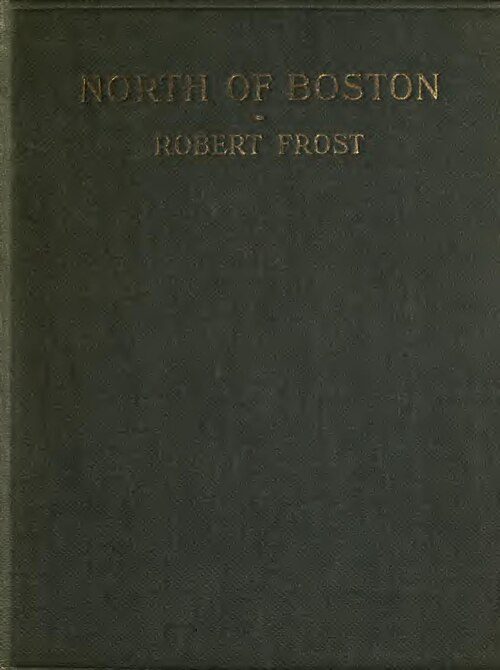
From the bookNorth of BostonFront cover, David Nutt, London, 1914
Analysis
Mending Wall: analysis
Introduction
"Mending Wall" is a blank-verse monologue of 45 lines. Its speaker is a farmer who meets his neighbor each spring to rebuild the stone wall between their land. As they work, the speaker questions why the wall is needed at all. The neighbor answers only with a proverb: "Good fences make good neighbors."
The poem sets two attitudes side by side. One doubts boundaries and asks what they are for. The other keeps them because they have always been kept. Much of the poem's interest lies in how far the doubter takes part in what he doubts. He calls the neighbor to the job, and he keeps his longest argument to himself.
Summary
The speaker begins by saying that something does not love a wall. It heaves the frozen ground beneath the stones. It spills the top boulders off in the sun. It opens gaps wide enough for two people to pass side by side.
He separates these gaps from the damage hunters do. Hunters pull whole stretches apart to drive a rabbit out for their dogs, and he has followed them to repair it. The other gaps appear without anyone seeing or hearing them made. The two men find them at spring mending-time.
The speaker tells his neighbor beyond the hill, and they meet to walk the line. They rebuild the wall together, each keeping to his own side and lifting the boulders fallen there. Some stones are loaf-shaped and some nearly round, so the men joke that they need a spell to keep them balanced. Their fingers grow rough from handling them.
The speaker calls the work just another outdoor game, one on a side. He says that here they do not need the wall. The neighbor's land is pine and his own is apple orchard. He tells the neighbor his apple trees will never cross over and eat the cones under the pines. The neighbor only says, "Good fences make good neighbors."
Spring puts mischief in the speaker, and he wonders whether he could put a notion in the neighbor's head. He imagines asking why fences make good neighbors, since there are no cows here. He would want to know what a wall walls in or out, and whom it might offend. He thinks of saying "Elves" but holds back. He would rather the neighbor said it himself.
The speaker watches the neighbor carry a stone in each hand. To the speaker he looks like an armed savage from the Stone Age. He seems to move in a darkness that is not only the shade of trees. He will not go behind his father's saying. He likes it so well that he says it again: "Good fences make good neighbors."
Themes and meaning
The wall itself is the poem's central question. The speaker wants to know, before building, "What I was walling in or walling out" (line 33). His practical test is simple. A wall makes sense "Where there are cows" (line 31), and here there are none. Pine trees and apple trees cannot trespass, so on his account the wall guards nothing.
Against this stands inherited custom. The neighbor "will not go behind his father's saying" (line 43). He offers the proverb twice and never explains it. The poem presents his belief as something handed down rather than thought through. The speaker's images of him, "an old-stone savage armed" and a man who "moves in darkness", can be read as a picture of custom kept without question.
A third idea is the force that undoes the wall. "Something" heaves the ground, spills the boulders and makes gaps "No one has seen" made (line 10). The speaker nearly calls it "Elves", then admits "it's not elves exactly" (line 37). The poem never names it. It can be read as frost and weather, or as something in people that resists division.
The poem is also ironic about its own speaker. It is he who says "I let my neighbor know beyond the hill" (line 12), so he starts the mending. He enjoys the work as "another kind of outdoor game" and jokes about the spell. He never speaks his full argument aloud. Some readers therefore see the doubter as a partner in keeping the wall.
This points to a last, divided theme. The wall separates the two men, but it is also the one reason they meet each year. Both readings have support in the text. The speaker keeps saying "between us" (lines 14–15), which stresses separation. Yet the work is shared, and the proverb, not the speaker, has the final word.
Tone
The opening tone is riddling and relaxed. The inverted phrase "Something there is" sounds like a folk saying or a puzzle. The account of hunters and frost is plain and practical.
Humor enters with the stones. The speaker imagines a spell, "Stay where you are until our backs are turned!" (line 19), and calls the work a "game". His claim about apple trees eating pine cones is a deliberate joke. He admits "Spring is the mischief in me" (line 28).
The tone sharpens as he watches his neighbor. The simile of the "old-stone savage armed" is mocking and uneasy at once. The darkness of lines 41–42 moves from the literal shade of trees toward something bleaker. The speaker marks this as his own view with "as it seems to me".
The close is flat and resigned. The neighbor repeats his proverb, and the speaker reports it without reply. The final line leaves the argument unresolved.
Form and structure
"Mending Wall" is a single stanza of 45 lines. It is blank verse: unrhymed lines in loose iambic pentameter. Every line has 10 or 11 syllables. Twelve lines carry the extra syllable, often as an unstressed ending, as in "hiding" and "balance". The stresses shift often, starting with the inverted opening "Something there is".
There is no rhyme scheme. The only matching line endings come from repeated words. The word "wall" ends line 1, line 23 and line 35. The word "neighbors" ends line 27 and the last line.
Sentences often run across line breaks, which keeps the voice close to speech. The whole poem is one unbroken block. This lets the work, the talk and the private thinking run together, like one day spent on the wall.
Poetic devices
Inversion (anastrophe) line 1
Something there is that doesn't love a wall The reversed word order sounds like a riddle or old saying. It gives the unnamed force the weight of a proverb, set against the neighbor's proverb.
Imagery line 2
frozen-ground-swell The compound shows frost heaving the soil from below. It explains, in physical terms, how the wall comes apart unseen.
Caesura line 9
To please the yelping dogs. The gaps I mean, The full stop mid-line turns sharply from the hunters back to the mysterious gaps. It separates damage with a cause from damage without one.
Metaphor line 17
And some are loaves and some so nearly balls Homely shapes make the stones concrete and hard to stack. They also prepare the joke about needing a spell.
Apostrophe line 19
"Stay where you are until our backs are turned!" The men address the stones as if they could obey. The mock charm admits the wall will fall again as soon as they leave.
Metaphor line 21
Oh, just another kind of outdoor game, Calling the work a game makes it playful and pointless at once. It also suggests two sides and rules, like a contest.
Antithesis line 24
He is all pine and I am apple orchard. Each man is identified with his trees. The contrast shows the two properties cannot harm each other, which undercuts the wall's purpose.
Refrain line 27
Good fences make good neighbors. The proverb appears twice, here and in the last line. Its unchanged repetition shows a belief held without further thought.
Pun line 34
to give offense "offense" can be heard as 'a fence'. On this reading the speaker hints that walls themselves give offense.
Simile line 40
like an old-stone savage armed The neighbor, holding a stone in each hand, looks like a Stone Age fighter. The image casts his wall-building as primitive and faintly hostile.
Symbol line 41
He moves in darkness as it seems to me The darkness is first the shade of trees, but line 42 widens it. It can be read as ignorance or a mind closed to question.
Words worth knowing
abreast
Side by side. The gaps are wide enough for two people to walk through together.
frozen-ground-swell
The heaving of soil when the ground freezes, which pushes stones up and loosens the wall.
loaves
Here, stones shaped like loaves of bread: long and rounded, but flat enough to rest.
spell
A magic charm or incantation, not a period of time.
like to
In line 34, an older phrase meaning 'likely to'.
go behind
To look past or question. The neighbor will not examine where his father's saying comes from.
Context
"Mending Wall" is the first poem in Robert Frost's book North of Boston (1914). Frost lived from 1874 to 1963. The poem was Poem of the Day on americanpoems.com on 13 July 2000 and again on 10 July 2026. Readers left 65 comments on it between 2004 and 2010.
What readers have said
Lindsey reads the unexplained gaps as the key: whatever breaks the wall stands for a nature that is open and without walls. Lindsey, 2005
Jerry reads the wall as a good thing that defines the two men and brings them together, so both need it and the proverb is right. jerry, 2005
Kent argues that the neighbor has not thought about the proverb at all but simply repeats what his father told him. Kent, 2005
I. Lao, studying the poem in class, points out the irony that the speaker himself calls the neighbor to fix the wall he doubts. I. Lao, 2007
Melissa reads the poem as being about the Cold War and the Berlin Wall. melissa, 2005
Michael rejects the Berlin Wall reading because the poem appeared in 1914, and reads it instead as a metaphor for barriers people build without reason. Michael, 2005
This poem is rather confusing, like most of Robert Frost's poems. Although his poems are confusing i seek refuge in them. I dont always understand them but they alwa ys comfort me. thanks dude!!!
hapiAustralia
I think Frost's poem is so in depth and there is so much I could say about it. Mending a wall is ironic, because your mending an element that is designed to keep out. This whole poem is about how men are quite dominant and a patriarchal view of the society we live in is showed. He lived in over a hundred years ago, but the poem applies to the modern society as well. It extends from there to argument and that can be linked to today's wars and all sorts of things like that.
i think that the poem means how we always cover ourselves from each other with walls and we keep on doing because we think it willmake things better but it really doesnt and then even though we dont want to build these walls we still do it because no one would back down and say that this is wrong.....anyway i love this poem and i think robert frost is a really great poet...
jerryUnited States
To me the poem is about teamwork. It is about the limits of who we are. Knowing where we meet and how to meet is a good thing. The wall is the network that keeps us together. Without the wall, we would not meet. This is not the Berlin Wall or that wall being put up between palestine and israel. it's a wall that defines us. We both need the wall, that's why we maintain it, and that's why 'good fences make good neighbors'. That's what it means...to me.
I believe that Frost is speaking about he walls that we as humans create to shut out others or protect ourselves from others. We tend to use these walls in many ways. First, to maintain our privacy. Second, to draw a line between two countries that aren't getting along and trying to keep the other out of there area. But, most of all we need to ask ourself, "what is it that we are walling out?" I also belive that the walls that Frost is talking about are a reference to seperation and segregation. Overall, he is saying who likes a wall and why should we have them.
butrfly
brendaCanada
i myself thought it was an extremly crap poem.it was not at all interesting and to be quite frank,it bored the tits of me
brendaCanada
i myself thought mending wall was an extremly boring poem and was not interesting at all.to be quite frank,it bored the tits off me!!
kENUnited States
I feel it is a question of what to leave behind and ,what to learn from.Or you can say, what to wall in or, to wall out. The neighbor is a symbol for someone who is interested in digging deeper to figure you out while,you are eger to put up your defences once again.The neighbor yet again finds you strange and decides to add a reason (stone) to your mindset.
sashaUnited States
In the poem mending wall by robert frost the speaker feels that it is pointless to put obstacles between others when it is not necessary. He uses cows as a legitimate reason to have a barrie between others but they do not have cows therefore he is left confused, basically the speaker wants human interaction and the neighbor does not he is ignorant and gives no explanation for his belief.
KarynUnited States
This poem came up when discussing a neighbors wall and it seems that the wall is permeable it creates not only the boundary but the basis for interaction. The yearly discussion and mending of the wall. It is the wall that brings them together. It is what makes the relationship stable. Even though the voice of the narrator is confused the underlying theme is good fences make good neighbors.
I think Frost's poem is about two country neighbours who share the maintenance of a fence. One of the neighbours is sick of repairing the fence and tries to convince his recluse friend to tear the fence down and that fences are for cows but the friend says, "Good fences make good neighbours."
I disagree with the last comment I believe the Mending Wall really is about society and how men have to have these barriers around are emotional stabillity. Its necessary for these barriers for men to live in comfort. Thats why they keep rebuilding the wall.
kennethSingapore
its a story between the writer and his friend. its almost as if at the start the writer does not want to be friends with the other party, thus drawing up a wall. later on he wants to be frenz, and they meet. but theres still this wall between them, so theres tension between them. And he tries to make friends again, but the other party simply rejects him saying tat good fences make good neighbours, showing he wants a barrier between the two of them
i love this poem, it is describing the relationship between 2 neighbors and how they don't get along and arent the best of friends but they are there for each other. they have the fence up and it is a barrier between their feelings...like a lot of us today, we have walls up against others but at some point our walls may fall.
VUnited States
A beautiful poem full of hidden meaning and literary elements. ^^
Trevor Cook
This is an excellent poem about the narrator and his neighbor. The narrator and his neighbor mend the wall together, each time strengthening the emotional barriers between them. When the narrator says that, "he moves in darkness it seems to me" much is told. This comment from the poem states that the neighbor means nothing to him, just bad, perhaps evil. The narrator is selfless in a way in saying this because this…
Read the whole comment
This is an excellent poem about the narrator and his neighbor. The narrator and his neighbor mend the wall together, each time strengthening the emotional barriers between them. When the narrator says that, "he moves in darkness it seems to me" much is told. This comment from the poem states that the neighbor means nothing to him, just bad, perhaps evil. The narrator is selfless in a way in saying this because this may be what the neighbor likes. I do NOT belive that this poem is a battle of emotional wills, but a battle of self confidence and perserverence in one another. Please feel free to email comments back-- Email: [email removed]
--To understand this poem fully, I think that you need to read it as much, if not more than 7 times.
it is a very weird peom and it confuses me, i dont think that its a good one because it is too repetitive and i dont really like it, it bores me. yours truely em
melissaAustralia
this poem is about the cold war which is refered to in this poem.The poet robert frost is on the american side of the cold war and its about the berlin wall. the germans want the wall up to stop the americans coming over and to keep the germans from going over to the americans side of germany. This is the deep meaning of the poem "mending wall".
Reka HUnited States
This is a poem which requires much thought, Frost seems to be referring to the mending wall as a relationship between two neighbors who barely speak or talk to one another but share a common interest of repairing the fence. This way they both stay out of each others hair and that makes them appreciate the fence and what it does for them.
SusanUnited States
This poem has nothing to do with the Berlin Wall. The poem was written in 1914, and the Berlin Wall was built in The 1960s. He's talking about the walls we build around us to protect our inner selves from others. We don't want everyone to know everything about us. Many people build walls to hid their true feelings, thoughts, or even past life experiences. We even build walls to keep our memories from returning to painful times in our lives. The stones are symbolic of the things we are trying to block people out of - you may drop your guard and open up(stone falling off the fence), but then something happens and we build the wall back up.
Linda ShafferUnited States
I think that this poem is a pleasant statement about life in 1914...and today. We do things with people to keep the peace and be polite regardless of our inner aversion to the behavior. This poem reflects respect of others and inner playfullnes. I think it is refreshingly encouraging.
I disagree with Melissa from australias comments. This poem cannot be about the cold war and involving the Berlin wall as this poem was published in 1914 and the cold war was post WWII (1945+). Rather this poem is a metaphor for the barriers we create between ourselves for no rational reason. Are we so paranoid that we cant let anyone get close to us? That is essentially what this poem is about.
LindseyUnited States
Everyone talks about the mending of the wall here, but I think thta people are missing something. In the beginning, when Frost says that the gaps in the wall are made, but no one knows by whom or why - thye just have to fix them. I think this breaking down of the wall by something other than these neighbors symbolizes the need to not have walls - the underlying character of nature - completely wall-less and open.
jassi sokheyUnited States
i think it is a great poem by Frost. This poem makes you feel the value of relationships and responsibility . This is the wall that bring two neighbors close. Fexing it every year means they are aware towards others privacy and comfort. Thats why "Good fences make good neighbors."
The speaker of the poem clearly dislikes the wall - he doesn't see the need for a barrier between his neighbor and him. His neighbor finds use for the wall in keeping their relationship on a particular level - the mending of the wall reminds them that they must actively work to keep each other separate. Frost comments on the nature of humans with the mention of gaps regularly forming in the wall - it is not a human…
Read the whole comment
The speaker of the poem clearly dislikes the wall - he doesn't see the need for a barrier between his neighbor and him. His neighbor finds use for the wall in keeping their relationship on a particular level - the mending of the wall reminds them that they must actively work to keep each other separate. Frost comments on the nature of humans with the mention of gaps regularly forming in the wall - it is not a human tendency to isolate oneself from others, and not a naturally occurring thing - the wall breaks down over time and must be actively mended. The wall is not necessarily physical, but metaphorical - relationships cannot always remain the same with the passage of time. Circumstances change and with them the nature of the relationship, for better or worse. To fight change is futile because it will always come back, as the gaps in the wall do. The neighbor follows his father's maxim, believing it to be true, because he does not want to accept change - hence his following his father's words and not what he perhaps wants, which may or may not fall in with his father's tendencies.
Will gladly answer (polite) responses to this comment through e-mail. I must also point out that this poem is most emphatically not about the Cold War - Robert Frost died in 1963.
Nature may have no need for walls, but men and countries do. It is part of our nature to set boundaries for ourselves and what we believe in. Mexico's Presidente Fox would benefit from re-reading this poem.
Albert CAustralia
I think this poem requires deep thought and understanding for you to be able to know the meaning of it. It tells us about the wall collapsing, by nature, and by hunters and the two neighbours mending the wall at springtime each mend the part of the wall which the stone has fallen down to. They never cross to the other person's side but the narrator doesn't believe they need a wall.
invisiUnited States
this should be easy for you people that know how to properly analyze this poem.... How does the neighbor feel about the wall? please help....me...please...
I thought that the neighbor felt secure and happy about having a wall because it "makes good neighbors", but i'm not sure...
invisiUnited States
Oops... Sorry everyone, I've found my answer, and sorry for posting that.
I agree with most people that this poem is enjoyable and fun. It hit me when I finally read it correctly. I'm glad I understood its meaning.
AbdullahIran
I think Roberts brain is, "frosted" just like his poems. Can't his poems get any better. My view is that the neighbour is a homosexual.
debbie deeUnited States
I think you may lack knowledge of Frost's great sense of humor. He is playing with us a good time."before I built a wall I ....to know to whom I gave offense. If you've ever been to Boston you know the ground is all stone and bolders. To clear a small patch for growing takes a mighty effort and so almost 100% of the homes and farms are surrounded by these bolders..you know "put them over there temporarily." But Frost uses this situation to make you think about "your father's words" and maybe you can make some charitable changes of your own. debbie dee
"He will not go behind his father's saying, And he likes having thought of it so well He says again, 'Good fences make good neighbors.'" The problem is that the neighbor has not thought of it at all; he simply repeats what his father told him, whose father told him, etc. In short, he has taken an adage for truth without really looking into the validity of it. In that way we build walls around us--walls of ignorance…
Read the whole comment
"He will not go behind his father's saying, And he likes having thought of it so well He says again, 'Good fences make good neighbors.'"
The problem is that the neighbor has not thought of it at all; he simply repeats what his father told him, whose father told him, etc. In short, he has taken an adage for truth without really looking into the validity of it.
In that way we build walls around us--walls of ignorance because we do not take the time to look at our actions and values in the open light.
Frost shows this ignorance by painting the neighbor in this way:
"I see him there Bringing a stone grasped firmly by the top In each hand, like an old-stone savage armed. He moves in darkness as it seems to me-- Not of woods only and the shade of trees."
It is the darkness of ignorance. It is the darkness caused by walls without meaning, the ignorance of not thinking for ourselves what is right and what is wrong, the ignorance of "old-stone" savages who corral their ideas and lives into neat little pens, who fail to contemplate their own lives.
This poem has 3 meanings. I think the whole poem is symbol of American Isolationism during the beginning of WWI (being written in 1914 when WWI began). Each line has a literal meaning (an actual wall), a deeper meaning (the personal thoughts involved with personal walls) and a symbollic meaning (the holes in the wall being previous disputes with other involved countries).
SusanUnited Kingdom
I completely agree with most concepts on this poem - about social segregation and division of relationships, but when analysing this poem, two things puzzle me - what is the importance of the hunters and the elves?!
Maricel SuicoPhilippines
I think this poem talks about being alone. Be in oneself. Don't care about other people or maybe this talks on trust towards other people.
Don from North CarolinaUnited States
I believe a clue to the meaning of the poem is right in front of our eyes in plain sight. I believe that Frost chose the title, "Mending Wall", to make his meaning clear, and that intention is irony. While some may say that good fences make good neighbors, as does the "old-stone savage" who unthinkingly repeats it like a mantra, because they ensure that one's activities do not interfere with the other's, it is…
Read the whole comment
I believe a clue to the meaning of the poem is right in front of our eyes in plain sight. I believe that Frost chose the title, "Mending Wall", to make his meaning clear, and that intention is irony. While some may say that good fences make good neighbors, as does the "old-stone savage" who unthinkingly repeats it like a mantra, because they ensure that one's activities do not interfere with the other's, it is clear, as the narrator/speaker plainly says: "Something there is that doesn't love a wall." That something is nature, both the organic and the human. The dogs overturn them trying to get the rabbits out of hiding, and people overturn them trying to remove the barriers to their freedom. The wall of the poem is not really a mending, healing or reparative, structure. Instead, it merely reinforces the isolation of man from other men. I believe it is Frost's diatribe against isolationist political philosophies gaining credence worldwide. Too bad Frost did not live to see the collapse of the Berlin Wall.
I Think this poem inspires people to stop the discrimination between each other and the segregation in society.
RobertUnited States
I think that the poem is being overanalyzed. The true value in this piece is Frost and his use brilliant use of language. He coined an eloquent and intriguing phrase and is finding an excuse to use it while having some fun with it. "Good fences" DO "make good neighbors" The rest is Frost being as colorful and playful with language as he ca be.
WE SHOULD LEARN FROM NATURE--TAKE THE WALL DOWN AND LEARN TO BECOME GOOD NEIGHBORS. THE WALL IS PREVENTING US FROM BEING TOO FRIENDLY. WITH THE WALL--WE WILL NEVER LEARN. I WOULD LIKE TO WRITE A POEM ABOUT THE PROBLEM OF BRENDA FROM CANADA.
syilaMalaysia
i think that fences make and built the gap between people.there shouldn't be any gaps or differences between people.
I love that first two lines - Something there is that doesn't love a wall, That sends the frozen-ground-swell under it - the thing under the wall is frost, as in Robert Frost.
As the saying goes "Good fences make good neighbours". Truly good fences do make good neighbours.There must always be an arm's distance in your relationship which will strenghten the relationship and tend to last for a long time.
the poem talks of the routine of events in life. every now and then we try to bring up walls between us and without our knowledge something brings it down and then we realize that we have gone too far with somebody and then mend the wall.... this goes on and on. thats what he is trying to tell thru this poem... love to hear from u guys! steve.
IanUnited States
I am reading this poem and i think it sucks. what was he thinking. My fruity little friend likes this poem. But he is midly retarted. Thought i would leave a comment on how i feel. Bad poem Bad writer.
MeganAustralia
I liked this poem and Frost's casual style of writing. There is a comfort in the annual ritual of resetting the wall and the stubborn resolve of the neighbour to maintain it. I like the humour Frost incorporates. I likethe way he mentions the spell to keep the stone in place and his mischievous notion about the conspiring pixies.
AnnaUnited States
I think that what the poem is trying to convey is that, yes, sometimes walls are necessary like country boarders or laws. Without most of them we would have a big mess, but some walls are completely illogical. For an example you could use Race, Social Class, or popularity. Some people, out of ignorance, are always trying to place boundaries between these things. Either way, there will always be people who try to break the boundaries down, or rebuild them, whether those "walls" be good or bad.
Robert Frost's "Mending Wall" is a poem about the barriers that people use to separate themselves from the outside world and its problems. The two men meet each spring to repair the wall that has been damaged by the winter ground swell. Frost shows how isolating oneself leads to hostility toward others. Speaker one, who wants the wall, hopes to convince speaker two that "There where it is we do not need the wall."…
Read the whole comment
Robert Frost's "Mending Wall" is a poem about the barriers that people use to separate themselves from the outside world and its problems. The two men meet each spring to repair the wall that has been damaged by the winter ground swell. Frost shows how isolating oneself leads to hostility toward others. Speaker one, who wants the wall, hopes to convince speaker two that "There where it is we do not need the wall." Speaker two repeats his father's saying, "Good fences make good neighbors." The opposing views of human relations, like many relationships in our modern world, are never resolved because of how the two men view one another's ideas. Speaker one sees speaker two, at one point, as an "old stone savage armed." Speaker two simply closes his mind to any argument in favor of neighborliness. Both men have been conditioned to think as they do. Frost shows how the world as a whole views these ideas. Repairing the wall is a metaphor for continued isolation, a condition that gave rise to World war I.
In this poem "Mending Wall," the author Robert Frost, refers to the wall as it were the cold war and that was the Berlin Wall. Its about 2 neighbors who don't get along (just like the east germans and west germans). And its not allowing the neighbors to interact and get to know eachother.
Christine FissellaUnited States
In this poem I believe that Frost is describig a wall that seperates two neigbors. they have no communication between each other and can't see or speack to each other. I do believe that there are walls soemtimes in todays world. Between, what ethnisity you are, social class, or even in high school the cliques. "The Wall" pervents us from having any friendships build or and other kind of relashonships.
youssefMorocco
three main element silent ,uncommunication and the absurdity of nature ,there is a one part conversation ,which may also signify fear and menace
bobCanada
i had to do this assignment in english, and we had to pick a poem and this is the poem i picked cuz i really liked it
this poem presnts two views, 1) why do walls make good neighbors? and 2)why dont walls make good neighbors? This is the typical writing style of Robert Frost, he presents a conflict then ask the reader to create his/her own solution. in this poem i think that creating the wall maintains friendship, from a metaphorical point of view the walls can be seen as the personal barriers which we build up to maitain a…
Read the whole comment
this poem presnts two views, 1) why do walls make good neighbors? and 2)why dont walls make good neighbors? This is the typical writing style of Robert Frost, he presents a conflict then ask the reader to create his/her own solution. in this poem i think that creating the wall maintains friendship, from a metaphorical point of view the walls can be seen as the personal barriers which we build up to maitain a relationship with our peers, that is it is not everything we do that we want our friends to know about hence we create secrets,diaries et cetera to keep 'things'away.From the other view point i think robert is trying to pose why should we do this?(that is create barriers) Dont we love one another?
Mending Wall is one of the poems that I'm studying in IB this year. The poem starts out with the ambiguous "Something there is that doesn't love a wall". Frost ponders why there's something in him, perhaps in all humans that doesn't like walls. Yet the irony is that he contacted his neighbor "I let my neighbor know beyond the hill" to fix the wall. Frost is the one that instigates this fixing of the wall. He also…
Read the whole comment
Mending Wall is one of the poems that I'm studying in IB this year. The poem starts out with the ambiguous "Something there is that doesn't love a wall". Frost ponders why there's something in him, perhaps in all humans that doesn't like walls. Yet the irony is that he contacted his neighbor "I let my neighbor know beyond the hill" to fix the wall. Frost is the one that instigates this fixing of the wall. He also mocks his neighbor a bit, repeating "good fences make good neighbors", as if the man is very stubborn and determined to fix the fence. Also, Frost's neighbor seems to be ignorant or simplistic, perhaps even primitive. The neighbor is described to be "like an old-stone savage". Yet, at the very end of the poem, Frost seems to come to the realization that fences, though he may not like them, are necessary because they give people a sense of security. The end of the poem is much darker than the rest of the poem, and Frost seems to see that there may be a part of his neighbor that he, too, would like to keep away from him, as shown by,
"In each hand, like an old-stone savage armed.
He moves in darkness as it seems to me,
Not of woods only and the shade of trees.
It seems that his neighbor can appear dangerous as well, and Frost ends with his neighbor's statement, "Good fences make good neighbors". In short, the fence is what physically keeps the two neighbors apart, but also brings them together each spring to mend it once again.
just to clarify what Nick in comment 50 said: this poem is not about the Berlin Wall. It is often interpreted like that but this poem was written in 1914, which was before the Berlin wall was constructed.
Frosty
Frost is only humorously challenging the idea of maintaining walls, his eyes twinkling in elvin mischief at his neighbor whom he would never utter such thoughts to aloud; he knows as well as the next clay-footer that they are indeed necessary just in order to keep the fields free of stones for the plows.
CharlieUnited States
What Frost is trying to say in this poem is that walls don't make good neighbors; walls are unnecessary. Many may disagree, but if the poem is read in-depth, it is obvious that Frost does not condone mending walls between people. The beginning of the poem makes the speaker seem like he's ok with the wall. That's actually just because he's following tradition-he's not thinking individually. The speaker meets up with…
Read the whole comment
What Frost is trying to say in this poem is that walls don't make good neighbors; walls are unnecessary. Many may disagree, but if the poem is read in-depth, it is obvious that Frost does not condone mending walls between people. The beginning of the poem makes the speaker seem like he's ok with the wall. That's actually just because he's following tradition-he's not thinking individually. The speaker meets up with his neighbor to repair the wall and the neighbor says, "Good fences make good neighbors." The speaker then is able to start thinking about the actual purpose of the wall/fence. It doesn't really do anything except keep the neighbors apart or keep in livestock (which is not present). The speaker likens the neighbor to a savage, making him appear old-fashioned and traditional. The neighbor keeps true to the beliefs held by his father and repeats, "Good fences make good neighbors."
The main theme of this poem is to question traditions. The fence (wall) divides the neighbors and alienates them from each other--not exactly a "good neighbor" in itself. From the way the speaker likens the neighbor to a savage, it is obvious that the speaker thinks the neighbor is in the wrong when he believes in mending walls. The fence/wall represents old traditions, especially traditions that are actually bad for society. Frost is sending a message to the readers that we should do away with this "wall" and commit to new ideas which will benefit human relations. However, the pessimistic message he also sends us is contained in the last three lines. The neighbor remains faithful to his father's tradition and continues thinking well of fences. This represents humans' conformity. Most people are susceptible to traditional views and thus are hard to change. Frost is negatively saying that most of the time, no matter how bad the tradition is, people still refuse to accept change.
..according to my own understainding, "MENDING WALL" discusses so many topics..
first is the wrong beliefs such... GOOD FENCES, MAKES GOOD NEIGHBORS ..how could you be close with your neighbor if there is a wall between you and themm..
second is the relationship between rich and poor ...just like what Frost said SOME ARE LOAVES AND SOME ARE NEARLY BALLS ...rich eats loaves and poor eats those things which are nearly balls..
..some thinks that it is better for them to live in separate ways..
this poem is talking about the boundaries man builds against man. things like race,caste,religion.the speaker's neighbor won't budge on his opinion of the fence.he thinks it's neccessary.the speaker tries to convince him that you don't need a fence and they can live in peace without it.nothing moves the grumpy neighbor.it's pretty much about that.yup.
SergioPhilippines
Poem
i liked it a lot
palakAustralia
Mending wall
this is a poem that we hav to study in yr10. this site has helped me lot and thanks to all of you. This has helped me a lot to write my notes. Speacial thanks to sam from china.
BBBotswana
ponies.
I think mending walls is about Ponies and Rob-dogs desperation to have a pony.
NancyUnited States
The wall is the boundary line that man haves against each other. This wall is needed because we as humans do not want others to see what is truly inside. We only want them to see what we want them to see. The facade individuals put on cannot last forever due to the fact when winter comes along and it " sends the frozen-ground swell under it". This means that the weather has moved the rock used to build the wall and…
Read the whole comment
The wall is the boundary line that man haves against each other. This wall is needed because we as humans do not want others to see what is truly inside. We only want them to see what we want them to see. The facade individuals put on cannot last forever due to the fact when winter comes along and it " sends the frozen-ground swell under it". This means that the weather has moved the rock used to build the wall and what is underneath is truly exposed (mans true self). Every year the narrator and his neighbor has to keep rebuilding the wall and since the rocks used are uneven and "the boulders that have fallen to each" once again lucidly displays that maintaining a facade is nearly... impossible as Frost states "we have to use magic to make them balance". Although it seems ironic that "good fences make good neighbors" there is some truth in this statement. Men need privacy among society. We need privacy and there is the factor of-trust. It also remains the neighbors what is yours and what is theirs which is important because it is the idea of ownership. But...the narrator is not fully opposing the idea of a wall as he states "where there are cows? But here there are no cows". The generals public needs boundary. Due to this wall, the narrator does not see his neighbor clearly "he moves in darkness as it seems to me". Once again the narrator literally cannot see his neighbor but rather his shadow.
This poem is rather confusing, like most of Robert Frost's poems. Although his poems are confusing i seek refuge in them. I dont always understand them but they alwa ys comfort me. thanks dude!!!
I think Frost's poem is so in depth and there is so much I could say about it. Mending a wall is ironic, because your mending an element that is designed to keep out. This whole poem is about how men are quite dominant and a patriarchal view of the society we live in is showed. He lived in over a hundred years ago, but the poem applies to the modern society as well. It extends from there to argument and that can be linked to today's wars and all sorts of things like that.
i think that the poem means how we always cover ourselves from each other with walls and we keep on doing because we think it willmake things better but it really doesnt and then even though we dont want to build these walls we still do it because no one would back down and say that this is wrong.....anyway i love this poem and i think robert frost is a really great poet...
To me the poem is about teamwork. It is about the limits of who we are. Knowing where we meet and how to meet is a good thing. The wall is the network that keeps us together. Without the wall, we would not meet. This is not the Berlin Wall or that wall being put up between palestine and israel. it's a wall that defines us. We both need the wall, that's why we maintain it, and that's why 'good fences make good neighbors'. That's what it means...to me.
I believe that Frost is speaking about he walls that we as humans create to shut out others or protect ourselves from others. We tend to use these walls in many ways. First, to maintain our privacy. Second, to draw a line between two countries that aren't getting along and trying to keep the other out of there area. But, most of all we need to ask ourself, "what is it that we are walling out?" I also belive that the walls that Frost is talking about are a reference to seperation and segregation. Overall, he is saying who likes a wall and why should we have them.
butrfly
i myself thought it was an extremly crap poem.it was not at all interesting and to be quite frank,it bored the tits of me
i myself thought mending wall was an extremly boring poem and was not interesting at all.to be quite frank,it bored the tits off me!!
I feel it is a question of what to leave behind and ,what to learn from.Or you can say, what to wall in or, to wall out. The neighbor is a symbol for someone who is interested in digging deeper to figure you out while,you are eger to put up your defences once again.The neighbor yet again finds you strange and decides to add a reason (stone) to your mindset.
In the poem mending wall by robert frost the speaker feels that it is pointless to put obstacles between others when it is not necessary. He uses cows as a legitimate reason to have a barrie between others but they do not have cows therefore he is left confused, basically the speaker wants human interaction and the neighbor does not he is ignorant and gives no explanation for his belief.
This poem came up when discussing a neighbors wall and it seems that the wall is permeable it creates not only the boundary but the basis for interaction. The yearly discussion and mending of the wall. It is the wall that brings them together. It is what makes the relationship stable. Even though the voice of the narrator is confused the underlying theme is good fences make good neighbors.
I think Frost's poem is about two country neighbours who share the maintenance of a fence. One of the neighbours is sick of repairing the fence and tries to convince his recluse friend to tear the fence down and that fences are for cows but the friend says, "Good fences make good neighbours."
I disagree with the last comment I believe the Mending Wall really is about society and how men have to have these barriers around are emotional stabillity. Its necessary for these barriers for men to live in comfort. Thats why they keep rebuilding the wall.
its a story between the writer and his friend. its almost as if at the start the writer does not want to be friends with the other party, thus drawing up a wall. later on he wants to be frenz, and they meet. but theres still this wall between them, so theres tension between them. And he tries to make friends again, but the other party simply rejects him saying tat good fences make good neighbours, showing he wants a barrier between the two of them
i love this poem, it is describing the relationship between 2 neighbors and how they don't get along and arent the best of friends but they are there for each other. they have the fence up and it is a barrier between their feelings...like a lot of us today, we have walls up against others but at some point our walls may fall.
A beautiful poem full of hidden meaning and literary elements. ^^
This is an excellent poem about the narrator and his neighbor. The narrator and his neighbor mend the wall together, each time strengthening the emotional barriers between them. When the narrator says that, "he moves in darkness it seems to me" much is told. This comment from the poem states that the neighbor means nothing to him, just bad, perhaps evil. The narrator is selfless in a way in saying this because this…
Read the whole commentThis is an excellent poem about the narrator and his neighbor. The narrator and his neighbor mend the wall together, each time strengthening the emotional barriers between them. When the narrator says that, "he moves in darkness it seems to me" much is told. This comment from the poem states that the neighbor means nothing to him, just bad, perhaps evil. The narrator is selfless in a way in saying this because this may be what the neighbor likes. I do NOT belive that this poem is a battle of emotional wills, but a battle of self confidence and perserverence in one another.
Please feel free to email comments back-- Email:
[email removed]
--To understand this poem fully, I think that you need to read it as much, if not more than 7 times.
it is a very weird peom and it confuses me, i dont think that its a good one because it is too repetitive and i dont really like it, it bores me. yours truely em
this poem is about the cold war which is refered to in this poem.The poet robert frost is on the american side of the cold war and its about the berlin wall. the germans want the wall up to stop the americans coming over and to keep the germans from going over to the americans side of germany. This is the deep meaning of the poem "mending wall".
This is a poem which requires much thought, Frost seems to be referring to the mending wall as a relationship between two neighbors who barely speak or talk to one another but share a common interest of repairing the fence. This way they both stay out of each others hair and that makes them appreciate the fence and what it does for them.
This poem has nothing to do with the Berlin Wall. The poem was written in 1914, and the Berlin Wall was built in The 1960s. He's talking about the walls we build around us to protect our inner selves from others. We don't want everyone to know everything about us. Many people build walls to hid their true feelings, thoughts, or even past life experiences. We even build walls to keep our memories from returning to painful times in our lives. The stones are symbolic of the things we are trying to block people out of - you may drop your guard and open up(stone falling off the fence), but then something happens and we build the wall back up.
I think that this poem is a pleasant statement about life in 1914...and today. We do things with people to keep the peace and be polite regardless of our inner aversion to the behavior. This poem reflects respect of others and inner playfullnes. I think it is refreshingly encouraging.
I disagree with Melissa from australias comments. This poem cannot be about the cold war and involving the Berlin wall as this poem was published in 1914 and the cold war was post WWII (1945+). Rather this poem is a metaphor for the barriers we create between ourselves for no rational reason. Are we so paranoid that we cant let anyone get close to us? That is essentially what this poem is about.
Everyone talks about the mending of the wall here, but I think thta people are missing something. In the beginning, when Frost says that the gaps in the wall are made, but no one knows by whom or why - thye just have to fix them. I think this breaking down of the wall by something other than these neighbors symbolizes the need to not have walls - the underlying character of nature - completely wall-less and open.
i think it is a great poem by Frost. This poem makes you feel the value of relationships and responsibility . This is the wall that bring two neighbors close. Fexing it every year means they are aware towards others privacy and comfort. Thats why "Good fences make good neighbors."
The speaker of the poem clearly dislikes the wall - he doesn't see the need for a barrier between his neighbor and him. His neighbor finds use for the wall in keeping their relationship on a particular level - the mending of the wall reminds them that they must actively work to keep each other separate. Frost comments on the nature of humans with the mention of gaps regularly forming in the wall - it is not a human…
Read the whole commentThe speaker of the poem clearly dislikes the wall - he doesn't see the need for a barrier between his neighbor and him. His neighbor finds use for the wall in keeping their relationship on a particular level - the mending of the wall reminds them that they must actively work to keep each other separate. Frost comments on the nature of humans with the mention of gaps regularly forming in the wall - it is not a human tendency to isolate oneself from others, and not a naturally occurring thing - the wall breaks down over time and must be actively mended. The wall is not necessarily physical, but metaphorical - relationships cannot always remain the same with the passage of time. Circumstances change and with them the nature of the relationship, for better or worse. To fight change is futile because it will always come back, as the gaps in the wall do. The neighbor follows his father's maxim, believing it to be true, because he does not want to accept change - hence his following his father's words and not what he perhaps wants, which may or may not fall in with his father's tendencies.
Will gladly answer (polite) responses to this comment through e-mail. I must also point out that this poem is most emphatically not about the Cold War - Robert Frost died in 1963.
Nature may have no need for walls, but men and countries do. It is part of our nature to set boundaries for ourselves and what we believe in. Mexico's Presidente Fox would benefit from re-reading this poem.
I think this poem requires deep thought and understanding for you to be able to know the meaning of it. It tells us about the wall collapsing, by nature, and by hunters and the two neighbours mending the wall at springtime each mend the part of the wall which the stone has fallen down to. They never cross to the other person's side but the narrator doesn't believe they need a wall.
this should be easy for you people that know how to properly analyze this poem.... How does the neighbor feel about the wall? please help....me...please...
I thought that the neighbor felt secure and happy about having a wall because it "makes good neighbors", but i'm not sure...
Oops... Sorry everyone, I've found my answer, and sorry for posting that.
I agree with most people that this poem is enjoyable and fun. It hit me when I finally read it correctly. I'm glad I understood its meaning.
I think Roberts brain is, "frosted" just like his poems. Can't his poems get any better. My view is that the neighbour is a homosexual.
I think you may lack knowledge of Frost's great sense of humor. He is playing with us a good time."before I built a wall I ....to know to whom I gave offense. If you've ever been to Boston you know the ground is all stone and bolders. To clear a small patch for growing takes a mighty effort and so almost 100% of the homes and farms are surrounded by these bolders..you know "put them over there temporarily." But Frost uses this situation to make you think about "your father's words" and maybe you can make some charitable changes of your own. debbie dee
"He will not go behind his father's saying, And he likes having thought of it so well He says again, 'Good fences make good neighbors.'" The problem is that the neighbor has not thought of it at all; he simply repeats what his father told him, whose father told him, etc. In short, he has taken an adage for truth without really looking into the validity of it. In that way we build walls around us--walls of ignorance…
Read the whole comment"He will not go behind his father's saying,
And he likes having thought of it so well
He says again, 'Good fences make good neighbors.'"
The problem is that the neighbor has not thought of it at all; he simply repeats what his father told him, whose father told him, etc. In short, he has taken an adage for truth without really looking into the validity of it.
In that way we build walls around us--walls of ignorance because we do not take the time to look at our actions and values in the open light.
Frost shows this ignorance by painting the neighbor in this way:
"I see him there
Bringing a stone grasped firmly by the top
In each hand, like an old-stone savage armed.
He moves in darkness as it seems to me--
Not of woods only and the shade of trees."
It is the darkness of ignorance. It is the darkness caused by walls without meaning, the ignorance of not thinking for ourselves what is right and what is wrong, the ignorance of "old-stone" savages who corral their ideas and lives into neat little pens, who fail to contemplate their own lives.
This poem has 3 meanings. I think the whole poem is symbol of American Isolationism during the beginning of WWI (being written in 1914 when WWI began). Each line has a literal meaning (an actual wall), a deeper meaning (the personal thoughts involved with personal walls) and a symbollic meaning (the holes in the wall being previous disputes with other involved countries).
I completely agree with most concepts on this poem - about social segregation and division of relationships, but when analysing this poem, two things puzzle me - what is the importance of the hunters and the elves?!
I think this poem talks about being alone. Be in oneself. Don't care about other people or maybe this talks on trust towards other people.
I believe a clue to the meaning of the poem is right in front of our eyes in plain sight. I believe that Frost chose the title, "Mending Wall", to make his meaning clear, and that intention is irony. While some may say that good fences make good neighbors, as does the "old-stone savage" who unthinkingly repeats it like a mantra, because they ensure that one's activities do not interfere with the other's, it is…
Read the whole commentI believe a clue to the meaning of the poem is right in front of our eyes in plain sight. I believe that Frost chose the title, "Mending Wall", to make his meaning clear, and that intention is irony. While some may say that good fences make good neighbors, as does the "old-stone savage" who unthinkingly repeats it like a mantra, because they ensure that one's activities do not interfere with the other's, it is clear, as the narrator/speaker plainly says: "Something there is that doesn't love a wall." That something is nature, both the organic and the human. The dogs overturn them trying to get the rabbits out of hiding, and people overturn them trying to remove the barriers to their freedom. The wall of the poem is not really a mending, healing or reparative, structure. Instead, it merely reinforces the isolation of man from other men. I believe it is Frost's diatribe against isolationist political philosophies gaining credence worldwide. Too bad Frost did not live to see the collapse of the Berlin Wall.
I Think this poem inspires people to stop the discrimination between each other and the segregation in society.
I think that the poem is being overanalyzed. The true value in this piece is Frost and his use brilliant use of language. He coined an eloquent and intriguing phrase and is finding an excuse to use it while having some fun with it. "Good fences" DO "make good neighbors" The rest is Frost being as colorful and playful with language as he ca be.
WE SHOULD LEARN FROM NATURE--TAKE THE WALL DOWN AND LEARN TO BECOME GOOD NEIGHBORS. THE WALL IS PREVENTING US FROM BEING TOO FRIENDLY. WITH THE WALL--WE WILL NEVER LEARN. I WOULD LIKE TO WRITE A POEM ABOUT THE PROBLEM OF BRENDA FROM CANADA.
i think that fences make and built the gap between people.there shouldn't be any gaps or differences between people.
I love that first two lines -
Something there is that doesn't love a wall,
That sends the frozen-ground-swell under it
- the thing under the wall is frost, as in Robert Frost.
As the saying goes "Good fences make good neighbours".
Truly good fences do make good neighbours.There must always be an arm's distance in your relationship which will strenghten the relationship and tend to last for a long time.
the poem talks of the routine of events in life. every now and then we try to bring up walls between us and without our knowledge something brings it down and then we realize that we have gone too far with somebody and then mend the wall.... this goes on and on. thats what he is trying to tell thru this poem...
love to hear from u guys! steve.
I am reading this poem and i think it sucks. what was he thinking. My fruity little friend likes this poem. But he is midly retarted. Thought i would leave a comment on how i feel. Bad poem Bad writer.
I liked this poem and Frost's casual style of writing. There is a comfort in the annual ritual of resetting the wall and the stubborn resolve of the neighbour to maintain it. I like the humour Frost incorporates. I likethe way he mentions the spell to keep the stone in place and his mischievous notion about the conspiring pixies.
I think that what the poem is trying to convey is that, yes, sometimes walls are necessary like country boarders or laws. Without most of them we would have a big mess, but some walls are completely illogical. For an example you could use Race, Social Class, or popularity. Some people, out of ignorance, are always trying to place boundaries between these things. Either way, there will always be people who try to break the boundaries down, or rebuild them, whether those "walls" be good or bad.
Robert Frost's "Mending Wall" is a poem about the barriers that people use to separate themselves from the outside world and its problems. The two men meet each spring to repair the wall that has been damaged by the winter ground swell. Frost shows how isolating oneself leads to hostility toward others. Speaker one, who wants the wall, hopes to convince speaker two that "There where it is we do not need the wall."…
Read the whole commentRobert Frost's "Mending Wall" is a poem about the barriers that people use to
separate themselves from the outside world and its problems. The two men meet each
spring to repair the wall that has been damaged by the winter ground swell. Frost shows
how isolating oneself leads to hostility toward others. Speaker one, who wants the wall,
hopes to convince speaker two that "There where it is we do not need the wall." Speaker
two repeats his father's saying, "Good fences make good neighbors." The opposing
views of human relations, like many relationships in our modern world, are never
resolved because of how the two men view one another's ideas. Speaker one sees
speaker two, at one point, as an "old stone savage armed." Speaker two simply closes
his mind to any argument in favor of neighborliness. Both men have been conditioned to
think as they do. Frost shows how the world as a whole views these ideas. Repairing the
wall is a metaphor for continued isolation, a condition that gave rise to World war I.
This poem is Horrible. I think they should tear down the wall and be friends. not really. THIS POEM SUCKS
is a very neat and interesting poem.
In this poem "Mending Wall," the author Robert Frost, refers to the wall as it were the cold war and that was the Berlin Wall. Its about 2 neighbors who don't get along (just like the east germans and west germans). And its not allowing the neighbors to interact and get to know eachother.
In this poem I believe that Frost is describig a wall that seperates two neigbors. they have no communication between each other and can't see or speack to each other. I do believe that there are walls soemtimes in todays world. Between, what ethnisity you are, social class, or even in high school the cliques. "The Wall" pervents us from having any friendships build or and other kind of relashonships.
three main element silent ,uncommunication and the absurdity of nature ,there is a one part conversation ,which may also signify fear and menace
i had to do this assignment in english, and we had to pick a poem and this is the poem i picked cuz i really liked it
this poem presnts two views, 1) why do walls make good neighbors? and 2)why dont walls make good neighbors? This is the typical writing style of Robert Frost, he presents a conflict then ask the reader to create his/her own solution. in this poem i think that creating the wall maintains friendship, from a metaphorical point of view the walls can be seen as the personal barriers which we build up to maitain a…
Read the whole commentthis poem presnts two views, 1) why do walls make good neighbors? and 2)why dont walls make good neighbors? This is the typical writing style of Robert Frost, he presents a conflict then ask the reader to create his/her own solution. in this poem i think that
creating the wall maintains friendship, from a metaphorical point of view the walls can be seen as the personal barriers which we build up to maitain a relationship with our peers, that is it is not everything we do that we want our friends to know about hence we create secrets,diaries et cetera to keep 'things'away.From the other view point i think robert is trying to pose why should we do this?(that is create barriers) Dont we love one another?
Mending Wall is one of the poems that I'm studying in IB this year. The poem starts out with the ambiguous "Something there is that doesn't love a wall". Frost ponders why there's something in him, perhaps in all humans that doesn't like walls. Yet the irony is that he contacted his neighbor "I let my neighbor know beyond the hill" to fix the wall. Frost is the one that instigates this fixing of the wall. He also…
Read the whole commentMending Wall is one of the poems that I'm studying in IB this year. The poem starts out with the ambiguous "Something there is that doesn't love a wall". Frost ponders why there's something in him, perhaps in all humans that doesn't like walls. Yet the irony is that he contacted his neighbor "I let my neighbor know beyond the hill" to fix the wall. Frost is the one that instigates this fixing of the wall. He also mocks his neighbor a bit, repeating "good fences make good neighbors", as if the man is very stubborn and determined to fix the fence. Also, Frost's neighbor seems to be ignorant or simplistic, perhaps even primitive. The neighbor is described to be "like an old-stone savage". Yet, at the very end of the poem, Frost seems to come to the realization that fences, though he may not like them, are necessary because they give people a sense of security. The end of the poem is much darker than the rest of the poem, and Frost seems to see that there may be a part of his neighbor that he, too, would like to keep away from him, as shown by,
"In each hand, like an old-stone savage armed.
He moves in darkness as it seems to me,
Not of woods only and the shade of trees.
It seems that his neighbor can appear dangerous as well, and Frost ends with his neighbor's statement, "Good fences make good neighbors". In short, the fence is what physically keeps the two neighbors apart, but also brings them together each spring to mend it once again.
just to clarify what Nick in comment 50 said: this poem is not about the Berlin Wall. It is often interpreted like that but this poem was written in 1914, which was before the Berlin wall was constructed.
Frost is only humorously challenging the idea of maintaining walls, his eyes twinkling in elvin mischief at his neighbor whom he would never utter such thoughts to aloud; he knows as well as the next clay-footer that they are indeed necessary just in order to keep the fields free of stones for the plows.
What Frost is trying to say in this poem is that walls don't make good neighbors; walls are unnecessary. Many may disagree, but if the poem is read in-depth, it is obvious that Frost does not condone mending walls between people. The beginning of the poem makes the speaker seem like he's ok with the wall. That's actually just because he's following tradition-he's not thinking individually. The speaker meets up with…
Read the whole commentWhat Frost is trying to say in this poem is that walls don't make good neighbors; walls are unnecessary. Many may disagree, but if the poem is read in-depth, it is obvious that Frost does not condone mending walls between people. The beginning of the poem makes the speaker seem like he's ok with the wall. That's actually just because he's following tradition-he's not thinking individually. The speaker meets up with his neighbor to repair the wall and the neighbor says, "Good fences make good neighbors." The speaker then is able to start thinking about the actual purpose of the wall/fence. It doesn't really do anything except keep the neighbors apart or keep in livestock (which is not present). The speaker likens the neighbor to a savage, making him appear old-fashioned and traditional. The neighbor keeps true to the beliefs held by his father and repeats, "Good fences make good neighbors."
The main theme of this poem is to question traditions. The fence (wall) divides the neighbors and alienates them from each other--not exactly a "good neighbor" in itself. From the way the speaker likens the neighbor to a savage, it is obvious that the speaker thinks the neighbor is in the wrong when he believes in mending walls. The fence/wall represents old traditions, especially traditions that are actually bad for society. Frost is sending a message to the readers that we should do away with this "wall" and commit to new ideas which will benefit human relations. However, the pessimistic message he also sends us is contained in the last three lines. The neighbor remains faithful to his father's tradition and continues thinking well of fences. This represents humans' conformity. Most people are susceptible to traditional views and thus are hard to change. Frost is negatively saying that most of the time, no matter how bad the tradition is, people still refuse to accept change.
mending wall
in short mending wall is a poem of brotherhood
...just dropping buy...
..according to my own understainding, "MENDING WALL" discusses so many topics..
first is the wrong beliefs such...
GOOD FENCES, MAKES GOOD NEIGHBORS
..how could you be close with your neighbor if there is a wall between you and themm..
second is the relationship between rich and poor
...just like what Frost said SOME ARE LOAVES AND SOME ARE NEARLY BALLS
...rich eats loaves and poor eats those things which are nearly balls..
..some thinks that it is better for them to live in separate ways..
...just sharing..c:
duh
this poem is talking about the boundaries man builds against man. things like race,caste,religion.the speaker's neighbor won't budge on his opinion of the fence.he thinks it's neccessary.the speaker tries to convince him that you don't need a fence and they can live in peace without it.nothing moves the grumpy neighbor.it's pretty much about that.yup.
Poem
i liked it a lot
Mending wall
this is a poem that we hav to study in yr10. this site has helped me lot and thanks to all of you. This has helped me a lot to write my notes. Speacial thanks to sam from china.
ponies.
I think mending walls is about Ponies and Rob-dogs desperation to have a pony.
The wall is the boundary line that man haves against each other. This wall is needed because we as humans do not want others to see what is truly inside. We only want them to see what we want them to see. The facade individuals put on cannot last forever due to the fact when winter comes along and it " sends the frozen-ground swell under it". This means that the weather has moved the rock used to build the wall and…
Read the whole commentThe wall is the boundary line that man haves against each other. This wall is needed because we as humans do not want others to see what is truly inside. We only want them to see what we want them to see. The facade individuals put on cannot last forever due to the fact when winter comes along and it " sends the frozen-ground swell under it". This means that the weather has moved the rock used to build the wall and what is underneath is truly exposed (mans true self). Every year the narrator and his neighbor has to keep rebuilding the wall and since the rocks used are uneven and "the boulders that have fallen to each" once again lucidly displays that maintaining a facade is nearly... impossible as Frost states "we have to use magic to make them balance". Although it seems ironic that "good fences make good neighbors" there is some truth in this statement. Men need privacy among society. We need privacy and there is the factor of-trust. It also remains the neighbors what is yours and what is theirs which is important because it is the idea of ownership. But...the narrator is not fully opposing the idea of a wall as he states "where there are cows? But here there are no cows". The generals public needs boundary. Due to this wall, the narrator does not see his neighbor clearly "he moves in darkness as it seems to me". Once again the narrator literally cannot see his neighbor but rather his shadow.