When I see birches bend to left and right
Across the lines of straighter darker trees,
I like to think some boy's been swinging them.
But swinging doesn't bend them down to stay.
Ice-storms do that. Often you must have seen them
Loaded with ice a sunny winter morning
After a rain. They click upon themselves
As the breeze rises, and turn many-coloured
As the stir cracks and crazes their enamel.
Soon the sun's warmth makes them shed crystal shells
Shattering and avalanching on the snow-crust
Such heaps of broken glass to sweep away
You'd think the inner dome of heaven had fallen.
They are dragged to the withered bracken by the load,
And they seem not to break; though once they are bowed
So low for long, they never right themselves:
You may see their trunks arching in the woods
Years afterwards, trailing their leaves on the ground,
Like girls on hands and knees that throw their hair
Before them over their heads to dry in the sun.
But I was going to say when Truth broke in
With all her matter-of-fact about the ice-storm,
I should prefer to have some boy bend them
As he went out and in to fetch the cows--
Some boy too far from town to learn baseball,
Whose only play was what he found himself,
Summer or winter, and could play alone.
One by one he subdued his father's trees
By riding them down over and over again
Until he took the stiffness out of them,
And not one but hung limp, not one was left
For him to conquer. He learned all there was
To learn about not launching out too soon
And so not carrying the tree away
Clear to the ground. He always kept his poise
To the top branches, climbing carefully
With the same pains you use to fill a cup
Up to the brim, and even above the brim.
Then he flung outward, feet first, with a swish,
Kicking his way down through the air to the ground.
So was I once myself a swinger of birches.
And so I dream of going back to be.
It's when I'm weary of considerations,
And life is too much like a pathless wood
Where your face burns and tickles with the cobwebs
Broken across it, and one eye is weeping
From a twig's having lashed across it open.
I'd like to get away from earth awhile
And then come back to it and begin over.
May no fate wilfully misunderstand me
And half grant what I wish and snatch me away
Not to return. Earth's the right place for love:
I don't know where it's likely to go better.
I'd like to go by climbing a birch tree,
And climb black branches up a snow-white trunk
Toward heaven, till the tree could bear no more,
But dipped its top and set me down again.
That would be good both going and coming back.
One could do worse than be a swinger of birches.
✦
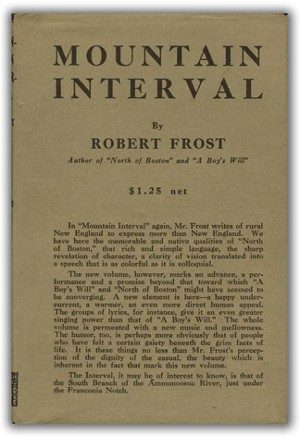
From the bookMountain IntervalFirst-edition dust jacket, Henry Holt, 1916
Analysis
Birches: analysis
Introduction
Birches is a poem of fifty-nine lines in blank verse by Robert Frost. A speaker sees birches bent low among straighter trees. He would like to think a boy bent them by swinging on them. He admits that ice storms are the real cause.
The poem then imagines that boy in careful detail. It ends with the speaker's wish to climb toward heaven and be set down on earth again. It sets fact against imagination, and weariness against renewal. Its last line weighs that wish with quiet understatement.
Summary
The speaker sees birches bent to left and right among straighter, darker trees. He likes to think a boy has been swinging them. Then he admits that swinging does not bend them down to stay. Ice storms do that.
He describes the trees on a sunny winter morning after rain. Ice coats them, and they click together as the breeze rises. The ice cracks and turns many colours. The sun's warmth makes the trees shed it onto the snow-crust. The heaps of ice look like broken glass, as if heaven's dome had fallen.
The weight drags the trees down to the bracken. They do not seem to break. But once bowed so low for so long, they never straighten. Years later their trunks still arch in the woods. Their leaves trail on the ground like the hair of girls drying it in the sun.
The speaker says Truth broke in with facts about the ice storm. He returns to his preferred story of a boy who fetches the cows. The boy lives too far from town to learn baseball. He finds his own play and plays alone. One by one he rides his father's trees down until none is stiff.
The boy learns not to launch out too soon. That way the tree does not carry him all the way to the ground. He climbs carefully to the top branches, keeping his balance. The speaker compares this care to filling a cup above the brim. Then the boy flings himself outward, feet first, and kicks his way down.
The speaker says he was once a swinger of birches. He dreams of going back to it. The wish comes when he is weary of considerations. Then life feels like a pathless wood, with cobwebs on his face and one eye weeping from a twig. He would like to leave earth awhile, then come back and begin over.
He hopes no fate will half grant the wish and take him away for good. Earth, he says, is the right place for love. He would like to climb a birch toward heaven until it can bear no more. Then it would dip and set him down again. He ends by saying one could do worse than be a swinger of birches.
Themes and meaning
The first theme is imagination against fact. The speaker knows that ice storms bend birches, yet he prefers the story of the boy. Truth is personified as an interrupter, with "all her matter-of-fact about the ice-storm" (line 22). The poem never denies the fact. It chooses the story anyway, and that choice can be read as its subject.
A second theme is escape and return. The speaker wants to "get away from earth awhile" (line 48), but he is just as careful about coming back. He fears a fate that might "half grant what I wish" and keep him away. So the wish is for a break, not a departure. The birch suits it, lifting him "Toward heaven" and then setting him down.
The boy's play also shows skill and balance. He learns about "not launching out too soon" (line 33) and keeps "his poise" to the top. The cup filled "even above the brim" suggests control at the very edge of excess. The passage can be read as a picture of how to take any risk well.
Damage and weariness run under the play. The ice-bent trees "never right themselves" (line 16), and many readers take this as an image of lasting harm. The adult speaker finds life "too much like a pathless wood" that burns and lashes. The poem does not claim such damage can be undone. It offers only a brief climb and a return.
The last theme is earth and heaven. Heaven appears first as a dome of ice that seems to fall, then as the direction of the climb. The speaker wants to go toward it, not into it. He states plainly that "Earth's the right place for love" (line 52).
Tone
The tone is conversational and relaxed. The speaker uses casual phrases such as "I like to think" and "But I was going to say". He speaks to the reader directly: "Often you must have seen them". In the ice-storm passage the tone becomes exact and admiring. It turns wry when Truth "broke in".
In the boy passage the tone is fond and patient. It grows heavier at line 43, "when I'm weary of considerations". After the discomfort of the pathless wood, the speaker turns cautious, almost superstitious: "May no fate wilfully misunderstand me". The last line settles into understatement. "One could do worse" claims little, and so it sounds sure.
Form and structure
Birches is a single stanza of 59 lines. It is written in blank verse: unrhymed lines that are mostly iambic pentameter. Only a few end-words echo by chance, such as "stay" and "away". Syllable counts run from 9 to 12. Most lines have ten or eleven syllables.
Many eleven-syllable lines end on an unstressed syllable, as with "morning" and "many-coloured". The metre is loose rather than strict, which suits the speaking voice. Sentences often run across line ends, as at line 32. There are no stanza breaks. Turns of thought mark the sections instead, such as "But I was going to say" at line 21.
Poetic devices
Caesura line 5
Ice-storms do that. A short, blunt sentence stops the line midway. It deflates the fancy of the boy with a plain fact.
Imagery and alliteration line 9
cracks and crazes their enamel The hard c sounds imitate the snapping ice. Calling the ice enamel makes the trees look glazed like pottery.
Hyperbole line 13
You'd think the inner dome of heaven had fallen. The fallen ice is magnified into a cosmic collapse. It introduces heaven, which returns at the end of the poem.
Simile line 19
Like girls on hands and knees that throw their hair The bent trees become kneeling girls drying their hair. The comparison makes lasting damage look almost graceful.
Personification line 21
when Truth broke in Truth is a person who interrupts the speaker. The capital letter turns fact into a rival voice in the poem.
Enjambment line 32
He learned all there was The sentence runs on into the next line. The reader, like the boy, has to hold on before the phrase completes.
Simile line 37
With the same pains you use to fill a cup The boy's climb is compared to filling a cup. It stresses precision and the risk of going too far.
Onomatopoeia line 39
with a swish The word sounds like the rush of the boy and branches through the air.
Repetition line 41
So was I once myself a swinger of birches. The phrase a swinger of birches returns in the last line. The echo ties the speaker's past to the poem's conclusion.
Metaphor line 44
life is too much like a pathless wood Adult life becomes a trackless wood that stings and blinds. It explains why the speaker wants to climb out of it.
Contrast line 55
And climb black branches up a snow-white trunk Black against white sharpens the picture of the birch. The alliterating b sounds give the climb a steady rhythm.
Understatement line 59
One could do worse than be a swinger of birches. The ending praises the swinger by the mildest claim. The restraint makes the conclusion sound earned, not boastful.
Words worth knowing
crazes
Covers with a network of fine cracks, as on glazed pottery.
enamel
Here, the glassy coat of ice on the branches.
bracken
Large ferns growing on the woodland floor, here withered by winter.
poise
Balance and steady control of the body.
considerations
Things that must be weighed and decided. Here, the burdens of adult judgement.
Context
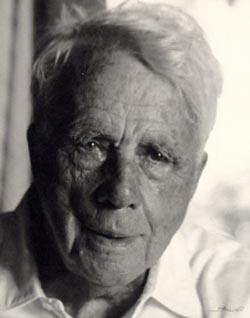
Birches appeared in Robert Frost's book Mountain Interval, published in 1916. It is the twelfth poem in that book. Frost lived from 1874 to 1963.
What readers have said
A reader past sixty says the trees that never right themselves now remind him of old scars and pain that stay with people for years. Jim, 2004
One reader takes the climb and return as a wish for a fresh start, over and over. Sharh11, 2005
One reader rejects any sexual meaning and reads the poem as a longing to be a carefree child again. Erica, 2005
Another reader argues for deliberate sexual imagery, citing phrases such as "took the stiffness out of them" and "hung limp". Eric, 2007
One reader sees the poem swinging between opposites: truth and imagination, youth and age, heaven and earth. J, 2010
One reader asks why the pathless-wood passage, which they read as an image of love, is so violent. Josay, 2007
This poem was a favorite of my English Prof. at Dickinson College. He read it to us, and told us he also was a swinger of birches. I've always loved it. I looked it up to send to a friend in Canada who has a retirement home near Lake Winnipeg, and surrounded, by Birches!
A great poem it just awsome it just great i love it alot.
ReneeUnited States
This poem is my favorite when i saw the movie here on earth i feel in love with it. It makes me fell good about my youth. i wish i had as much talent as Mr. Frost.
JimUnited States
This and "Stopping By Woods" were my favorites in High School. Never knew why, but now that I'm well past 60 I see things I missed when I was younger. I see how old scars and pain can be seen in people long after the events that caused them. In Frost's words..though they never break, they never right themselves. Wonderful poem...wonderful man.
this is one of my favorite poems by Frost. at my high school, we were taught the analysis of the innocent boy, swinging on birch trees. our teacher told us that Frost admired youth and innocence, but later, my friend and i analyzed it in a different way, and found that this poem is also very sexual. see if you can interpret this poem that we did. our teacher was very surprised that we could find such an analysis at our age, have fun!
joseEgypt
this poem is totally stupid and it reeks like poo
annaUnited States
great poem, love the imagery.
BelindaUnited States
If one thinks that this poem stinks like poo - it would be my thought that one has not had the pleasure at a younger age of swinging from birches and the memory of the freedom feeling. Oh how wonderful the feeling was and how great the memory. I love the poem.
michael A.United States
to have the free spirit of youth and innocence be inmortalized in this way is tribute to mr frost's talent and insight. great poem one of my favorites
AlexUnited States
You know, if you replace the letter "R" in the word birches with a letter "T", the poem becomes a lot funnier.
keelyUnited Kingdom
i have never read this poem. i guess i should by all the nice comments you are getting.
SteveUnited States
That thing where you take the r in birches and replace it with the t is funny as hell
A.J.HareendranIndia
The poem is an excellent symbolic representation of our mundane existence which is made fruitful by spiritual aspirations.Frost makes the best use of different techniques like simile, metaphor, onamatopoea, alliteration etc. I firmly believe that the poem has no sexual connotations as some would think.
ellenNetherlands
Its my favourite, just read it again and again and you will smile
KapishKyrgyz Republic (Kyrgyzstan)
This poem makes me get roudy
tea cupUnited States
poo poo
Latin MaidGreece
I get hot 'down there' when I hear this poem. O so hot!
m kamran sufiPakistan
after reading birches, i want to observe nature more closely. you can also try.
Sharh11United States
I just read this poem for the first time this morning and I have thought of it all day. Wondeful imagery of the ice storm and then he drifts off from that reality to a dream of swinging on birches as a boy, and of the trees ending to him. I wish I could swing with such abandon up to the heavens and then return to the ground, over and over, each time a fresh start. I love this poem.
I am researching Robert Frost for school and i came across this poem. Once you take the time to read it, its a very sweet poem.
susanUnited States
This poem has such beautiful imagery: it nicely constrasts winter and summer, youth and aging, harshness and innocence - i love it
xunUnited States
GReat interpretation! the poem shows the life as the birch tree, which explains the effects from many problem. Mr.Frost simulated these effects into nature. What a great poem!
ThreesomeUnited Kingdom
This poem made me feel so hot and wet between my legs. I can just imagine riding the birches with Robert Frost. I thought about it for the rest of the day and I couldn't wait to get home to my vaseline. I read it to my boyfriend naked and we reinacted the poem but it wasn't his birch that was swinging.
Jessica, Lorna, Sophie.United Kingdom
we thought this poem was highly entertaining.it has strong sexuall imagery which we througly enjoyed.(together)AMAZING!!!
SaggyLittleBeyotchUnited States
this poem gets my juices flowing... to the max! I can't wait to go home to my hubby and read this to him while fondling his anus... he's gonna love this... and our gay son can read it and smother his body in vaseline when he comes home from school.
nouraLebanon
this poem is one of the great poems since it makes us live with the feelings of the poet since he portrait the birches trees and his wish to go back and live the happy moments in climding the trees .so wow!if anyone know how to understand it he will be pleased
EricaUnited States
I don't think it has any sexual meaning! This poem is simply about how childhood used to be. When we grow up life is harsh but when your a child you don't worry about what tomorrow might bring you are worry free. And he just talks about being a child again.
it is prosaic in langage but deep and inwardly poetic. both the tree and man alive in this poem (physical) the observer 'I' is frost hiself who likes to investigate the problem of human life. the life time is emphasized here with the starting word 'WHEN' in capital where we have to meet with lots of colorful hurdles through which we gain experience and mold ourselves.
Shuai KingUnited States
Great poem, I actually did not think it was about childhood and such, but I thought it was about the ups and downs of life. Strongly recommend reading this poem.
EdenAustralia
My name is Eden and i have always had a secret fantasy of Robert Frost. Not only does this poem turn me on, but i just cant get the image of MR FROST out of my head. What a HOT-TAY
alylaArgentina
from reading this poem, i believe that frost finds everday life boring. he would rather make up a story behind why things are the way they are than know the true reason. frost wants more than what is common and usual. he has the proper technique and the correct language to provide that for himself and his readers.
ScottCanada
The poem brought back many happy thoughts of enjoying nature , especially the birch and its significance to canoeing, in the Canadian north . Nature in Canada would not be as rich without the birch.
kristaUnited States
every time i read frost i get taken away, but never too far. In fact i am inside the poem. Swinging from birch to birch. One could do worse!
I quite enjoy Mr.Frost's poetry, this poem is another great example of Mr.Frosts' talents. I fail to see any sexual context in it at all though...contrary to many posts.
LidiaUnited States
Im Writing a poetry paper on this poem and found that the main themes of the poem were the joys of innocence and how the old painful memories of the past will not break ou but will never fade completley from your memory
Birchey McBirchUzbekistan
birches...ah birches...even the mention of that tree gets me hot and sweaty, 4 some guy on horse action. i also love the subverted flower. it reminds me of the morning dawn. lol. ps. i would give my right arm 4 a sex toy that was the same shape and rough texture of a birch LOG. who cares if i bleed 2 death??
EricUnited States
This poem definitly contains a great deal of sexual imagery..."could play alone, took the stiffness out of them, hung limp, not launching out too soon, fill a cup, up to the brim" youre kidding youreself if you think Frost put all of these images together out of chance, it represence his childhood innocence and fantasies.
Im doing a project for my one class and one question is "why did he write it?" and I dont know what it is could someone please help me??
BrittanyUnited States
Wow, i, like many who have or are reading this poem, am reading it for school. first of all, for all of those people who only see or think Frosts' poem, Birches has sexual meaning is not really analyzing very well or looking at it. it takes more than that. u can almost read anything and turn it to something sexual. I believe this poem is about looking back and wanting innocence, fun, happiness and the joys of youth.…
Read the whole comment
Wow, i, like many who have or are reading this poem, am reading it for school.
first of all, for all of those people who only see or think Frosts' poem, Birches has sexual meaning is not really analyzing very well or looking at it. it takes more than that. u can almost read anything and turn it to something sexual.
I believe this poem is about looking back and wanting innocence, fun, happiness and the joys of youth. its not jus about the boy swinging and enjoying life. The birches can symbolize poeple or a person. People grow old and tired not by their youthful and fun experiences but throw hard times. "But swinging doesn't bend then down to stay. Ice storms do that." Birches shed leaves like humans shed youth. both are such beautiful things " you'd think the inner dome of heaven had fallen." also like people." once they are bowed for so long, they never right themselves." they jus age.
the narrator says how he'd rather have a boy swinging bend the birches. its shows the signaficance of youth, innocence and happiness. wouldnt you want to grow old by the feel of freedon and happiness instead of by hard times and obsticals of life? no, its not possible but it is a feel good fantasy.
the boy swinging shows the wonderful part of youth that gives u the will power and drive to be brave and andventurous, yet there is always a limit or self protection that is in the mindset. " "and so not carrying the tree away clear to the ground" even. . ."with the same pains you use to fill a cup to the brim. . ."
At the last part, the narrator goes back to his reality more. He says how he would like away and swing on a birch or get away from reality when life is going nowhere and he is aged and lonely/ " and one eye is weepiong from a twig's having lashed it across it open" which can be seen as having ur heart broken or slashed from a relationship or situation. he'd like to go away and come back to start over. he doesnt want every thing to fade away or go away for ever but only to revisit thhe happiness that he once had. " Earth's the right place for love," love, the love of happiness and experiences. going back to that memory but also coming back. you can not live in happiness or memories forever but having them with u in life helps u move on. . .
"one could do worse than be a swinger of branches. . ."
“And life is too much like a pathless wood where your face burns and tickles with the cobwebs broken across it, and one is weeping from twigs having lashed across it open.” Why is this image of love filled with such violence?
Frosts brilliance comes with his moments of cognition. Well, let me say that I might believe that all great poetry is born from a fleeting moment of brilliant cognition, that second when god seems to speak to you. And you understand the world. I mean, you don't understand the whole damn thing, but one part of the world, your part becomes crystal clear. The moment may happen when you're watching water wash over a…
Read the whole comment
Frosts brilliance comes with his moments of cognition. Well, let me say that I might believe that all great poetry is born from a fleeting moment of brilliant cognition, that second when god seems to speak to you. And you understand the world. I mean, you don't understand the whole damn thing, but one part of the world, your part becomes crystal clear. The moment may happen when you're watching water wash over a windshield or when a spider is stuck in the bathtub. And those images will become a metaphor, like the world is speaking to you. I think everyone has had a moment like that, when you feel like poetry is the only way to express it. Perhaps I measure poetry looking for that cognition only after reading Frost. He seems to explain what it's like to be in that moment.
In Birches, like others of his work, he takes us through the symbols, memories, and thoughts that he had one moment while he noticed birch trees all bent over. And he reflected on his own nostalgia, that he swung from trees as a kid, even while admitting that these trees are likely bent by nature. (We had a huge willow tree where I grew up, we would swing from it like Tarzan. I will never forget that.)
I believe Frost wrote this poem in his early 40s, at a time when many men first start "feeling" the effects of aging. Stiff joints. And realizing that what seems to be the truth, our past, becomes a story, really, clouded by nostalgia. The temptation is to see the bent over birches and imagine swinging from them. But the sensual reality is that they are bent from the weather. The temptation is to "tame" all of the birch trees, out of a childish playfulness and boredom.
At the time birch trees might have conjured images of corporal punishment, a switch. I don't think he could have written the poem without alluding to it somehow. The stinging in the eye. But the poem isn't about punishment. I mean, daddy can spank me for going into the brier patch, but it hardly matters, because life, the brier patch it's self, will extract a punishment with it's thorns. Life comes with scratches, and it's as annoying as hell.
That can be too much, sometimes. It wears you down and you do want to stop the merry-go-round, and get off once and a while. But Frost would come back, because he can't imagine love without life, here. This poem seems to be his case for re-incarnation. He wrote this poem when few americans thought about re-incarnation, even though in his formative years the US was experiencing a 'Psychic' or 'new age' sort of craze.
You spend your youth, your life, learning to climb the trees, fearlessly but carefully. Learning to live life (tree of life) fearlessly but carefully. And then you climb to the very top, how Frost wants it to be, you climb to heaven and the tree gently swings you back to earth again, in new life. He proclaims he's a "swinger of birches", like he's found his religion, like you would aver that you are a Hindu or a Spiritualist. "One could do worse than be a swinger of birches."
The poem is about life and only in that way does it relate to sex. because without sex the human race would die and there would be no life. But Frost doesn't allude to that. You know sometimes a birch tree isn't a cigar.
Life is something we can discuss after passing through it.It's immposible before death.Why not talking about trees then.They can't walk and can bear everything silently and with indignity.This noblety of trees,even the tender ones,irritates us.It's poem of fighting,I think.
PetunaUnited States
What does the last line of the poem mean? I don't understand it.
This Poem Is based on the natuaralities of facing life and death and confronting these two challenges in such a confusing, elloquent, iirationalized, unethical, contrivance but I do believe that in the end Robert Frost is a very excellent writer and contains alot of good morals and values especially when he proved that in his writings =]]
RoxyUnited States
I dont belive that in 1916 someone would ateempt to write a poem about "riding birches" as something sexual and don't think about replacing the r with a t because that term wasn't loosely used in that time. Also, the last line is not about him saying that there are worse things than sex or thinking about sex, just clearing that up.
albanaArgentina
hello
i don`t have any critic about this poem it is writen very good ano it it is based in a life and death and confronting challenges Robert Frost is a very excellent writer and contrains moral in his writing..
The first time I read this poem I was really confused. It is hard for me to understand Poetry. My teacher then told us about it and good golly this is definatly not a G rated poem if you look into it. I thought she was just pulling my leg, but I was curious so I looked up some information about Robert Frost so I could better understand his miliue a little better and I do believe that this poem is very sexually related. It's too bad.
jeffUnited States
lol
some of the comments r funnier than hell. like #24
JUnited Kingdom
Birches
I think this poem contains a number of different themes but is centered largely around the theme of swinging between two polar opposites: Truth and imagination, youth and age, heaven and earth. From the first few lines we see the contrast between the playful activity of swinging birches and the 'straighter darker trees' which I believe represent the realism of life. Just as the voice of 'After apple picking' seems…
Read the whole comment
I think this poem contains a number of different themes but is centered largely around the theme of swinging between two polar opposites: Truth and imagination, youth and age, heaven and earth. From the first few lines we see the contrast between the playful activity of swinging birches and the 'straighter darker trees' which I believe represent the realism of life. Just as the voice of 'After apple picking' seems to long to return to its youth, there is an element in 'Birches' of the voice dreaming 'of going back to' his youth so that he may re-influence his future. Climbing the birch tree will also help him to navigate the 'pathless wood' that his life has become lost in. Ultimately though there is a strong sense that, in order for the voice of the poem to achieve the 'Truth' he must be prepared to take control of his own actions by not 'launching out too soon'. In my opinion this truth seems to be the ability to connect the real with the ideal as a rational thinker to achieve an equilibrium, which the boy can achieve by accepting the concrete and the imagination.
This poem was a favorite of my English Prof. at Dickinson College. He read it to us, and told us he also was a swinger of birches. I've always loved it. I looked it up to send to a friend in Canada who has a retirement home near Lake Winnipeg, and surrounded, by Birches!
A great poem it just awsome it just great i love it alot.
This poem is my favorite when i saw the movie here on earth i feel in love with it. It makes me fell good about my youth. i wish i had as much talent as Mr. Frost.
This and "Stopping By Woods" were my favorites in High School. Never knew why, but now that I'm well past 60 I see things I missed when I was younger. I see how old scars and pain can be seen in people long after the events that caused them. In Frost's words..though they never break, they never right themselves. Wonderful poem...wonderful man.
this is one of my favorite poems by Frost. at my high school, we were taught the analysis of the innocent boy, swinging on birch trees. our teacher told us that Frost admired youth and innocence, but later, my friend and i analyzed it in a different way, and found that this poem is also very sexual. see if you can interpret this poem that we did. our teacher was very surprised that we could find such an analysis at our age, have fun!
this poem is totally stupid and it reeks like poo
great poem, love the imagery.
If one thinks that this poem stinks like poo - it would be my thought that one has not had the pleasure at a younger age of swinging from birches and the memory of the freedom feeling. Oh how wonderful the feeling was and how great the memory. I love the poem.
to have the free spirit of youth and innocence be inmortalized in this way is tribute to mr frost's talent and insight. great poem one of my favorites
You know, if you replace the letter "R" in the word birches with a letter "T", the poem becomes a lot funnier.
i have never read this poem. i guess i should by all the nice comments you are getting.
That thing where you take the r in birches and replace it with the t is funny as hell
The poem is an excellent symbolic representation of our mundane existence which is made fruitful by spiritual aspirations.Frost makes the best use of different techniques like simile, metaphor, onamatopoea, alliteration etc. I firmly believe that the poem has no sexual connotations as some would think.
Its my favourite, just read it again and again and you will smile
This poem makes me get roudy
poo poo
I get hot 'down there' when I hear this poem. O so hot!
after reading birches, i want to observe nature more closely. you can also try.
I just read this poem for the first time this morning and I have thought of it all day. Wondeful imagery of the ice storm and then he drifts off from that reality to a dream of swinging on birches as a boy, and of the trees ending to him. I wish I could swing with such abandon up to the heavens and then return to the ground, over and over, each time a fresh start. I love this poem.
I am researching Robert Frost for school and i came across this poem. Once you take the time to read it, its a very sweet poem.
This poem has such beautiful imagery: it nicely constrasts winter and summer, youth and aging, harshness and innocence - i love it
GReat interpretation! the poem shows the life as the birch tree, which explains the effects from many problem. Mr.Frost simulated these effects into nature. What a great poem!
This poem made me feel so hot and wet between my legs. I can just imagine riding the birches with Robert Frost. I thought about it for the rest of the day and I couldn't wait to get home to my vaseline. I read it to my boyfriend naked and we reinacted the poem but it wasn't his birch that was swinging.
we thought this poem was highly entertaining.it has strong sexuall imagery which we througly enjoyed.(together)AMAZING!!!
this poem gets my juices flowing... to the max! I can't wait to go home to my hubby and read this to him while fondling his anus... he's gonna love this... and our gay son can read it and smother his body in vaseline when he comes home from school.
this poem is one of the great poems since it makes us live with the feelings of the poet since he portrait the birches trees and his wish to go back and live the happy moments in climding the trees .so wow!if anyone know how to understand it he will be pleased
I don't think it has any sexual meaning! This poem is simply about how childhood used to be. When we grow up life is harsh but when your a child you don't worry about what tomorrow might bring you are worry free. And he just talks about being a child again.
it is prosaic in langage but deep and inwardly poetic. both the tree and man alive in this poem (physical) the observer 'I' is frost hiself who likes to investigate the problem of human life. the life time is emphasized here with the starting word 'WHEN' in capital where we have to meet with lots of colorful hurdles through which we gain experience and mold ourselves.
Great poem, I actually did not think it was about childhood and such, but I thought it was about the ups and downs of life. Strongly recommend reading this poem.
My name is Eden and i have always had a secret fantasy of Robert Frost. Not only does this poem turn me on, but i just cant get the image of MR FROST out of my head. What a HOT-TAY
from reading this poem, i believe that frost finds everday life boring. he would rather make up a story behind why things are the way they are than know the true reason. frost wants more than what is common and usual. he has the proper technique and the correct language to provide that for himself and his readers.
The poem brought back many happy thoughts of enjoying nature , especially the birch and its significance to canoeing, in the Canadian north . Nature in Canada would not be as rich without the birch.
every time i read frost i get taken away, but never too far. In fact i am inside the poem. Swinging from birch to birch. One could do worse!
I quite enjoy Mr.Frost's poetry, this poem is another great example of Mr.Frosts' talents. I fail to see any sexual context in it at all though...contrary to many posts.
Im Writing a poetry paper on this poem and found that the main themes of the poem were the joys of innocence and how the old painful memories of the past will not break ou but will never fade completley from your memory
birches...ah birches...even the mention of that tree gets me hot and sweaty, 4 some guy on horse action. i also love the subverted flower. it reminds me of the morning dawn. lol. ps. i would give my right arm 4 a sex toy that was the same shape and rough texture of a birch LOG. who cares if i bleed 2 death??
This poem definitly contains a great deal of sexual imagery..."could play alone, took the stiffness out of them, hung limp, not launching out too soon, fill a cup, up to the brim" youre kidding youreself if you think Frost put all of these images together out of chance, it represence his childhood innocence and fantasies.
Im doing a project for my one class and one question is "why did he write it?" and I dont know what it is could someone please help me??
Wow, i, like many who have or are reading this poem, am reading it for school. first of all, for all of those people who only see or think Frosts' poem, Birches has sexual meaning is not really analyzing very well or looking at it. it takes more than that. u can almost read anything and turn it to something sexual. I believe this poem is about looking back and wanting innocence, fun, happiness and the joys of youth.…
Read the whole commentWow, i, like many who have or are reading this poem, am reading it for school.
first of all, for all of those people who only see or think Frosts' poem, Birches has sexual meaning is not really analyzing very well or looking at it. it takes more than that. u can almost read anything and turn it to something sexual.
I believe this poem is about looking back and wanting innocence, fun, happiness and the joys of youth. its not jus about the boy swinging and enjoying life. The birches can symbolize poeple or a person. People grow old and tired not by their youthful and fun experiences but throw hard times. "But swinging doesn't bend then down to stay. Ice storms do that."
Birches shed leaves like humans shed youth. both are such beautiful things " you'd think the inner dome of heaven had fallen." also like people." once they are bowed for so long, they never right themselves." they jus age.
the narrator says how he'd rather have a boy swinging bend the birches. its shows the signaficance of youth, innocence and happiness. wouldnt you want to grow old by the feel of freedon and happiness instead of by hard times and obsticals of life? no, its not possible but it is a feel good fantasy.
the boy swinging shows the wonderful part of youth that gives u the will power and drive to be brave and andventurous, yet there is always a limit or self protection that is in the mindset. " "and so not carrying the tree away clear to the ground" even. . ."with the same pains you use to fill a cup to the brim. . ."
At the last part, the narrator goes back to his reality more. He says how he would like away and swing on a birch or get away from reality when life is going nowhere and he is aged and lonely/ " and one eye is weepiong from a twig's having lashed it across it open" which can be seen as having ur heart broken or slashed from a relationship or situation. he'd like to go away and come back to start over. he doesnt want every thing to fade away or go away for ever but only to revisit thhe happiness that he once had. " Earth's the right place for love," love, the love of happiness and experiences. going back to that memory but also coming back. you can not live in happiness or memories forever but having them with u in life helps u move on. . .
"one could do worse than be a swinger of branches. . ."
“And life is too much like a pathless wood where your face burns and tickles with the cobwebs broken across it, and one is weeping from twigs having lashed across it open.” Why is this image of love filled with such violence?
Frosts brilliance comes with his moments of cognition. Well, let me say that I might believe that all great poetry is born from a fleeting moment of brilliant cognition, that second when god seems to speak to you. And you understand the world. I mean, you don't understand the whole damn thing, but one part of the world, your part becomes crystal clear. The moment may happen when you're watching water wash over a…
Read the whole commentFrosts brilliance comes with his moments of cognition. Well, let me say that I might believe that all great poetry is born from a fleeting moment of brilliant cognition, that second when god seems to speak to you. And you understand the world. I mean, you don't understand the whole damn thing, but one part of the world, your part becomes crystal clear. The moment may happen when you're watching water wash over a windshield or when a spider is stuck in the bathtub. And those images will become a metaphor, like the world is speaking to you. I think everyone has had a moment like that, when you feel like poetry is the only way to express it. Perhaps I measure poetry looking for that cognition only after reading Frost. He seems to explain what it's like to be in that moment.
In Birches, like others of his work, he takes us through the symbols, memories, and thoughts that he had one moment while he noticed birch trees all bent over. And he reflected on his own nostalgia, that he swung from trees as a kid, even while admitting that these trees are likely bent by nature. (We had a huge willow tree where I grew up, we would swing from it like Tarzan. I will never forget that.)
I believe Frost wrote this poem in his early 40s, at a time when many men first start "feeling" the effects of aging. Stiff joints. And realizing that what seems to be the truth, our past, becomes a story, really, clouded by nostalgia. The temptation is to see the bent over birches and imagine swinging from them. But the sensual reality is that they are bent from the weather. The temptation is to "tame" all of the birch trees, out of a childish playfulness and boredom.
At the time birch trees might have conjured images of corporal punishment, a switch. I don't think he could have written the poem without alluding to it somehow. The stinging in the eye. But the poem isn't about punishment. I mean, daddy can spank me for going into the brier patch, but it hardly matters, because life, the brier patch it's self, will extract a punishment with it's thorns. Life comes with scratches, and it's as annoying as hell.
That can be too much, sometimes. It wears you down and you do want to stop the merry-go-round, and get off once and a while. But Frost would come back, because he can't imagine love without life, here. This poem seems to be his case for re-incarnation. He wrote this poem when few americans thought about re-incarnation, even though in his formative years the US was experiencing a 'Psychic' or 'new age' sort of craze.
You spend your youth, your life, learning to climb the trees, fearlessly but carefully. Learning to live life (tree of life) fearlessly but carefully. And then you climb to the very top, how Frost wants it to be, you climb to heaven and the tree gently swings you back to earth again, in new life. He proclaims he's a "swinger of birches", like he's found his religion, like you would aver that you are a Hindu or a Spiritualist. "One could do worse than be a swinger of birches."
The poem is about life and only in that way does it relate to sex. because without sex the human race would die and there would be no life. But Frost doesn't allude to that. You know sometimes a birch tree isn't a cigar.
Life is something we can discuss after passing through it.It's immposible before death.Why not talking about trees then.They can't walk and can bear everything silently and with indignity.This noblety of trees,even the tender ones,irritates us.It's poem of fighting,I think.
What does the last line of the poem mean? I don't understand it.
This Poem Is based on the natuaralities of facing life and death and confronting these two challenges in such a confusing, elloquent, iirationalized, unethical, contrivance but I do believe that in the end Robert Frost is a very excellent writer and contains alot of good morals and values especially when he proved that in his writings =]]
I dont belive that in 1916 someone would ateempt to write a poem about "riding birches" as something sexual and don't think about replacing the r with a t because that term wasn't loosely used in that time. Also, the last line is not about him saying that there are worse things than sex or thinking about sex, just clearing that up.
hello
i don`t have any critic about this poem it is writen very good ano it it is based in a life and death and confronting challenges Robert Frost is a very excellent writer and contrains moral in his writing..
:P
The first time I read this poem I was really confused. It is hard for me to understand Poetry. My teacher then told us about it and good golly this is definatly not a G rated poem if you look into it. I thought she was just pulling my leg, but I was curious so I looked up some information about Robert Frost so I could better understand his miliue a little better and I do believe that this poem is very sexually related. It's too bad.
lol
some of the comments r funnier than hell. like #24
Birches
I think this poem contains a number of different themes but is centered largely around the theme of swinging between two polar opposites: Truth and imagination, youth and age, heaven and earth. From the first few lines we see the contrast between the playful activity of swinging birches and the 'straighter darker trees' which I believe represent the realism of life. Just as the voice of 'After apple picking' seems…
Read the whole commentI think this poem contains a number of different themes but is centered largely around the theme of swinging between two polar opposites: Truth and imagination, youth and age, heaven and earth. From the first few lines we see the contrast between the playful activity of swinging birches and the 'straighter darker trees' which I believe represent the realism of life. Just as the voice of 'After apple picking' seems to long to return to its youth, there is an element in 'Birches' of the voice dreaming 'of going back to' his youth so that he may re-influence his future. Climbing the birch tree will also help him to navigate the 'pathless wood' that his life has become lost in. Ultimately though there is a strong sense that, in order for the voice of the poem to achieve the 'Truth' he must be prepared to take control of his own actions by not 'launching out too soon'. In my opinion this truth seems to be the ability to connect the real with the ideal as a rational thinker to achieve an equilibrium, which the boy can achieve by accepting the concrete and the imagination.
memory
I remember reading this poem in the 6th grade. Then i couldnt appreciate it for its worth but now i see it for its true beauty