The shattered water made a misty din.
Great waves looked over others coming in,
And thought of doing something to the shore
That water never did to land before.
The clouds were low and hairy in the skies,
Like locks blown forward in the gleam of eyes.
You could not tell, and yet it looked as if
The shore was lucky in being backed by cliff,
The cliff in being backed by continent;
It looked as if a night of dark intent
Was coming, and not only a night, an age.
Someone had better be prepared for rage.
There would be more than ocean-water broken
Before God's last Put out the Light was spoken.
✦
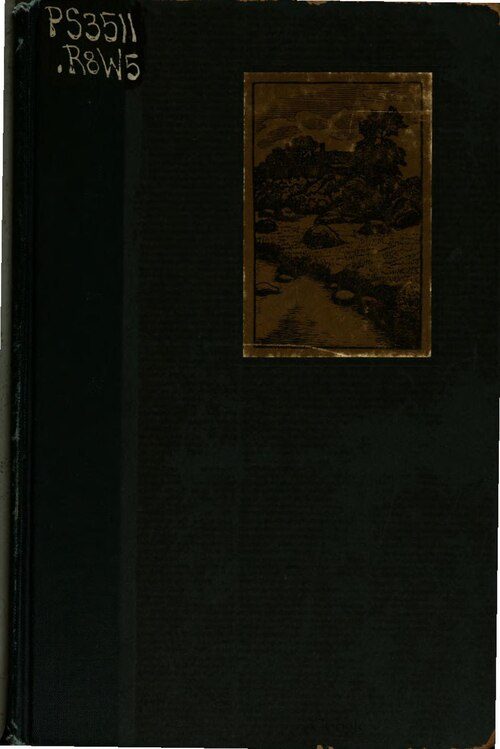
From the bookWest-Running BrookFront cover with pictorial label, Henry Holt, 1928; library copy
Analysis
Once By The Pacific: analysis
Introduction
This fourteen-line poem by Robert Frost describes a storm on the Pacific coast that seems to threaten far more than the coast. A speaker watches great waves and low clouds from the shore. The waves seem to be planning something that "water never did to land before" (line 4).
The poem moves from a scene of weather to a warning about an age of darkness. It ends at the end of the world, when God's "last Put out the Light" is spoken. The words are short and plain. Much of the menace comes from what the speaker will not say outright.
Summary
Lines 1–4 open on a stormy shore. Water breaks into spray with a loud, misty noise. The great waves seem to look over the smaller waves coming in ahead of them. They seem to be thinking of doing something to the shore. What they have in mind is something "water never did to land before".
Lines 5–6 turn to the sky. The clouds hang low and look shaggy, "hairy in the skies". The speaker compares them to locks of hair blown forward over gleaming eyes. The comparison gives the storm a face.
In lines 7–9 the speaker admits that no one could be sure. Still, it looked as if the shore was lucky to have a cliff behind it. The cliff, in turn, was lucky to have a whole continent behind it. The land seems to stand in layers against the sea.
Lines 10–11 predict what is coming. It looked as if a night "of dark intent" was on its way. The speaker then widens the claim: not only a night, but an age. Line 12 gives a blunt warning. Someone "had better be prepared for rage".
The last two lines widen the threat again. More than ocean-water will be broken before the end comes. That end is the moment when God speaks a final command, "Put out the Light". The poem stops on the word "spoken".
Themes and meaning
The first theme is nature as a hostile will. The poem gives the sea a mind. The waves "looked over" the others and "thought of doing something" (lines 2–3). The clouds have hair, and the storm seems to have eyes. Nature here is not a view to admire but a force with plans aimed at the land.
A second theme is how thin our protection is. The shore is "lucky" in its cliff, and the cliff in its continent (lines 8–9). Luck is a weak word for safety. It suggests that the defence is chance, not design. The claim also sits inside a hedge: "You could not tell, and yet it looked as if". The speaker offers comfort and doubts it in the same breath.
A third theme is the end of time. The threat grows line by line. It begins with the shore, becomes "a night of dark intent", and then "an age" (lines 10–11). The final couplet reaches the end of everything, when God speaks the last command. The phrase "Put out the Light" can be read as the undoing of creation. Several readers hear it as a reversal of the biblical command that made light.
A fourth theme is rage whose owner is never named. Line 12 says "Someone had better be prepared for rage" but does not say whose rage. It could belong to the sea, to God, or to people. The phrase "more than ocean-water broken" (line 13) hints that people or their works will break too. The poem can be read as a storm scene or as a warning about human violence. The text leaves both open.
Tone
The tone moves from uneasy observation to prophecy. The opening lines describe the storm, with a trace of dry wit in waves that "thought of doing something". The hedges "You could not tell" and "it looked as if" keep the speaker cautious.
The word "lucky" carries a wry, uneasy humour. Then the voice hardens. Line 12 is flat, colloquial and menacing. The casual "had better" makes the warning sound more certain, not less.
The final couplet is grave and sweeping. The speaker stops describing and starts foretelling. The poem can be read as ominous from the start, with the early lightness only masking the threat.
Form and structure
The poem has 14 lines in 1 stanza of 14 lines. It is written in rhymed couplets, with the computed scheme AABBCCDDEFGGHH. Its length and metre make it a kind of sonnet built from couplets rather than quatrains.
The metre is iambic pentameter, with lines of 10 to 11 syllables. Most lines are regular. The eighth, eleventh, thirteenth and fourteenth lines each carry one extra unstressed syllable. The last couplet ends on "broken" and "spoken", a falling feminine rhyme that makes the close sound heavy.
The computed scheme treats line 9 and line 10 as unrhymed. The words "continent" and "intent" share an ending, but the stress falls on different syllables. The ear hears only a faint, off-balance rhyme at the point where the poem turns from the land to the coming night.
Poetic devices
metaphor line 1
The shattered water Water is treated as something solid that can shatter like glass. The word sets up the breaking that returns in line 13.
alliteration line 1
made a misty din The repeated m sound softens the line before the hard word din. Sight and sound blur together, as spray and noise do in a storm.
personification line 2
Great waves looked over others coming in The waves look and, in the next line, think. The sea gains a watching, scheming mind.
enjambment line 3
And thought of doing something to the shore The sentence runs on into line 4 before the plan is defined. The delay mimics a wave gathering before it breaks.
simile line 6
Like locks blown forward in the gleam of eyes The clouds become hair falling over glaring eyes. The storm gains a face, and a threatening one.
repetition line 10
It looked as if The phrase repeats line 7. Each prediction is framed as appearance, which keeps the speaker's claims hedged even as they grow darker.
parallelism line 9
The cliff in being backed by continent The line copies the pattern of line 8. The chain of shore, cliff and continent builds a sense of layered defence.
amplification line 11
not only a night, an age The speaker corrects and enlarges the threat mid-line. A single night of storm becomes a whole era of darkness.
understatement line 12
Someone had better be prepared for rage. The everyday phrase had better and the vague Someone understate an enormous threat. The flatness makes the warning more chilling.
allusion line 14
Put out the Light The capitals mark the words as a spoken command, quoted as if from scripture or drama. Readers hear it as a reversal of the creation of light, or as an echo of Othello.
feminine rhyme line 13
ocean-water broken Broken rhymes with spoken on an unstressed final syllable. The closing couplet falls away, like the light going out.
Words worth knowing
din
A loud, continuous noise. Here, the roar of breaking surf.
locks
Locks of hair, not door locks. The clouds look like hair blown over a face.
backed
Supported or protected from behind, as a wall backs a line of defenders.
age
An era or long period of history, not old age.
Context
The poem appeared in Robert Frost's book West-Running Brook, published in 1928.
What readers have said
Courtney read the poem as God's wrath and the coming end of the world. Courtney, 2004
Tony disagreed, reading it as God protecting people and holding off the coming evil until their time has come. Tony, 2005
Jackie read it as a poem about the power of nature, with the water conspiring against a shore saved only by its cliff, and heard the last line as a reversal of the biblical command that made light. Jackie, 2005
Scott pointed out that "Put out the Light" echoes a line Othello speaks in Shakespeare's play just before he kills the woman he wrongly believes betrayed him. scott, 2007
Kari, analysing the poem for a class, read it as the voice of a woman deeply hurt by someone she trusted, whose rage is building toward revenge or confrontation. Kari, 2006
Quilty, writing from the San Francisco peninsula, felt the poem captures a child's fear of fog, wind, waves, the unknown and the night. Quilty, 2006
I perceived this poem as being a wrath that God is having, about the world comming to an end.
TonyUnited States
This poem is not about God sending down his wrath. It's about god protecting us and saving us for the evil that's about to come. It's like his telling us that he is not going to let us go untill it is time and it's not time for us to all die.He is giving us hope and joy to still live and go on. that's what this poem is about.
Jackie
I thought this poem was about the power of nature. The water has the ability to erode and to destroy. The stormy weather seems to suggest that the wateris almost conspiring to attack the shore. But it cannot because it is luckily backed by a cliff. There is also a biblical reference "Put out the Light" is a reversal of "Let there be light" In Frost's poetry he reflects an ambivalence towards nature. This poem conters many traditional American writers like Whitman who worship nature. Nature is not always good. It can also destroy.
When I analyzed this poem, I did not see it in a religious point of view. My interpretation was that this poem suggested a deeper meaning than just waves crashing against the shore. It felt as though the waves were entertaining thoughts of "doing something to the shore that water had never done to land before". I read the tone as ominious and strongly hinting toward Apocalypse. This is only my interpretation.
I at first thought the poem was about the end of the world and human life but then it came to seem that the wrath of the oceans had once killed a happy person and broken their life.
stevenUnited States
I may be a late comer to this, but as look at the poem it seems to evoke the furious energy of nature, and a combination of ambviilence towards the vastness and/or agelessness of natural forces, and a sober consideration of its end
soy soyChina
i thought this poem meant that eggs being eaton by peeps was pretty radical :)
Ryan B.United States
I think this poem has very deep meaning. As you read it over and over you can not tell what Robert Frost is trying to point out. Is it just about how powerful nature can be? Or just about the possibilities of nature? I think not. The last line of the poem says “before god’s last ‘put out the light’ was spoken” Put out the light is the reversal of “let there be light.” I think what Robert Frost is trying to say that…
Read the whole comment
I think this poem has very deep meaning. As you read it over and over you can not tell what Robert Frost is trying to point out. Is it just about how powerful nature can be? Or just about the possibilities of nature? I think not. The last line of the poem says “before god’s last ‘put out the light’ was spoken” Put out the light is the reversal of “let there be light.” I think what Robert Frost is trying to say that god created (let there be light,) so god has the power to destroy (put out the light.) Robert Frost could have had deeper meaning as to why he should express these thoughts, but that is beyond me, maybe he thinks that we should all follow the man who has the ultimate power of nature, because he has the power to kill us all, or maybe he’s trying to point out that we should live life to the fullest because god can end it. I personally didn't know him so I do not know.
I chose to analyze the poem for a class assignment and I believe it is open to many interpretations. For instance I looked at it from the stand point of a woman who has been deeply hurt by someone she loved and trusted and now has a growing sense of rage as she dwells. She is coming to a breaking point and points this out with a menacing tone. She may take revenge or simply have a confrontation.
I really like the allusion that Jackie brings up about how god putting out the light is the opposite of god saying let there be light. I believe that this poem is a metaphor for the human race and how we are too proud to help each other out, so we fight wars to prove how strong we are. However, mankind is all the same even though we strive to be different and to stand out from the crowd we are all one and though we…
Read the whole comment
I really like the allusion that Jackie brings up about how god putting out the light is the opposite of god saying let there be light. I believe that this poem is a metaphor for the human race and how we are too proud to help each other out, so we fight wars to prove how strong we are. However, mankind is all the same even though we strive to be different and to stand out from the crowd we are all one and though we should tread our own paths it is always good to have someone to fall back on. Therefore, if we keep fighting wars then the end is closer that we suspect. The locks that cover the eyes is propaganda that is used to cover the true evil of war. Robert Frost does all this by alluding to the natural process of nature and how water erodes the cliff, but thankfully there is so much land that it will take forever for land to be completely wiped out; however, at this rate it is sooner than we think. The night of dark intent is a storm clud (a third party) that speeds the process along. All in all this poem is pessimistic and it is supposed to be a very succinct wake up call saying work together!
Frost was born in San Francisco and lived here until he was 10 years old. This poem has always been special to me because it evokes a child's fear of fog, wind, and waves here on the penninsula. It expresses a child's fear of the unknown and of the night.
GeorgeUnited States
What would you say this poem is... Lyric? Sonnet? Free verse?
GeogiaUnited States
i really like this peom it feels so real.
scottUnited States
“Put out the Light” is a famous line from the Shakespeare play “Othello.” Othello speaks these lines just before he kills his wife, who he feels (inaccurately) has betrayed him. He believes that only by killing her can her "innocence” be restored.
The hubris of humans is not "in the gleam of eyes" of a creator; moreover, no "dark intent" could be in the eyes of God. And for the irreverence shown by Actaeon's lack of humility for the glory of nature, Artemis transformed him into a stag and his light of life was put out.
How in the world would anyone do or need an analysis of Robert Frost poem (s). He can't say it clearer. He said what it means and it's not about anything other than the subject.
count the number of lines 7 rhyming couplets How many syllables per line accent pattern weak strong seven times in every line Frost liked the "old school" form of poetry, saying "free verse was like playing tennis without a net"
I perceived this poem as being a wrath that God is having, about the world comming to an end.
This poem is not about God sending down his wrath. It's about god protecting us and saving us for the evil that's about to come. It's like his telling us that he is not going to let us go untill it is time and it's not time for us to all die.He is giving us hope and joy to still live and go on. that's what this poem is about.
I thought this poem was about the power of nature. The water has the ability to erode and to destroy. The stormy weather seems to suggest that the wateris almost conspiring to attack the shore. But it cannot because it is luckily backed by a cliff. There is also a biblical reference "Put out the Light" is a reversal of "Let there be light" In Frost's poetry he reflects an ambivalence towards nature. This poem conters many traditional American writers like Whitman who worship nature. Nature is not always good. It can also destroy.
When I analyzed this poem, I did not see it in a religious point of view. My interpretation was that this poem suggested a deeper meaning than just waves crashing against the shore. It felt as though the waves were entertaining thoughts of "doing something to the shore that water had never done to land before". I read the tone as ominious and strongly hinting toward Apocalypse. This is only my interpretation.
I at first thought the poem was about the end of the world and human life but then it came to seem that the wrath of the oceans had once killed a happy person and broken their life.
I may be a late comer to this, but as look at the poem it seems to evoke the furious energy of nature, and a combination of ambviilence towards the vastness and/or agelessness of natural forces, and a sober consideration of its end
i thought this poem meant that eggs being eaton by peeps was pretty radical :)
I think this poem has very deep meaning. As you read it over and over you can not tell what Robert Frost is trying to point out. Is it just about how powerful nature can be? Or just about the possibilities of nature? I think not. The last line of the poem says “before god’s last ‘put out the light’ was spoken” Put out the light is the reversal of “let there be light.” I think what Robert Frost is trying to say that…
Read the whole commentI think this poem has very deep meaning. As you read it over and over you can not tell what Robert Frost is trying to point out. Is it just about how powerful nature can be? Or just about the possibilities of nature? I think not. The last line of the poem says “before god’s last ‘put out the light’ was spoken” Put out the light is the reversal of “let there be light.” I think what Robert Frost is trying to say that god created (let there be light,) so god has the power to destroy (put out the light.) Robert Frost could have had deeper meaning as to why he should express these thoughts, but that is beyond me, maybe he thinks that we should all follow the man who has the ultimate power of nature, because he has the power to kill us all, or maybe he’s trying to point out that we should live life to the fullest because god can end it. I personally didn't know him so I do not know.
I chose to analyze the poem for a class assignment and I believe it is open to many interpretations. For instance I looked at it from the stand point of a woman who has been deeply hurt by someone she loved and trusted and now has a growing sense of rage as she dwells. She is coming to a breaking point and points this out with a menacing tone. She may take revenge or simply have a confrontation.
I really like the allusion that Jackie brings up about how god putting out the light is the opposite of god saying let there be light. I believe that this poem is a metaphor for the human race and how we are too proud to help each other out, so we fight wars to prove how strong we are. However, mankind is all the same even though we strive to be different and to stand out from the crowd we are all one and though we…
Read the whole commentI really like the allusion that Jackie brings up about how god putting out the light is the opposite of god saying let there be light. I believe that this poem is a metaphor for the human race and how we are too proud to help each other out, so we fight wars to prove how strong we are. However, mankind is all the same even though we strive to be different and to stand out from the crowd we are all one and though we should tread our own paths it is always good to have someone to fall back on. Therefore, if we keep fighting wars then the end is closer that we suspect. The locks that cover the eyes is propaganda that is used to cover the true evil of war. Robert Frost does all this by alluding to the natural process of nature and how water erodes the cliff, but thankfully there is so much land that it will take forever for land to be completely wiped out; however, at this rate it is sooner than we think. The night of dark intent is a storm clud (a third party) that speeds the process along. All in all this poem is pessimistic and it is supposed to be a very succinct wake up call saying work together!
Frost was born in San Francisco and lived here until he was 10 years old. This poem has always been special to me because it evokes a child's fear of fog, wind, and waves here on the penninsula. It expresses a child's fear of the unknown and of the night.
What would you say this poem is... Lyric? Sonnet? Free verse?
i really like this peom it feels so real.
“Put out the Light” is a famous line from the Shakespeare play “Othello.” Othello speaks these lines just before he kills his wife, who he feels (inaccurately) has betrayed him. He believes that only by killing her can her "innocence” be restored.
the poem is a sonnet about the end of the world
Once by the Pacific
This poem really signifies th epower of nature!
great flood
i thought the poem was about the great flood because it talked about water and how someone had better be prepared for rage (Noah)
no global warming
the poem is not about global warming like people think! this poem was created in 1928!
poetry
poetry sucks but
Brah, global warming was known since 1898.
The hubris of humans is not "in the gleam of eyes" of a creator; moreover, no "dark intent" could be in the eyes of God. And for the irreverence shown by Actaeon's lack of humility for the glory of nature, Artemis transformed him into a stag and his light of life was put out.
How in the world would anyone do or need an analysis of Robert Frost poem (s).
He can't say it clearer. He said what it means and it's not about anything other than the subject.
count the number of lines
7 rhyming couplets
How many syllables per line
accent pattern weak strong seven times in every line
Frost liked the "old school" form of poetry, saying "free verse was like playing tennis without a net"
Don't read poetry if you aren't open to interpretations. You clearly don't understand his work.
Good point, suzy johnson. Most good poems are transparent. I am, as Susan Sontag said, "Against Interpretation."