The poem
Razors pain you; Rivers are damp; Acids stain you; And drugs cause cramp. Guns aren't lawful; Nooses give; Gas smells awful; You might as well live.

The poem
Razors pain you; Rivers are damp; Acids stain you; And drugs cause cramp. Guns aren't lawful; Nooses give; Gas smells awful; You might as well live.
"Resume" is an eight-line poem that lists ways to end one's own life and rejects each of them. Every method gets a flat, practical objection. Razors hurt, rivers are wet, acids leave stains and drugs bring cramps. The last line draws the conclusion: "You might as well live."
The joke is that the case for living is built only from the drawbacks of dying. The title means a summary, a short list of findings. The poem is fast and deadpan, and its humour sits right next to a grave subject.
Lines 1 to 4 name four methods of dying and give one drawback for each. Line 1 says "Razors pain you." Line 2 says "Rivers are damp." Line 3 says "Acids stain you," and line 4 says "drugs cause cramp." Each drawback is a single short statement about a physical nuisance.
Lines 5 to 7 add three more methods in the same pattern. Line 5 says "Guns aren't lawful." Line 6 says "Nooses give," so a rope may stretch or fail. Line 7 says "Gas smells awful." Each of the seven lines up to this point ends with a semicolon, so the list runs on without a break.
Line 8 closes the list with a conclusion. It turns from the methods to the person addressed: "You might as well live." This line names no method and gives no drawback. It ends with the poem's only full stop. Nothing follows it, and the speaker adds no comment on the choice.
The first theme is death reduced to inconvenience. The poem judges each method the way a shopper judges a faulty product. The objections are about pain, mess, the law and smell, never about grief or right and wrong. "Rivers are damp" is the most absurd of them, since it complains that water is wet. That drop from a grave subject to a trivial complaint is what makes the list funny.
The second theme is life chosen by default. "You might as well live" is not a celebration of living. The words "might as well" are what people say about a choice made because the other options are worse. Life wins only because every rival has been ruled out. The poem never gives a positive reason to live, and it never says why dying was being considered.
The third theme is humour as a way of handling despair. The form turns a dark subject into light verse. Rhyme, short lines and a brisk list keep it moving too fast for gloom to settle. The second person "you" lets the poem speak to anyone who has had the thought.
The last line can be read as grim comedy that admits despair, or as a real argument for staying alive. The text supports both, and the reader comments below split along exactly that line. The flat shrug of "might as well" is what lets it carry both meanings at once.
The tone is deadpan. The speaker lists methods of dying in the voice of someone comparing household goods. There is no self-pity and no drama. Each objection is stated as plain fact, as in "Acids stain you" and "Gas smells awful."
The clipped lines make the voice brisk and dry. Words like "damp" and "cramp" are deliberately small for the subject, and the smallness is the joke. The speaker sounds as if the options have been weighed many times already.
The last line shifts from complaint to a shrug. "You might as well live" sounds weary rather than hopeful. It may also sound kind, since it does end on living. Whether the shrug consoles or only jokes is left open by the text.
"Resume" is a single stanza of 8 lines. The lines are very short, none longer than 5 syllables. Each carries two main stresses. Several lines open on a stressed syllable, as in "Razors," "Rivers" and "Acids," which gives a falling, blunt start.
The first four lines rhyme ABAB. Lines 1 and 3 end in a two-syllable rhyme, "pain you" and "stain you", and "damp" rhymes with "cramp." The computed scheme treats the last four lines as unrhymed. By ear, though, "lawful" rhymes with "awful" and "give" with "live," so the second half repeats the pattern.
The syntax is strictly parallel. Seven lines give a noun and a drawback, each closed by a semicolon. The pattern breaks only in line 8, which is the longest and the only full sentence of advice.
Razors pain youThe first line sets the pattern of method plus drawback. Seven lines repeat it, so the list feels like a checklist being ticked off.
Rivers are dampDrowning is dismissed because water is wet. The drop from a grave act to a trivial complaint is the poem's sharpest joke.
Acids stain youThe phrase "stain you" rhymes on two syllables with "pain you" in line 1. The jingling rhyme keeps the subject in the register of light verse.
drugs cause crampThe hard k sounds in "cause cramp" make the line clipped and sharp. The sound fits the plainness of the complaint.
Guns aren't lawfulThe objection to a gun is a legal technicality. It is absurd to worry about the law in this situation, and that is the joke.
Nooses giveThe verb "give" means that a rope stretches or breaks under weight. The same verb usually means offering something, which adds a dry twist.
Gas smells awfulThe word "awful" echoes "lawful" in line 5. The rhyme turns a matter of mere smell into a matching item on the list.
You might as well liveAfter seven objections the conclusion is a shrug, not a triumph. The phrase "might as well" makes living the leftover option.
YouThe poem speaks to "you" throughout, and the final line makes that address explicit. It reads as advice given to anyone, including the speaker.
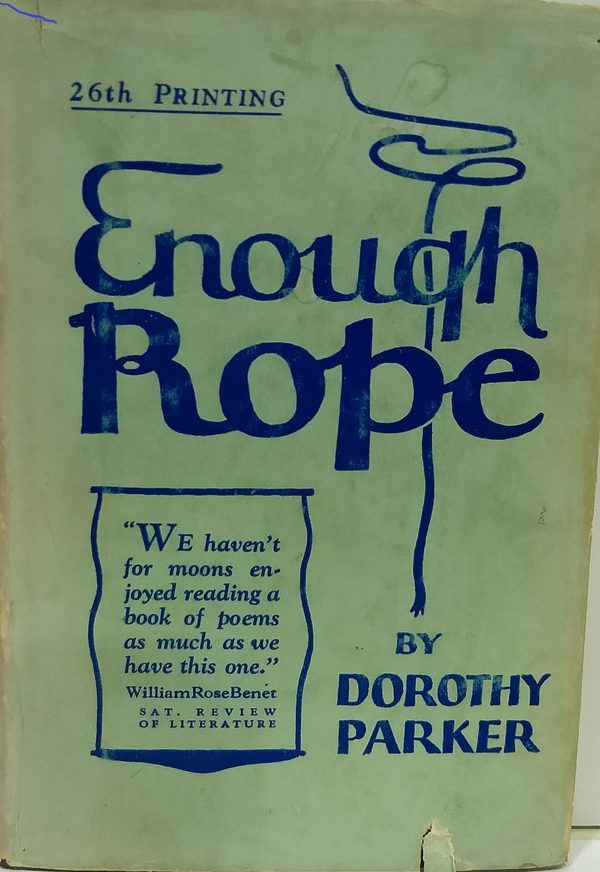
The poem appears in Dorothy Parker's collection Enough Rope, published in 1926, as number 43 in the book. Parker lived from 1893 to 1967. The poem has been on americanpoems.com since February 2004. Readers left 27 comments on it between 2004 and 2011.
Keep reading
Readers
I was recently diagnosed with congestive heart failure and metastatic cancer. This poem really cheers me up, as do so many of Parker's works, and lets me know that a big part of survival is in the attitude.
I'm glad that the poem cheered you up when you needed it to--however, I don't think Parker meant to be cheery or optomistic. Infact, the point of Resume was basically to say that even death was to much of a hassale to her--not that life was such a superior optoion.
Anyway, I'm glad someone else on earth has read this poem and enjoyed it. Have you read Dylan's 'Rage Against The Night'? That's a truley life affirming poem
(from another suicidal drunk--go figure).
liz, I do not see Leslie saying how Lindon should interpret the poem, Leslie simply says she "thinks" this is what Parker meant. I do not see how Leslie is out of order, and I think your comments were completely uncalled for.
--Moby
I love the poem. Recieved it on a card one year for my birthday. Very influential to me.
Who is the Dylan you speak of, leslie? I'm very interested.
TO Kat: I believe Dylan Thomas's "Do not go gentle into that good night" is the poem Leslie was referring to. Both Resume and ...Good Night remind us that life is the better alternative. Resume has been my favorite poem since I memorized it in grade school.
Resume,like Too Blue by Langston Hughes, has a convoluted quality the reader can appreciate. The poem has the power to transform depression into humor. I had committed Resume to memory years ago and then it was lost in the cobwebs of my mind. The other day I saw part of a movie, Mrs. Parker, and went in search of the poem I knew I enjoyed, yet couldn't recall. Seeing Resume listed I remembered it immediately.
I did my senior thesis on this poem. It would be nice to think of it as an 'around the bush' method of being cheery, but all she was saying was that all the trouble dying posed in itself was enough to convince her that it was equally hard as living and not worth the additional effort. And gosh, isn't it the truth: that dying is sometimes too hard to accomplish no matter how miserable living is.
My friend Kate told me about this poem and I think that it can be looked at in a lot of ways, but honestly, the poem is so true...it's the reason why some of my friends and myself are alive today....Parker has done a great job on this poem and she is one of my favortie poets along with Emily Dickinson and Edgar Allen Poe
This poem is so intriguing...mainly because it's meter. The poem starts is trochaic and makes it sharp, each beginning word jumping at you strong. But the last line in iamb symbolizes this dark humor...like all of the sudden she became optimistic. It's brilliant.
A poem means different things to different people.
"resume" has always been a fave, that suicide is an option is a strange comfort, but one nevertheless. I always thought that Frost's "Stopping By Woods on A Snowy Evening" was a contemplation of suicide.
I was in English class, looking for a poem/poet to do a presentation on. I decided on Dorothy Parker because I skimmed through her book, and I knew she must have been brilliant. How could somone so depressed make words turn into magic like she does. I really feel like a better person, just knowing this poem exists. I Agree with most of you. Too bad I wasn't allowed to chose the poem for my presentation..It was too short. But I promise, I will mention it.
I was introduced to this poem by the character Lisa in the movie Girl, Interrupted. She recites it in one scene while playing cards. The poem is so truthful. I have attempted suicide several times and come very close to death twice. Most people don't understand just how difficult a thing to do suicide is. Plus, as Parker writes, it's no fun
I chose Dorothy Parker as my subject for the poet study I am doing for English because Resume was an interesting poem to me. Parker is very straightforward and cynical about life and living.
i love this peom and has helped me alot from killing my english teacher at school, and it has also got me through my poetry project without a fail mark. thnx Dorothy
yea...this poem definatly helped in the times i needed...i just wish she was still here today, i need someone i can relate to.
I entered this page for searching opinions on this poem and I saw all your comments and I just couldn't help myself from not posting one too!!I really loved this poem and when sawing the Girl interrupted movie I was really amazed!!that is why I decided to do a liltte searche about its author!!it made me be no longer superhappy...:(
this poem really inspired me.. and i can feel the agony of dorothy parker that lead her of doing this suicide attempts.. Life is Fine by Langston Hughes is also a poem about attempting to commit suicide with a touch of humor..
Wow this poem really saved many people's lives
Very good poem
I have this poem tattooed on my forearm, over some old razor scars.
Parker completely exposes herself in Resume. She expresses such naked pathos and longing that is so bittersweet. It is a tragedy that a woman capable of such lucid expression ahould have been so morose and mired in depression and hopelessness.
Why does noone think this is funny? Its Hi-freaking-larious.
her poems always end in an unexpected fashion. someday it'll then be predictable but till then, i love her works!
i have problems. this poem almost fixed them but i still ended up killing myself. WAHHHH ( . Y . )
resume
i think that this poem is just another masterpiece of Parker's. her sarcasm is what makes her work so great, though the meaning of this morbid poem is so sad.
Resume
This poem is the only thing keeping me alive tonight. Thanks Dorothy, wherever you are.
add coments
ganda! i like this poem so much. its inspired me on how life important
Resume
I memorized this in high school as I needed eight more lines to recite for a class project - even the teacher laughed - I think about it every so often.