Under a spreading chestnut-tree
The village smithy stands;
The smith, a mighty man is he,
With large and sinewy hands;
And the muscles of his brawny arms
Are strong as iron bands.
His hair is crisp, and black, and long,
His face is like the tan;
His brow is wet with honest sweat,
He earns whate'er he can,
And looks the whole world in the face,
For he owes not any man.
Week in, week out, from morn till night,
You can hear his bellows blow;
You can hear him swing his heavy sledge,
With measured beat and slow,
Like a sexton ringing the village bell,
When the evening sun is low.
And children coming home from school
Look in at the open door;
They love to see the flaming forge,
And hear the bellows roar,
And catch the burning sparks that fly
Like chaff from a threshing-floor.
He goes on Sunday to the church,
And sits among his boys;
He hears the parson pray and preach,
He hears his daughter's voice,
Singing in the village choir,
And it makes his heart rejoice.
It sounds to him like her mother's voice,
Singing in Paradise!
He needs must think of her once more,
How in the grave she lies;
And with his hard, rough hand he wipes
A tear out of his eyes.
Toiling,--rejoicing,--sorrowing,
Onward through life he goes;
Each morning sees some task begin,
Each evening sees it close
Something attempted, something done,
Has earned a night's repose.
Thanks, thanks to thee, my worthy friend,
For the lesson thou hast taught!
Thus at the flaming forge of life
Our fortunes must be wrought;
Thus on its sounding anvil shaped
Each burning deed and thought.
This poem by Henry Wadsworth Longfellow is a portrait of a village smith in eight six-line stanzas. It follows him at the forge, in church and through the round of his days. The speaker watches him closely and admires what he sees.
The first half shows his strength, his honesty and his steady labour. The second half turns to feeling. He hears his daughter sing and remembers her dead mother. The last stanza speaks to the smith directly and draws a lesson from him. His forge becomes an image of how every person's fortunes and deeds are shaped.
Summary
A smithy stands under a spreading chestnut tree in a village. The smith is "a mighty man," with "large and sinewy hands." The muscles of his arms are "strong as iron bands."
His hair is "crisp, and black, and long," and his face is tanned. His brow is "wet with honest sweat." He earns what he can and owes nothing to anyone. So he can look "the whole world in the face."
All week, from morning till night, people can hear his bellows and his heavy hammer. The hammer falls "With measured beat and slow." The speaker compares the sound to a sexton ringing the village bell at sunset.
Children on their way home from school look in at the open door. They like to watch the "flaming forge" and hear the bellows roar. They try to catch the sparks, which fly "Like chaff from a threshing-floor."
On Sunday the smith goes to church and sits "among his boys." He hears the parson pray and preach. He also hears his daughter singing in the village choir, and his heart rejoices.
Her voice sounds to him like her mother's voice "Singing in Paradise!" He has to think once more of the mother lying in her grave. With his rough hand he wipes a tear from his eyes.
The speaker sums up the smith's days as "Toiling,--rejoicing,--sorrowing." He goes onward through life. Each morning a task begins and each evening it ends. Something attempted and something done "Has earned a night's repose."
The speaker thanks the smith, his "worthy friend," for the lesson he has taught. Life, too, has a "flaming forge," where "Our fortunes must be wrought." On its "sounding anvil" each "burning deed and thought" is shaped.
Themes and meaning
The smith's worth rests on labour and on paying his way. His brow is "wet with honest sweat," and "He earns whate'er he can." Because "he owes not any man," he can look "the whole world in the face." The poem links freedom from debt with moral standing. Work here is not a burden but the source of his self-respect.
The first stanzas stress the body: "large and sinewy hands" and arms "strong as iron bands." Stanzas five and six show the same man moved to tears in church. The hand that swings the sledge now wipes "A tear out of his eyes." The poem presents feeling as part of his strength, not a contradiction of it.
The daughter's singing brings back her dead mother. The speaker places the mother "in Paradise" and also "in the grave." Both images stand in stanza six without comment. The poem can be read as consoling, since the voice is heard in heaven. It can also be read as showing a loss the smith still carries, since he "needs must" think of her.
The poem measures the smith's days in regular units. He works "Week in, week out, from morn till night." Each morning a task begins and each evening "sees it close." Rest is something earned: "Something attempted, something done" earns "a night's repose." The steady beat of the hammer, "measured" and "slow," matches this ordered round of days.
The last stanza turns the smith's trade into a figure for everyone. The "flaming forge of life" is where "Our fortunes must be wrought." Deeds and thoughts are "burning," like iron, and shaped on a "sounding anvil." The word "must" suggests that trial and heat are necessary. The smith becomes a teacher, and the reader is meant to take his lesson.
Tone
The speaker begins with open admiration. The smith is "a mighty man," and his sweat is "honest." The details are plain and approving, and the pace is unhurried.
The tone warms in stanza four, where children crowd the door to watch the sparks. Stanza five is gentle and domestic. His daughter's voice "makes his heart rejoice."
Stanza six grows quiet and sorrowful. The exclamation "Singing in Paradise!" gives way to the grave and a wiped tear. The speaker records this grief with restraint and no commentary.
Stanza seven steadies again, balancing "Toiling,--rejoicing,--sorrowing" in one line. The close is direct, grateful and instructive. The speaker addresses the smith as "my worthy friend" and states a lesson with "Thus" and "must." The final tone is earnest and moral.
Form and structure
The poem has 48 lines in 8 stanzas of 6 lines each. Every stanza has the same shape. Line lengths run from 5 to 10 syllables.
Odd lines usually carry eight syllables and even lines six or seven. This suggests alternating iambic tetrameter and trimeter, the pattern of the ballad stanza. The metre is loose. Extra unstressed syllables lengthen lines such as line 5 and line 17, the longest.
Rhyme falls mainly on the even lines. In stanzas one to four and eight, lines two, four and six share one rhyme. The computed scheme links fewer lines in stanzas five to seven. Stanza one also rhymes its first and third lines. Line 9 adds an internal rhyme.
Poetic devices
Simile line 6
Are strong as iron bands The smith's body is compared to the metal he works. Strength of arm and strength of material become one image.
Internal rhyme line 9
His brow is wet with honest sweat The chime of wet and sweat ties the sweat to the adjective between them. Physical effort and moral honesty are fused in one line.
Anaphora line 15
You can hear him swing his heavy sledge The repeated opening from line 14 mimics the steady, repeated strokes of work. It also draws the reader in as a listener.
Simile line 17
Like a sexton ringing the village bell The hammer is likened to a church bell. This gives the work a sacred rhythm and anticipates the church scene in stanza five.
Alliteration line 21
They love to see the flaming forge The repeated f sound gives the forge a vivid, crackling presence. The same phrase returns in line 45 to carry the final metaphor.
Simile line 24
Like chaff from a threshing-floor Sparks are compared to chaff at harvest. The image keeps the poem inside rural village work.
Contrast line 35
rough hand he wipes The working hand is set against the gentle act of wiping a tear. The line shows strength and grief in one gesture.
Asyndeton line 37
Toiling,--rejoicing,--sorrowing Three participles, cut apart by dashes, sum up the three movements of the poem so far: work, joy in church and grief.
Parallelism line 41
Something attempted, something done The balanced halves state the poem's measure of a good day. Effort and completion are given equal weight.
Apostrophe line 43
Thanks, thanks to thee, my worthy friend The speaker turns to address the smith directly. The poem shifts from description to lesson.
Extended metaphor line 45
Thus at the flaming forge of life The smithy becomes a figure for all human life. Fortunes, deeds and thoughts are heated and shaped like iron.
Words worth knowing
smithy
The blacksmith's workshop, not the man himself. In line 2 it is the building that stands under the tree.
sledge
A sledgehammer, the heavy hammer used at the anvil, not a sled.
sexton
A church officer who rings the bell and looks after the church and graveyard.
threshing-floor
A floor where grain is beaten to separate it from the husks. The loose husks, or chaff, fly off in the process.
needs must
An old phrase meaning 'cannot help but' or 'must of necessity'.
Context
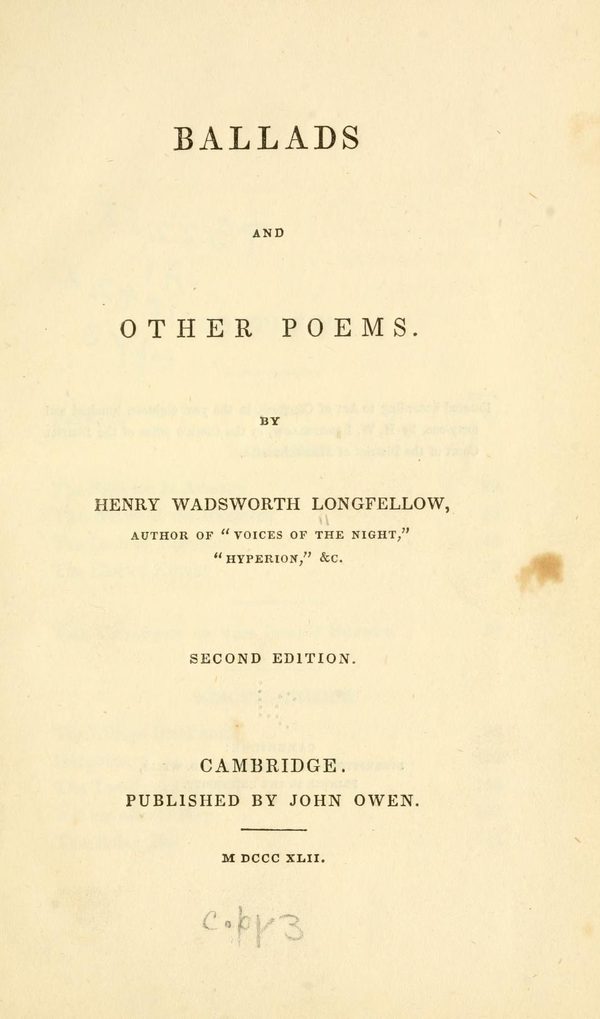
Henry Wadsworth Longfellow lived from 1807 to 1882. The poem appears in his collection Ballads and Other Poems, as the third poem in the book. It has been on americanpoems.com since 2004. It was Poem of the Day in 2005. Readers left 86 comments on it between 2004 and 2016.
What readers have said
Alan B. Chisholm, a blacksmith for 25 years, says old-timers nod when he recites the poem but young people do not understand how hard it was to forge out a living. Alan B. Chisholm, 2004
Alex Samaniego values the poem's pride in an ordinary man and its showing that a strong, manly figure has an emotional side. Alex Samaniego, 2004
Sukiro compares the smith to Joe in Dickens's Great Expectations, pointing to the mighty build, the honest sweat and the long hours at the forge. Sukiro, 2004
Vasanth Srinivasa takes lines 41–42 as the core of the poem: daily struggle aims at the contentment of an earned night's repose. Vasanth Srinivasa, 2006
Jim Kerbey questions the word in line 35 and argues it should read 'hard, rough hand', since 'haul' does not seem right. Jim Kerbey, 2006
joodie dislikes the poem's layout and would rearrange its lines, a lone dissent among comments that mostly praise it. joodie, 2005
Keep reading
Discover more of Henry Wadsworth Longfellow’s poetry.
My fifth grade class (1949 - Salem In) was required to memorize this poem. How we moaned and groaned.
As we were reading and rereading this poem our teacher, Mrs. Brooks would ask us questions. At first it was just a big task and Mrs. Brooks was just plain goofy. Ha!
I don't know about the rest of my classmates but I learned to love this poem and many other poems. Mrs. Brooks brought the Blacksmith alive. What a good man he was. Anyway, Mrs. Brooks where ever you are, and Im pretty sure you are looking down, THANKS!
Alan B. Chisholm
I have forged and Blacksmithed for the last 25 years, and have recited this poem many times, and the old-timers nod and agree. The young kids don't understand. In this age of computers and throw-away items we forget how hard it was to work and forge out a living. I wish the kids of today could experiance just one week of the life of the old-time blacksmith. Then they might appreciate the life-style that is afforded them today.
Cathy Hernandez
My friends and I were in Mrs.O'hara's class when we first saw this poem. We had to read and answer questions, the sighs of disappointment were heard round. I at first did not understand, and after many years I finally found out the truth about this poem. That hard work pays with the most rewarding rewards!
Jerry Croy
At 69 yrs of age, I'm taking up forging for fun. While pounding iron on the anvil, sparks flying, flames roaring, The Village Blacksmith by HWL came streaming into my head. We memorized it in 1944 - 5th grade -2 room school in Vera Cruz, Indiana. Now thats LIVING.
Melinda Strelak
When I was younger and growing up, I would go visit my Grandfather in California and almost every night we would read from a book of poems, and i would choose some and he would choose some. He always chose this poem. Now that i am 22, he has developed Alzhtimers and is slipping fast. But he still remembers reading ths to me, and even at a yery young age i knew what the poem truely meant. and i plan on passing the book to my children like he passed it to me from his grandfather.
Jennifer Snell (Troy)Canada
My father, Nicholas Troy, born in Co Waterford Ireland, would often recite the poem, The Village Blacksmith, as a bedtime story. Although my father received very little formal education in Ireland, he had committed this poem to memory. The line I remember the best is 'under the spreading chestnut tree.' I did not know the actual title or the author until recently. One day, while on a trip to the UK, the line "under…
Read the whole comment
My father, Nicholas Troy, born in Co Waterford Ireland, would often recite the poem, The Village Blacksmith, as a bedtime story. Although my father received very little formal education in Ireland, he had committed this poem to memory. The line I remember the best is 'under the spreading chestnut tree.' I did not know the actual title or the author until recently. One day, while on a trip to the UK, the line "under the spreading chestunt tree" came into my mind. Later that very same day, at a Scottish ruin there it was, "The Village Blacksmith" beautifully displayed. I was not by intent reading the poem; but the line, 'under the spreading chestnut tree' caught my eye. This was a very spiritual experience for me. There is no doubt that my father in heaven wanted me to know that the beloved poem was entitled "The Village Blacksmith, written by Henry Wadsworth Longfellow.
When I was in 6th grade my teacher, Mrs Hunter, said that we would have ot memorize this poem. There were a lot of moaning and groning, but most of us did it. To our surpise the poem was one of the bets we had ever read. We came to love this poem very much. So every day my teacher would read it to us before class and we would discuss what we thought the meaning of this poem was. Now that I am in collage my professor has assigned that we pick a poem and tell him what it means to us. When he said that I immediately thought of this poem and how much it meant to me.
BrittneyUnited States
I like the description in this poem. It forms really good imagery. My sophomore English teacher read this to us the other day, and i really enjoyed hearing it.
Luke von LambertGermany
This poem is beautifullly representative of the fireside poets. It uses exciting vivid imagery to bring this imaginery blacksmith to startling life! It has nostalgic elements as well as he refers to the event in the third person
Ivan RomanoveRussia
this poem is a great example of the fire-side poets of the 19th century. It shows how hard work and a spiritual life can help you get great rewards. "Something attempted, something done, Has earmed a night's repose".
This poem somewhat reminded me of Joe from Great Expectations by Charles Dickens. Even though the familial references don't portray Joe, the imagery in the first three stanzas reminded me of Joe's role as the village smithy. A "mighty man," the "wet brow of honest sweat," and working from morning till night in the forge. This poem has great imagery and illustrates a vivid picture of this village blacksmith.
This poem is pretty cool. It just shows the normal life of some people. This guy is just doing what he needs to to stay alive. His mother is dead, but he still goes to church to stay in the swing of things.
AmyUnited States
This poem does very well at using descriptive imagery. I think it is a well- written poem. I love how you just picture the blacksmith in your mind. I heard this poem a few days ago for the first time and liked it a lot.
Kyle
This poem seemed a little wierd and erotic at the beggining. But then as I read on, my opinion changed. Although I cannot say I loved it, or even liked it to some extent. I can say that I related to the "everyday guy" picture. He just went through the same motions everyday. He did what he was expected, and was a moral citizen. I did not reach a clear understanding of what the theme was, but I can tell that this is a well-written poem. Enjoyable, that is skeptical.
Alex Samaniego
Overall, I really enjoyed this poem. I realy liked the aspect of taking such concern and pride over one individual, who normal is not set up on a pedstal. Also, the fact that Longfellow can show a "manly-man" hhas an emotional side is an apealling aspect
KeithUnited Kingdom
I recently spent a few days in Hay-on-Wye (Powys, Wales) which is the book capital of Britain. This trip came a few days after a conversation with my Father and Grandfather about poetry they had memorised, which had been taught them by my Great Grandfather who it was acknowledged knew more still than they. This was one poem they both remebered fondly, and I was struck by the power of it, its lyrical strength and the…
Read the whole comment
I recently spent a few days in Hay-on-Wye (Powys, Wales) which is the book capital of Britain. This trip came a few days after a conversation with my Father and Grandfather about poetry they had memorised, which had been taught them by my Great Grandfather who it was acknowledged knew more still than they. This was one poem they both remebered fondly, and I was struck by the power of it, its lyrical strength and the spirit of continuity that I felt hearing generation after generation of my family knew it by heart. My family has not been highly educated in the past, though all those mentioned were intelligent men, they just grew up in age when education was restricted. Both my Grandfather and Great-Grandfather worked in the East End of London, mostly in East India Docks. I couldn't find the poem in Hay-on-Wye, though it is a wonderful place. The combination of Google and this sight has led me to The Village Blacksmith, even though I only remembered the first line. A thousand thank-yous to whoever runs this sight, now I too can learn this, and pass it on.
danUnited States
yeah, i read this peom and thought it was the wierdest thing ive ever read. and then i read a parody of it and found i liked the actual poem alot better... whatever...
NatalieUnited States
I love metalworking, and every time I work I think of this. It is so beautiful - the plain imagery and the way that Longfellow can so simply tell a story that sums up so much of human existance. It's an encouragement, like so many of his poems are, to work on and better ourselves. That message is just so beautiful...
Richard RobbinsUnited States
As a child growing up I heard this poem from both my mother and grandmother and also while in school as a boy I heard it several times. I liked the poem and read it from time to time but never really looked at it until one day while going through some papers in our family history and saw that the blacksmith that the poem is about is a far distant relative of mine. I mentioned this to my mother who smiled and we talked to my grandmother who smiled also and said that the poem was written the "Sipple" side of her family. Her maiden name is Sipple. Since then that poem has become more close to me over the years.
AliceUnited States
The poem is wonderful for kids of all ages. I enjoyed it.
simon woodsUnited Kingdom
Ive never memorised it; I always associate it with the last ball of the day the blacksmith bowled for the village cricket team that won the game. Its a marvellous riposte to appalling late feminism and their deriding of men; it shows the courage, strength, experience of men and also perfectly illustrates the village or what we today understand as community. Its also poetry as history, vital, remembered and present with the words chosen for their fullness and strength. Poems are about words. Should be read to the late feminist as a lesson, and A Byatt. SIMON WOODS
david briggsUnited Kingdom
I first read this poem over forty years ago at school and still enjoy every word of it. Spread the good news.
Daniel GentileSwitzerland
I just love that one :) it hangs on a wall in my Blade-&Blacksmith shop and every once in a while I reread it.
I guess the poem has something that many a working man would apprciate.
simply wonderful
Frank Goodman, SRUnited States
It is with a bit of nastalgia that I read this and other poems that the last two generations do not know. My father and my maternal grandfather were blacksmiths. As a very young child I remember watching them work at the anvil and forge. I loved to see the sparks fly when the hot metal was first struck after being taken from the forge. My brother and I used to try to catch the sparks. I also imagined the fireflies…
Read the whole comment
It is with a bit of nastalgia that I read this and other poems that the last two generations do not know. My father and my maternal grandfather were blacksmiths. As a very young child I remember watching them work at the anvil and forge. I loved to see the sparks fly when the hot metal was first struck after being taken from the forge. My brother and I used to try to catch the sparks. I also imagined the fireflies at night to be the sparks from the forge of nature as the master smith struck the metal from which all existence is made. My mother was a school teacher who was one of those who required pupils to memorize the poem and others now long forgotten. Now I write poems of my own. Modern poets do not get the mood of poetry as I know it. They do not put enough latent images that must be developed by the reader.
ann j mortonUnited States
I have the original book of The Village Blacksmith Illustrated in excellent [email removed] Does anyone know the value? Thanks, Ann
Eugene Maynard
This poem was contained within a text book, I think - English Grammar, when I was in the Sixth Grade of elementary school. My teacher the year I attended this school did not require us to memorize the poem, but a playmate who attended the following year was required to do so. The teachers had changed. He was having a hard time with the memorization and I tried to help him. As a result, I became quite well acquainted…
Read the whole comment
This poem was contained within a text book, I think - English Grammar, when I was in the Sixth Grade of elementary school. My teacher the year I attended this school did not require us to memorize the poem, but a playmate who attended the following year was required to do so. The teachers had changed. He was having a hard time with the memorization and I tried to help him. As a result, I became quite well acquainted with the poem, and came to love it. To my mind, it tells the story of a honest, hard working man who knows his trade and revels in his work. It teaches a good lesson to the young: There is great rewards personally in honest, sweat breaking, hard work. To my mind it is one of the great American poems from a great poet.
Dr. Leslie R. DavisUnited States
We had to memorize this poem in Mrs. Singleton's 6th grade class in 1957. Needless to say from all of the comments above, this poem had made its impression on me and my entire life. God bless Mrs. Singleton who probably had the greatest single effect in my life.
JoyUnited States
As a small child,sitting on my daddy's lap, he'd recite this poem.He was taught this poem in the 3rd grade in 1923. He never forget it. Then he taught to me and I've never forget. I can still hear him. He's passed on now but what I'll remember are the times I shared with him recited this poem. Now I'm passing it down to my children.
Sue SoudersUnited States
My grandfather was a blacksmith in a little town in Texas many years ago. I'm in my late 60's and have looked for this poem a long time. I've just recently gotten a computer and so glad I've found it. I also had to learn it in school.
elianaUnited States
doooodes this is an awsome poem i luv it i know it by memory!! hahaha byebye luv ya'lls im from texas too hehe
sammy jonesUnited States
I have recently met a person who shoes horses for a living. Today as I was talking to him, Ithought of this poem. I can't tell you how many memories it brought back to me. We learned this poem in the 5th grade and I never forgot it. The poem spoke to me so much that a tear came to my eye. Life should still be so simple for us, but it is not. God and family should always come 1st in our lives, but sometimes the daily grind gets in our way. God forgive us.
NancyUnited States
I also had to memorize this poem, a difficult task for a very shy 6th grader who had to stand in front of Mrs. Miller's class to recite it if I wanted to get an A. The words have come back to me countless times through the years. Thanks, Mrs. Miller, I've grown to understand and love the poem..but I still would not enjoy reciting it in front of a crowd!
Joshua LangevinUnited States
I love poetry about blacksmiths. My father is a blacksmith and shoes horses for a living, although he is getting older and can't handle the labor as well as he once did. Reading poems such as this makes me see my father as more than a man, almost a myth. He has always been my hero, he lives in these verses as he lives in my heart: as a hero.
JillUnited States
While doing my genealogy, I came across a personal letter to my aunt who did the genealogy for the entire family (being mormon and all). He remembered my great-grandfather who was a blacksmith in the town where Mr. Wadsworth grew up. Although the physical description was a bit off I think she was trying to convince the family this was her grandfather for sure. Interesting anyways. My great grandfather help build the…
Read the whole comment
While doing my genealogy, I came across a personal letter to my aunt who did the genealogy for the entire family (being mormon and all). He remembered my great-grandfather who was a blacksmith in the town where Mr. Wadsworth grew up. Although the physical description was a bit off I think she was trying to convince the family this was her grandfather for sure. Interesting anyways. My great grandfather help build the conastoga wagons for the Mormons who left Illinois for Utah those many years ago. Finding the Mormons good and honest people he decided to join their church. They were marvelous men who stood up to the Indians. I feel lucky to have the hand-written letters from these people who of course are no longer with us.
CLARENCE SKINNERUnited States
IN 1944 IN 4TH GRADE IN SHELOCTA,PA I LEARNED THIS POEM ALONG WITH OTHERS MY SISTERS WERE LEARNING IN 8TH GRADE.(OH-CAPTAIN, MY CAPTAIN) (OLD IRONSIDES)(BAREFOOT BOY)(SONG OF HIAWATHA)(TREES).WILL BE 70 THIS JUNE AND STILL REMEMBER SOME OF THEM,THE OLD MASTERS WERE THE BEST.I WRITE POEMS NOW AND AGAIN BUT CAN NOT COMPARE WITH THEM CLARENCE J. SKINNER
The _MasterUnited States
Brings vivid images to my mind. Awesome imagery.
JowUnited States
this poem is amazing.
RodneyAustralia
i love that poem
JeremyUnited States
I have always enjoyed the old poetry, but this one has special meaning because I am a blacksmith and farrier. There is something satisfying in honest, hard work.
MargieUnited States
I work in a nursing home and one of the residents has a "Village Blacksmith" picture in her room. She said that it reminds her of her father because he was a blacksmith. She remembered part of the poem but not all of it. I looked it up so I could read her the poem. I know it will mean alot to her. Thank you for having such a great website.
leonUnited States
it is a beatiful poem and a symbol of a mans toil in this world. being a machine shop owner and blacksith by trade I can relate to the poem. Here is my problem.I am looking for a picture of the blacksmith in the header of this poem. I believe he is at the anvil inside the outline of his shop. any help would be great. thanks for your time! leon
DarnayChina
Though there is till much prolem in completely understaning it. I have a balcksmith Uncle. So this poem somethimes soothes me.
Joan SaponUnited States
My mother, age 93, called me and mentioned that something was really bothering her. She said she had to memorize this poem in school, and now she could only remember bits and pieces of it. This is why I came to your website. I printed the poem and will send it to her. Thank you. Joan
Tom WardUnited States
I remember much of this poem from my childhood This poem has remained to help me understand a deeper meaning for existance. No person is perfect but the village smithy is a beautiful example for all people of what comes close.
I fine this poem to be one of the best ever, today a friend bought a book of the 100 best poem and this one was not in it, i guss it all depends on who doing the review, i learn this poem over 40 yrs ago and still remember most of it, will memorise it once more, LDD.
crvkarmaIndia
a very beautiful poem summarising the honesty and sincerity of common people like the blacksmith.
Gersh LundbergUnited States
"hard", rough hand not "haul" This is an old favorite of mine.
Hi, I'm a third generation blacksmith in Hamilton and never tire of this poem. As we live we shall be seen, as we're seen we are judged, Honest toil aint the half of it, you can almost hear it all.
joodieBulgaria
I absolutely abhor the awful layout of this poem. I would've put the first line after the third line and the fifth line after the ninth. Now that is just sad! You need to tell Henry Wadsworth to rewrite this awful piece of work.
LENDAUnited States
I LEARNED THIS POEM IN THE 5TH GRADE & IT HOLDS A SPECIAL PLACE IN MY HEART. I JUST GOT A COMPUTER & ONE OF THE FIRST THINGS I THOUGHT OF WAS TO LOOK IT UP BECAUSE I'D FORGOTTEN A LOT OF IT. THIS IS GREAT!
Jerry SchleeperUnited States
When I received the Connecticut State Quarter, the chestnut tree reminded me of the poem and, like others, induced me to to go to the Internet to read it once again. I, too, had to recite the first t wo stanzas fom memory in grade school.
Suzanne P.United States
I work in a Nursing home, an 84 yr.old patient was reciting this poem to me and couldn't remember the proper order of the stanzas. I looked this up on your website, will print it and take it to work on Mon. with me. Thank-you for helping to orient a wonderful man and to re-introduce me to this great poem.
EMUnited States
I guess I am not the only one who had to memorize this poem for school!!! I memorized it (with actions!) in fifth grade. I think it is VERY well written. I still can recite almost the whole thing. This poem will always hold many happy memories for me.
Bonnie Longfellow HixsonUnited States
I learned this poem in Grade school also. Have always wondered if my family was a decendent of Henry. Only found out he had two sons the past year, so it is possible. Would like to know anyone who know the family tree?
KayteUnited States
All I have to say is wow! The intricate detail!
Wow
-Kayte
cormac mac connellIreland
On this day, in County Clare in West of Ireland I talked to an 80-year old village blacksmith called Tom O'Sullivan working away at his anvil. Over the forge is a spreading chestnut tree! And the forge itself is on the edge of a beautiful townland(district) in Clare, beside the River Shannon, called Paradise, near the village of Ballinacally. Absolute Gospel truth!
I learned this poem in 6th grade English class. My teacher made us stand up and recite it by heart. I learned it right away because I was able to connect to it. I am a big fan of this poem and of Henry Wadsworth Longfellow in general. I am now a Junior in highschool and I still remember this poem word for word. I love it so much it has become a motto for me and it has also become the topic for my senior essay. I have analyzed this poem many times and each time it's the same. I am going to college as a poerty analizer, please feel free to ask me about this poem if you've any questions. Thanks ~ Dominique
Jerry StorkUnited States
After learning this poem in grade school, many, many years ago, I seem to remember a painting depicting that poem, showing the smithy at work in front of his barn shoeing a horse. There some adults and children watching him work. Of course all this was under a very large spreading chestnut tree! Is there such a painting, and is anyone familiar with it! I have a friend who is a farrier and I would love to get it for him!
A short comment to Jerry Stork..yes Jerry, that picture does actually exist. My Mother had a copy as well as my Aunt. Both are gone today, and I wish I had one of them. Whether or not that particular picture was supposed to depict the image of "The Village Blacksmith" or not is unknown to me, however my Mom and Aunt seemed to indicate it was. Both my Aunt and Mother were lovers of such poetry as this. I also learned…
Read the whole comment
A short comment to Jerry Stork..yes Jerry, that picture does actually exist. My Mother had a copy as well as my Aunt. Both are gone today, and I wish I had one of them. Whether or not that particular picture was supposed to depict the image of "The Village Blacksmith" or not is unknown to me, however my Mom and Aunt seemed to indicate it was. Both my Aunt and Mother were lovers of such poetry as this.
I also learned it as a school project..it was not assigned, but rather the class was asked to learn a poem over the Christmas Holiday..this would have been about 1941 or `42, some 60+ years ago. I will never forget the poems read after we came back to class..several of the quaint "Roses are red..Violets are blue" types, plus a few created by the individuals.. I recited The Village Blacksmith. The teacher was flabbergasted.. I believe this was the 4th grade.
I had forgotten some of the poem stanzas, and came looking for a copy to refresh my memory. (Kind of dim now at age 75)LOL
William SchaumUnited States
I MEMORIZED THIS POEM IN 1935 WHILE IN THE 5th GRADE AT ST JOSEPH"S GRADE SCHOOL IN HUNTINGTON WVA,,, IT HAS BEEN MY FAVORITE FOR 70 YEARS and I HAVE TAUGHT IT TO ALL MY GRAND CHILDREB AND GREAT GRANDS, I have resided IN BALTIMORE
Millie PearsonUnited States
Just that it was a poem that seemed to mean something to my dade and he did share it with me in the 40's when I was growing up. I believe Dad felt a kinship with the smithy. Beautiful.
David NeiswenderUnited States
I learned this poem sometime in the 1930's. It always meant a lot to me because my paternal grandfather was a blacksmith. He died when I was five, but the poem seems to fit my few memories of him, especially the physical description. Good stuff! I have a painting by Paul Detlefsen which was obviously patterned after the poem: the blacksmith shop, the chestnut tree, the barefoot boy watching, the horse waiting to be shoed, etc. It's one of my favorite paintings!
Jim KerbeyUnited States
Am I wrong, or shouldn't the poem read " . . . with his HARD, rough hand he wipes a tear out of his eyes." The word "haul" doesn't seem right.
H.W.Longfellow has long been one of my favourite poets. His style encompasses thought and rhyme to perfection. This poem in particular, has always impressed me, for its deep insight into human existence. I concur with the poet when he says that " Something Attempted, Something done, has earned a night's repose." This line embodies the basic tenet of life, why we struggle in the world every day, for at the end of the day it is to acheive contentment, which translates into a night's repose. A beautiful thought indeed!
i loved the poem, it reminded me of a chicken just like you
Kevin O'BrienUnited States
This particular poem seems to be the most moving works I have read by him. To the untrained eye, it seems he talks only of his friend, which he's describing as a blacksmith, but in reality he is speaking of a person who does his job, loves their family, and is commited to religion. He talks of the average working American.
Sherry AmesUnited States
Great poem, of a hard working man with values. I memorized this poem in an elementary school in Roswell, New Mexico. Its a piece of art, I have never forgotten. Been some forty years ago. Thanks, Sherry
JanUnited States
Hmmmmm! To bad. Never had to memorize this poem of the blacksmith. My teacher had us memorize the 19th Psalm in 5th grade. I love the poem. Tells of an honest, hardworking, family man who apparently is widowed and raising his family alone. I have a picture hanging in my hall that is somewhat like the poem. Too bad the man in the picture is sawing wood with a cross cut saw.
nicUnited States
memorized in 5th grad eand loved it. Everybody should have to memorize this poem. It's a heart felt poem that hasn't lost it's power to time.
Pastor Jack RiffeUnited States
My father was a blacksmith, and it seems that I can hear him hammering away on some piece of steel as he fixes something for someone. Also, he taught me the trade when I was a young boy, and I still remember how to do it. Longfellow is my favorite poet of all time. I used to read his "Wreck of the Hesperies," if that's the way to spell it. It is a poem about a ship lost at sea. would love to find a copy of it. But The Village Blacksmith will remain a favorite for me. Thanks to all for the "Precious Memories."
This is an especially cool poem because not only is it beautiful, but it relates directly to his life because as a child, Longfellow loved to watch the Village Blacksmith work.
Lyell ThompsonUnited States
I went to a one room country school, in Oklahoma, from 1932 to 1938; when in the 7th grade I memorized this poem.
Rachael ConnerUnited States
this poem was written about the village smithy from the small town i grew up in and live in now. its a beautiful peaceful place called Hiram on the Saco river in the foothills. I do believe i know the hill and the spot he is speaking of the smithy working. his grandfather settled this town and its widely roomer d that it was written here.
The forging and farriery I've done has been good honest work. Reading The Village Blacksmith brough wetness to my eyes. I will take a copy with me tomorrow for folks to read while others try my forge and anvil. Thank you for having the peom available.
STAR JEWELUnited States
This is NOT a chat room you idiots!!! Ohh....Im from here.......I'm from there. None of you idiots are related to him.....stupid!
hannah
im in english just wasting time :) i am supposed to be doing a biography on this dude, but he SUCKS. so im posting a comment
poyalUnited Kingdom
when I was in grade 8. I memorised this poem in the year 1989. Thank you. choose this poem.
barbaraUnited States
I just found a memory book "To my Daugter With Love" in it my mother wrote the the Village Blacksmith was her favorite poem. I think that is a wonderful poem about living a good and honest life. My mom died a year ago, I wish she was here to tell me why she liked this poem so much.
NancyUnited States
Iknow this sounds crazy, but, as comment 81 stated, i found this in a memory book my mother did for my daughter. She passed away in Feb. of this year and I also wish I could ask her why she liked it so much. I really enjoyed it, though.
DebUnited States
The Village Blacksmith
My mom remembered this poem and suggested we include it in the program for my dad's funeral a couple weeks ago. A family member looked it up on the Internet. There wasn't a dry eye in the house as she read it aloud. It was like looking through the door of my dad's blacksmith shop again...the brawny arms, the sweat on his brow...the loud ringing of the hammer on white hot metal as he sharpened plow lathes amidst the…
Read the whole comment
My mom remembered this poem and suggested we include it in the program for my dad's funeral a couple weeks ago. A family member looked it up on the Internet. There wasn't a dry eye in the house as she read it aloud. It was like looking through the door of my dad's blacksmith shop again...the brawny arms, the sweat on his brow...the loud ringing of the hammer on white hot metal as he sharpened plow lathes amidst the flying sparks. I was that little girl walking home from country school stopping by to get a chance to say "Hi" to dad as I went home. There's so much of this poem that describes my dad.... I was never any good at memorization, but I'm glad my mom had learned this poem in school. It's sad that when their generation is gone, many of us will no longer realize such fantastic literature even exists.
KarenAustralia
The Smithy
This was my Mums favourite poem from childhood days in Warwick Queensland Austalia. They learnt it off by heart, and when my son needed a piece of poetry for his English assignment this was dug out of my mothers head at a moments notice, she remembered most but had to think about the rest and ring me later, but in checking the original she had done very well. She is 80 now. The poem is so simple and heartfelt. Great words to live by. Bring it back is schools again I say.
Jerry CrystalUnited States
Another version
Under the spreading donut tree The village chestnut stands And what a mighty nut is he With whiskers on his hands. And the muscles in his scrawny arms Are strong as rubber bands.
henry wadsworth longfellows, the village blacksmith is my favorite poem because we listened to it in elementary school. i can just picture the blacksmith in my mind!
ArthurPaAustria
pozdravhappy.ru
The poet thanks the blacksmith for somewhere teaching him that like he molds and melts metal to make something new out of it; we all are the makers of our fate. It’s in our hands how our future is going to be, it’s in the actions that we do in the present. Like the blacksmith, we slowly work towards how our life and character becomes in coming time.
My fifth grade class (1949 - Salem In) was required to memorize this poem. How we moaned and groaned.
As we were reading and rereading this poem our teacher, Mrs. Brooks would ask us questions. At first it was just a big task and Mrs. Brooks was just plain goofy. Ha!
I don't know about the rest of my classmates but I learned to love this poem and many other poems. Mrs. Brooks brought the Blacksmith alive. What a good man he was. Anyway, Mrs. Brooks where ever you are, and Im pretty sure you are looking down, THANKS!
I have forged and Blacksmithed for the last 25 years, and have recited this poem many times, and the old-timers nod and agree. The young kids don't understand. In this age of computers and throw-away items we forget how hard it was to work and forge out a living. I wish the kids of today could experiance just one week of the life of the old-time blacksmith. Then they might appreciate the life-style that is afforded them today.
My friends and I were in Mrs.O'hara's class when we first saw this poem. We had to read and answer questions, the sighs of disappointment were heard round. I at first did not understand, and after many years I finally found out the truth about this poem. That hard work pays with the most rewarding rewards!
At 69 yrs of age, I'm taking up forging for fun. While pounding iron on the anvil, sparks flying, flames roaring, The Village Blacksmith by HWL came streaming into my head. We memorized it in 1944 - 5th grade -2 room school in Vera Cruz, Indiana. Now thats LIVING.
When I was younger and growing up, I would go visit my Grandfather in California and almost every night we would read from a book of poems, and i would choose some and he would choose some. He always chose this poem. Now that i am 22, he has developed Alzhtimers and is slipping fast. But he still remembers reading ths to me, and even at a yery young age i knew what the poem truely meant. and i plan on passing the book to my children like he passed it to me from his grandfather.
My father, Nicholas Troy, born in Co Waterford Ireland, would often recite the poem, The Village Blacksmith, as a bedtime story. Although my father received very little formal education in Ireland, he had committed this poem to memory. The line I remember the best is 'under the spreading chestnut tree.' I did not know the actual title or the author until recently. One day, while on a trip to the UK, the line "under…
Read the whole commentMy father, Nicholas Troy, born in Co Waterford Ireland, would often recite the poem, The Village Blacksmith, as a bedtime story. Although my father received very little formal education in Ireland, he had committed this poem to memory. The line I remember the best is 'under the spreading chestnut tree.' I did not know the actual title or the author until recently. One day, while on a trip to the UK, the line "under the spreading chestunt tree" came into my mind. Later that very same day, at a Scottish ruin there it was, "The Village Blacksmith" beautifully displayed. I was not by intent reading the poem; but the line, 'under the spreading chestnut tree' caught my eye. This was a very spiritual experience for me. There is no doubt that my father in heaven wanted me to know that the beloved poem was entitled "The Village Blacksmith, written by Henry Wadsworth Longfellow.
Jennifer Snell,
Ottawa, Canada
When I was in 6th grade my teacher, Mrs Hunter, said that we would have ot memorize this poem. There were a lot of moaning and groning, but most of us did it. To our surpise the poem was one of the bets we had ever read. We came to love this poem very much. So every day my teacher would read it to us before class and we would discuss what we thought the meaning of this poem was. Now that I am in collage my professor has assigned that we pick a poem and tell him what it means to us. When he said that I immediately thought of this poem and how much it meant to me.
I like the description in this poem. It forms really good imagery. My sophomore English teacher read this to us the other day, and i really enjoyed hearing it.
This poem is beautifullly representative of the fireside poets. It uses exciting vivid imagery to bring this imaginery blacksmith to startling life! It has nostalgic elements as well as he refers to the event in the third person
this poem is a great example of the fire-side poets of the 19th century. It shows how hard work and a spiritual life can help you get great rewards. "Something attempted, something done, Has earmed a night's repose".
This poem somewhat reminded me of Joe from Great Expectations by Charles Dickens. Even though the familial references don't portray Joe, the imagery in the first three stanzas reminded me of Joe's role as the village smithy. A "mighty man," the "wet brow of honest sweat," and working from morning till night in the forge. This poem has great imagery and illustrates a vivid picture of this village blacksmith.
This poem is pretty cool. It just shows the normal life of some people. This guy is just doing what he needs to to stay alive. His mother is dead, but he still goes to church to stay in the swing of things.
This poem does very well at using descriptive imagery. I think it is a well- written poem. I love how you just picture the blacksmith in your mind. I heard this poem a few days ago for the first time and liked it a lot.
This poem seemed a little wierd and erotic at the beggining. But then as I read on, my opinion changed. Although I cannot say I loved it, or even liked it to some extent. I can say that I related to the "everyday guy" picture. He just went through the same motions everyday. He did what he was expected, and was a moral citizen. I did not reach a clear understanding of what the theme was, but I can tell that this is a well-written poem. Enjoyable, that is skeptical.
Overall, I really enjoyed this poem. I realy liked the aspect of taking such concern and pride over one individual, who normal is not set up on a pedstal. Also, the fact that Longfellow can show a "manly-man" hhas an emotional side is an apealling aspect
I recently spent a few days in Hay-on-Wye (Powys, Wales) which is the book capital of Britain. This trip came a few days after a conversation with my Father and Grandfather about poetry they had memorised, which had been taught them by my Great Grandfather who it was acknowledged knew more still than they. This was one poem they both remebered fondly, and I was struck by the power of it, its lyrical strength and the…
Read the whole commentI recently spent a few days in Hay-on-Wye (Powys, Wales) which is the book capital of Britain. This trip came a few days after a conversation with my Father and Grandfather about poetry they had memorised, which had been taught them by my Great Grandfather who it was acknowledged knew more still than they. This was one poem they both remebered fondly, and I was struck by the power of it, its lyrical strength and the spirit of continuity that I felt hearing generation after generation of my family knew it by heart. My family has not been highly educated in the past, though all those mentioned were intelligent men, they just grew up in age when education was restricted. Both my Grandfather and Great-Grandfather worked in the East End of London, mostly in East India Docks. I couldn't find the poem in Hay-on-Wye, though it is a wonderful place. The combination of Google and this sight has led me to The Village Blacksmith, even though I only remembered the first line. A thousand thank-yous to whoever runs this sight, now I too can learn this, and pass it on.
yeah, i read this peom and thought it was the wierdest thing ive ever read. and then i read a parody of it and found i liked the actual poem alot better... whatever...
I love metalworking, and every time I work I think of this. It is so beautiful - the plain imagery and the way that Longfellow can so simply tell a story that sums up so much of human existance. It's an encouragement, like so many of his poems are, to work on and better ourselves. That message is just so beautiful...
As a child growing up I heard this poem from both my mother and grandmother and also while in school as a boy I heard it several times. I liked the poem and read it from time to time but never really looked at it until one day while going through some papers in our family history and saw that the blacksmith that the poem is about is a far distant relative of mine. I mentioned this to my mother who smiled and we talked to my grandmother who smiled also and said that the poem was written the "Sipple" side of her family. Her maiden name is Sipple. Since then that poem has become more close to me over the years.
The poem is wonderful for kids of all ages. I enjoyed it.
Ive never memorised it; I always associate it with the last ball of the day the blacksmith bowled for the village cricket team that won the game.
Its a marvellous riposte to appalling late feminism and their deriding of men; it shows the courage, strength, experience of men and also perfectly illustrates the village or what we today understand as community. Its also poetry as history, vital, remembered and present with the words chosen for their fullness and strength. Poems are about words.
Should be read to the late feminist as a lesson, and A Byatt.
SIMON WOODS
I first read this poem over forty years ago at school and still enjoy every word of it. Spread the good news.
I just love that one :)
it hangs on a wall in my Blade-&Blacksmith shop and every once in a while I reread it.
I guess the poem has something that many a working man would apprciate.
simply wonderful
It is with a bit of nastalgia that I read this and other poems that the last two generations do not know. My father and my maternal grandfather were blacksmiths. As a very young child I remember watching them work at the anvil and forge. I loved to see the sparks fly when the hot metal was first struck after being taken from the forge. My brother and I used to try to catch the sparks. I also imagined the fireflies…
Read the whole commentIt is with a bit of nastalgia that I read this and other poems that the last two generations do not know. My father and my maternal grandfather were blacksmiths. As a very young child I remember watching them work at the anvil and forge. I loved to see the sparks fly when the hot metal was first struck after being taken from the forge. My brother and I used to try to catch the sparks. I also imagined the fireflies at night to be the sparks from the forge of nature as the master smith struck the metal from which all existence is made. My mother was a school teacher who was one of those who required pupils to memorize the poem and others now long forgotten. Now I write poems of my own. Modern poets do not get the mood of poetry as I know it. They do not put enough latent images that must be developed by the reader.
I have the original book of The Village Blacksmith Illustrated in excellent [email removed] Does anyone know the value? Thanks, Ann
This poem was contained within a text book, I think - English Grammar, when I was in the Sixth Grade of elementary school. My teacher the year I attended this school did not require us to memorize the poem, but a playmate who attended the following year was required to do so. The teachers had changed. He was having a hard time with the memorization and I tried to help him. As a result, I became quite well acquainted…
Read the whole commentThis poem was contained within a text book, I think - English Grammar, when I was in the Sixth Grade of elementary school. My teacher the year I attended this school did not require us to memorize the poem, but a playmate who attended the following year was required to do so. The teachers had changed. He was having a hard time with the memorization and I tried to help him. As a result, I became quite well acquainted with the poem, and came to love it. To my mind, it tells the story of a honest, hard working man who knows his trade and revels in his work. It teaches a good lesson to the young: There is great rewards personally in honest, sweat breaking, hard work. To my mind it is one of the great American poems from a great poet.
We had to memorize this poem in Mrs. Singleton's 6th grade class in 1957. Needless to say from all of the comments above, this poem had made its impression on me and my entire life. God bless Mrs. Singleton who probably had the greatest single effect in my life.
As a small child,sitting on my daddy's lap, he'd recite this poem.He was taught this poem in the 3rd grade in 1923. He never forget it. Then he taught to me and I've never forget. I can still hear him. He's passed on now but what I'll remember are the times I shared with him recited this poem. Now I'm passing it down to my children.
My grandfather was a blacksmith in a little town in Texas many years ago. I'm in my late 60's and have looked for this poem a long time. I've just recently gotten a computer and so glad I've found it. I also had to learn it in school.
doooodes this is an awsome poem i luv it i know it by memory!! hahaha byebye luv ya'lls im from texas too hehe
I have recently met a person who shoes horses for a living. Today as I was talking to him, Ithought of this poem.
I can't tell you how many memories it brought back to me. We learned this poem in the 5th grade and I never forgot it. The poem spoke to me so much that a tear came to my eye. Life should still be so simple for us, but it is not. God and family should always come 1st in our lives, but sometimes the daily grind gets in our way. God forgive us.
I also had to memorize this poem, a difficult task for a very shy 6th grader who had to stand in front of Mrs. Miller's class to recite it if I wanted to get an A. The words have come back to me countless times through the years. Thanks, Mrs. Miller, I've grown to understand and love the poem..but I still would not enjoy reciting it in front of a crowd!
I love poetry about blacksmiths. My father is a blacksmith and shoes horses for a living, although he is getting older and can't handle the labor as well as he once did. Reading poems such as this makes me see my father as more than a man, almost a myth. He has always been my hero, he lives in these verses as he lives in my heart: as a hero.
While doing my genealogy, I came across a personal letter to my aunt who did the genealogy for the entire family (being mormon and all). He remembered my great-grandfather who was a blacksmith in the town where Mr. Wadsworth grew up. Although the physical description was a bit off I think she was trying to convince the family this was her grandfather for sure. Interesting anyways. My great grandfather help build the…
Read the whole commentWhile doing my genealogy, I came across a personal letter to my aunt who did the genealogy for the entire family (being mormon and all). He remembered my great-grandfather who was a blacksmith in the town where Mr. Wadsworth grew up. Although the physical description was a bit off I think she was trying to convince the family this was her grandfather for sure. Interesting
anyways. My great grandfather help build the conastoga
wagons for the Mormons who left Illinois for Utah those
many years ago. Finding the Mormons good and honest people he decided to join their church. They were marvelous men who stood up to the Indians. I feel lucky to have the hand-written letters from these people who of course are no longer with us.
IN 1944 IN 4TH GRADE IN SHELOCTA,PA I LEARNED THIS POEM ALONG WITH OTHERS MY SISTERS WERE LEARNING IN 8TH GRADE.(OH-CAPTAIN, MY CAPTAIN) (OLD IRONSIDES)(BAREFOOT BOY)(SONG OF HIAWATHA)(TREES).WILL BE 70 THIS JUNE AND STILL REMEMBER SOME OF THEM,THE OLD MASTERS WERE THE BEST.I WRITE POEMS NOW AND AGAIN BUT CAN NOT COMPARE WITH THEM CLARENCE J. SKINNER
Brings vivid images to my mind. Awesome imagery.
this poem is amazing.
i love that poem
I have always enjoyed the old poetry, but this one has special meaning because I am a blacksmith and farrier. There is something satisfying in honest, hard work.
I work in a nursing home and one of the residents has a "Village Blacksmith" picture in her room. She said that it reminds her of her father because he was a blacksmith. She remembered part of the poem but not all of it. I looked it up so I could read her the poem. I know it will mean alot to her. Thank you for having such a great website.
it is a beatiful poem and a symbol of a mans toil in this world. being a machine shop owner and blacksith by trade I can relate to the poem. Here is my problem.I am looking for a picture of the blacksmith in the header of this poem. I believe he is at the anvil inside the outline of his shop. any help would be great. thanks for your time! leon
Though there is till much prolem in completely understaning it. I have a balcksmith Uncle.
So this poem somethimes soothes me.
My mother, age 93, called me and mentioned that something was really bothering her. She said she had to memorize this poem in school, and now she could only remember bits and pieces of it. This is why I came to your website. I printed the poem and will send it to her. Thank you. Joan
I remember much of this poem from my childhood This poem has remained to help me understand a deeper meaning for existance. No person is perfect but the village smithy is a beautiful example for all people of what comes close.
I fine this poem to be one of the best ever, today a friend bought a book of the 100 best poem and this one was not in it, i guss it all depends on who doing the review, i learn this poem over 40 yrs ago and still remember most of it, will memorise it once more, LDD.
a very beautiful poem summarising the honesty and sincerity of common people like the blacksmith.
"hard", rough hand not "haul"
This is an old favorite of mine.
Hi, I'm a third generation blacksmith in Hamilton and never tire of this poem.
As we live we shall be seen, as we're seen we are judged,
Honest toil aint the half of it, you can almost hear it all.
I absolutely abhor the awful layout of this poem. I would've put the first line after the third line and the fifth line after the ninth. Now that is just sad! You need to tell Henry Wadsworth to rewrite this awful piece of work.
I LEARNED THIS POEM IN THE 5TH GRADE & IT HOLDS A SPECIAL PLACE IN MY HEART. I JUST GOT A COMPUTER & ONE OF THE FIRST THINGS I THOUGHT OF WAS TO LOOK IT UP BECAUSE I'D FORGOTTEN A LOT OF IT. THIS IS GREAT!
When I received the Connecticut State Quarter, the chestnut tree reminded me of the poem and, like others, induced me to to go to the Internet to read it once again. I, too, had to recite the first t
wo stanzas fom memory in grade school.
I work in a Nursing home, an 84 yr.old patient was reciting this poem to me and couldn't remember the proper order of the stanzas. I looked this up on your website, will print it and take it to work on Mon. with me. Thank-you for helping to orient a wonderful man and to re-introduce me to this great poem.
I guess I am not the only one who had to memorize this poem for school!!! I memorized it (with actions!) in fifth grade. I think it is VERY well written. I still can recite almost the whole thing. This poem will always hold many happy memories for me.
I learned this poem in Grade
school also. Have always wondered if my family was a decendent of Henry. Only found out he had two sons the past year, so it is possible. Would like to know anyone who know the family tree?
All I have to say is wow! The intricate detail!
Wow
-Kayte
On this day, in County Clare in West of Ireland I talked to an 80-year old village blacksmith called Tom O'Sullivan working away at his anvil. Over the forge
is a spreading chestnut tree! And the forge itself
is on the edge of a beautiful townland(district) in Clare, beside the River Shannon, called Paradise,
near the village of Ballinacally. Absolute Gospel truth!
I learned this poem in 6th grade English class. My teacher made us stand up and recite it by heart. I learned it right away because I was able to connect to it. I am a big fan of this poem and of Henry Wadsworth Longfellow in general. I am now a Junior in highschool and I still remember this poem word for word. I love it so much it has become a motto for me and it has also become the topic for my senior essay. I have analyzed this poem many times and each time it's the same. I am going to college as a poerty analizer, please feel free to ask me about this poem if you've any questions. Thanks ~ Dominique
After learning this poem in grade school, many, many years ago, I seem to remember a painting depicting that poem, showing the smithy at work in front of his barn shoeing a horse. There some adults and children watching him work. Of course all this was under a very large spreading chestnut tree! Is there such a painting, and is anyone familiar with it! I have a friend who is a farrier and I would love to get it for him!
A short comment to Jerry Stork..yes Jerry, that picture does actually exist. My Mother had a copy as well as my Aunt. Both are gone today, and I wish I had one of them. Whether or not that particular picture was supposed to depict the image of "The Village Blacksmith" or not is unknown to me, however my Mom and Aunt seemed to indicate it was. Both my Aunt and Mother were lovers of such poetry as this. I also learned…
Read the whole commentA short comment to Jerry Stork..yes Jerry, that picture does actually exist. My Mother had a copy as well as my Aunt. Both are gone today, and I wish I had one of them. Whether or not that particular picture was supposed to depict the image of "The Village Blacksmith" or not is unknown to me, however my Mom and Aunt seemed to indicate it was. Both my Aunt and Mother were lovers of such poetry as this.
I also learned it as a school project..it was not assigned, but rather the class was asked to learn a poem over the Christmas Holiday..this would have been about 1941 or `42, some 60+ years ago. I will never forget the poems read after we came back to class..several of the quaint "Roses are red..Violets are blue" types, plus a few created by the individuals.. I recited The Village Blacksmith. The teacher was flabbergasted.. I believe this was the 4th grade.
I had forgotten some of the poem stanzas, and came looking for a copy to refresh my memory. (Kind of dim now at age 75)LOL
I MEMORIZED THIS POEM IN 1935 WHILE IN THE 5th GRADE AT ST JOSEPH"S GRADE SCHOOL IN HUNTINGTON WVA,,, IT HAS BEEN MY FAVORITE FOR 70 YEARS and I HAVE TAUGHT IT TO ALL MY GRAND CHILDREB AND GREAT GRANDS, I have resided IN BALTIMORE
Just that it was a poem that seemed to mean something to my dade and he did share it with me in the 40's when I was growing up. I believe Dad felt a kinship with the smithy. Beautiful.
I learned this poem sometime in the 1930's. It always meant a lot to me because my paternal grandfather was a blacksmith. He died when I was five, but the poem seems to fit my few memories of him, especially the physical description. Good stuff! I have a painting by Paul Detlefsen which was obviously patterned after the poem: the blacksmith shop, the chestnut tree, the barefoot boy watching, the horse waiting to be shoed, etc. It's one of my favorite paintings!
Am I wrong, or shouldn't the poem read " . . . with his HARD, rough hand he wipes a tear out of his eyes." The word "haul" doesn't seem right.
deep
very touching.........NOT!!
H.W.Longfellow has long been one of my favourite poets. His style encompasses thought and rhyme to perfection. This poem in particular, has always impressed me, for its deep insight into human existence. I concur with the poet when he says that " Something Attempted, Something done, has earned a night's repose." This line embodies the basic tenet of life, why we struggle in the world every day, for at the end of the day it is to acheive contentment, which translates into a night's repose. A beautiful thought indeed!
i loved the poem, it reminded me of a chicken just like you
This particular poem seems to be the most moving works I have read by him. To the untrained eye, it seems he talks only of his friend, which he's describing as a blacksmith, but in reality he is speaking of a person who does his job, loves their family, and is commited to religion. He talks of the average working American.
Great poem, of a hard working man with values. I memorized this poem in an elementary school in Roswell, New Mexico. Its a piece of art, I have never forgotten. Been some forty years ago. Thanks, Sherry
Hmmmmm! To bad. Never had to memorize this poem of the blacksmith. My teacher had us memorize the 19th Psalm in 5th grade. I love the poem. Tells of an honest, hardworking, family man who apparently is widowed and raising his family alone. I have a picture hanging in my hall that is somewhat like the poem. Too bad the man in the picture is sawing wood with a cross cut saw.
memorized in 5th grad eand loved it. Everybody should have to memorize this poem. It's a heart felt poem that hasn't lost it's power to time.
My father was a blacksmith, and it seems that I can hear him hammering away on some piece of steel as he fixes something for someone. Also, he taught me the trade when I was a young boy, and I still remember how to do it.
Longfellow is my favorite poet of all time. I used to read his "Wreck of the Hesperies," if that's the way to spell it. It is a poem about a ship lost at sea. would love to find a copy of it.
But The Village Blacksmith will remain a favorite for me. Thanks to all for the "Precious Memories."
This is an especially cool poem because not only is it beautiful, but it relates directly to his life because as a child, Longfellow loved to watch the Village Blacksmith work.
I went to a one room country school, in Oklahoma, from 1932 to 1938; when in the 7th grade I memorized this poem.
this poem was written about the village smithy from the small town i grew up in and live in now. its a beautiful peaceful place called Hiram on the Saco river in the foothills. I do believe i know the hill and the spot he is speaking of the smithy working. his grandfather settled this town and its widely roomer d that it was written here.
The forging and farriery I've done has been good honest work. Reading The Village Blacksmith brough wetness to my eyes. I will take a copy with me tomorrow for folks to read while others try my forge and anvil. Thank you for having the peom available.
This is NOT a chat room you idiots!!! Ohh....Im from here.......I'm from there. None of you idiots are related to him.....stupid!
im in english just wasting time :) i am supposed to be doing a biography on this dude, but he SUCKS. so im posting a comment
when I was in grade 8. I memorised this poem in the year 1989. Thank you. choose this poem.
I just found a memory book "To my Daugter With Love" in it my mother wrote the the Village Blacksmith was her favorite poem. I think that is a wonderful poem about living a good and honest life. My mom died a year ago, I wish she was here to tell me why she liked this poem so much.
Iknow this sounds crazy, but, as comment 81 stated, i found this in a memory book my mother did for my daughter. She passed away in Feb. of this year and I also wish I could ask her why she liked it so much. I really enjoyed it, though.
The Village Blacksmith
My mom remembered this poem and suggested we include it in the program for my dad's funeral a couple weeks ago. A family member looked it up on the Internet. There wasn't a dry eye in the house as she read it aloud. It was like looking through the door of my dad's blacksmith shop again...the brawny arms, the sweat on his brow...the loud ringing of the hammer on white hot metal as he sharpened plow lathes amidst the…
Read the whole commentMy mom remembered this poem and suggested we include it in the program for my dad's funeral a couple weeks ago. A family member looked it up on the Internet. There wasn't a dry eye in the house as she read it aloud. It was like looking through the door of my dad's blacksmith shop again...the brawny arms, the sweat on his brow...the loud ringing of the hammer on white hot metal as he sharpened plow lathes amidst the flying sparks. I was that little girl walking home from country school stopping by to get a chance to say "Hi" to dad as I went home. There's so much of this poem that describes my dad....
I was never any good at memorization, but I'm glad my mom had learned this poem in school. It's sad that when their generation is gone, many of us will no longer realize such fantastic literature even exists.
The Smithy
This was my Mums favourite poem from childhood days in Warwick Queensland Austalia. They learnt it off by heart, and when my son needed a piece of poetry for his English assignment this was dug out of my mothers head at a moments notice, she remembered most but had to think about the rest and ring me later, but in checking the original she had done very well. She is 80 now. The poem is so simple and heartfelt. Great words to live by. Bring it back is schools again I say.
Another version
Under the spreading donut tree
The village chestnut stands
And what a mighty nut is he
With whiskers on his hands.
And the muscles in his scrawny arms
Are strong as rubber bands.
henry wadsworth longfellows, the village blacksmith is my favorite poem because we listened to it in elementary school. i can just picture the blacksmith in my mind!
pozdravhappy.ru
The poet thanks the blacksmith for somewhere teaching him that like he molds and melts metal to make something new out of it; we all are the makers of our fate. It’s in our hands how our future is going to be, it’s in the actions that we do in the present. Like the blacksmith, we slowly work towards how our life and character becomes in coming time.