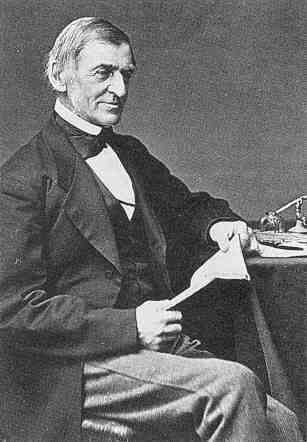
Ralph Waldo Emerson

Portrait of Ralph Waldo Emerson
Ralph Waldo Emerson 1803–1882
1803Born

Emerson was one of the central characters in the transcendental movement emerging in literary circles around Concord, Massachusetts during the late 1830’s. He resigned from his occupation as a Unitarian clergyman in 1832 to travel to Europe, where he befriended Carlyle, Coleridge and Wordsworth among others. In the U.S. he lectured in philosophy, while forming a transcendentalist group comprising fellow writers and poets such as Henry Wadsworth Longfellow, Nathaniel Hawthorne and Henry David Thoreau. In 1842 he took over the role as editor of The Dial, which served as spokes vehicle for the movement.

In 1855, Emerson recieved a thin book of poetry entitled "Leaves of Grass" by a poet he had never heard of before. He loved this book of poetry which was unorthodox in both style and subject. Emerson wrote an encouraging letter to this unknown poet, who of course was Walt Whitman. Later they also met, and Whitman was very flattered by the praise of Emerson.

Emerson’s first book, Nature (1836) expressed his theories that the imagination of man is shaped by nature and helped spark an entirely new philosophical movement in New England. Essays (1841 and 1844), containing his essays on philosophy and other subjects, brought him international renown. Representative Men (1850) is a collection of lectures held in Oxford and London in 1847. Later lecture collections include The Conduct of Life (1860) and Society and Solitude (1870). His poetry, Poems (1847) and May-Day and Other Pieces (1867) may not have been ground breaking as a whole, but some of his pieces are considered to be among the most important poetry of the 19th century.

Reading closely

Analyses

A full analysis sits under 9 of these poems: what each poem says, how it is built and how readers here have read it. About the analyses

  • FableA squirrel's reply to a proud mountain, and the lesson that talents differ
  • The Snow-StormThe north wind as a wild builder whose night's work human art can only copy
  • The AmuletFixed keepsakes, a changing heart, and the wish for a charm that shows if love lives
  • Good-byLeaving the proud world for a home in the hills, and whether that home means death
  • BrahmaThe one presence in slayer and slain, shame and fame, and why it lies beyond heaven
  • FateGifts that toil cannot earn, the unfairness of birth, and success as the one lasting good
  • BacchusA wine not from the grape, and its power to join all nature and restore lost memory
  • ErosLove as the short meaning of the world, and why neither men nor gods can improve on it

From readers

What readers say about Ralph Waldo Emerson

  1. On The Snow-Storm

    “This poem is amazing. Emerson, like many other transcendentalists, writes of nature prasingly. In "The Snow-storm," he does not only praise nature's work, but he also depicts that man cannot compete with or control nature. "The mad wind's night-work" is "so fanciful, so savage," yet "nought cares…”

  2. On Brahma

    “Brahma - the single absolute being pervading the universe and found within the individual; atman. I think that in "The vanished gods to me appear, And one to me are shame and fame.", it means that he doesn't care for the gods, for in saying "The strong gods pine for my abode, And pine in vain the…”

  3. On Eros

    “Ali this poem is describing how although, short and seemingly simple, love is thrown and miss used by men and gods as well. this poem is basically Eros, the god of love, teaching of his excistence and purpose.”

  4. On Concord Hymn

    “This poem was recited at the unveiling of a memorial for those that fought in the American Revolution and is the origin of the iconic phrase "the shot heard round the world". There's nothing stupid about immortalizing the sacrifices made by those that fought for American freedom.”

  5. On The Apology

    “By having a look on thi poem i understood that poet want to say to the people who are working in the paddy field that not to misunderstand him unkind and rude, be”

  6. On Fable

    “i like this poem because it really touches the thoughts of the readers and it can prove our way of judging to others especially those person who have more knowledge,i know some of us easy to reject those people who have poorer knowledge and some of us think that "you are wiser than you know"”

Where readers gather

Most discussed

  1. Fable15 comments
  2. The Snow-Storm10 comments
  3. The Amulet8 comments
  4. The Rhodora8 comments
  5. Good-by7 comments
  6. Brahma6 comments
  7. Fate6 comments
  8. Bacchus5 comments
  9. Eros5 comments
  10. Forbearance4 comments

All 54 poems

Poems · 54