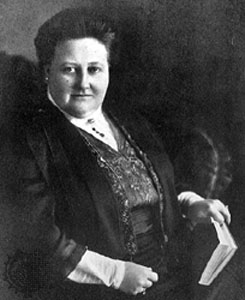
Biography
Amy Lowell didn't become a poet until she was years into her adulthood; then, when she died early, her poetry (and life) were nearly forgotten -- until gender studies as a discipline began to look at women like Lowell as illustrative of an earlier lesbianism. She lived her later years in a "Boston marriage" and wrote erotic love poems addressed to a woman.
T. S. Eliot called her the "demon saleswoman of poetry." Of herself, she said, "God made me a businesswoman and I made myself a poet."
Amy Lowell was born to wealth and prominence. Her paternal grandfather, John Amory Lowell, developed the cotton industry of Massachusetts with her maternal grandfather, Abbott Lawrence. The towns of Lowell and Lawrence, Massachusetts, are named for the families. John Amory Lowell's cousin was the poet James Russell Lowell.
Read the full biography
Amy was the youngest child of five. Her eldest brother, Percival Lowell, became an astronomer in his late 30's and founded Lowell Observatory in Flagstaff, Arizona. He discovered the "canals" of Mars. Earlier he'd written two books inspired by his travels to Japan and the Far East. Amy Lowell's other brother, Abbott Lawrence Lowell, became president of Harvard University.
The family home was called "Sevenels" for the "Seven L's" or Lowells. Amy Lawrence was educated there by an English governess until 1883, when she was sent to a series of private schools. She was far from a model student. During vacations, she traveled with her family to Europe and to America's west.
In 1891, as a proper young lady from a wealthy family, she had her debut. She was invited to numerous parties, but did not get the marriage proposal that the year was supposed to produce. A university education was out of the question for a Lowell daughter, although not for the sons. So Amy Lowell set about educating herself, reading from the 7,000 volume library of her father and also taking advantage of the Boston Athenaeum.
Mostly she lived the life of a wealthy socialite. She began a lifelong habit of book collecting. She accepted a marriage proposal, but the young man changed his mind and set his heart on another woman. Amy Lowell went to Europe and Egypt in 1897-98 to recover, living on a severe diet that was supposed to improve her health (and help with her increasing weight problem). Instead, the diet nearly ruined her health.
In 1900, after her parents had both died, she bought the family home, Sevenels. Her life as a socialite continued, with parties and entertaining. She also took up the civic involvement of her father, especially in supporting education and libraries.
Amy had enjoyed writing, but her efforts at writing plays didn't meet with her own satisfaction. She was fascinated by the theater. In 1893 and 1896, she had seen performances by the actress Eleanora Duse. In 1902, after seeing Duse on another tour, Amy went home and wrote a tribute to her in blank verse -- and, as she later said, "I found out where my true function lay." She became a poet -- or, as she also later said, "made myself a poet."
By 1910, her first poem was published in Atlantic Monthly, and three others were accepted there for publication. In 1912 -- a year that also saw the first books published by Robert Frost and Edna St. Vincent Millay -- she published her first collection of poetry, A Dome of Many-Coloured Glass.
It was also in 1912 that Amy Lowell met actress Ada Dwyer Russell. From about 1914 on, Russell, a widow who was 11 years older than Lowell, became Amy's traveling and living companion and secretary. They lived together in a "Boston marriage" until Amy's death. Whether the relationship was platonic or sexual is not certain -- Ada burned all personal correspondence as executrix for Amy after her death -- but poems which Amy clearly directed towards Ada are sometimes erotic and full of suggestive imagery.
In the January 1913 issue of Poetry, Amy read a poem signed by "H.D., Imagiste." With a sense of recognition, she decided that she, too, was an Imagist, and by summer had gone to London to meet Ezra Pound and other Imagist poets, armed with a letter of introduction from Poetry editor Harriet Monroe.
She returned to England again the next summer -- this time bringing her maroon auto and maroon-coated chauffeur, part of her eccentric persona. She returned to America just as World War I began, having sent that maroon auto on ahead of her.
She was already by that time feuding with Pound, who termed her version of Imagism "Amygism." She focused herself on writing poetry in the new style, and also on promoting and sometimes literally supporting other poets who were also part of the Imagist movement.
In 1914, she published her second book of poetry, Sword Blades and Poppy Seeds. Many of the poems were in vers libre (free verse), which she renamed "unrhymed cadence." A few were in a form she invented, which she called "polyphonic prose."
In 1915, Amy Lowell published an anthology of Imagist verse, followed by new volumes in 1916 and 1917. Her own lecture tours began in 1915, as she talked of poetry and also read her own works. She was a popular speaker, often speaking to overflow crowds. Perhaps the novelty of the Imagist poetry drew people; perhaps they were drawn to the performances in part because she was a Lowell; in part her reputation for eccentricities helped bring in the people.
She slept until three in the afternoon and worked through the night. She was overweight, and a glandular condition was diagnosed which caused her to continue to gain. (Ezra Pound called her "hippopoetess.") She was operated on several times for persistent hernia problems.
She dressed mannishly, in severe suits and men's shirts. She wore a pince nez and had her hair done -- usually by Ada Russell -- in a pompadour that added a bit of height to her five feet. She slept on a custom-made bed with exactly sixteen pillows. She kept sheepdogs -- at least until World War I's meat rationing made her give them up -- and had to give guests towels to put in their laps to protect them from the dogs' affectionate habits. She draped mirrors and stopped clocks. And, perhaps most famously, she smoked cigars -- not "big, black" ones as was sometimes reported, but small cigars, which she claimed were less distracting to her work than cigarettes, because they lasted longer.
In 1915, she also ventured into criticism with Six French Poets, featuring Symbolist poets little known in America. In 1916, she published another volume of her own verse, Men, Women and Ghosts. A book derived from her lectures, Tendencies in Modern American Poetry followed in 1917, then another poetry collection in 1918, Can Grande's Castle and Pictures of the Floating World in 1919 and adaptations of myths and legends in 1921 in Legends.
During an illness in 1922 she wrote and published A Critical Fable - anonymously. For some months she denied that she'd written it. Her relative, James Russell Lowell, had published in his generation A Fable for Critics, witty and pointed verse analyzing poets who were his contemporaries. Amy Lowell's A Critical Fable likewise skewered her own poetic contemporaries.
She worked for the next few years on a massive biography of John Keats, whose works she'd been collecting since 1905. Almost a day-by-day account of his life, the book also recognized Fanny Brawne for the first time as a positive influence on him.
This work was taxing on Lowell's health, though. She nearly ruined her eyesight, and her hernias continued to cause her trouble. In May of 1925, she was advised to remain in bed with a troublesome hernia. On May 12 she got out of bed anyway, and was struck with a massive cerebral hemorrhage. She died hours later.
Ada Russell, her executrix, not only burned all personal correspondence, as directed by Amy Lowell, but also published three more volumes of Lowell's poems posthumously. These included some late sonnets to Eleanora Duse, who had died in 1912 herself, and other poems considered too controversial for Lowell to publish during her lifetime. Lowell left her fortune and Sevenels in trust to Ada Russell.
The Imagist movement didn't outlive Amy Lowell for long. Her poems didn't withstand the test of time well, and while a few of her poems ("Patterns" and "Lilacs" especially) were still studied and anthologized, she was nearly forgotten.
Then, Lillian Faderman and others rediscovered Amy Lowell as an example of poets and others whose same-sex relationships had been important to them in their lives, but who had -- for obvious social reasons -- not been explicit and open about those relationships. Faderman and others re-examined poems like "Clear, With Light Variable Winds" or "Venus Transiens" or "Taxi" or "A Lady" and found the theme -- barely concealed -- of the love of women. "A Decade," which had been written as a celebration of the ten year anniversary of Ada and Amy's relationship, and the "Two Speak Together" section of Pictures of the Floating World was recognized for the love poetry that it is.
The theme was not completely concealed, of course, especially to those who knew the couple well. John Livingston Lowes, a friend of Amy Lowell's, had recognized Ada as the object of one of her poems, and Lowell wrote back to him, "I am very glad indeed that you liked 'Madonna of the Evening Flowers.' How could so exact a portrait remain unrecognized?"
And so, too, the portrait of the committed relationship and love of Amy Lowell and Ada Dwyer Russell was largely unrecognized until recently.
Her "Sisters" -- alluding to the sisterhood that included Lowell, Elizabeth Barrett Browning and Emily Dickinson -- makes it clear that Amy Lowell saw herself as part of a continuing tradition of women poets. Poems By Amy Lowell
On Patterns
On Irony
On The Captured Goddess
On Astigmatism
On Happiness
On Leisure