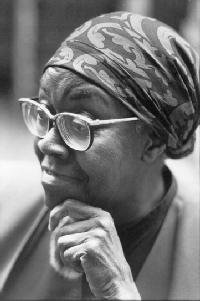
Gwendolyn Brooks

Portrait of Gwendolyn Brooks
Gwendolyn Brooks 1917–2000
1917Born

Gwendolyn Brooks (June 7, 1917 - December 3, 2000) was an award-winning African American woman poet. Born in Topeka, Kansas, she grew up in and remained in Chicago, Illinois. Although she also wrote a novel, an autobiography and some other prose works, she was noted primarily as a poet. Her 1949 book of poetry, Annie Allen, received a Pulitzer Prize, the first won by an African American. In 1968, she was made Poet Laureate of Illinois. Other awards she received included the Frost Medal, the Shelley Memorial Award, and an American Academy of Arts and Letters award.

Her poetry is rooted in the poor and mostly African-American South Side of Chicago. She initially published her poetry as a columnist for the Chicago Defender, an African American newspaper. Although her poems range in style from traditional ballads and sonnets to using blues rhythms in free verse, her characters are often drawn from the poor inner city. Her bluesy poem We Real Cool is often found in school textbooks. She is seen as a leader of the Black Arts movement.

After her first book of poetry was published in 1945, she received a Guggenheim Fellowship. After John F. Kennedy invited her to a Library of Congress poetry festival in 1962, she began a college teaching career which saw her teach at Columbia College Chicago, Northeastern Illinois University, Elmhurst College, Columbia University, Clay College of New York, and the University of Wisconsin. She was the 1985 Library of Congress' Consultant in Poetry, a one year position whose title changed the next year to Poet Laureate Consultant in Poetry. In 1994, she was chosen as the National Endowment for the Humanities's Jefferson Lecturer, one of the highest honors for American literature.

Reading closely

Analyses

A full analysis sits under 3 of these poems: what each poem says, how it is built and how readers here have read it. About the analyses

  • To Be In LoveLove's sharpened sight, its unbearable secrecy, and the golden column that falls to ash
  • The Crazy WomanA woman who will not sing in May, her song of gray, and the crowd that calls her crazy

From readers

What readers say about Gwendolyn Brooks

  1. On A Penitent Considers Another Coming Of Mary

    “The meaning of this poem I think, is that if mary (the mother of Jesus) could comeback and punish for what was done to christ, would she? Then at the end of the poem she says that mary would not punish.This means she is showing mercy and forgiveness so the theme is forgiving like the "good book"…”

  2. On We Real Cool

    “I got to a drop-out school and there are so many kids who I would like to share this with. Kids who are runnin the streets, chasing the Hood dreams, Tryin' to be "gagstas". If they could only read this and understand that it ain't so cool, that they have to get educated in order to truly free…”

  3. On To Be In Love

    “I loved this absolutly beautiful poem. I'm only 11 years old and even I can fell a deep connection with it.(and for those wondering, yes I DO understand it)”

  4. On The Crazy Woman

    “Oh but the crazy lady a wait for the gray, not much happiness for de' month of may, in de mist of darkness, the night shall be dark, the pain that sits upon the gloomy heart, oh shall the soul live upon the dark, one day de' lord shall show me the sun, I cry upon the gloomy night, daughter of the…”

Where readers gather

Most discussed

  1. We Real Cool13 comments
  2. To Be In Love9 comments
  3. The Crazy Woman7 comments
  4. A Penitent Considers Another Coming Of Mary3 comments
  5. One Wants A Teller In A Time Like This2 comments

All 5 poems

Poems · 5