Biography
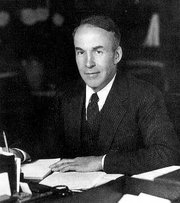
Archibald MacLeish (May 7, 1892 - April 20, 1982) was an American poet, writer, and public servant. He is associated with the modernist school of poetry.
MacLeish was born in Glencoe, Illinois. His father, Andrew MacLeish, was a dry-goods merchant. His mother, Martha Hillard, was a college professor. He grew up on an estate bordering Lake Michigan.
He attended the Hotchkiss School from 1907 to 1911, before moving on to Yale where he majored in English and became a member of the Skull and Bones secret society. He then enrolled in the Harvard Law School. In 1916, he married Ada Hitchcock.
Read the full biography
His studies were interrupted by World War I, in which he served first as an ambulance driver and later as a captain of artillery. He graduated from the law school in 1919. He taught law for a semester for the government department at Harvard, then worked briefly as an editor for the "New Republic". He next spent three years practicing law.
In 1923 MacLeish left his law firm and moved with his wife to Paris, where they joined the community of literary expatriates that included such members as Gertrude Stein and Ernest Hemingway. He returned to America in 1928.
From 1930 to 1938 he worked as a writer and editor for Fortune Magazine, during which time he also became increasingly politically active, especially with anti-fascist causes. He was a great admirer of Franklin Roosevelt, who appointed him Librarian of Congress in 1939. MacLeish held this job for five years, and is remembered as an effective leader who helped modernize the Library.
During World War II MacLeish also served as director of the War Department's Office of Facts and Figures, and as the assistant director of the Office of War Information. These jobs were heavily involved with propaganda, which was well-suited to MacLeish's talents; he had written quite a bit of politically-motivated work in the previous decade.
He spent a year as the Assistant Secretary of State for cultural affairs, and a further year representing the U.S. at the creation of UNESCO. After this, he retired from public service and returned to academia.
Despite a long history of criticizing Marxism, MacLeish came under fire from conservative politicians of the 1940s and 1950s, including J. Edgar Hoover and Joseph McCarthy. Much of this was due to his involvement with anti-fascist organizations like the League of American Writers, and to his friendship with prominent left-wing writers.
In 1949 MacLeish became the Boylston Professor of Rhetoric and Oratory at Harvard. He held this position until his retirement in 1962.
From 1963 to 1967 he was the John Woodruff Simpson Lecturer at Amherst College.
On Ars Poetica
On The End Of The World
On You, Andrew Marvell
On An Eternity