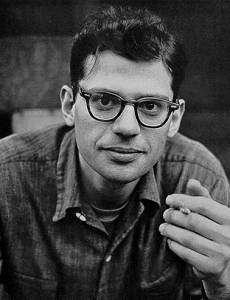
The poem
I
In the depths of the Greyhound Terminal sitting dumbly on a baggage truck looking at the sky waiting for the Los Angeles Express to depart worrying about eternity over the Post Office roof in the night-time red downtown heaven staring through my eyeglasses I realized shuddering these thoughts were not eternity, nor the poverty of our lives, irritable baggage clerks, nor the millions of weeping relatives surrounding the buses waving goodbye, nor other millions of the poor rushing around from city to city to see their loved ones, nor an indian dead with fright talking to a huge cop by the Coke machine, nor this trembling old lady with a cane taking the last trip of her life, nor the red-capped cynical porter collecting his quar- ters and smiling over the smashed baggage, nor me looking around at the horrible dream, nor mustached negro Operating Clerk named Spade, dealing out with his marvelous long hand the fate of thousands of express packages, nor fairy Sam in the basement limping from leaden trunk to trunk, nor Joe at the counter with his nervous breakdown smiling cowardly at the customers, nor the grayish-green whale's stomach interior loft where we keep the baggage in hideous racks, hundreds of suitcases full of tragedy rocking back and forth waiting to be opened, nor the baggage that's lost, nor damaged handles, nameplates vanished, busted wires & broken ropes, whole trunks exploding on the concrete floor, nor seabags emptied into the night in the final warehouse.
II
Yet Spade reminded me of Angel, unloading a bus, dressed in blue overalls black face official Angel's work- man cap, pushing with his belly a huge tin horse piled high with black baggage, looking up as he passed the yellow light bulb of the loft and holding high on his arm an iron shepherd's crook.
III
It was the racks, I realized, sitting myself on top of them now as is my wont at lunchtime to rest my tired foot, it was the racks, great wooden shelves and stanchions posts and beams assembled floor to roof jumbled with baggage, --the Japanese white metal postwar trunk gaudily flowered & headed for Fort Bragg, one Mexican green paper package in purple rope adorned with names for Nogales, hundreds of radiators all at once for Eureka, crates of Hawaiian underwear, rolls of posters scattered over the Peninsula, nuts to Sacramento, one human eye for Napa, an aluminum box of human blood for Stockton and a little red package of teeth for Calistoga- it was the racks and these on the racks I saw naked in electric light the night before I quit, the racks were created to hang our possessions, to keep us together, a temporary shift in space, God's only way of building the rickety structure of Time, to hold the bags to send on the roads, to carry our luggage from place to place looking for a bus to ride us back home to Eternity where the heart was left and farewell tears began.
IV
A swarm of baggage sitting by the counter as the trans- continental bus pulls in. The clock registering 12:15 A.M., May 9, 1956, the second hand moving forward, red. Getting ready to load my last bus.-Farewell, Walnut Creek Richmond Vallejo Portland Pacific Highway Fleet-footed Quicksilver, God of transience. One last package sits lone at midnight sticking up out of the Coast rack high as the dusty fluorescent light.
The wage they pay us is too low to live on. Tragedy reduced to numbers. This for the poor shepherds. I am a communist. Farewell ye Greyhound where I suffered so much, hurt my knee and scraped my hand and built my pectoral muscles big as a vagina.
May 9, 1956
This poem [In the Baggage Room at Greyhound] refers to the Greyhound Terminal in San Francisco at Market and 7th. I worked there for a year in 1962-63 when a student. Ginsberg vividly and accurately brings to life what it was like working there: his descriptions of the staff - the baggage handlers; the 'huge tin horse' that we used to take baggage on from the storage area to the buses; the racks where the baggage…
Read the whole commentThis poem [In the Baggage Room at Greyhound] refers to the Greyhound Terminal in San Francisco at Market and 7th. I worked there for a year in 1962-63 when a student. Ginsberg vividly and accurately brings to life what it was like working there: his descriptions of the staff - the baggage handlers; the 'huge tin horse' that we used to take baggage on from the storage area to the buses; the racks where the baggage was stored and where we used to sit and talk while waiting for the next bus. When i worked there, Joe, Spade and Sam were still there, and Sam told us he worked with Ginsberg, but unfortunately did not have a lot to say about him. The poem talks about a 'basement', however, there was no basement there - the baggage was stored in a room with high racks adjacent to the main hall. The staff worked on 3 shifts [8am-4pm, 4pm - 12 midnite, and midite to 8am], which you would bid on according to seniority. I actually thought the pay was good - and saved enough to go to school, and the baggage room was an intersting place to work. Although some buses, especially at rush hour, were local, most buses were for points all over the US, and the big Sceni-cruisers going to New York - and being driven non-stop virtually for 3 days -were interesting, and even exciting to be around, with a certain buzz.
Reading his poem takes me back in time, over 40 years, such that i can almost see, feel and smell the people [baggage handlers and travellers] , the baggage and the atmosphere of the terminal.